Skip to content

Nylon And Carbon Fiber Comparisons

PPS-CF and PPA-CF materials are shown with their impressive chemical resistance, high heat tolerance, and strength properties.

PPS-CF vs PPA-CF: Chemical Resistance, Heat and Strength

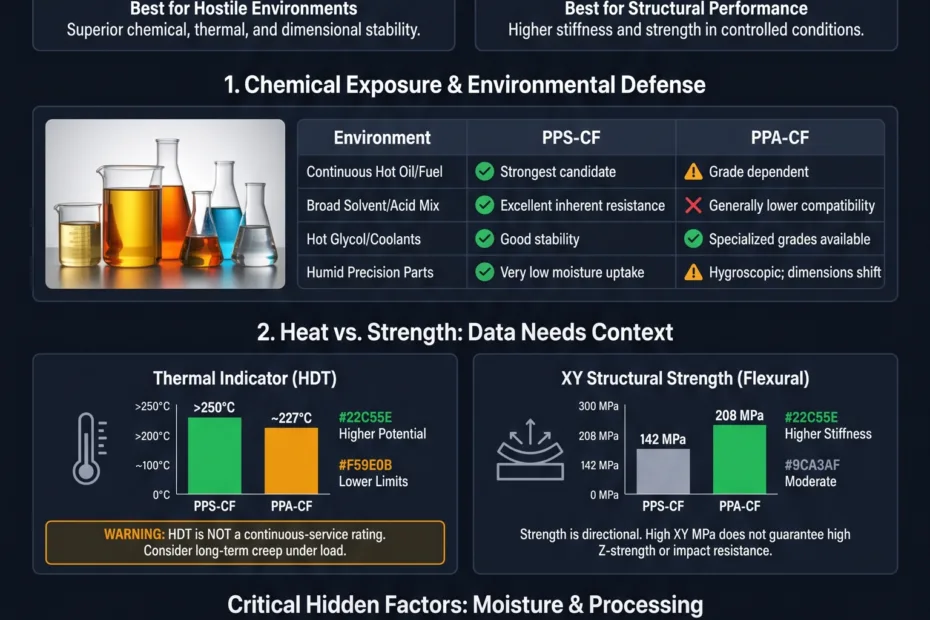
PPS-CF and PPA-CF solve different failure problems even though both sit near the high end of carbon-fiber-reinforced FFF materials. PPA-CF can deliver higher mechanical strength in some printed-material comparisons, while PPS-CF becomes more compelling when… 
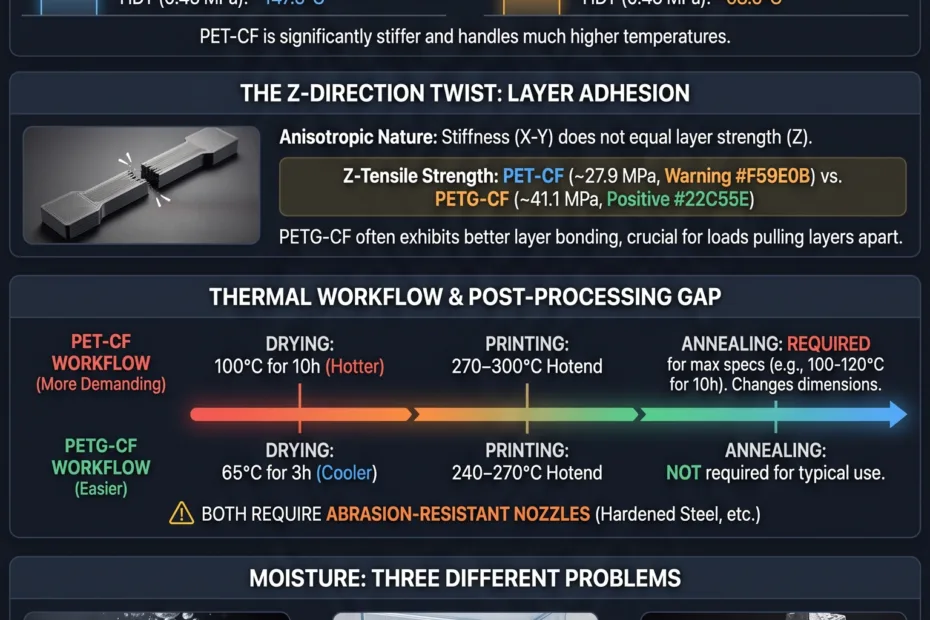
Comparison of PET-CF and PETG-CF filament stiffness, moisture absorption, and printing challenges for 3D printing enthusiasts.

PET-CF vs PETG-CF: Stiffness, Moisture and Print Difficulty

PET-CF generally targets higher rigidity and better retention of shape at elevated temperatures, while PETG-CF usually reaches useful carbon-fiber-reinforced performance with a less demanding thermal workflow. The choice is not simply PET versus PETG, because… 

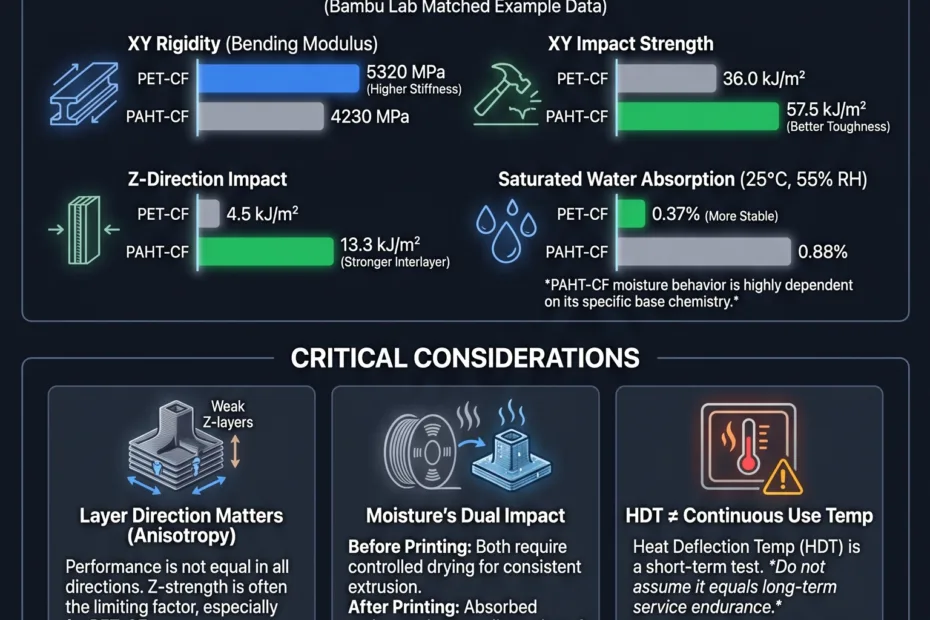
Comparison of PET-CF and PAHT-CF shows differences in rigidity, moisture resistance, and heat performance for various applications.

PET-CF vs PAHT-CF: Rigidity, Moisture and Heat Performance

PET-CF generally favors higher rigidity, lower moisture uptake and tighter dimensional control, while PAHT-CF can trade some stiffness for better impact behavior and stronger layer-to-layer performance. The choice becomes less obvious once heat, humidity and… 

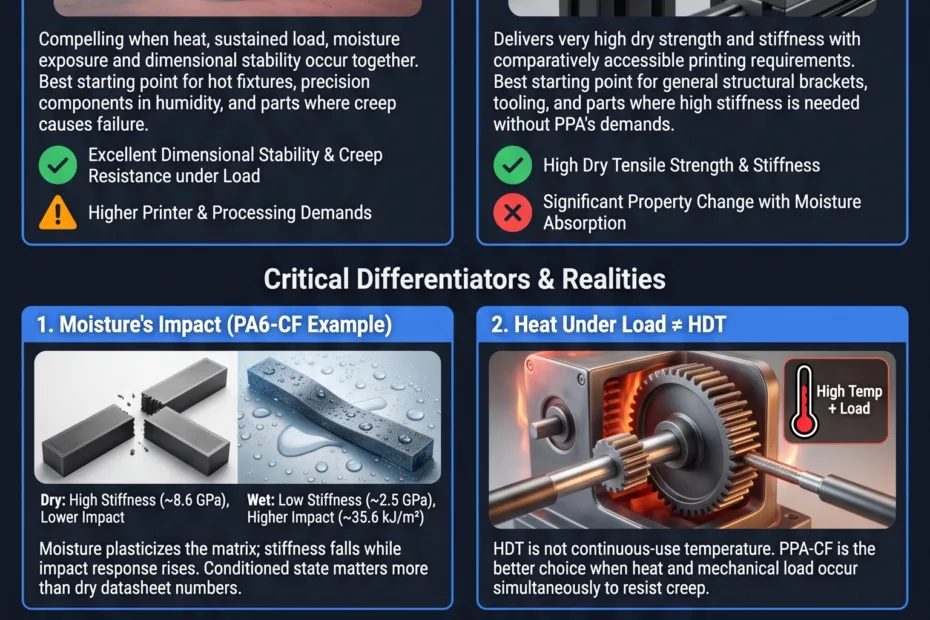
Comparison of PPA-CF and PA6-CF filaments highlighting differences in strength, heat resistance, and 3D printing requirements.

PPA-CF vs PA6-CF: Strength, Heat and Printing Requirements

PPA-CF and PA6-CF can both produce stiff, load-bearing printed parts, but they solve different engineering problems. PA6-CF can deliver very high dry strength and stiffness with comparatively accessible printing requirements, while PPA-CF becomes more compelling… 

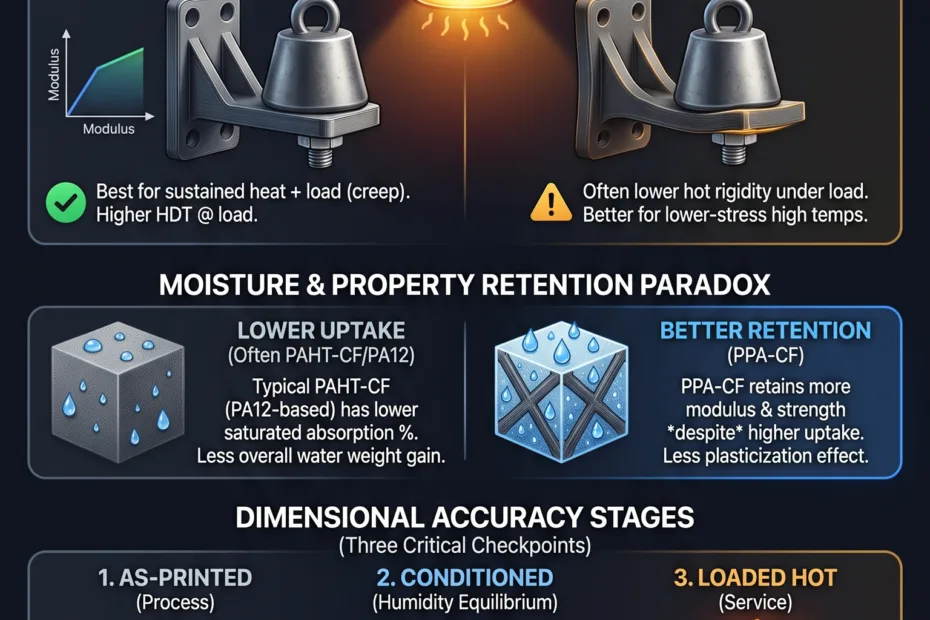
Comparison of PPA-CF and PAHT-CF shows differences in heat resistance, moisture retention, and dimensional accuracy for advanced materi…

PPA-CF vs PAHT-CF: Heat, Moisture and Dimensional Accuracy

PPA-CF is usually chosen when a printed part must retain stiffness and geometry under sustained heat, while PAHT-CF often offers a more accessible balance of heat resistance, moisture control, layer bonding, and printability. The comparison… 

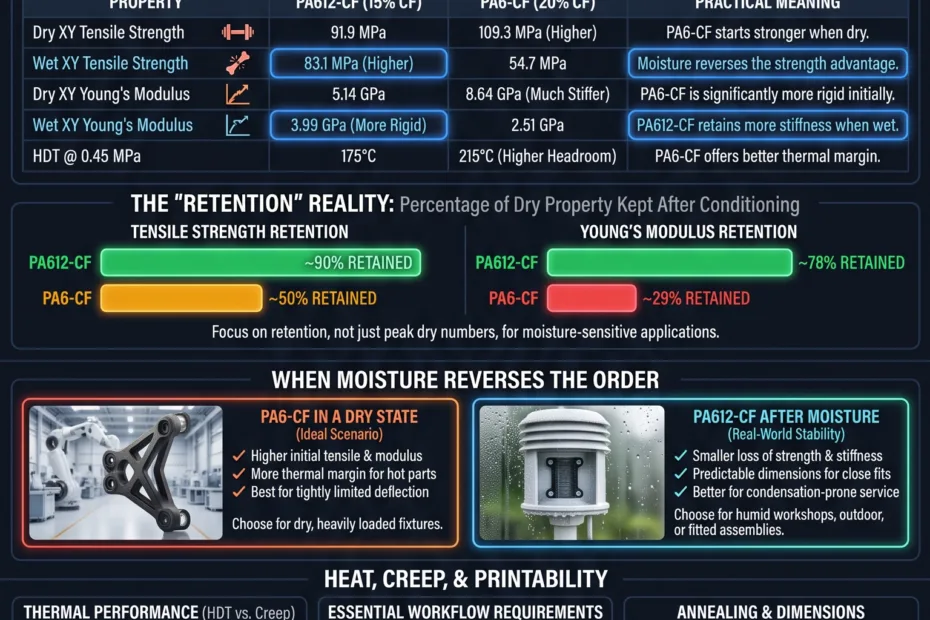
Comparison of PA612-CF and PA6-CF highlighting differences in wet strength, rigidity, and printability for advanced materials.

PA612-CF vs PA6-CF: Wet Strength, Rigidity and Printability

PA6-CF commonly delivers higher dry stiffness, tensile strength, and heat-deflection performance, while PA612-CF gives up some of that peak performance to keep its properties more stable after moisture exposure. The practical choice is therefore not… 

Comparison of PA12-CF and PAHT-CF focusing on moisture stability, strength, and heat resistance in advanced materials.

PA12-CF vs PAHT-CF: Moisture Stability, Strength and Heat Resistance

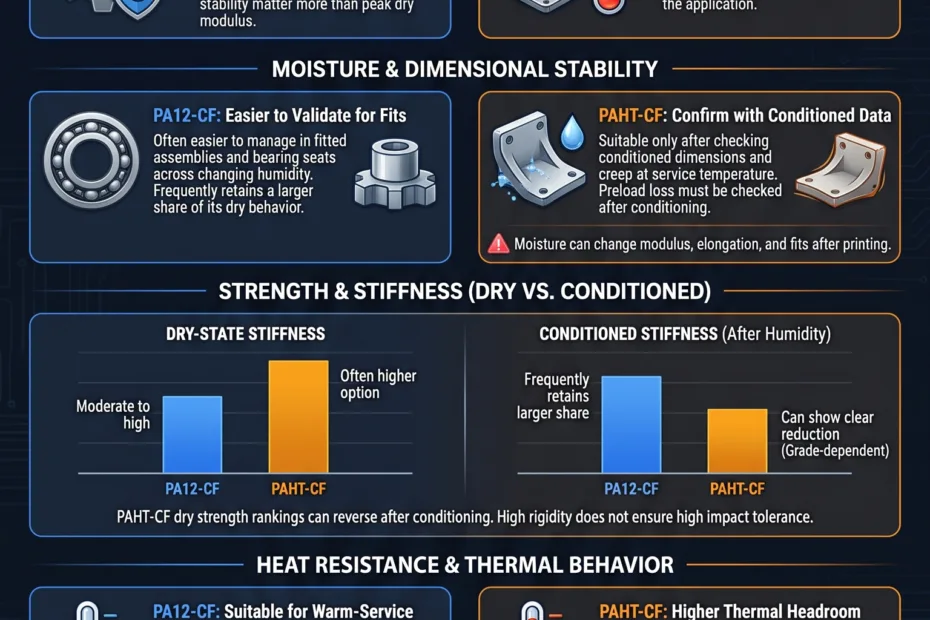
PA12-CF is usually chosen for low moisture sensitivity and predictable dimensions, while PAHT-CF is sold around higher thermal and structural performance. The difficult part is that PAHT-CF is not one standardized polymer chemistry, so its… 

Comparison of PA6-GF and PA6-CF showing differences in toughness, stiffness, and nozzle wear for engineering applications.

PA6-GF vs PA6-CF: Toughness, Stiffness and Nozzle Wear

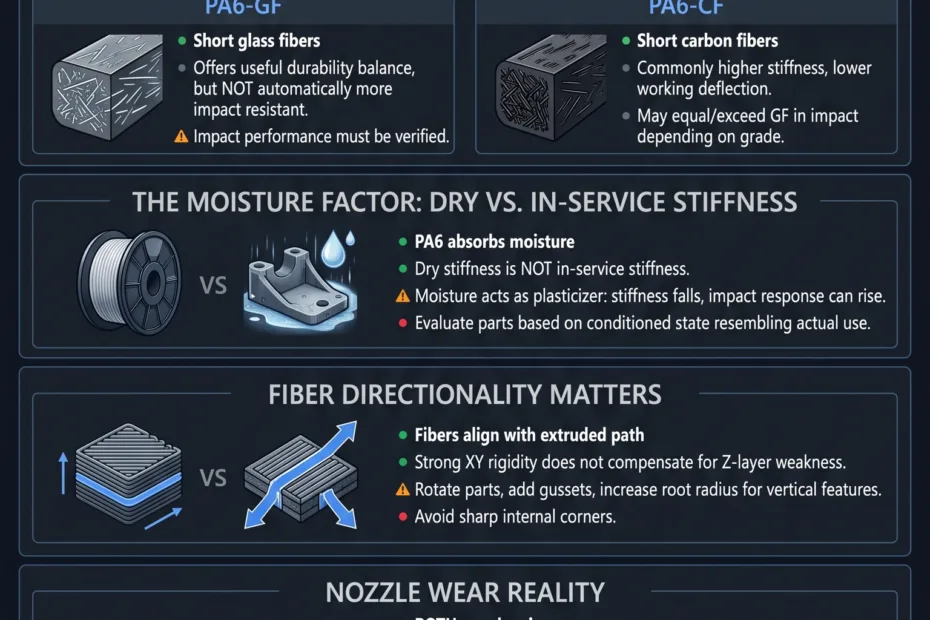
PA6-CF is normally the better starting point when a printed part must resist bending, while PA6-GF can make more sense when the design needs a less stiffness-dominated balance of rigidity, durability, weight and cost. That… 

Comparison of PA12 and PA612 showing differences in water absorption, toughness, and rigidity for engineering applications.

PA12 vs PA612: Water Absorption, Toughness and Rigidity

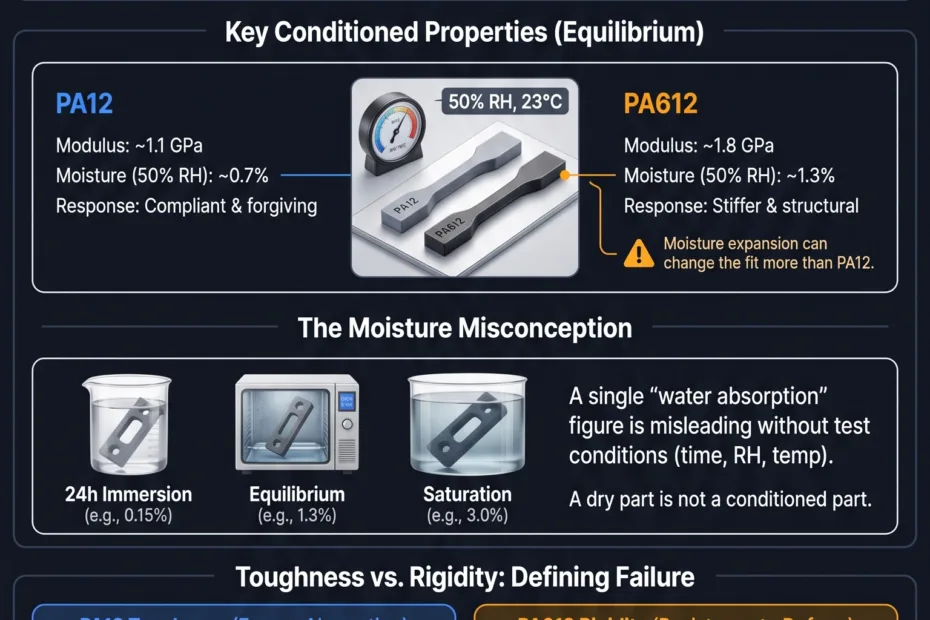
PA12 usually provides the more stable behavior when moisture, dimensional movement, and low-temperature impact are the main concerns, while PA612 can offer a stiffer structural response and a higher thermal ceiling. The choice is not… 

Comparison of PA6 and PA66 showing differences in heat resistance, strength, and moisture absorption for material selection.

PA6 vs PA66: Heat Resistance, Strength and Moisture Absorption

PA66 provides a higher thermal ceiling than PA6, but that advantage does not automatically produce a stronger or more reliable printed part. PA6 can be the better practical choice when the printer cannot maintain the… 

Comparison of PA11 and PA12 showing differences in impact strength, moisture resistance, and dimensional stability.

PA11 vs PA12: Impact Strength, Moisture and Dimensional Stability

PA11 usually offers the more forgiving impact response, while PA12 is generally easier to specify when a part must retain holes, clearances, and mating dimensions across changing humidity. The decision is not simply toughness versus… 

Comparison chart showing differences between PA6 and PA11 in moisture, toughness, and print challenge for 3D printing.

PA6 vs PA11: Moisture, Toughness and Print Difficulty

PA6 usually offers greater dry-state stiffness and load resistance, while PA11 gives up some rigidity for lower moisture sensitivity, higher ductility and more stable behavior as humidity changes. The harder decision is not which nylon…