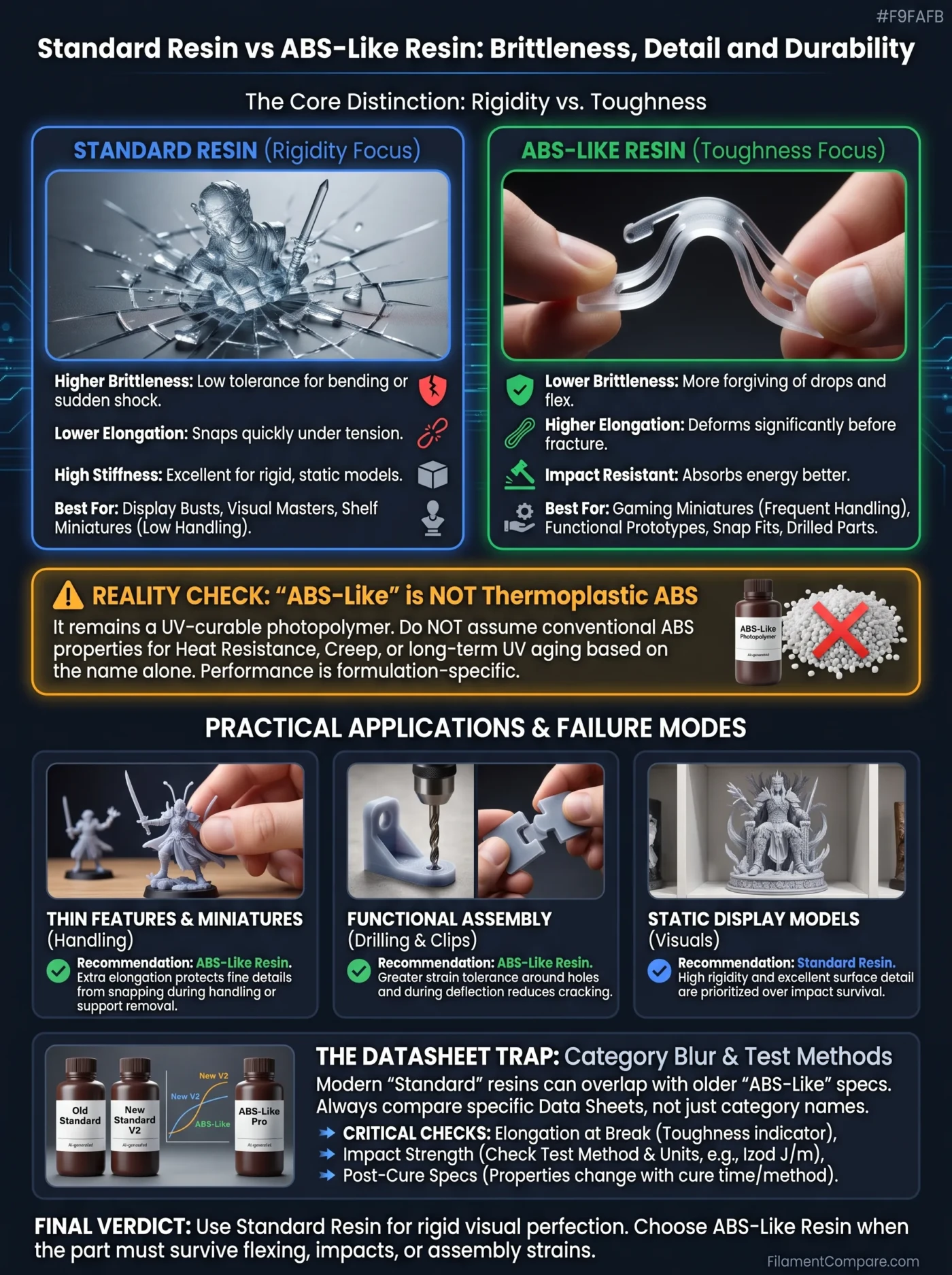
Standard resin and ABS-like resin can produce similarly clean SLA, MSLA, and LCD prints, but they often behave very differently once those parts leave the build plate. Standard resin usually favors rigidity, while ABS-like resin is formulated around greater toughness and strain tolerance. That difference matters most when a print is dropped, flexed, assembled, drilled, or built with thin projections that concentrate stress.
| Property | Standard Resin | ABS-Like Resin | What It Means for a Printed Part |
|---|---|---|---|
| Material Type | UV-curable photopolymer | UV-curable photopolymer formulated for tougher behavior | ABS-like resin is not conventional ABS thermoplastic |
| Brittleness | Often higher | Usually lower | Thin features are generally less tolerant of bending in a brittle formulation |
| Tensile Strength | Can equal or exceed ABS-like grades | Can be similar or lower depending on formulation | Higher tensile strength alone does not prove better drop resistance |
| Elongation at Break | Often lower | Usually higher | ABS-like parts can normally deform farther before fracture |
| Impact Resistance | Usually lower in traditional standard formulations | Usually one of the main design priorities | Relevant to drops, knocks, and sudden loading |
| Stiffness | Often higher | Formulation-dependent; may allow more movement | Rigid reference models may benefit from standard resin |
| Fine Detail | Excellent with a calibrated profile | Can also be excellent | Exposure, optics, pigment, shrinkage, and calibration matter more than the category name alone |
| Thin Features | Can reproduce them accurately but may fracture more readily | Usually more forgiving after printing | Useful for fingers, weapons, antennae, clips, and narrow joints |
| Drilling and Assembly | Greater crack sensitivity in brittle grades | Usually better suited to light drilling, tapping, and assembly loads | Local strain around holes becomes important |
| Dimensional Accuracy | Potentially very good | Potentially very good | Check shrinkage and the exact formulation rather than assuming one category is more accurate |
| Heat Resistance | Product-specific | Product-specific | The ABS-like name does not guarantee ABS-level thermal behavior |
| Typical Fit | Display models, masters, rigid visual prototypes | Handled models, functional prototypes, housings, clips, impact-prone parts | Geometry and expected failure mode should drive the choice |
Method note: This Standard Resin vs ABS-Like Resin comparison combines current manufacturer datasheets and specification pages with established plastics test references to describe category-level trends; actual results can change with formulation, color, printer, orientation, exposure, geometry, and post-curing.
Strength, Toughness, and Brittleness Are Different Properties
The most useful distinction is not simply which resin is “stronger.” Tensile strength, stiffness, elongation, and impact resistance measure different responses to load. A resin can withstand a relatively high tensile stress and still fracture after very little deformation, while another can show a lower peak tensile value but absorb more movement before breaking.
- Tensile Strength
- The maximum tensile stress recorded under the specified test conditions. It does not directly describe drop survival.
- Elongation at Break
- How far a specimen stretches relative to its original length before fracture. Higher elongation generally indicates greater ductility.
- Impact Strength
- The energy a defined specimen absorbs during an impact test. Test method, notch geometry, specimen size, and units matter.
- Young’s Modulus
- A measure of elastic stiffness. A higher value generally means the material resists elastic deformation more strongly.
- Hardness
- Resistance to localized indentation. A hard surface is not automatically a tough or impact-resistant part.
This distinction explains an otherwise surprising result in current manufacturer data. Anycubic Standard Resin is specified at 40–50 MPa tensile strength, compared with 35–45 MPa for ABS-Like Resin Pro 2, yet the ABS-like formulation has much higher elongation and a higher published Izod impact value. Peak tensile stress and fracture behavior are not interchangeable measurements.
A Same-Brand Data Check
| Resin | Tensile Strength | Elongation at Break | Izod Impact Strength | Shore Hardness |
|---|---|---|---|---|
| Standard Resin [a] | 40–50 MPa | 12–16% | 103 J/m | 84–86 HD |
| Standard Resin V2 [b] | 35–45 MPa | 25–30% | 192 J/m | 80–83 HD |
| ABS-Like Resin Pro 2 [c] | 35–45 MPa | 35–40% | 212 J/m | 82–84 HD |
The middle row changes the usual comparison. Standard Resin V2 sits much closer to ABS-Like Resin Pro 2 than the older Standard Resin does in elongation and impact performance. Resin names still describe useful product families, but generation and exact formulation can narrow the gap considerably.
A category label is a starting point, not a mechanical specification. A newer standard resin can overlap with an ABS-like formulation, while two ABS-like products from different manufacturers can have noticeably different stiffness, impact, and elongation values.
What “ABS-Like” Actually Means
ABS-like resin is still a UV-curable photopolymer. It is not a bottle of dissolved ABS, nor does the printed part become conventional injection-molded acrylonitrile butadiene styrene. The name describes a formulation intended to provide some of the toughness, ductility, stiffness balance, or impact behavior associated with engineering plastics.
There is also no single universal mechanical specification that every ABS-like resin must meet. One manufacturer may emphasize elongation, another impact resistance, and another a balance of rigidity and toughness. Formlabs likewise treats “toughness” as a group of related behaviors, including ductility, elongation, impact resistance, and fracture response rather than one isolated property. [d]
ABS-Like ≠ ABS. The printed material remains a cured photopolymer system, so heat behavior, aging, UV response, creep, and impact performance must come from the resin’s own data rather than from assumptions about molded ABS.
Brittleness Becomes Most Visible at Stress Concentrators
A thick block may make two resins appear fairly similar during casual handling. Change the geometry to a narrow sword, a small hook, a screw boss, or an ankle connecting a miniature to its base, and fracture behavior becomes much easier to see. Small cross-sections and sharp changes in geometry concentrate stress into a limited area.
Thin Swords, Fingers, Antennae, and Horns
These features can print cleanly in either resin family. The difference appears after printing. A lower-elongation standard resin may remain very rigid until the local strain reaches its limit, while a tougher ABS-like formulation can tolerate more movement before fracture. The advantage is mechanical survival, not automatically higher print resolution.
Clips and Snap Features
A clip works by deflecting during assembly and returning toward its original position. That makes strain capacity and geometry especially important. ABS-like resin is generally a more suitable starting category for light snap features because greater elongation provides more room for controlled deflection, though a purpose-made engineering resin may still be needed for repeated cycling or demanding service loads.
Holes, Screws, and Local Assembly Loads
Drilling, tapping, press fits, and self-tapping screws place concentrated stresses around a hole. A brittle material has less deformation available before a crack begins, so tougher formulations can offer more assembly tolerance. Anycubic lists drilling and tapping as supported uses across several of its current ABS-like formulations, including ABS-Like Resin 2.0, 3.0, and Pro 2. [e]
Fine Detail Is Not Controlled by the Resin Name Alone
Standard resin is often associated with miniatures and cosmetic models, but “standard” does not own fine detail. The smallest reproducible feature is also influenced by the printer’s pixel or laser spot size, optical behavior, exposure, layer height, resin pigmentation, cure depth, shrinkage, orientation, and post-processing.
An ABS-like resin can therefore reproduce sharp texture, engraving, panel lines, and small lettering when the formulation and print profile support them. Current ABS-like products are available specifically with high-accuracy and low-shrinkage positioning, so assuming that toughness automatically produces soft or blurred surfaces is too broad.
Printed Detail and Surviving Detail Are Different
A thin spear can be resolved perfectly by the printer and still snap during support removal or later handling. For that reason, detail retention has two stages: whether the printer reproduces the geometry and whether that geometry survives cleaning, curing, assembly, transport, and use.
This matters particularly for tabletop miniatures. A display model with thick geometry may gain little from extra ductility, while a gaming figure with thin weapons and repeated handling can benefit from greater post-print fracture tolerance even when both resins reproduce the original surface texture well.
Durability Includes More Than Drop Resistance
Impact performance is an important part of durability, but it is only one part. A useful material comparison also separates sudden impact, repeated handling, static loading, heat, dimensional stability, and environmental exposure. One resin can perform well in one mode without leading in the others.
Drops and Sudden Impact
This is the area where ABS-like formulations usually have their clearest purpose. Higher elongation and improved impact behavior allow more energy to be absorbed through deformation before fracture. In the current Anycubic example, ABS-Like Resin Pro 2 lists 212 J/m Izod impact strength compared with 103 J/m for the original Standard Resin.
Repeated Handling
Miniatures, game pieces, enclosures, knobs, and prototypes experience many small loads rather than one dramatic test. Lower brittle-fracture tendency is useful here, especially where thin features are touched regularly. Repeated-flex fatigue, however, is its own behavior and should not be inferred from elongation alone.
Static Loads and Creep
A resin that survives a drop is not automatically the preferred material for a bracket carrying a continuous load. Creep describes deformation over time under sustained stress, and it is not represented by a single impact or tensile number. Long-term loaded parts need product-specific creep or engineering data when dimensional retention matters.
Heat and UV Exposure
The ABS-like label should not be used as a shortcut for heat resistance or outdoor stability. Formlabs notes that ABS-like photopolymer applications still need their own thermal and environmental evaluation, and its material comparisons show that printed photopolymers and conventional ABS do not share identical property profiles. [f]
Newer Standard Resins Blur the Old Category Boundary
The classic description of standard resin as rigid and highly brittle remains useful for many formulations, but it is no longer reliable as a universal rule. Anycubic’s current Standard Resin V2 illustrates the change: its published elongation rises to 25–30%, compared with 12–16% for the company’s original Standard Resin, while published Izod impact strength rises from 103 to 192 J/m.
That places Standard Resin V2 much closer to the company’s ABS-Like Resin Pro 2 at 35–40% elongation and 212 J/m impact strength. The practical lesson is simple: compare the generation and exact product, not only the family name printed on the bottle.
Post-Curing Can Shift Mechanical Behavior
A resin print is not mechanically defined the moment it leaves the printer. Washing removes uncured surface resin, while post-curing continues photochemical conversion under controlled light and, for some systems, heat. The manufacturer’s mechanical data normally assumes stated processing conditions, so cure state belongs in any meaningful comparison.
Formlabs, for example, publishes Tough 2000 Resin V2 properties from parts made with specified print settings and a defined Form Cure cycle, while also noting that part geometry, print orientation, settings, and temperature can change material properties. [g]
Identical cure time is not automatically an equal test condition. Two different resin formulations may require different post-cure schedules to reach the states represented by their own datasheets.
Washing Time Is Part of the Process Too
Cleaning conditions should also follow the individual resin specification. For example, Formlabs instructs a 20-minute IPA wash for Tough Resin V5 and states that leaving the material in IPA beyond that period can make parts flexible and weak. That warning applies to the named material and process, but it illustrates why wash conditions should not be treated as mechanically irrelevant. [h]
Shrinkage and Dimensional Accuracy Need Their Own Comparison
More toughness does not automatically mean poorer accuracy. Dimensional results depend on photopolymerization shrinkage, exposure, compensation, orientation, geometry, and post-curing. A well-formulated ABS-like resin can be both tough and dimensionally controlled.
The current Anycubic examples reinforce that point. Standard Resin lists a volume shrinkage range of 4.5–5.5%, Standard Resin V2 lists 4.3–5.6%, and ABS-Like Resin Pro 2 also lists 4.3–5.6%. Those figures do not predict every finished dimension, but they show why category name alone cannot rank dimensional accuracy.
Where Dimensional Differences Matter Most
- Mating surfaces: small dimensional shifts can change whether two printed components assemble cleanly.
- Holes and pins: exposure and shrinkage can change clearance even when the outer surface looks accurate.
- Thin walls: geometry can move during printing or curing more readily than a thick block.
- Flat reference faces: support placement and post-cure stress can influence final flatness.
- Mechanical fits: an ABS-like resin’s extra ductility may tolerate a small interference that a more brittle formulation does not.
Support Removal Can Reveal the Mechanical Difference
Support contacts create small, highly localized loads during removal. On a brittle model, a support attached near a fingertip, blade, horn, or narrow decorative element can transfer enough stress to fracture the printed feature. Greater local strain tolerance can make ABS-like parts more forgiving during this stage.
That does not mean ABS-like supports will always release more easily. Contact depth, tip diameter, exposure, resin temperature, support geometry, and part orientation remain influential. Support-removal durability and support-removal ease are separate questions.
Miniatures: Display Detail vs Handling Durability
For a painted bust or display miniature that spends most of its life on a shelf, traditional standard resin can be a logical fit because rigidity and clean cosmetic reproduction may matter more than impact tolerance. Thick bases and compact geometry also reduce the practical effect of brittleness.
Gaming miniatures experience a different load pattern. They are picked up repeatedly, transported, placed in storage, and may contain narrow swords, staffs, fingers, tails, or antennae. Here, ABS-like resin’s extra elongation can protect delicate geometry after printing, even when the two materials produced similar visual detail on the printer.
Functional Parts Put More Weight on Toughness
Housings, covers, knobs, brackets, light-duty fixtures, prototype clips, and assembly parts introduce loads that static display models rarely experience. Impact, local flexing, fastener stress, and repeated handling become more important, which is why ABS-like formulations often fit functional prototyping better than traditional standard resin.
ABS-like should still not be treated as a universal engineering grade. A component exposed to elevated temperature, long-term structural load, weathering, aggressive chemicals, or many flex cycles requires property data for that exact service condition. A product name cannot replace those measurements.
Use the Expected Failure Mode to Separate the Two
| Printed Part or Requirement | More Natural Starting Point | Reason |
|---|---|---|
| Display bust | Standard Resin | Low impact demand; rigidity and surface quality dominate |
| Painted shelf miniature | Standard Resin | Mechanical toughness may add little when handling is limited |
| Tabletop gaming miniature | ABS-Like Resin | Frequent handling and accidental drops make strain tolerance useful |
| Thin sword, staff, finger, or antenna | ABS-Like Resin | Higher elongation can reduce brittle snapping |
| Prototype enclosure | ABS-Like Resin | Assembly and handling place local loads around walls and fasteners |
| Snap tab or clip | ABS-Like Resin or specialist tough resin | Controlled deflection is part of the feature’s function |
| Rigid visual master | Standard Resin | High rigidity can be preferable when impact is minimal |
| Drilled or tapped prototype | ABS-Like Resin | Greater strain tolerance around the hole can be useful |
| Precision mating part | Compare exact datasheets | Shrinkage, exposure, compensation, and geometry matter more than the category label |
| High-temperature fixture | Compare documented HDT data | Neither “standard” nor “ABS-like” guarantees elevated-temperature performance |
| Continuously loaded bracket | Compare engineering and creep data | Impact toughness does not establish long-term dimensional stability |
Read Impact Numbers With Their Test Method Attached
Impact data is especially easy to misread because manufacturers may report notched Izod, unnotched Izod, Gardner impact, energy per width, or energy per area. Numbers expressed in J/m, kJ/m², or joules are not automatically interchangeable.
ASTM D256 describes a defined pendulum impact method and specifically warns that specimen preparation, notching, dimensions, conditioning, and other test conditions can affect measured impact behavior. It also notes that a material showing twice the energy absorption under one test condition does not guarantee the same relationship under another. Impact values should therefore be compared only when the method and units are compatible. [i]
What the Datasheet Should Settle Before the Resin Name Does
When two current products sit close together, the label becomes less informative than the test data. A useful comparison starts with how the part is expected to fail and then checks the property that represents that failure mode.
- Elongation at break: relevant when a part must tolerate strain before fracture.
- Impact strength: relevant to drops and sudden hits, provided the same test method and units are being compared.
- Tensile strength: useful for tensile loading, but not a substitute for toughness data.
- Young’s or tensile modulus: shows how strongly the material resists elastic deformation.
- Shrinkage data: useful when holes, fits, wall dimensions, and mating surfaces matter.
- Heat-deflection data: needed when the part must retain shape under load at elevated temperature.
- Post-cure condition: tells whether two published datasets represent comparable cured states.
- Print orientation and specimen condition: needed when the manufacturer reports orientation-specific or process-specific results.
- Test standard and units: keep unlike tensile, impact, and thermal methods from being treated as directly equivalent.
ASTM D638 likewise defines tensile testing under controlled specimen and environmental conditions rather than treating tensile strength as an absolute property detached from the test. Temperature, specimen preparation, conditioning, and test speed matter when values from different datasets are compared. [j]
The Practical Material Split
Standard resin fits parts that mainly need rigidity, clean geometry, and visual detail with limited impact or flexing. Modern standard formulations can be much tougher than older category expectations suggest.
ABS-like resin fits parts where controlled deformation before fracture has real value: frequently handled miniatures, thin projections, housings, assembly features, and prototypes exposed to knocks or local bending.
When the published values overlap, the exact datasheet should decide the comparison. A newer standard formulation may sit close to an ABS-like product in impact performance, while another ABS-like formulation may emphasize far greater elongation or a different stiffness balance.
Technical References
- [a] Anycubic — Standard Resin Specifications
- [b] Anycubic — Standard Resin V2 Specifications
- [c] Anycubic — ABS-Like Resin Pro 2 Specifications
- [d] Formlabs — ABS-Like Resin vs. Real ABS: Properties and Comparisons
- [e] Anycubic — ABS-Like Resin Family Specifications
- [f] Formlabs — Mechanical Comparison of ABS-Like Materials and ABS
- [g] Formlabs — Tough 2000 Resin V2 Mechanical Properties
- [h] Formlabs — Using Tough Resin V5
- [i] ASTM International — ASTM D256, Izod Pendulum Impact Resistance of Plastics
- [j] ASTM International — ASTM D638, Tensile Properties of Plastics
