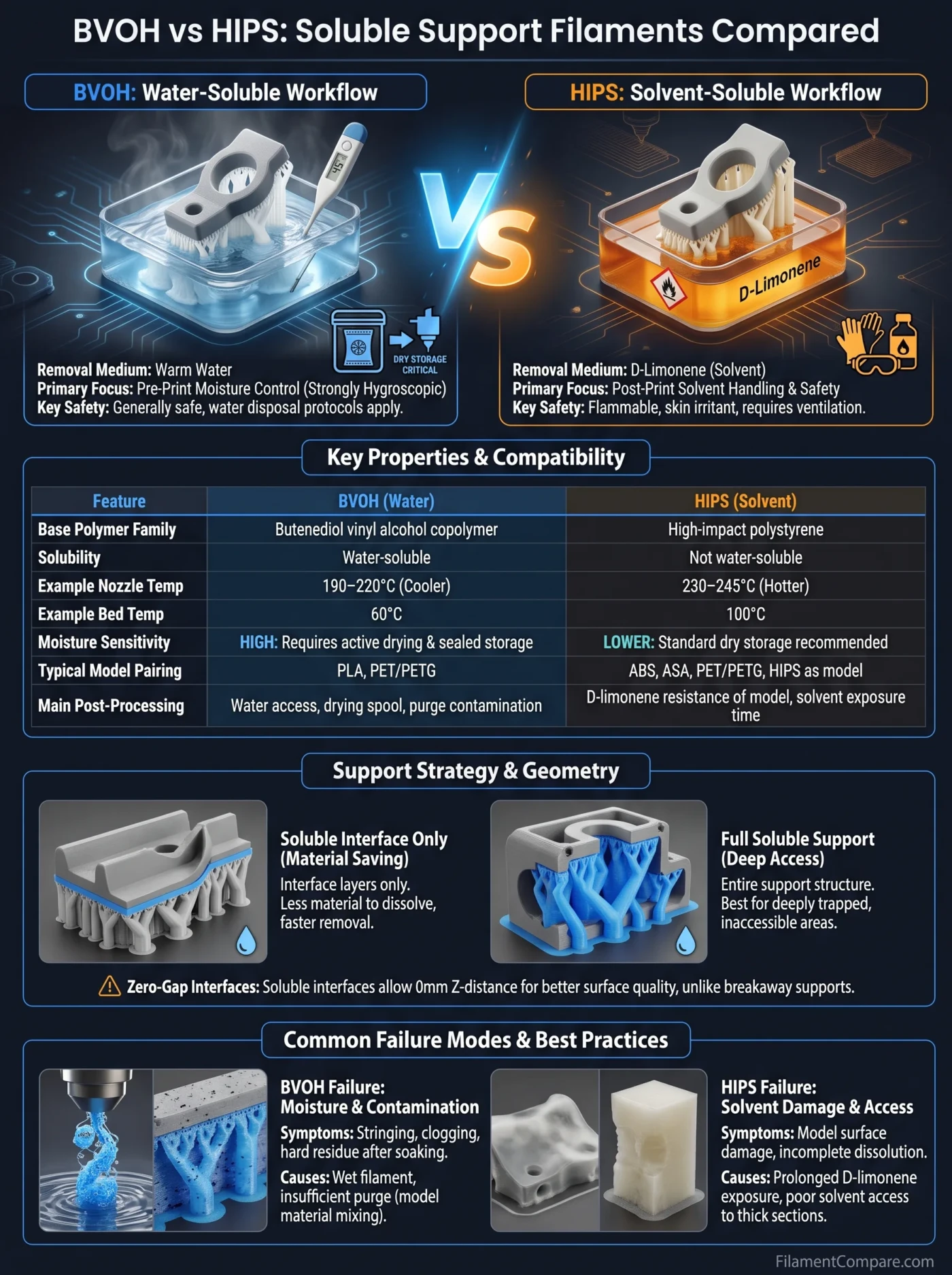
| Decision Area | BVOH | HIPS |
|---|---|---|
| Polymer family | Butenediol vinyl alcohol copolymer | High-impact polystyrene |
| Main support role | Water-soluble support or soluble interface | Solvent-soluble support; can also be printed as a model material |
| Removal medium | Water | D-limonene |
| Water-soluble | Yes | No |
| Example nozzle range | 190–220°C for Fiberlogy BVOH [a] | 230–245°C for Fiberlogy HIPS [b] |
| Example bed temperature | 60°C in the Fiberlogy profile | 100°C in the Fiberlogy profile |
| Example density | 1.14 g/cm³ | 1.04 g/cm³ |
| Example Vicat softening point | 92°C | 74°C |
| Moisture management | High priority; BVOH is strongly hygroscopic | Usually closer to conventional filament storage, while sealed dry storage remains good practice |
| Typical lower-temperature pairing | PLA and selected PET/PETG systems | Not normally the first choice for standard PLA |
| Higher-temperature pairing | Highly dependent on the exact BVOH grade and model polymer | Commonly evaluated with ABS, PET/PETG, ASA, and compatible engineering grades |
| Main post-processing concern | Water access, support mass, contamination, and adequate drying of the spool before printing | Model-material resistance to D-limonene, solvent handling, and exposure time |
| Best storage distinction | Dry storage is part of normal printing preparation | Lower moisture-management burden, but exact product instructions still control drying and storage |
| Internal support use | Useful where water can enter and dissolved material can leave | Useful where D-limonene can reach the support and the model tolerates the solvent process |
BVOH and HIPS can both remove the need to pull support material from difficult geometry, but they create very different support workflows. BVOH disappears in water and demands tight moisture control before printing. HIPS requires an appropriate solvent such as D-limonene, shifting much of the post-processing burden from filament storage to solvent compatibility and handling.
The choice is therefore broader than asking which filament dissolves more easily. A usable pairing needs printing-temperature overlap, reliable adhesion at the support interface, and a removal liquid that does not create problems for the model material. A filament can pass one of those tests and fail another.
The useful distinction: print compatibility and removal-fluid compatibility are separate questions. HIPS may print successfully beside a model filament while prolonged D-limonene exposure is unsuitable for that exact formulation. BVOH can also bond to polymers that another BVOH product does not officially support.
Two Soluble Supports, Two Different Removal Chemistries
BVOH is a vinyl-alcohol-based copolymer developed largely for temporary support structures. Its useful property in FFF printing is direct water solubility. Once the model is printed, water penetrates the support, softens it, and gradually carries the polymer away.
HIPS is different. High-impact polystyrene is a printable thermoplastic in its own right, produced by modifying polystyrene for improved impact behavior. It does not dissolve in water. Support removal instead relies on D-limonene or another removal method approved for the exact material.
This chemistry difference changes the entire workflow. With BVOH, ambient humidity becomes a printing variable before the job begins. With HIPS, solvent exposure becomes a post-processing variable after the job ends. Neither issue is represented accurately by a simple “soluble support” label.
Solubility Depends on Geometry as Much as Material
A soluble filament does not vanish at a fixed rate. Liquid access and exposed surface area strongly influence removal. A thin interface beneath a flat overhang can clear much sooner than a dense support column buried inside a narrow channel, even when both use the same spool.
How BVOH Behaves in Water
Warm water generally accelerates BVOH removal, but hotter is not automatically better. In its own soluble-support workflow, Prusa recommends water at a maximum of about 45°C and describes removal times ranging from several hours to overnight depending on geometry and support quantity. It also recommends removing accessible support while dry before soaking. [d]
- Thin interface layers: large surface area relative to their mass allows water to reach the material quickly.
- Dense support blocks: fresh water reaches the center more slowly as dissolved polymer accumulates around the structure.
- Narrow channels: removal slows when stagnant solution cannot be displaced by fresh water.
- Open internal passages: an inlet and outlet let liquid circulate and softened support leave the model.
- Sealed cavities: soluble support is not automatically useful if neither liquid nor dissolved material has a practical flow path.
Prusa also states that roughly 1 g of BVOH can dissolve in about 20 g (ml) of water in its material guidance. That figure is useful for understanding why a large full-support structure needs much more liquid than a thin soluble interface, but it should not be treated as a universal bath-sizing formula for every BVOH formulation. [c]
How HIPS Behaves in D-Limonene
HIPS follows a different path. The support is exposed to D-limonene, which attacks the HIPS structure and allows it to soften or dissolve. Thick support sections still take longer than thin interfaces, and access remains important: solvent cannot remove material efficiently from a region it cannot reach.
Full dissolution is not always the preferred target. Prusa notes that some ABS and ASA filaments can themselves be affected by extended limonene exposure, including loss of layer adhesion. Its HIPS guidance therefore describes brief solvent exposure to loosen support followed by mechanical removal as a useful option for susceptible material combinations. [e]
D-limonene is not interchangeable with water. PubChem lists D-limonene as a flammable liquid and identifies skin irritation, skin sensitization, and aquatic-hazard classifications. Product SDS instructions, suitable containers, ventilation, ignition control, personal protection, and local disposal requirements therefore belong to the HIPS removal process. [f]
Compatibility Has Three Separate Tests
Calling two materials “compatible” can hide several different requirements. For BVOH or HIPS support to work reliably, the pairing has to satisfy three separate conditions: thermal compatibility during extrusion, usable inter-material adhesion, and acceptable behavior during support removal.
1. Printing-Temperature Compatibility
The model polymer and support filament need workable extrusion conditions on the same print. Fiberlogy, for example, specifies 190–220°C for its BVOH and 230–245°C for its HIPS. Those ranges help explain why BVOH often appears beside PLA-class workflows while HIPS occupies a hotter printing range, but other formulations can differ.
Temperature overlap matters even more on a single-nozzle material-changing system. The same melt path alternates between two polymers, so nozzle temperature, standby behavior, purge volume, and the time each material spends hot all interact. Independent toolheads reduce some of that compromise.
2. Interface Adhesion
A support material must bond well enough to carry the first model layers above an overhang. Too little adhesion allows the interface to detach during printing; excessive or chemically unsuitable interaction can produce a poor surface or unstable material transition. Similar extrusion temperatures alone do not prove a useful support pairing.
This point is especially important with modified polymers. “PLA,” “ABS,” “PETG,” and “ASA” describe broad material families, while commercial filaments may contain impact modifiers, flow additives, mineral fillers, pigments, fibers, or proprietary blends. The exact grades matter.
3. Removal-Medium Compatibility
The final test occurs after printing. A model supported with BVOH needs to tolerate the selected water temperature and soak duration. A model supported with HIPS needs to tolerate D-limonene for long enough to release the support without unacceptable dimensional or layer effects.
This third test explains why “HIPS works with ABS” should not be interpreted as “every ABS can remain indefinitely in D-limonene.” The same distinction applies to specialty coatings, adhesives, inserts, labels, seals, and other components added to a printed assembly. The support liquid interacts with the finished object, not only the support.
BVOH vs HIPS Material Compatibility
Support compatibility is best treated as product-specific rather than polymer-name-specific. BASF Forward AM’s Ultrafuse compatibility chart illustrates this clearly: its BVOH is listed as compatible with PLA, PET, PA and several selected engineering grades, while its standard ABS and ASA entries are not listed as compatible with that BVOH. Its HIPS chart follows a different pattern. Fiberlogy’s BVOH, meanwhile, explicitly lists adhesion to PLA, ABS, ASA, and PET-G. [g]
| Model Material | BVOH | HIPS | Main Compatibility Check |
|---|---|---|---|
| PLA | Common support candidate | Not normally the default pairing; some specialty combinations exist | Temperature overlap and interface adhesion |
| PET / PETG | Common candidate with validated grades | Possible with selected profiles and products | Interface adhesion and nozzle-temperature range |
| ABS | Highly grade-dependent; some BVOH products list ABS while others do not | Common print pairing in compatible systems | D-limonene tolerance of the exact ABS formulation |
| ASA | Highly grade-dependent | Available in validated pairings | Solvent exposure is especially important because some ASA grades respond to limonene |
| PA / Nylon | Available in selected validated BVOH systems | Not a universal HIPS pairing | Support temperature capability and inter-material bond |
| TPU | Possible with selected product combinations | Possible only where the specific grades are validated | Flexible-material interface adhesion |
| PC/ABS and related blends | Product-specific | Available in selected support portfolios | High print temperature plus removal-medium resistance |
| PP | Not normally assumed compatible | Not normally assumed compatible | Low inter-material adhesion makes dedicated support systems preferable when specified |
| Fiber-filled engineering grades | Some manufacturer-validated combinations exist | Some manufacturer-validated combinations exist | Use the exact compatibility chart for the model filament |
Why generic compatibility charts can conflict: one BVOH formulation may adhere well to a particular ABS blend while another supplier does not validate its BVOH with standard ABS at all. Brand and grade are part of the compatibility specification.
BVOH Storage Is Part of the Printing Process
BVOH has a direct relationship with water before and after printing. Water is useful after the print because it removes the support, but ambient moisture is unwanted while the material is stored and fed. BVOH is strongly hygroscopic, so leaving a spool exposed changes the condition of the filament that enters the extruder.
Fiberlogy instructs users to store its BVOH in a dry place such as a resealable bag and lists 50°C for 4 hours as the drying condition for that specific product. Its published profile also gives a 190–220°C printing range, 60°C bed temperature, 1.14 g/cm³ density, and 92°C Vicat softening point. These are useful product examples, not category-wide BVOH settings.
Dry BVOH Storage Chain
- Dry spool
- Sealed container or bag
- Fresh desiccant
- Dry feeding during long prints
- Reseal after use
The goal is consistency. BVOH should reach the hotend in a controlled dry condition, particularly when repeated loading and unloading are part of the print.
What Moisture Changes During a BVOH Print
Moist BVOH can become more difficult to feed consistently and may show stringing, irregular extrusion, loading problems, or clogging behavior. The problem is more noticeable on multi-material systems because the same filament tip may be shaped, unloaded, reloaded, and purged many times during one print.
Drying cannot correct every support failure. A dry spool may still produce a poor interface when the temperature profile, material assignment, purge volume, cooling, support density, or tool alignment is wrong. Moisture is one variable, not a universal diagnosis.
HIPS Storage Is Usually More Conventional
HIPS does not carry the same day-to-day moisture-management burden as water-soluble BVOH. Its storage routine is normally closer to that of other conventional thermoplastic filaments: keep the spool clean, sealed, and dry, then follow the exact manufacturer instructions if drying is needed.
A universal HIPS drying temperature should not be copied between brands. Spool construction and formulation can vary, and manufacturers may describe conditioning differently. Fiberlogy’s current HIPS product page, for example, lists 230–245°C extrusion, a 100°C bed, 1.04 g/cm³ density, and a 74°C Vicat value for its own grade.
The practical storage distinction is simple: BVOH often requires active moisture management to remain predictable, while HIPS generally places more of its special handling burden after the print, during solvent-based support removal.
| Storage Issue | BVOH | HIPS |
|---|---|---|
| Sensitivity to ambient moisture | High; dry condition strongly affects feeding and extrusion | Lower operational burden than BVOH, while dry storage remains preferable |
| Airtight storage | Strongly recommended | Recommended |
| Desiccant | Strongly recommended | Useful for stable long-term storage |
| Printing from a dry box | Useful for long or moisture-sensitive jobs | Normally less central than with BVOH |
| Generic drying temperature | Do not use one; follow the exact BVOH product | Do not use one; follow the exact HIPS product |
| Main special handling stage | Before and during printing | After printing when D-limonene is used |
Full Soluble Support or Soluble Interface Only?
Printing every support wall from BVOH or HIPS is not always necessary. When most of the support scaffold remains accessible, a printer can use the model material for the large support body and place the soluble filament only in the dense interface layers that touch the model.
Full Soluble Support
Structure: the support body and contact interface are printed from the soluble material.
- Useful for deeply trapped supports.
- Useful for internal channels where the scaffold cannot be extracted in sections.
- Consumes more soluble filament.
- Creates a larger mass that later has to dissolve or soften.
- Can increase tool changes and purge waste on single-nozzle systems.
Soluble Interface Only
Structure: the main support tower uses the model material while only the contact layers use BVOH or HIPS.
- Reduces specialty support-filament consumption.
- Leaves less material for the removal bath.
- Can shorten soaking or solvent exposure.
- Preserves the main benefit where it matters: the model-to-support contact surface.
Prusa’s soluble-support profiles separate these two strategies as Soluble Full and Soluble Interface. In its MMU workflow, the interface-only option exists specifically to reduce soluble-material use while keeping the removable material between the normal support scaffold and the model.
Zero-Gap Interfaces Change Supported Surface Quality
Ordinary same-material supports normally require a small Z separation so the support does not fuse permanently to the model. That gap helps removal, but it also gives the first supported model layer room to sag. A soluble interface changes that tradeoff because physical peeling is no longer the only release mechanism.
Prusa specifies a 0 mm Z distance for BVOH/PVA soluble support in its own tested workflow. That close contact can produce a flatter underside because the model layer is deposited directly against a dense temporary surface. The setting should not be copied blindly to unrelated material pairs; interface adhesion and slicer profiles still need to match the actual materials.
For HIPS, the same principle can apply where a tested profile permits close contact, but removal chemistry is different. A clean interface still depends on controlled bonding during printing and controlled separation afterward.
Purge Contamination Can Stop BVOH From Dissolving Cleanly
This failure mode matters most on printers that push several materials through one nozzle. During a change from model polymer to BVOH, the hotend still contains some of the previous polymer. If the purge is too small, insoluble model material becomes mixed into the soluble support path.
The result can look confusing after soaking. Most of the BVOH disappears, yet thin strands, hard specks, or stubborn interface fragments remain. The water is working correctly; the remaining material may simply not be BVOH anymore.
Prusa explicitly notes that residual PLA inside BVOH/PVA can prevent complete dissolution. In its MMU3/MMU2S instructions it raises the normal filament-change purge from 140 mm³ to at least 200–240 mm³ for water-soluble supports, with 240 mm³ potentially required when changing from BVOH/PVA. Those values apply to that printer workflow rather than every multi-material machine.
Signs That Point Toward Material Contamination
- Most of the BVOH has dissolved but stiff threads remain.
- Residue appears mainly around tool-change-heavy sections.
- A support interface dissolves unevenly despite good water access.
- Small internal channels contain hard fragments after the surrounding support is gone.
- The problem changes when purge volume or nozzle-cleaning behavior changes.
HIPS can also be affected by imperfect material switching, although the visible failure may differ because D-limonene is the removal medium. Clean separation begins in the hotend, not in the bath.
Printer Architecture Changes the Workload
Independent Dual Nozzles or Toolheads
An independent tool system keeps BVOH or HIPS in its own melt path. That reduces direct cross-contamination and allows each tool to use a more suitable active and standby temperature. Purge towers may shrink or disappear depending on the printer design, while nozzle alignment and inactive-nozzle management become more important.
Single-Nozzle Material Changing
A single melt path introduces repeated loading, unloading, temperature transitions, tip shaping, wiping, and purging. The process is especially demanding for moisture-sensitive BVOH, since a long print may include hundreds of filament swaps.
HIPS avoids BVOH’s water-soluble-filament storage burden but still needs a reliable transition from the model polymer. If two materials require substantially different temperatures, tool-change tuning can dominate total print time even when the support volume itself is small.
| Printer Design | BVOH Effect | HIPS Effect |
|---|---|---|
| Independent toolheads | Less polymer cross-contamination; separate thermal control | Separate hotend can handle the hotter HIPS profile more independently |
| IDEX | Dedicated BVOH nozzle reduces repeated filament loading | Useful when model and HIPS temperatures differ |
| Single-nozzle changer | Dryness, tip shape, purge volume, and contamination become more prominent | Temperature transitions and purge behavior become more prominent |
| Basic single-material printer | Cannot automatically place BVOH only where required without material-changing hardware | Cannot automatically alternate HIPS and model material without a second-material system |
BVOH and HIPS Removal Workflows Side by Side
BVOH Workflow
- Start with dry BVOH.
- Print the full support or selected interface with a validated material pairing.
- Remove large accessible support sections where practical.
- Expose the remaining BVOH to water within the product or printer guidance.
- Allow fresh water to reach internal support surfaces.
- Rinse away remaining softened or dissolved material.
- Dry the finished model as required by its main polymer and geometry.
HIPS Workflow
- Print HIPS with a validated model-material profile.
- Remove large accessible support sections when this reduces solvent exposure.
- Use an appropriate D-limonene product and container according to its SDS.
- Expose the HIPS long enough to soften or dissolve the required support.
- Limit unnecessary exposure when the model polymer has uncertain solvent resistance.
- Remove loosened HIPS and clean the model according to the material and solvent instructions.
- Manage used solvent and residue under the applicable product and local disposal guidance.
The workflow difference is easy to underestimate. BVOH asks for more discipline before and during the print. HIPS moves more of the unusual handling to post-processing.
Where BVOH Fits More Naturally
- PLA models with internal supports or delicate supported faces.
- Validated PET/PETG combinations where a water-soluble interface is available.
- Print-in-place mechanisms where support fragments cannot be pulled out safely.
- Narrow channels that have adequate water entry and drainage.
- Parts where use of an organic support-removal solvent is undesirable.
- Printers with a tested BVOH profile and dependable dry feeding.
- Jobs where only a few interface layers need to dissolve rather than an entire support tower.
BVOH is especially attractive when water is compatible with the finished model and the printer can keep the spool dry. Its storage demands are real, but the removal medium is simple and accessible.
Where HIPS Fits More Naturally
- Validated ABS, PET/PETG, ASA, or other higher-temperature material combinations.
- Printer setups where HIPS temperature requirements match the model polymer well.
- Workflows that already have suitable D-limonene handling and storage.
- Support jobs where BVOH’s moisture sensitivity would create unnecessary handling.
- Large or complex supports where HIPS can be loosened and partly removed mechanically rather than fully dissolved.
- Cases where the exact model filament has been confirmed to tolerate the intended solvent exposure.
HIPS should be selected from the complete material system rather than from an old rule that simply pairs it with ABS. The model grade, HIPS grade, printer profile, and limonene exposure all matter.
When Neither Soluble Material Adds Much Value
Soluble support adds hardware changes, another filament profile, post-processing, and often more purge waste. When every support surface is accessible, ordinary model-material or breakaway support may be simpler.
- The support consists of a few exposed towers that can be removed by hand.
- No delicate model surface is threatened by mechanical removal.
- The supported underside does not require a near-zero-gap interface.
- A large soluble-support volume would create more post-processing than the geometry justifies.
- The printer would generate more purge material than soluble interface material.
- The cavity is sealed and provides no realistic path for water or solvent exchange.
- The model includes components or finishes that should not be immersed.
The strongest use case remains geometry that is difficult to reach mechanically. Solubility has the most value when it changes what can be removed, not merely how it is removed.
Common BVOH and HIPS Failure Patterns
| Symptom | BVOH Checks | HIPS Checks |
|---|---|---|
| Support does not disappear fully | Model-polymer contamination, insufficient water access, excessive support mass, stagnant solution | Limited solvent access, insufficient exposure for the support geometry, incompatible removal process |
| Support interface detaches while printing | Wet filament, incorrect temperature, weak pairing, excessive cooling | Interface adhesion, temperature mismatch, cooling or support geometry |
| Stringing during tool changes | Moisture, idle temperature, tip formation, retraction | Standby temperature, retraction, purge and nozzle behavior |
| Loading or unloading becomes unreliable | Check BVOH dryness and filament-tip condition first | Check profile, temperature, filament path, and tip formation |
| Removal is much slower than expected | Thick support, low exposed area, poor water circulation, contaminated support | Thick HIPS, limited D-limonene access, large solvent-depleted boundary around support |
| Model changes during removal | Check water temperature and the model polymer’s water/heat tolerance | Stop and verify D-limonene compatibility and exposure time for the exact model filament |
| Hard strands remain after BVOH soaking | Often consistent with inadequate purging between model material and BVOH | Not directly comparable; determine whether the residue is HIPS or transferred model polymer |
Choosing by Model Material and Workflow
- PLA model
- BVOH is the more natural starting point when soluble support is genuinely needed, provided the exact PLA and BVOH grades have a tested interface.
- PET or PETG model
- BVOH is widely used in selected PET/PETG systems, while HIPS is also supported by some manufacturer and printer profiles. Use the exact pairing data rather than a category-wide rule.
- ABS model
- HIPS is a common support candidate because the printing temperatures can align well. BVOH is not automatically excluded: some commercial BVOH products explicitly list ABS adhesion, while other compatibility charts do not validate the combination.
- ASA model
- Both choices become more product-dependent. Some BVOH formulations list ASA adhesion, while HIPS can print beside selected ASA grades. D-limonene tolerance must be checked separately.
- PA or Nylon model
- Selected BVOH products are validated for selected PA families. Generic HIPS compatibility should not be assumed.
- Flexible or filled engineering filament
- Use the support manufacturer’s compatibility chart for the exact grade. Polymer family names alone do not provide enough information.
Common BVOH and HIPS Questions
Does BVOH Dissolve Faster Than HIPS?
There is no useful universal speed comparison because the materials use different liquids and different dissolution mechanisms. Support thickness, surface area, liquid movement, temperature, contamination, geometry, and product formulation can change removal time more than the material label alone.
Can HIPS Be Used as Support for ABS?
Yes, many HIPS systems are designed for ABS-compatible printing temperatures. The separate question is whether the exact ABS grade can tolerate the intended D-limonene exposure. Some ABS formulations can be affected by prolonged contact, so a validated material combination is preferable.
Can BVOH Support ABS or ASA?
Some BVOH products explicitly list adhesion to ABS and ASA, while other manufacturer compatibility charts do not validate those same generic material categories for their own BVOH. This is a clear case where the exact product pair matters more than a blanket compatibility statement.
Which Is Easier to Store?
HIPS generally requires less active moisture control. BVOH is strongly hygroscopic and benefits from sealed storage, desiccant, and controlled dry feeding. HIPS should still be stored properly, but its normal workflow is less dependent on keeping a water-soluble polymer continuously dry.
Should the Entire Support Be Printed in BVOH or HIPS?
Not necessarily. A soluble interface only can provide the clean contact surface while the model material forms most of the support tower. Full soluble support becomes more useful when the support body itself is trapped and cannot be extracted mechanically.
Can Soluble Support Be Used Inside a Completely Sealed Cavity?
Only when the design provides a realistic route for the removal liquid to enter and for dissolved or softened material to leave. A fully sealed cavity defeats the normal liquid-removal process; calling the support soluble does not remove the need for fluid access and drainage.
Why Does BVOH Sometimes Leave Hard Material After Soaking?
One cause is insufficient purging in a shared-nozzle printer. PLA, PETG, or another model polymer can remain mixed into the BVOH path and form insoluble strands. Water removes the BVOH around them but cannot dissolve the contaminating polymer.
Technical References
- [a] Fiberlogy — BVOH — Product printing range, bed temperature, drying condition, density, Vicat value, water solubility, storage guidance, and listed material adhesion.
- [b] Fiberlogy — HIPS Filament S2 — D-limonene solubility, printing range, bed temperature, density, thermal data, and product specifications.
- [c] Prusa Knowledge Base — Water Soluble BVOH/PVA — BVOH water-solubility guidance, hygroscopic behavior, PLA pairing, zero-distance support interface, and residual model-material contamination.
- [d] Prusa Knowledge Base — Water-Soluble Materials PVA/BVOH — Full versus interface support, MMU purge guidance, warm-water removal procedure, storage, and dry-box handling.
- [e] Prusa Knowledge Base — HIPS — HIPS printing guidance, D-limonene removal, PETG support use, and warnings about prolonged limonene exposure with selected ABS and ASA formulations.
- [f] PubChem — D-Limonene — GHS flammability, skin irritation, sensitization, and environmental hazard information.
- [g] BASF Forward AM — Support Compatibility for Ultrafuse Filaments — Manufacturer compatibility matrix for Ultrafuse BVOH, Ultrafuse HIPS, and specific model-filament grades.
