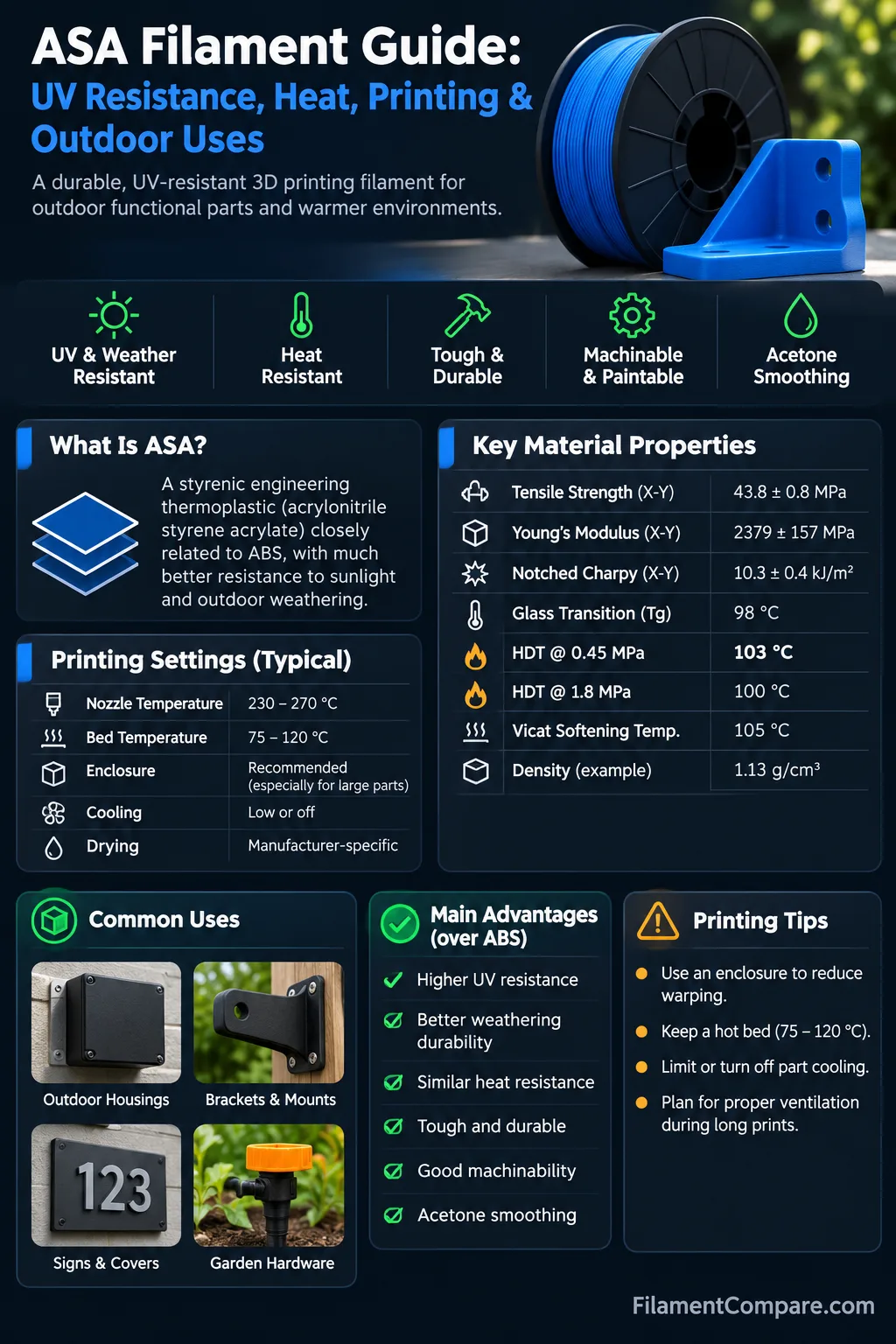
ASA filament is a styrenic engineering thermoplastic built for outdoor functional parts, sunlight exposure, and warmer service conditions. Its defining advantage over standard ABS is better resistance to ultraviolet light and weathering while retaining similar heat resistance, toughness, machinability, and acetone post-processing. ASA does require more printer control than PLA or PETG: large parts benefit from an enclosure, bed temperatures are high, cooling must be managed carefully, and ventilation should be planned before long prints.
| Property | Current Reference | Why It Matters |
|---|---|---|
| Polymer | Acrylonitrile styrene acrylate | Styrenic engineering thermoplastic closely related to ABS |
| Main Material Advantage | High UV and weather resistance | Well suited to sun-exposed housings, brackets, signage, covers, and exterior fixtures |
| Density Example | Polymaker ASA: 1.13 g/cm³ | Product-specific reference for mass and material calculations[a] |
| X-Y Tensile Strength Example | 43.8 ± 0.8 MPa | Shows useful printed mechanical strength; other ASA formulations can differ |
| X-Y Young’s Modulus Example | 2379 ± 157 MPa | Represents a fairly rigid engineering-plastic response |
| X-Y Notched Charpy Example | 10.3 ± 0.4 kJ/m² | Impact result for one formulation and stated ISO test |
| Glass Transition Temperature | 98 °C | Thermal transition reference; not a maximum service-temperature rating |
| HDT at 0.45 MPa | 103 °C | Useful for comparing deformation under a standardized load |
| HDT at 1.8 MPa | 100 °C | Shows how test load affects thermal deformation data |
| Vicat Softening Temperature | 105 °C | Another thermal measurement that should not be substituted for HDT or service temperature |
| Typical Nozzle Range | Current manufacturer examples span roughly 230–270 °C | The exact spool profile should decide the setting |
| Typical Bed Range | Current examples span roughly 75–120 °C | ASA relies on a hot build surface to limit cooling stress |
| Enclosure | Recommended; especially important as part size increases | Higher ambient temperature reduces warping and layer separation |
| Cooling | Low or off for many standard ASA profiles | Too much cooling can increase thermal stress and weaken layer bonding |
| Drying | Manufacturer-specific | Current ASA products use different drying temperatures and durations |
| Surface Finish | Often matte to satin | Can visually reduce the appearance of layer lines |
| Post-Processing | Sanding, drilling, machining, painting, gluing, acetone smoothing | Useful for finished housings, prototypes, and exterior components |
| Common Uses | Outdoor housings, signs, garden hardware, automotive accessories, brackets, covers, fixtures | Matches ASA’s UV, weather, heat, and mechanical profile |
ASA properties vary by resin formulation, pigment, fiber content, printer conditions, and test method. The numerical values above come from Polymaker ASA documentation and should be treated as one manufacturer-specific reference rather than fixed values for every ASA filament. Polymaker ASA was formerly named PolyLite ASA; the manufacturer confirmed that the October 29, 2025 name change did not alter its formulation.[g]
What Is ASA Filament?
ASA stands for acrylonitrile styrene acrylate. It belongs to the styrenic thermoplastic family and is closely related to ABS, but the rubber phase used in ASA gives the material much better resistance to sunlight and outdoor weathering. That difference is why ASA is commonly selected for components that need to remain outside rather than merely survive a short outdoor test.
Mechanically, ASA behaves like a rigid engineering plastic rather than a flexible or highly ductile filament. It can be drilled, sanded, machined, glued, painted, or solvent-smoothed. It also handles substantially more heat than standard PLA or PETG in many current product datasets. Its specialty is the combination of heat resistance and UV stability.
ASA is not simply “outdoor ABS.” Weathering performance is the main reason to choose it, but formulation still matters. Standard ASA, high-flow ASA, ASA-CF, and ASA-GF can have different stiffness, impact behavior, print temperature, warping, nozzle requirements, and moisture handling.
Why ASA Works Well Outdoors
Outdoor service exposes a printed part to more than rain. Ultraviolet radiation, temperature cycling, humidity, surface heating, mechanical stress, and repeated wet-dry cycles can all change a polymer over time. Standard ASA formulations are designed to handle that environment better than common ABS.
Polymaker reports both natural and accelerated aging work for its ASA. After a two-year natural aging examination, the company reported a color-change value below ΔE 2.5. Its accelerated test reported a ΔE below 5 with minimal tensile-strength loss after 8000 kJ/m² irradiation.[b] Those figures belong to that material and test program, but they provide a more useful description of weather resistance than simply labeling all ASA “UV proof.”
What UV Resistance Means
UV resistance means the polymer is formulated to reduce property loss caused by prolonged ultraviolet exposure. In practical terms, the goals are slower color change, reduced embrittlement, and better retention of mechanical properties compared with a material that is poorly suited to sunlight.
It does not mean zero aging. Pigment, surface temperature, wall thickness, continuous load, climate, and print quality all affect service life. A dark ASA enclosure sitting in full summer sun can become much hotter than the surrounding air, so UV resistance and heat resistance still need to work together.
What Weather Resistance Means
Weather resistance is broader than UV resistance. It includes the material’s response to sunlight, rain, humidity, heat, cooling cycles, and environmental stress. ASA is useful outdoors because these properties are considered together rather than treating sunlight as the only exposure.
A printed object can still fail outdoors because of geometry even when the polymer itself ages slowly. Water traps, thin screw bosses, poor layer orientation, excessive preload, and sharp stress concentrations can shorten the life of an otherwise suitable ASA part.
ASA Heat Resistance
ASA offers a much higher thermal margin than ordinary PLA and usually more than standard PETG. Current Polymaker ASA technical data lists a 98 °C glass-transition temperature, 103 °C HDT at 0.45 MPa, 100 °C HDT at 1.8 MPa, and 105 °C Vicat softening temperature.[a]
These values describe different tests. They should not be collapsed into one “ASA temperature resistance” number.
- Glass Transition Temperature (Tg)
- A polymer transition where molecular mobility changes. Tg is useful material information but is not the maximum safe operating temperature of a printed component.
- Heat-Deflection Temperature (HDT)
- The temperature at which a standardized specimen reaches a defined deformation while carrying a specified load. Always compare HDT values at the same load.
- Vicat Softening Temperature
- A standardized penetration-based softening measurement. It answers a different thermal question from HDT.
- Service Temperature
- The acceptable temperature for the actual printed part under its real load, geometry, exposure duration, orientation, and dimensional tolerance.
A thick unloaded ASA cover may remain dimensionally acceptable at a temperature where a thin bracket under constant tension has already begun to creep. Continuous load matters. This is why HDT is useful for comparison but cannot replace validation of the actual component.
ASA Mechanical Properties
ASA is useful for functional parts because it combines rigidity with moderate impact tolerance. Current Polymaker printed-specimen data reports an X-Y tensile strength of 43.8 ± 0.8 MPa, Young’s modulus of 2379 ± 157 MPa, bending strength of 73.4 ± 2.1 MPa, and notched Charpy impact strength of 10.3 ± 0.4 kJ/m².[a]
The same sheet reports lower Z-direction tensile and impact values than X-Y values. That is a reminder that ASA parts remain anisotropic. Print orientation still belongs in the mechanical design. A strong base material cannot compensate for a layer interface placed directly across the highest tensile load.
ASA Filament Printing Settings
ASA profiles differ noticeably by brand. Current Polymaker ASA guidance lists 230–260 °C at the nozzle, 75–95 °C on the build plate, 50–200 mm/s, fan off, and an enclosed chamber.[b] Prusa’s current general ASA profile uses 260 °C at the nozzle, 105 °C on the first layer, and 110 °C afterward.[c]
Flashforge’s current ASA specification is different again: 240–270 °C nozzle, 100–120 °C build plate, 40–300 mm/s, and 0–50% cooling.[d] These differences are normal. Resin formulation, flow behavior, printer chamber design, and intended print speed all change the useful settings.
| Manufacturer Example | Nozzle | Build Plate | Cooling | Speed / Environment | Drying Reference |
|---|---|---|---|---|---|
| Polymaker ASA | 230–260 °C | 75–95 °C | Fan off | 50–200 mm/s; enclosed chamber | 70 °C for 7 h |
| Prusa ASA Guidance | 260 °C | 105 °C first layer; 110 °C afterward | Geometry-dependent | High ambient temperature; enclosure preferred for larger parts | Dry when moisture symptoms justify it |
| Flashforge ASA | 240–270 °C | 100–120 °C | 0–50% | 40–300 mm/s | 80 °C for 12 h in current product guidance |
The correct starting point is the current profile for the exact ASA product. Copying a high-flow ASA profile to an older formulation can create over-extrusion, stringing, poor overhangs, or weak dimensional control. Using an old slow profile on a new high-flow grade can leave performance on the table.
Does ASA Need an Enclosure?
For reliable functional printing, an enclosure is strongly recommended. ASA contracts as it cools, and large temperature differences between freshly deposited material and the surrounding part create internal stress. That stress can lift corners, curve flat walls, or split layers.
Prusa recommends keeping ASA at a high ambient temperature and notes that large parts need an enclosure.[c] Polymaker similarly lists an enclosed chamber in its current ASA printing conditions and explains that bigger models benefit more from chamber temperature control.[b]
Part size changes the enclosure requirement. A compact ASA clip may succeed on a carefully prepared open printer, while a broad electronics enclosure can warp even when the first layer looks perfect. The larger and denser the part, the more useful a stable warm chamber becomes.
Enclosure vs Heated Chamber
An enclosure traps heat generated by the build plate and printer. An actively heated chamber controls air temperature more directly. Ordinary ASA does not always require an actively heated chamber, but larger or dimensionally demanding objects can benefit from one when the printer and material support it.
Do not raise chamber temperature without checking printer limits. Toolhead plastics, electronics, motors, belts, lubricant, and filament-feed components may have their own temperature restrictions.
Why ASA Warps
Warping is a cooling-stress problem. The lower layers are constrained by the build plate while upper material contracts as it loses heat. If the stress exceeds the grip of the bed or the strength of a layer interface, the object can lift or crack.
Conditions That Affect ASA Warping
- Part footprint: Wide flat parts accumulate more cooling stress.
- Sharp corners: Stress concentrates around abrupt geometric changes.
- Chamber temperature: A warmer environment reduces the temperature gradient through the print.
- Build-plate adhesion: The first layers must remain anchored while the part cools.
- Part cooling: Excess fan can cool walls too quickly.
- Infill and wall design: Dense internal structures can add shrinkage stress.
A brim can help keep corners down, but it does not remove stress from the rest of the model. Chamber temperature and geometry matter more as the object becomes larger.
ASA Cooling and Layer Adhesion
ASA generally uses less fan than PLA or PETG. Polymaker currently specifies the cooling fan off for its standard ASA and notes that hotter, slower printing improves layer adhesion.[b] Flashforge allows up to 50% cooling on its ASA, showing again that formulation and printer profile matter.
Overhangs and bridges may need some localized cooling. The compromise is simple: more cooling can improve unsupported geometry, while less cooling tends to favor thermal stability and layer fusion. A slicer profile that varies fan speed by feature is often more useful than one fixed percentage.
ASA Build Plate Adhesion
ASA needs a clean, heat-tolerant build surface with enough adhesion to resist shrinkage forces. Current Polymaker guidance lists PC and textured PEI with glue when needed, while Prusa supports smooth and powder-coated PEI with a glue-stick layer in its ASA workflow.[c]
Glue can serve more than one purpose. Depending on the surface, it can improve adhesion during printing or help create a controlled release layer after cooling. Follow the build-plate manufacturer’s instructions rather than assuming every PEI, glass, PC, or textured surface behaves the same way.
ASA Ventilation and Printing Emissions
ASA is a styrenic material and should be printed with suitable ventilation or source filtration. Prusa warns that ASA produces fumes during printing and recommends a well-ventilated room while avoiding a cold draft across the print.[c] Polymaker also recommends ventilation and filtration for ASA printing.
An enclosure and ventilation solve different problems. The enclosure keeps the model warm. Ventilation or filtration manages what accumulates in the surrounding air. A sealed box with no air-management plan should not automatically be treated as an emissions solution.
Keep airflow away from the part itself. Ventilating a room by blowing cold air directly through the printer can increase warping. Source extraction or filtered enclosure airflow can control emissions without creating a strong draft over the build.
ASA Moisture and Drying
ASA is less moisture-sensitive than many nylon grades, but it is not immune to poor storage. Polymaker’s ASA documentation includes a moisture-absorption curve and specifies 70 °C for 7 hours as its drying setting.[a] Flashforge currently specifies 80 °C for 12 hours for its own ASA.[d]
This variation is why one universal ASA drying chart is a weak substitute for product documentation. A spool may also use cardboard, plastic, or another material with its own temperature limit.
Moisture-related symptoms can include popping, inconsistent extrusion, rough surfaces, fine strings, bubbles, or changes in gloss. Store opened ASA sealed with desiccant when repeatable surface quality and mechanical properties matter.
ASA Surface Finish
Standard ASA often produces a matte or satin finish that can make layer lines less visually prominent than a glossy polymer. Polymaker specifically identifies the matte appearance as one of the practical differences between ASA and ABS.[b]
Surface quality is still controlled by layer height, extrusion consistency, temperature, speed, cooling, and color. Carbon- and glass-fiber grades usually push the appearance farther toward a uniform matte texture while also changing stiffness and impact behavior.
ASA Post-Processing
ASA can be sanded, drilled, machined, glued, painted, and solvent-smoothed. Prusa documents both sanding and acetone-based smoothing or welding for ASA.[c]
Acetone smoothing can reduce visible layer texture and create a glossier surface, but it also rounds corners and can alter dimensions. Holes, snap features, threads, embossed text, and tight-fit geometry deserve extra clearance if chemical smoothing is planned.
Acetone is a volatile flammable solvent and needs appropriate handling, ventilation, storage, and ignition control. Mechanical sanding or painting may be the simpler route when dimensional detail matters.
ASA Chemical Resistance
ASA has useful resistance to several common chemical categories, but compatibility is not universal. Current Polymaker data rates its ASA good against weak acids, weak alkalis, oils, and grease; strong acids are rated poor and strong alkalis fair under the manufacturer’s stated assessment.[a]
A short splash and continuous immersion are different conditions. Concentration, temperature, time, stress, and additives can all change the outcome. Check the exact chemical against the exact ASA grade when chemical contact is part of the design.
Types of ASA Filament
| ASA Type | Main Change | Typical Reason to Use It | Printer Consideration |
|---|---|---|---|
| Standard ASA | Unfilled ASA formulation | Outdoor housings, brackets, signs, covers, fixtures, prototypes | Enclosure recommended; ordinary non-abrasive nozzle |
| High-Flow / High-Speed ASA | Flow behavior tuned for faster extrusion | Higher-throughput functional printing | Use the product’s rated volumetric flow and temperature rather than an older ASA profile |
| ASA-CF | Chopped carbon fiber reinforcement | Higher rigidity, lower warping, matte appearance, dimensional stability | Abrasion-resistant nozzle required |
| ASA-GF | Chopped glass fiber reinforcement | Stiffer outdoor structural parts and improved dimensional stability | Hardened nozzle required for abrasive glass fiber |
Standard and High-Speed ASA
Modern standard ASA is no longer limited to very slow printing. Polymaker currently rates its ASA up to 200 mm/s, while Flashforge lists a 40–300 mm/s range for its current product.[d] Those speeds depend on hotend flow, chamber stability, part geometry, layer time, and the quality target.
Motion speed alone is not enough. A printer running at 250 mm/s but limited by hotend volumetric flow may never reach that speed during sustained extrusion. High-flow ASA should be selected and tuned as its own formulation.
ASA-CF
ASA-CF combines ASA resin with chopped carbon fiber. The typical goal is higher stiffness, lower shrinkage, better dimensional control, and a uniform matte surface. Fiberon ASA-CF08 currently uses 8% carbon fiber by weight and lists 43.5 MPa X-Y tensile strength, 69.1 MPa bending strength, and 103 °C HDT at 0.45 MPa.[e]
The same product specifies a hardened nozzle, 260–280 °C nozzle temperature, 90–100 °C build plate, fan off, and printing speeds up to 350 mm/s. Carbon fiber reduces ductility and makes the raw filament more brittle, so multi-material feed paths with sharp bends may not be ideal.
ASA-CF is not simply “stronger ASA.” Carbon fiber usually raises stiffness and dimensional stability but can lower elongation and impact tolerance. Select it when rigidity and shape control are more useful than maximum ductility.
ASA-GF
Glass-fiber ASA targets a similar engineering role but uses chopped glass instead of carbon. Siraya Tech Fibreheart ASA-GF contains 10% chopped glass fiber and publishes 47.5 MPa tensile stress at break, 2993 MPa Young’s modulus, 81 MPa bending strength, and a Tg of 106 °C.[f]
The manufacturer specifies a hardened steel nozzle, 250–270 °C nozzle temperature, 100–110 °C build plate, and a 60–80 °C enclosure range. Its published HDT is around the mid-to-high 90 °C range depending on the stated method/load.
Glass fiber is abrasive. Brass nozzle wear can change extrusion diameter over time, so a hardened steel, tungsten-carbide, ruby, or another abrasion-resistant nozzle is the normal hardware direction for ASA-GF.
Standard ASA vs Fiber-Reinforced ASA
| Property | Standard ASA | ASA-CF | ASA-GF |
|---|---|---|---|
| UV / Weathering Base | Strong ASA outdoor profile | Retains ASA-based outdoor focus | Retains ASA-based outdoor focus |
| Stiffness | Moderate to high | Higher than standard ASA in fiber-focused formulations | Higher than standard ASA in glass-filled formulations |
| Ductility | Higher than many filled ASA grades | Usually reduced by carbon fiber | Usually reduced by glass fiber |
| Warping | Enclosure normally recommended | Fiber can reduce shrinkage and improve dimensional control | Fiber can improve dimensional stability |
| Surface Finish | Matte to satin | Uniform matte fiber texture | Matte or lightly textured composite finish |
| Nozzle Wear | Low with unfilled material | High; hardened nozzle required | High; hardened nozzle required |
| Best Fit | General outdoor functional parts | Rigid fixtures, housings, precision outdoor parts | Stiff outdoor brackets, fixtures, and structural-looking components |
Best Uses for ASA Filament
| Application | Why ASA Fits | ASA Type to Consider |
|---|---|---|
| Outdoor Electronics Enclosure | UV resistance, weathering resistance, useful heat margin | Standard ASA or stiff composite ASA |
| Garden Brackets and Hardware | Sunlight, rain, humidity, and temperature cycling | Standard ASA |
| Exterior Sensor Housing | UV stability and dimensional retention | Standard ASA or ASA-CF |
| Outdoor Signage | Color and property retention in sunlight | Standard ASA |
| Automotive Exterior Accessory | Weather exposure and higher thermal margin than PLA/PETG | Standard ASA, ASA-CF, or ASA-GF depending on stiffness need |
| Vehicle Interior Fixture | Higher heat resistance than standard PLA and PETG | Standard ASA, after validating actual cabin temperature and load |
| Outdoor Camera Mount | Sunlight resistance with functional rigidity | ASA or ASA-CF |
| Workshop Jig | Rigidity, machining, heat tolerance, easy post-processing | Standard ASA |
| Dimensionally Stable Outdoor Fixture | Fiber reinforcement can reduce deformation | ASA-CF or ASA-GF |
| Protective Machine Cover | Impact resistance, thermal margin, sandable surface | Standard ASA |
| Outdoor Recreational Equipment Part | Weather and UV exposure | Standard ASA with application-specific validation |
| Painted Exterior Prototype | Sandable surface with an outdoor-capable substrate | Standard ASA |
When Another Filament May Fit Better
For Easy Open-Frame Printing
PETG usually requires less thermal control and has a much lower warping risk. It is useful when outdoor exposure is moderate and ASA’s UV-focused material profile is not required.
For Very High Service Temperatures
ASA has useful thermal performance, but PC, reinforced nylon, PPA, PPS, or other high-temperature engineering materials can provide more margin when the application approaches ASA’s loaded thermal range.
For Maximum Impact Ductility
A specific ABS, PETG, nylon, or toughened formulation may outperform a particular ASA grade in the failure mode being tested. Compare matching impact tests instead of assuming outdoor suitability also means maximum impact strength.
For Flexible Outdoor Components
A UV-stabilized TPU or another weather-qualified elastomer is more appropriate when the component must bend, compress, or stretch rather than remain rigid.
Common ASA Printing Problems
| Symptom | Areas to Check | Technical Cause |
|---|---|---|
| Corners Lift From the Bed | Chamber temperature, bed adhesion, brim, drafts, part geometry | Cooling shrinkage creates stress at the footprint |
| Cracks Between Layers | Ambient temperature, nozzle heat, fan speed, wall geometry | Upper layers cool too quickly to maintain strong fusion |
| Large Part Is Dimensionally Distorted | Enclosure temperature, infill, walls, print orientation | Shrinkage is uneven across the model |
| Weak Layer Bonding | Nozzle temperature, cooling, chamber warmth, speed | Layers may cool before adequate fusion develops |
| Rough Surface or Popping | Moisture and drying | Absorbed water can disrupt extrusion |
| Overhangs Look Soft | Cooling and nozzle temperature | Warm chamber and low fan improve bonding but reduce unsupported-feature cooling |
| Part Is Difficult to Remove | Build surface, adhesive/release layer, removal temperature | ASA can bond firmly to some surfaces |
| Fiber-Filled ASA Wears the Nozzle | Nozzle material | Carbon and glass fibers are abrasive |
ASA Filament Questions
What Is ASA Filament Used For?
ASA is mainly used for outdoor and heat-exposed functional parts such as brackets, housings, signs, garden hardware, vehicle accessories, sensor covers, fixtures, and prototypes that need better UV stability than standard ABS.
Is ASA the Best Filament for Outdoor Use?
ASA is one of the strongest general-purpose FDM choices when UV exposure, weathering, rigidity, and moderate heat are all required. A flexible part may call for UV-stabilized TPU, while much hotter applications may require another engineering polymer.
Is ASA Waterproof?
ASA itself handles water and outdoor moisture well, but an FDM print is not automatically watertight. Seams, extrusion consistency, perimeters, layer defects, fittings, wall thickness, and pressure determine whether a finished enclosure or container leaks.
Can ASA Be Printed Without an Enclosure?
Small ASA parts can sometimes print successfully without an enclosure when bed adhesion is reliable and ambient conditions are stable. An enclosure is still recommended for consistent results and becomes more useful as parts become larger. Wide, dense, or dimensionally demanding models are particularly sensitive to cooling stress.
What Temperature Does ASA Print At?
Current manufacturer profiles commonly fall somewhere around 230–270 °C at the nozzle, but there is no universal ASA temperature. Current Polymaker ASA lists 230–260 °C, Prusa uses 260 °C in its standard guidance, and Flashforge lists 240–270 °C.
What Bed Temperature Does ASA Need?
ASA usually uses a hot bed. Current manufacturer examples range from 75–95 °C for Polymaker ASA to 105–110 °C in Prusa’s guidance and 100–120 °C for current Flashforge ASA. Use the value specified for the actual filament and build surface.
Does ASA Need a Cooling Fan?
Many ASA profiles use little or no fan because fast cooling increases thermal stress. Some formulations allow moderate fan for overhangs and bridges. Polymaker currently specifies fan off, while Flashforge lists 0–50%, illustrating why the exact profile matters.
Does ASA Need to Be Dried?
ASA benefits from dry storage and may need drying after moisture exposure. Drying settings differ by formulation: current Polymaker and Flashforge products use different temperatures and times, so the spool manufacturer’s limit should be followed.
Does ASA Smell When Printing?
ASA is a styrenic filament and can produce noticeable odor and printing emissions. Use suitable ventilation or filtration and keep the printer away from the normal breathing zone. Do not create a cold draft across the part while ventilating.
Can ASA Be Smoothed With Acetone?
Yes. ASA can be glued, welded, or vapor-smoothed with acetone. Smoothing can reduce layer texture but also rounds detail and can alter dimensions, so it is better suited to cosmetic surfaces than tight-tolerance features.
Does ASA Need a Hardened Nozzle?
Standard unfilled ASA normally does not. ASA-CF and ASA-GF are abrasive and should use the hardened or abrasion-resistant nozzle specified by the manufacturer.
Is ASA-CF Better Than Standard ASA?
ASA-CF is better when stiffness, reduced warping, dimensional stability, and a matte composite surface matter. Standard ASA is usually the better fit when more ductility, ordinary nozzle compatibility, and a wider color range are priorities.
What Is ASA-GF Used For?
ASA-GF combines outdoor-capable ASA with chopped glass fiber to raise stiffness and dimensional stability. It is suited to rigid exterior brackets, fixtures, housings, tooling, and parts where standard ASA bends or shrinks more than desired.
Technical Resources Used
- [a] Polymaker ASA Technical Data — Used for density, tensile and flexural properties, Charpy impact, Tg, HDT, Vicat softening, chemical-resistance data, print conditions, and drying reference.
- [b] Polymaker ASA Product Documentation — Used for UV and weathering data, natural and accelerated aging results, current printing guidance, enclosure behavior, surface finish, ventilation context, and acetone processing.
- [c] ASA | Prusa Knowledge Base — Used for ASA nozzle and bed temperatures, enclosure requirements, warping, UV/outdoor use, ventilation, build-sheet guidance, sanding, and acetone smoothing.
- [d] Flashforge ASA Filament — Used for current high-speed ASA printing range, nozzle and bed temperatures, cooling, drying, storage humidity, and outdoor positioning.
- [e] Fiberon ASA-CF08 — Used for the ASA-CF category, 8% carbon-fiber content, printing requirements, hardened-nozzle requirement, speed, enclosure guidance, and composite behavior.
- [f] Siraya Tech Fibreheart ASA-GF Technical Data — Used for the ASA-GF category, 10% chopped glass fiber, stiffness and strength values, thermal data, enclosure requirements, drying, and abrasion-resistant nozzle guidance.
- [g] Polymaker Product Changelog — Confirms the October 29, 2025 renaming of PolyLite ASA to Polymaker ASA without a formulation change.
