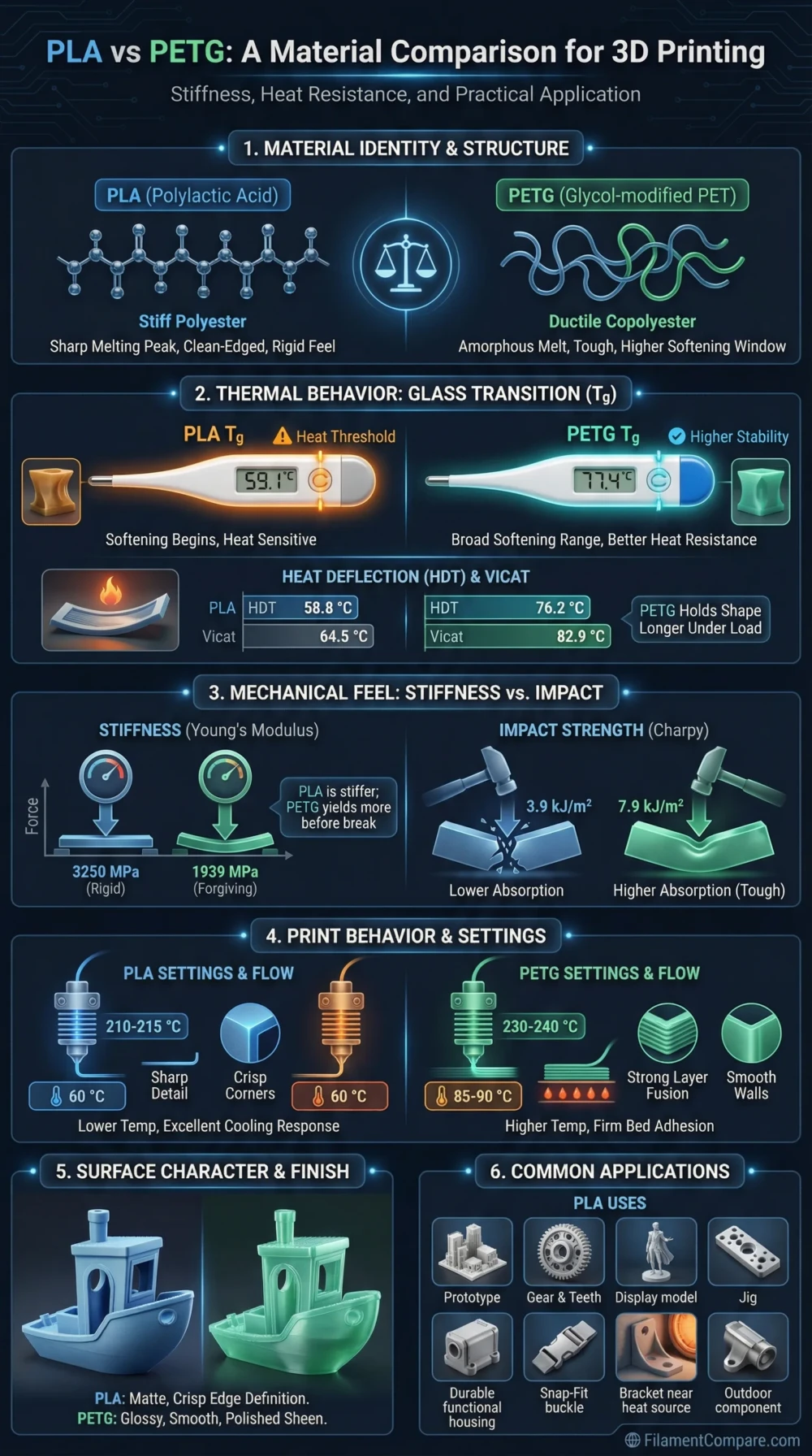
PLA is easier to print and holds fine detail well, while PETG gives better toughness, layer adhesion, and heat tolerance for functional parts. PLA fits visual models, prototypes, and beginner prints; PETG fits brackets, clips, outdoor accessories, and parts that need more ductility. The right choice depends less on raw “strength” and more on whether the part needs stiffness, impact resistance, temperature tolerance, or easy printing.
Choose PLA when you want the easiest setup, sharp surface detail, low warping, and reliable results on almost any FDM printer.
Choose PETG when the part needs better layer bonding, more impact tolerance, mild outdoor use, or moderate heat resistance.
PLA is the simpler printing material. PETG is the more practical functional material. Neither replaces the other; they solve different print problems.
Best for Beginners
PLA is easier to tune, works with more bed surfaces, and usually needs less drying before normal hobby printing.
Better for Functional Parts
PETG is usually better for brackets, holders, clips, and parts that may flex slightly before breaking.
Better Heat Tolerance
PETG keeps its shape better in warm conditions, although hot enclosed spaces can still exceed its comfort range.
Better Surface Detail
PLA is better for clean corners, crisp text, miniatures, decorative prints, and low-stringing surfaces.
Better Layer Adhesion
PETG tends to bond layers strongly, which helps parts loaded across layer lines when settings are dialed in.
Better Low-Warp Printing
PLA is more forgiving on open-frame printers and is less sensitive to chamber temperature control.
Better Outdoor Fit
PETG is more suitable than PLA for mild outdoor accessories, but long-term UV exposure still favors ASA or UV-stabilized grades.
Better for Fast Prototypes
PLA is usually the faster path to a clean test print when the part is not heat-loaded or impact-loaded.
| Category | PLA | PETG | Better Choice |
|---|---|---|---|
| Material Family | Polylactic acid, a bio-based thermoplastic polyester | Polyethylene terephthalate glycol-modified copolymer | Depends on use |
| Print Difficulty | Easy; low warp and broad printer compatibility | Moderate; more stringing and first-layer tuning | PLA |
| Typical Nozzle Temperature | About 200–220°C depending on brand and speed; Prusament PLA lists 210 ± 10°C[a] | Usually about 220–250°C; Prusament PETG V0 lists 230 ± 10°C[b] | Printer-dependent |
| Typical Bed Temperature | Often 40–60°C; some setups print PLA without a heated bed | Usually around 70–90°C for stronger bed adhesion | PLA |
| Enclosure Requirement | Not normally needed | Not normally needed, but drafts can still affect large parts | Similar |
| Heat Resistance | Lower; standard PLA softens earlier in warm environments | Higher; UltiMaker PETG lists HDT at 76.2 ± 0.8°C at 0.455 MPa[c] | PETG |
| Toughness | Stiff but more brittle under impact | More ductile and impact-tolerant in many printed parts | PETG |
| Stiffness | Usually higher stiffness and sharper shape retention at room temperature | Slightly more flexible under load | PLA |
| Layer Adhesion | Good when printed hot enough | Usually stronger layer bonding, especially for functional parts | PETG |
| Moisture Sensitivity | Lower than PETG in normal storage, but still benefits from dry storage | More likely to string, pop, or print hazy when damp | PLA |
| Surface Finish | Crisp details, matte or glossy depending on formulation | Glossier, slightly more rounded edges, more prone to fine strings | PLA |
| Outdoor Suitability | Less suitable for long exposure to sun and heat | More suitable for mild outdoor use, but not a full weatherproof replacement for ASA | PETG |
| Typical Uses | Display models, prototypes, miniatures, educational parts, fit checks | Brackets, clips, containers, printer parts, outdoor accessories, fixtures | Use-case based |
| Main Limitation | Lower heat tolerance and lower impact ductility | Stringing, oozing, and more first-layer tuning | Depends on priority |
This PLA and PETG comparison uses manufacturer material pages, technical datasheets, and common FDM printing behavior as a general trend; real results can change with brand, color, additives, moisture level, print orientation, and slicer settings.
PLA Material Profile
- Polymer type: Polylactic acid thermoplastic polyester
- Print difficulty: Easy
- Nozzle range: Commonly around 190–220°C, formulation-dependent
- Bed range: Often 40–60°C, sometimes lower on tuned surfaces
- Enclosure: Usually not needed
- Drying need: Helpful after poor storage, but less demanding than PETG
- Typical behavior: Stiff, clean detail, low warp, lower heat tolerance
- Best use cases: Prototypes, visual models, educational prints, miniatures, fit checks
PETG Material Profile
- Polymer type: Glycol-modified PET copolymer
- Print difficulty: Moderate
- Nozzle range: Commonly around 220–250°C, brand-dependent
- Bed range: Often 70–90°C
- Enclosure: Usually not required
- Drying need: More important for clean surfaces and reduced stringing
- Typical behavior: Tough, ductile, strong layer bonding, more oozing
- Best use cases: Functional brackets, clips, fixtures, mild outdoor parts, containers
Relative Printing Performance
These bars are relative use indicators for printed parts, not fixed lab ratings. Brand formula, additives, color, moisture, layer direction, nozzle temperature, cooling, and slicer settings can move the result.
Printability and Tuning
PLA is the easier material when the goal is a clean print with minimal tuning. It usually flows well at lower temperatures, sticks to common build plates, and tolerates open-frame printers. Cooling can stay high, which helps overhangs, bridges, small text, and fine corners.
PETG needs more attention. It prints hotter, often needs a hotter bed, and can leave fine strings if the spool is damp or the nozzle temperature is too high. PETG also likes to stick strongly to some smooth PEI surfaces, so a release layer may be useful on certain plates. Once tuned, it becomes reliable for larger functional prints, but the first few calibration prints matter more than they do with PLA.
Practical Tuning Difference
With PLA, the common tuning target is surface quality. With PETG, the target is balance: enough heat for layer bonding, enough cooling to control detail, and enough retraction control to reduce stringing.
Mechanical Behavior: Stiffness, Toughness, and Layer Strength
PLA often feels stronger in the hand because it is stiff. That stiffness helps parts keep their shape under light room-temperature loads. The tradeoff is brittleness: a PLA part can crack more suddenly under impact, snap-fit stress, or repeated bending.
PETG is usually less rigid but more ductile. It can bend slightly, absorb impact better, and hold layers together well. That makes PETG a better choice for clips, brackets, printer upgrades, cable guides, tool holders, and parts that may be dropped or flexed during use.
For strength comparisons, print orientation matters. A PLA part printed with layers aligned to the load may outperform a PETG part printed in a weaker orientation. In real prints, geometry and layer direction can matter as much as material choice.
Heat Resistance and Shape Retention
PLA is not the right default for warm environments. Standard PLA can soften near its glass transition range, so thin walls, loaded brackets, and clips may deform in sunlight, near electronics, or inside warm enclosed spaces. Annealed PLA or high-temperature PLA grades can improve this, but those are not the same as standard PLA.
PETG handles moderate warmth better than PLA. It is more suitable for parts near printers, electronics housings, garage accessories, and outdoor items that are not exposed to severe heat. Still, PETG should not be treated as a high-temperature engineering polymer. A hot car interior, heated appliance area, or load-bearing part in direct summer sun may call for ASA, ABS, PC, PA, or a high-temperature material instead.
Heat note: “More heat resistant than PLA” does not mean “safe for every hot environment.” Wall thickness, load, color, sun exposure, and airflow can change whether a PETG part holds its shape.
Surface Finish, Detail, and Appearance
PLA is usually better for sharp detail. It cools quickly, keeps corners clean, and handles small decorative features well. Matte PLA, silk PLA, wood-fill PLA, and tough PLA can change the finish, but the base printing behavior remains friendly compared with most PETG spools.
PETG often prints with a glossier surface. This can look good on practical parts, transparent colors, vases, containers, and outdoor accessories. The downside is that PETG can show wisps, blobs, and slightly rounded edges if retraction, temperature, travel speed, or drying is not tuned.
Moisture, Drying, and Storage
Both PLA and PETG should be stored dry, but PETG is usually more sensitive in day-to-day printing. Damp PETG can create popping sounds, rough surfaces, weak spots, stringing, and cloudy extrusion. Drying the spool before a detailed or functional print can make the difference between a clean part and a messy one.
PLA can also absorb moisture over time, especially in humid rooms or after long open storage. The symptoms are often rougher surface texture, brittle filament, and inconsistent extrusion. For occasional hobby printing, PLA is more forgiving; for repeatable results, both materials deserve sealed storage with desiccant.
Printer Requirements and Build Plate Behavior
Most modern FDM printers can handle both PLA and PETG. PLA is easier on entry-level machines because it does not demand high bed temperatures or chamber control. PETG asks more from the build surface and slicer profile, but it does not usually need a closed chamber like ABS or ASA.
Build plate behavior is different. PLA usually needs enough adhesion to prevent lifting. PETG can adhere too strongly on some smooth plates, which may damage the surface when the part is removed. Textured PEI, satin sheets, glue stick as a separator, or manufacturer-specific plate guidance can help.
| Use Case | More Suitable Material | Reason |
|---|---|---|
| Beginner prints | PLA | Lower tuning demand, low warp, and easier bed adhesion. |
| Visual models | PLA | Sharper detail, cleaner small features, and more finish options. |
| Functional brackets | PETG | Better toughness and layer bonding for practical loads. |
| Outdoor accessories | PETG | More suitable for mild outdoor use than standard PLA. |
| Car interior parts | Neither as default | PETG is better than PLA, but hot interiors can still deform many printed thermoplastics. |
| Clips and snap-fit parts | PETG | More ductile and less likely to crack suddenly under flex. |
| Miniatures | PLA | Better detail control, cleaner edges, and less stringing. |
| Containers and organizers | PETG | Tougher walls and better resistance to bumps during use. |
| Large flat prints | PLA | Usually lower warp and less bed-temperature demand. |
| Printer upgrade parts | PETG | Better temperature margin near motors, electronics, and moving assemblies. |
| Fine text and logos | PLA | Fast cooling helps small details stay defined. |
| Transparent-style prints | PETG | Glossy, translucent PETG grades can work well for light-diffusing parts. |
Where Each Material Fits Better
Choose PLA When
- You want the easiest material for a new printer.
- The part is decorative, educational, or used as a prototype.
- Sharp detail and clean corners matter more than impact resistance.
- The part will stay indoors at normal room temperature.
- You need low warping on an open-frame printer.
PLA Is Less Suitable When
- The part will sit in heat, direct sun, or a warm enclosure.
- The part needs repeated flexing or snap-fit movement.
- Impact resistance matters more than stiffness.
- The part will be used outdoors for long periods.
Choose PETG When
- You need a tougher part with better layer adhesion.
- The part may be bumped, dropped, clipped, or flexed lightly.
- You need better heat tolerance than standard PLA.
- The print is a bracket, holder, fixture, outdoor accessory, or printer part.
- A glossy or translucent finish fits the design.
PETG Is Less Suitable When
- You need the cleanest possible tiny details.
- You do not want to tune retraction, temperature, or cooling.
- The spool has absorbed moisture and cannot be dried before printing.
- The build plate is prone to PETG over-adhesion.
PLA vs PETG Settings Range
For PLA, start with a moderate nozzle temperature, strong part cooling, and a bed temperature near the middle of the filament maker’s recommended range. If layers look weak, raise the nozzle temperature slightly. If corners look soft or strings appear, lower temperature or increase cooling.
For PETG, start with the manufacturer profile when available. PETG often improves with dry filament, slightly lower fan than PLA, careful retraction, and travel moves that avoid crossing open areas. Too much cooling can reduce layer bonding; too little cooling can make overhangs and small details look soft.
Material Selection Matrix
Choose PLA if your print is mainly visual, decorative, educational, or a fast prototype that will stay indoors. PLA gives the cleaner and easier printing experience.
Choose PETG if your print must handle more stress, mild heat, bumps, clips, fixtures, or outdoor use. PETG is usually the safer functional choice once tuned.
Use neither as the default for high-heat mechanical parts, harsh outdoor exposure, structural safety parts, or food-contact parts without verified material grade, printer hygiene, surface treatment, and local compliance.
PLA vs PETG Questions
Is PETG stronger than PLA?
PETG is usually tougher and has better layer adhesion, but PLA is often stiffer. If “stronger” means impact resistance or ductility, PETG usually wins. If it means rigidity at room temperature, PLA can feel stronger.
Is PLA or PETG better for beginners?
PLA is better for beginners. It needs less heat, has lower warp, strings less, and is easier to tune on basic printers.
Can PETG replace PLA for every print?
No. PETG is better for many functional parts, but PLA still prints cleaner details, uses simpler settings, and often gives better small-feature quality.
Does PETG need an enclosure?
Usually no. PETG can print well on open-frame printers, but drafts, large parts, and cool rooms can still affect bed adhesion and consistency.
Is PLA or PETG better for outdoor prints?
PETG is usually more suitable than PLA for mild outdoor use. For long sun exposure, higher heat, or weather-loaded parts, ASA or UV-stabilized materials may be a better fit.
Which filament is better for printer parts?
PETG is commonly preferred for printer brackets, holders, guards, and replacement parts because it handles moderate warmth and mechanical stress better than standard PLA.
Resources Used
- [a] Technical datasheet – Prusament PLA by Prusa Polymers — Used for PLA recommended nozzle and bed temperature ranges in the main comparison table.
- [b] Technical datasheet – Prusament PETG V0 by Prusa Polymers — Used for PETG recommended nozzle and heatbed settings.
- [c] UltiMaker PETG — Used for PETG heat deflection data and general PETG material behavior.
- PLA – Prusa Knowledge Base — Used to cross-check PLA printability, low-warp behavior, and common PLA use cases.
- PETG – Prusa Knowledge Base — Used to cross-check PETG stringing behavior, bed requirements, and functional-part guidance.
- Filament Material Guide – Prusa Knowledge Base — Used for broader material comparison context such as print difficulty, impact resistance, and temperature behavior.
