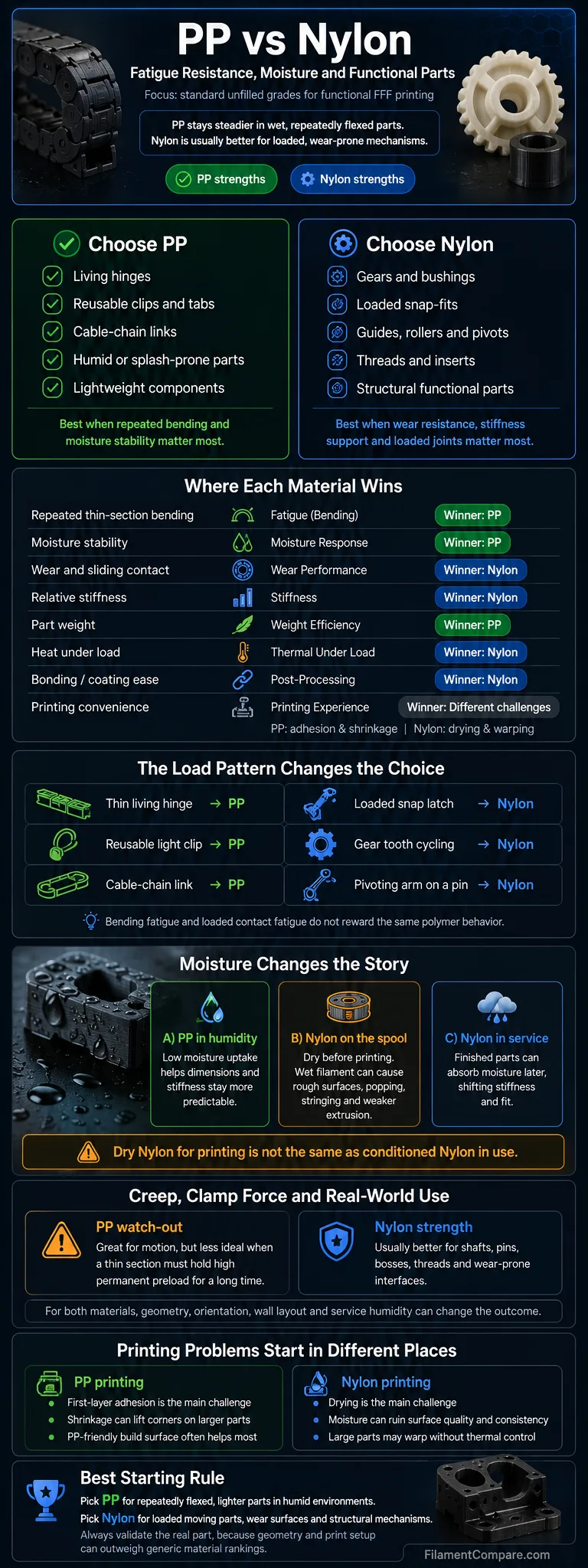
PP handles repeated bending and wet environments with less property drift, while Nylon is usually the stronger choice for loaded joints, gears, bushings, and wear-prone functional parts. The decision is not simply flexibility versus strength: fatigue type, moisture exposure, creep, print orientation, and assembly method can reverse the better choice. Standard unfilled grades are compared here; carbon-fiber and glass-fiber variants behave differently.
The Practical Choice
Choose PP for living hinges, frequently flexed clips, cable-chain links, low-mass parts, and components that must remain dimensionally steady around humidity or occasional water contact.
Choose Nylon for gears, bushings, mechanical arms, threaded fixtures, loaded snap-fits, and parts that need wear resistance with a better balance of stiffness and toughness.
There is no single overall winner. A part that bends thousands of times favors a different polymer behavior from a part that carries a shaft, holds a screw, or slides against another surface.
Living Hinges
PP is the clearer choice for thin, controlled hinge lines that open and close repeatedly.
Gears and Bushings
Nylon is generally better for sliding contact, tooth loading, and abrasion.
Humid Locations
PP absorbs little moisture and usually holds dimensions more consistently.
Loaded Snap-Fits
Nylon suits rigid latches and structural clips when the filament is printed dry.
Lightweight Parts
PP has very low density, which helps moving assemblies and handheld products.
Threaded Assemblies
Nylon usually provides better support for coarse printed threads and inserts.
Chemical Splash Areas
PP is often the safer starting point, subject to chemical, temperature, and exposure time.
Wear-Prone Mechanisms
Nylon is better suited to pivots, guides, rollers, and repeated sliding contact.
| Decision Area | PP Filament | Nylon Filament | Better Fit |
|---|---|---|---|
| Polymer family | Semi-crystalline polyolefin | Polyamide family; PA6, PA6/66, PA12, and copolyamides differ | Application-dependent |
| Repeated thin-section bending | Excellent general fit for living hinges and flexible tabs | Capable, but usually better in thicker loaded flexures than film-like hinge lines | PP |
| Wear and sliding contact | Low-friction behavior, but lower structural rigidity in many unfilled grades | Usually strong in gears, bushings, guides, and moving interfaces | Nylon |
| Moisture uptake | Low | High to moderate, depending on polyamide grade and additives | PP |
| Dimensional stability across humidity changes | Usually more stable | Can change as the printed part approaches moisture equilibrium | PP |
| Typical nozzle range | About 210–280°C across pure and modified PP formulations[c] | About 220–260°C for many unfilled grades; some products fall outside this range[f] | Grade-dependent |
| Typical bed range | About 50–80°C, with a PP-compatible surface or adhesive often needed | Often 70–100°C, though low-warp copolyamides may use different conditions | Printer and grade-dependent |
| Drying need before printing | Lower than Nylon, but drying may still improve consistency after poor storage | High; dry storage and printing from a dryer are commonly recommended | PP |
| Build plate behavior | Low surface adhesion and shrinkage can make the first layer demanding | Warping and edge lift are common risks on many grades | Different challenges |
| Relative stiffness | Usually lower in unfilled grades | Usually higher, especially in dry or reinforced grades | Nylon |
| Impact and toughness | Tough, flexible, and energy-absorbing | Tough with a useful stiffness-to-flexibility balance | Geometry-dependent |
| Heat under load | Grade-dependent; one printed UltiMaker PP example reports 64.1°C HDT at 0.455 MPa[b] | Often higher; one printed UltiMaker Nylon example reports 89.2°C under the same HDT load[d] | Usually Nylon |
| Part weight | Very low density in many unfilled grades | Usually heavier than standard PP | PP |
| Threads and inserts | Possible, but long-term clamp load and local deformation need attention | Usually better for coarse threads, bosses, and heat-set inserts | Nylon |
| Bonding and painting | More demanding because PP is a low-surface-energy plastic | Usually easier to prepare, bond, dye, or coat | Nylon |
| Typical functional parts | Living hinges, reusable clips, cable chains, fluid-area brackets, lightweight covers | Gears, bushings, rollers, mechanical arms, fixtures, structural snap-fits | Use-case based |
The PP and Nylon comparisons combine published manufacturer data sheets, material guidance, and peer-reviewed printing research; they describe common trends rather than guaranteed values because grade, color, additives, moisture, geometry, orientation, and machine settings change the result.
Material Profiles for Functional Printing
PP Functional Profile
- Print difficulty: Advanced, mainly because bed bonding and shrink control can be demanding.
- Nozzle and bed: Broadly formulation-dependent; verify the spool profile rather than copying generic settings.
- Enclosure: Helpful for large or flat parts and draft-sensitive printers.
- Moisture handling: Lower concern than Nylon, though clean dry storage still supports repeatability.
- Mechanical character: Flexible, low-density, low-friction, and resistant to repeated bending.
- Best uses: Living hinges, reusable latches, cable management, lightweight covers, and wet-area fixtures.
Nylon Functional Profile
- Print difficulty: Advanced, with moisture control, warping, and thermal stability as the main concerns.
- Nozzle and bed: Grade-specific; PA6, PA12, and copolyamides may need different temperatures.
- Enclosure: Often useful, although some low-warp commercial grades are designed for open printers.
- Moisture handling: Dry before printing and keep the spool protected during long jobs.
- Mechanical character: Tough, wear-resistant, low-friction, and more structurally supportive than standard PP.
- Best uses: Gears, bushings, moving joints, jigs, fixtures, rollers, and loaded snap-fit parts.
Relative Performance for Real Parts
PP
Nylon
These bars are relative FFF-use indicators, not fixed laboratory ratings. Brand formulation, polyamide grade, pigments, reinforcement, moisture level, wall layout, build direction, and slicer choices can move a part well above or below the displayed level.
Fatigue Depends on How the Part Moves
Fatigue resistance is often treated as a single property, yet a living hinge and a rotating gear do not fail in the same way. A hinge concentrates bending in a narrow flexible zone. A gear tooth sees repeated contact stress, root bending, friction, and heat. A clamp may experience both cyclic opening and a constant preload after installation.
PP Excels at Controlled Repeated Bending
PP is especially useful when the design deliberately allows elastic movement. Commercial PP guidance lists living hinges, connectors, and repeatedly bent clamps among its core applications[a]. This is why PP fits flip-top lids, cable-chain links, reusable clips, folding tabs, and protective parts that should deflect instead of crack.
The geometry still controls service life. A thin hinge line with smooth transitions spreads strain more predictably than a thick block forced to bend at a sharp corner. Place the hinge so deposited roads continue through the moving section rather than separating across a weak layer boundary. A PP print can survive repeated movement yet still creep if the tab remains permanently deflected.
Nylon Favors Loaded Cycles and Moving Interfaces
Nylon is better suited to parts where repeated motion is combined with tooth pressure, pin loading, surface wear, or a structural requirement. Typical examples include small gears, rollers, pivots, link arms, bushings, and latches that must return to a defined position. It can flex without behaving like a soft elastomer, which gives designers more support around bosses, holes, and bearing surfaces.
FFF fatigue life also changes with internal structure, nozzle size, wall layout, voids, and load direction. A peer-reviewed PA6 study found that printing parameters altered cyclic performance, reinforcing the need to test the actual part rather than ranking filaments from tensile strength alone[i].
| Repeated Load Pattern | Preferred Starting Material | Reason |
|---|---|---|
| Thin living hinge | PP | Designed flex can be concentrated in a thin hinge line without requiring high part stiffness. |
| Reusable flexible clip | PP | Works well when the clip opens frequently and carries light holding force. |
| Loaded snap latch | Nylon | Provides more structural support around the latch root and engagement face. |
| Gear tooth cycling | Nylon | Better fit for contact wear, root loading, and controlled stiffness. |
| Cable-chain link | PP | Low mass and repeated bending suit flexible articulated links. |
| Pivoting arm around a pin | Nylon | Better support for the bore and repeated bearing contact. |
| Impacting guard | Test both | PP may deflect more; Nylon may hold shape better. Wall geometry can decide the result. |
Moisture Changes Nylon Before and After Printing
Wet Filament Is a Processing Problem
Nylon can absorb water while sitting on the spool. During extrusion, that moisture can contribute to bubbling, rough surfaces, stringing, unstable flow, voids, and weaker printed material. Controlled research on nylon filament reports poorer surface quality and reduced mechanical performance as filament moisture rises[h]. A sealed bag is not proof that a spool is ready; dry it according to the exact product instructions and feed it from protected storage during long prints.
A Finished Nylon Part Continues to Condition
After printing, Nylon can absorb moisture from the service environment. That may reduce stiffness and alter dimensions while increasing ductility in some grades. The effect is not identical across PA6, PA12, copolyamides, or reinforced materials. Manufacturer guidance notes that higher moisture can lower strength, stiffness, and dimensional stability even when one thermal test value remains fairly stable[g].
This matters for press fits, bearing bores, gear backlash, threaded bosses, sensor alignment, and sliding clearances. Measure and test Nylon parts after they have spent time in the expected humidity, not only minutes after leaving the build plate. For tight assemblies, a dry shop test may overstate final stiffness or understate later dimensional movement.
PP Is More Predictable Around Humidity
PP has low moisture uptake, so humidity is less likely to change stiffness or fit in the same way. This makes it attractive for bathroom fixtures, irrigation accessories, washable clips, aquarium-adjacent brackets, and housings exposed to condensation. Low water absorption does not make an FFF part automatically watertight, pressure-rated, UV-stable, or suitable for every chemical. Layer paths, seams, temperature, additives, and exposure time remain part of the design.
Do not treat “dry Nylon” and “conditioned Nylon” as the same mechanical state. The spool should normally be dry for clean extrusion, while the finished part may later absorb moisture and settle into a different stiffness and dimensional state in service.
Creep, Wear, and Long-Term Shape Retention
Fatigue is damage from repeated loading. Creep is slow deformation under a load that may barely change. A clip can survive thousands of opening cycles yet lose holding force after remaining stretched for a month. A bracket can avoid cracking but sag slowly near a warm motor. Functional design needs both checks.
Where PP Can Lose Clamp Force
PP is a strong choice for motion but is less suitable when a thin arm must hold a high permanent preload with little deflection. Snap arms, spring tabs, and screw-clamped pads should spread load over a wide area. Add ribs where stiffness is needed, use generous root radii, and keep the flexible zone separate from the section that maintains clamp force. More infill alone does not correct a geometry that puts constant bending stress into a narrow neck.
Where Nylon Earns Its Place
Nylon generally supports shafts, pins, teeth, and fasteners better than unfilled PP. Its wear resistance and low-friction behavior suit sliding and rotating parts, but it is not free from creep. Warmth, moisture, sustained stress, and thin sections can still change fit over time. For a bearing seat or bolted fixture, test the assembly under real load and service humidity rather than relying on a short hand test.
For Static Load
Favor thicker load paths, ribs, washers, and metal sleeves. Nylon usually starts ahead, but both materials need creep testing.
For Sliding Contact
Nylon is normally the better first trial for bushings, guides, gears, and rollers. Check heat generation and lubrication compatibility.
For Repeated Flex
PP is normally the better first trial for living hinges and light spring tabs. Keep the flex zone thin and smooth.
Printing Problems Come from Different Places
PP: Build Surface and Shrink Control
PP can be dry and still fail at the first layer. Its surface chemistry makes standard adhesives less effective, and shrinkage can pull corners upward. A PP-specific build sheet, compatible adhesive, wide brim, clean surface, and stable enclosure are often more useful than simply raising bed temperature. Small calibration parts may print acceptably while a wide functional housing lifts or distorts.
Nylon: Drying and Thermal Stability
Nylon may stick to the plate yet print poorly because the spool absorbed moisture. It may also warp when a large part cools unevenly. A dry feed path, suitable adhesive surface, low draft exposure, conservative cooling, and a product-specific temperature profile are the normal starting points. PA12 and low-warp copolyamides are often easier than PA6, but the label “Nylon” alone does not predict printer requirements.
| Symptom | Likely PP Cause | Likely Nylon Cause | First Check |
|---|---|---|---|
| Corners lifting | Weak surface match, shrinkage, draft | Thermal contraction, draft, unsuitable plate preparation | Surface, enclosure, first-layer width |
| Popping from the nozzle | Possible moisture or contamination | Moist filament is a common cause | Drying history and protected feed |
| Rough or foamy surface | Temperature, flow, or contaminated material | Moisture and unstable extrusion | Dry spool, then retest temperature |
| Heavy stringing | Temperature and retraction tuning | Moisture first, then temperature and retraction | Confirm dryness before slicer changes |
| Weak layer bond | Low melt temperature, excess cooling, thin roads | Moisture, low melt temperature, draft, excess cooling | Dryness, flow, temperature, fan |
| Good small parts, distorted large parts | Shrink stress rises with footprint | Uneven cooling and accumulated warp stress | Enclosure and geometry segmentation |
Orientation, Geometry, and Assembly Can Decide the Result
Do Not Put the Main Load Across Weak Layer Interfaces
FFF parts are anisotropic. One UltiMaker Nylon data sheet reports tensile stress at break of about 40.4 MPa in a flat XY specimen and 23.0 MPa in the upright Z specimen for that exact material and test setup[e]. The values are not universal, but the directional gap shows why a latch, hinge, or bracket can fail even when the base polymer is well suited.
Orient a snap arm so continuous roads follow the arm length. Keep gear teeth supported by strong perimeters. Place pin bores so bearing pressure is distributed through walls rather than splitting layers. Increase wall count before using infill as the main load path, and remove sharp internal corners where fatigue cracks can begin.
Fasteners Favor Nylon, Mechanical Interlocks Favor PP
Nylon usually accepts coarse printed threads, screws, pins, and heat-set inserts more comfortably because the surrounding material is more structurally supportive. Use generous boss walls, pilot holes, washers, and controlled insertion heat. Repeated screw removal can still wear printed threads, so a metal insert or captive nut is preferable for serviceable assemblies.
PP can use threads and inserts, but local heat and clamp pressure need tighter control. Mechanical hooks, through-bolts, captured nuts, tabs, and molded-style interlocks are often more reliable than ordinary glue. Polypropylene is classed as a low-surface-energy plastic and is difficult to bond with many general adhesives without a suitable process or specialty product[j].
Best Material by Functional Part
| Functional Part | Preferred Material | Why It Fits | Design Caution |
|---|---|---|---|
| One-piece living hinge | PP | Repeated bending and low moisture uptake | Use a thin controlled hinge zone and smooth roots |
| Reusable cable clip | PP | Flexible recovery and light weight | Do not leave the clip permanently over-expanded |
| Power-transmission gear | Nylon | Wear resistance, tooth support, and low friction | Check backlash after moisture conditioning |
| Plain bushing or guide | Nylon | Better sliding-wear fit | Test clearance, temperature rise, and lubricant |
| Irrigation sensor bracket | PP | Humidity stability and low density | Confirm UV exposure, chemical contact, and fastening method |
| Robot joint link | Nylon | More controlled stiffness around pins and fasteners | Align layers with the main tensile load |
| Cable-chain link | PP | Repeated articulation with low moving mass | Keep hinge sections free from notch-like corners |
| Threaded inspection fixture | Nylon | Better support for threads and inserts | Use metal inserts for frequent maintenance |
| Chemical-container accessory | Usually PP | Broad chemical resistance in many mild applications | Verify the exact chemical, concentration, temperature, and exposure time |
| Spring-loaded latch | Test both | PP favors flex life; Nylon favors holding force | Separate the spring section from the locking face |
| Machine guard with repeated impacts | Test both | PP can deflect; Nylon can retain shape better | Use the real impact speed and mounting points in testing |
| Precision bearing housing | Nylon, with conditioning test | Better stiffness and fastener support | Account for moisture-driven size change |
Where Each Material Fits Better
Choose PP When
- The part contains a living hinge or a repeatedly opened flexible tab.
- Humidity stability matters more than maximum stiffness.
- Low part weight reduces inertia in a moving assembly.
- The part should bend or deflect before cracking.
- The application involves mild chemical splash or washable equipment (after compatibility checks).
- Mechanical interlocks can replace adhesive bonding.
PP Has More Limits When
- A thin part must hold a high permanent preload.
- Rigid bearing seats, accurate threads, or high clamp force are required.
- The printer lacks a PP-compatible build surface.
- Paint, conventional glue, or easy cosmetic finishing is part of the workflow.
- The part will see sustained warmth and load without room for deflection.
Choose Nylon When
- The part carries pins, gears, rollers, shafts, or repeated sliding contact.
- Structural snap-fits need more holding force than a PP-style flexible clip.
- Coarse threads, heat-set inserts, or bolted bosses are required.
- Toughness, wear resistance, and moderate stiffness must work together.
- The printing setup can keep the spool dry before and during extrusion.
- The finished part can be tested after exposure to service humidity.
Nylon Has More Limits When
- Tight fit must remain unchanged across large humidity swings.
- There is no reliable filament dryer or protected feed path.
- The design is a very thin living hinge intended for constant opening and closing.
- The part is assembled immediately after printing with no conditioning check.
- The grade identity is unclear and generic settings are being used.
A Useful Prototype Test Sequence
When the part combines bending, load, wear, and moisture, print both materials with the same functional geometry and compare them under the intended service conditions. Do not force identical slicer temperatures or cooling settings; each filament should first be printed with a sound product-specific profile.
1. Cycle the Motion
Open the hinge, flex the clip, or rotate the joint through a controlled angle. Record whitening, permanent set, looseness, and cycle count.
2. Hold the Static Load
Keep the part loaded for days rather than minutes. Measure sag, clamp-force loss, bore growth, and latch position.
3. Condition for Humidity
Measure Nylon before and after time in the target environment. Recheck press fits, gear clearance, and fastener torque.
4. Inspect the Wear Path
Look for tooth polishing, bore ovality, debris, heat, noise, and rising friction. Compare the complete assembly, not only isolated coupons.
Material Selection Matrix
Best Choice by Priority
Choose PP if the primary failure risk is cracking from repeated flexing, moisture-driven fit change, or excess moving mass. Design it as a flexible PP part rather than a thinner copy of a rigid Nylon component.
Choose Nylon if the primary failure risk is wear, tooth damage, bore deformation, thread failure, or insufficient structural support. Dry it for printing, then validate the finished part after it reaches the humidity expected in use.
Print and test both if the component must flex repeatedly while also holding a permanent load. In that mixed case, PP may last longer in the moving section while Nylon may preserve the locking geometry or bearing surface more effectively.
Common PP and Nylon Questions
Is PP more fatigue-resistant than Nylon?
For thin living hinges and repeated bending, PP is normally the better choice. For loaded cyclic parts such as gears, pivots, and mechanical links, Nylon can be more suitable because wear, stiffness, and contact stress matter alongside flex life.
Does a Nylon part need to stay dry after printing?
Not always. Nylon should normally be dry during extrusion, but a finished part may absorb moisture in service. That conditioning can change stiffness and dimensions, so test the part at the humidity where it will operate rather than assuming the just-printed state is final.
Which is better for gears, PP or Nylon?
Nylon is usually the better starting material for loaded gears because it combines wear resistance, low friction, and better tooth support. PP can suit lightly loaded, quiet, or chemically exposed mechanisms, but tooth deflection and creep require testing.
Which is easier to print?
Neither is a beginner-default filament. PP is often limited by build plate adhesion and shrinkage, while Nylon is limited by moisture uptake and warping. The easier option depends on whether the printer has a PP-compatible surface or a reliable dryer and enclosed build environment.
Can carbon-fiber Nylon replace standard Nylon in this comparison?
No. Carbon-fiber Nylon is usually stiffer and more dimensionally controlled, but it may be less flexible, is abrasive to ordinary nozzles, and does not represent the behavior of unfilled Nylon. Treat it as a separate material choice.
Technical References
- [a] S series PP – UltiMaker (Used for PP fatigue behavior, living-hinge applications, toughness, and low-friction positioning.)
- [b] Ultimaker PP Technical data sheet (Used for the product-specific PP HDT example and published printed-property context. The value is not a universal PP constant.)
- [c] PP | Polymaker Wiki (Used for broad PP nozzle and bed ranges, enclosure guidance, and build-adhesion context.)
- [d] Nylon 3D printing material – UltiMaker (Used for Nylon wear resistance, low friction, fatigue resistance, heat behavior, and industrial functional-part applications.)
- [e] Ultimaker Nylon Technical data sheet (Used for the build-orientation tensile example and the reminder that FFF properties vary by direction.)
- [f] PA | Polymaker Wiki (Used for typical Nylon printing ranges, drying guidance, enclosure needs, and differences among polyamide grades.)
- [g] Unique Product Questions 2025 | Polymaker Wiki (Used for the effect of absorbed moisture on Nylon strength, stiffness, creep behavior, and dimensional stability.)
- [h] Influence of Filament Moisture on 3D Printing Nylon (Peer-reviewed study used for the link between filament moisture, surface quality, thermal behavior, and mechanical performance.)
- [i] Optimization of Fatigue Performance of FDM ABS and Nylon Printed Parts (Peer-reviewed study used to support the effect of internal geometry and process parameters on Nylon fatigue life.)
- [j] Categorizing Surface Energy | 3M Science of Adhesion Educational Series (Used for PP’s low surface energy and the resulting difficulty of bonding it with ordinary adhesive systems.)
