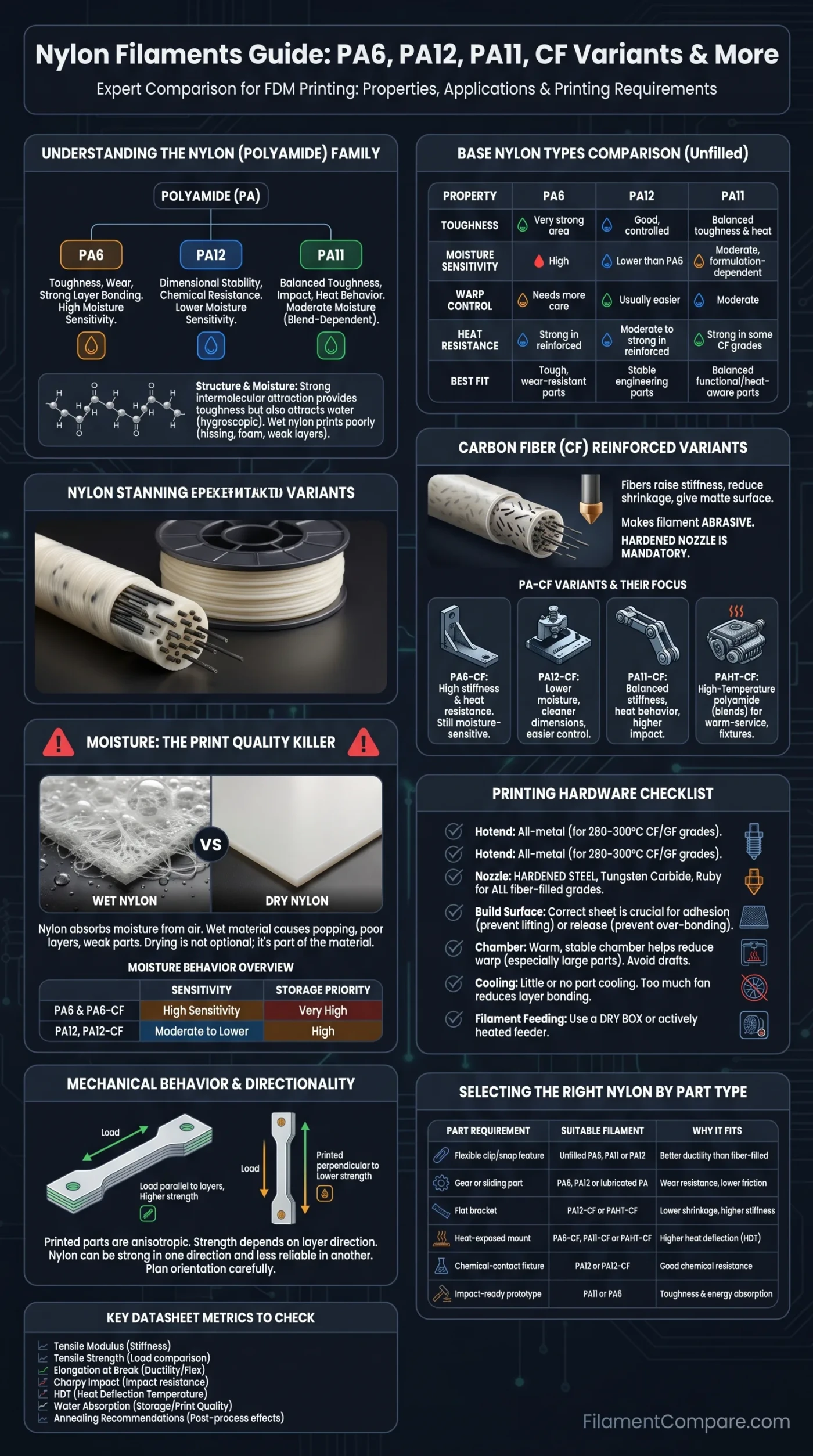
Nylon filament is not one single material. In FDM printing, nylon usually means a family of polyamides: PA6, PA12, PA11, PA-CF, PA-GF, PAHT-CF and several modified blends. They share the same broad character — toughness, wear resistance, fatigue resistance and chemical resistance — but their printing behavior can be very different. PA6 absorbs more moisture, PA12 tends to be more dimensionally stable, PA11 often brings a balanced mix of toughness and heat behavior, while carbon fiber variants trade some ductility for stiffness and lower warp.
| Nylon Type | Polyamide Base | Typical Nozzle Range | Typical Bed Range | Moisture Behavior | Main Strength Area | Common Use |
|---|---|---|---|---|---|---|
| PA6 | Polyamide 6 | 250–290°C | 70–100°C | Higher moisture uptake than PA12 | High toughness, strong layer bonding | Gears, hinges, clips, wear parts |
| PA12 | Polyamide 12 | 240–280°C | 70–100°C | Lower moisture sensitivity than PA6 | Dimensional stability, chemical resistance | Jigs, fixtures, housings, snap-fit parts |
| PA11 | Polyamide 11 | 270–295°C | 90–115°C | Moderate moisture uptake, varies by blend | Toughness, impact behavior, heat resistance | Functional prototypes, brackets, durable end-use parts |
| PA6-CF | PA6 with carbon fiber | 280–300°C | 25–50°C on some engineered grades | Still moisture-sensitive | High stiffness and heat deflection | Rigid tooling, brackets, fixtures, loaded parts |
| PA12-CF | PA12 with carbon fiber | 260–300°C | 25–60°C on some engineered grades | Lower moisture uptake than PA6-CF | Stable rigid parts with cleaner geometry | Manufacturing tools, mounts, low-warp parts |
| PA11-CF | PA11 with carbon fiber | Around 285°C | Around 110°C | Low short-term moisture uptake in some datasheets | Heat resistance and balanced strength | Heat-exposed brackets, stiff mechanical parts |
| PAHT-CF | High-temperature polyamide with carbon fiber | 270–300°C | 90–110°C | Usually formulated for lower moisture effect | Heat resistance, stiffness, controlled shrinkage | Engineering fixtures, ESD-safe variants, warm-service parts |
Datasheet values for nylon filaments are best read as trend data, not universal promises. A PA6-CF spool from one maker may show a different modulus, heat deflection temperature or drying response than another PA6-CF spool because fiber loading, base resin, annealing, print orientation and moisture state all change the final part.
What Nylon Means in FDM Printing
Nylon is the common printing name for polyamide. The “PA” code tells you the polymer family, while the number hints at the molecular structure. PA6, PA11 and PA12 are not just marketing labels. They behave differently during extrusion, cooling, storage and real use.
The main reason nylon feels different from PLA, PETG or ABS is its chain structure. Polyamides form strong intermolecular attraction, which helps with toughness, abrasion behavior and fatigue resistance. That same chemistry also attracts water. Dry nylon prints smoother, bonds better and keeps dimensions more predictably. Wet nylon can hiss, foam, string and lose surface quality.
Not all nylon is equally thirsty. PA6 absorbs moisture faster than PA12 in typical printing use, while PA12 is often selected when lower moisture sensitivity and cleaner dimensional control matter more than maximum toughness.
PA6 Nylon Filament
PA6, also called Nylon 6, is one of the classic engineering nylons. In 3D printing, it is valued for toughness, wear behavior and strong interlayer bonding. It can make parts that survive bending and repeated stress better than many rigid commodity filaments.
The tradeoff is moisture management. PA6 absorbs water readily, and print quality changes fast when the spool is not dry. The material may still extrude, but bubbles, rough walls and weaker part consistency often appear. For PA6, drying is not a small detail. It is part of the material.
PA6 Printing Character
- Layer bonding: often very good when the filament is dry and the chamber is warm.
- Impact behavior: well suited to flexible-tough mechanical parts.
- Warp tendency: higher than PA12, especially on wide flat parts.
- Moisture effect: strong; surface finish and strength can shift quickly.
- Bed adhesion: usually needs the correct surface and release layer to avoid either lifting or over-bonding.
PA6 fits moving parts, clips, living-hinge style geometry, sliding elements and mechanical items where toughness matters more than sharp cosmetic detail.
PA12 Nylon Filament
PA12, or Nylon 12, is usually the calmer nylon in desktop and professional FDM printing. It absorbs moisture more slowly than PA6 and often prints with less warp. That makes it attractive for fixtures, housings, clean mechanical prototypes and parts where dimensions must stay close to the CAD model.
PA12 does not replace PA6 in every role. It usually has a different balance: more stable, less moisture-sensitive, often less tough in extreme flex than PA6. For many printed parts, that balance is useful. Clean fit matters.
PA12 Printing Character
- Dimensional stability: usually better than PA6 on large or flat parts.
- Moisture behavior: lower uptake, but still benefits from dry storage.
- Chemical resistance: often a strong reason to choose PA12 for technical parts.
- Surface finish: tends to be cleaner than wetter or more warp-prone nylon grades.
- Use case: excellent for jigs, fixtures, covers, brackets and functional housings.
Polymaker’s PA12-CF technical data sheet lists an estimated equilibrium water absorption around 1.5% for its reinforced PA12-CF material, showing the lower moisture direction often associated with PA12-based nylon blends.[a]
PA11 Nylon Filament
PA11, or Nylon 11, sits between the more common PA6 and PA12 choices in many printer material lineups. It is used when toughness, impact behavior, heat resistance and a lighter moisture profile are wanted in the same material family.
One reason PA11 gets attention is its feedstock story. Industrial PA11 resins are known for castor-oil origin in some product families, including Arkema’s Rilsan PA11 resin line.[b] In filament selection, that origin is secondary to the datasheet. The part still needs the right nozzle, dry material and correct print surface.
Prusament PA11 Carbon Fiber lists polyamide 11 filled with carbon fibers, a 285 ± 5°C nozzle temperature and a 110 ± 10°C heated bed in its technical data sheet.[c] Those numbers place PA11-CF firmly in technical printer territory.
Carbon Fiber Nylon: PA-CF, PA6-CF, PA12-CF and PA11-CF
Carbon fiber filled nylon uses chopped carbon fibers inside the polyamide base. The fibers raise stiffness, reduce shrinkage and give parts a matte technical surface. They also make the filament abrasive. A hardened nozzle is not optional for long use.
The change is easy to feel in the hand: unfilled nylon can bend and spring back, while PA-CF feels more rigid and controlled. That is useful for brackets, tooling, motor mounts and structural fixtures. The printed part is still anisotropic, so layer direction remains important.
PA6-CF
PA6-CF is the stiffer, hotter-running version of PA6 in many filament catalogs. Polymaker’s PA6-CF data sheet lists 1.17 g/cm³ density, 218.5°C melting temperature and heat deflection temperature values of 173°C at 1.8 MPa and 215°C at 0.45 MPa after the stated conditioning and annealing process.[d]
That makes PA6-CF attractive for parts that need stiffness and heat resistance. It still needs dry handling. Carbon fiber does not remove PA6’s moisture sensitivity.
PA12-CF
PA12-CF is usually selected when the printer user wants carbon-fiber stiffness with lower moisture effect and cleaner dimensions. In Polymaker’s PA12-CF sheet, the material is described as carbon fiber reinforced PA12, with a 1.06 g/cm³ density and a 165°C melting temperature.[e]
Its heat deflection temperature is lower than the PA6-CF example above, but the material can be easier to control in prints where geometry accuracy matters. Less drama, cleaner parts.
PA11-CF
PA11-CF has a useful middle character. In Prusament’s published values, PA11-CF lists heat deflection temperature of 192°C at 0.45 MPa and 152°C at 1.80 MPa, with 24-hour moisture absorption reported as 0.20% under the stated test condition.[f]
For users comparing PA11-CF against PA12-CF, the difference is not only strength. The more useful question is whether the part needs heat resistance, lower warp, higher impact behavior, a specific print surface or a cleaner tolerance range.
PAHT-CF
PAHT-CF means high-temperature polyamide with carbon fiber. It is not always PA6, PA11 or PA12 in a simple form; many PAHT filaments are engineered blends. BASF Forward AM’s Ultrafuse PAHT CF15 is presented as a reinforced filament with chemical resistance and ESD-safe behavior in its extended technical documentation.[g]
PAHT-CF is usually chosen for warm-service tooling, fixtures and loaded parts where a standard nylon blend may not hold shape as well. Printer capability matters here: hotend temperature, bed temperature, chamber stability and nozzle material all need to match the filament.
Glass Fiber, Aramid and Other Nylon Variants
Carbon fiber gets most attention, but it is not the only reinforcement used with nylon filament. Glass fiber nylon and aramid-filled nylon serve different mechanical needs.
- PA-GF: glass fiber filled nylon. Often stiff, dimensionally stable and less electrically conductive than carbon fiber grades.
- PA-CF: carbon fiber filled nylon. Stiff, matte, low-shrink and abrasive to brass nozzles.
- PA-Aramid: aramid fiber filled nylon. Often selected for impact behavior, wear behavior and fiber-toughened parts.
- Lubricated PA: nylon blends with additives for sliding surfaces, bushings or wear-focused parts.
- ESD PA: nylon formulated for controlled surface resistance in electronics handling, fixtures or trays.
The reinforcement changes the part, not just the print settings. Fibers can reduce shrinkage, raise modulus and improve the feel of precision, but they also reduce some of the flexible nature that makes unfilled nylon useful.
Moisture: The Detail That Changes Nylon Prints
Nylon is hygroscopic. That means it takes in moisture from the air. The effect is visible during extrusion: wet nylon may pop at the nozzle, leave a rough surface, form strings and weaken the clean flow needed for consistent layer bonding.
This is why two users can print the same nylon and report different results. One spool may be fresh and dry; another may have sat open for a few days in a humid room. Same material name. Different print.
Moisture Behavior by Nylon Type
| Material | Moisture Sensitivity | Typical Print Effect When Wet | Storage Priority |
|---|---|---|---|
| PA6 | High | Popping, stringing, rough walls, variable strength | Very high |
| PA12 | Moderate to lower | Stringing and surface dullness after longer exposure | High |
| PA11 | Moderate, blend-dependent | Surface texture change and flow inconsistency | High |
| PA6-CF | High | Rough surface, weaker consistency, brittle feel in thin details | Very high |
| PA12-CF | Moderate to lower | Cleaner than PA6-CF, but still affected by moisture | High |
| PAHT-CF | Blend-dependent | Flow and surface quality changes | High |
Drying temperatures depend on the filament maker. Many nylon products use drying ranges around 70–90°C, but the safe value should come from the spool’s own documentation. Some spools, RFID cores or plastic reels do not tolerate high drying temperatures. The filament may be heat-ready while the spool is not.
Printing Requirements for Nylon Filaments
Nylon rewards a controlled printer setup. It does not always need an industrial machine, but it needs more attention than PLA. The main areas are hotend temperature, bed surface, chamber control, nozzle type and dry feeding.
Hotend and Nozzle
Unfilled PA12 may print at lower temperatures than PA6-CF or PA11-CF. Carbon fiber nylon often needs a hotend capable of 280–300°C. PTFE-lined hotends are not the right match for many nylon grades at these temperatures; all-metal hotends are the normal choice.
For CF and GF variants, use a hardened steel, tungsten carbide, ruby or similar wear-resistant nozzle. Polymaker’s PA6-CF and PA12-CF documentation notes frequent abrasion of brass nozzles and recommends wear-resistant nozzles for these materials.[h]
Build Surface
Nylon bed adhesion can move in two directions: not enough grip, or too much grip. Some surfaces need glue as an adhesive; others need glue as a release layer. This is why the correct sheet matters. PA can bond too strongly to certain surfaces and damage them during removal.
Chamber Temperature
A warm, stable chamber helps reduce warp on PA6, PA11 and many unfilled nylon grades. PA12 and PA-CF blends often behave better, but large parts still benefit from slower cooling. Drafts are not friendly to nylon.
Cooling Fan
Many nylon profiles use little or no part cooling. Too much cooling can reduce layer bonding and increase curl. Small overhangs may need limited airflow, but the material usually prefers heat retention over aggressive cooling.
Mechanical Behavior: Toughness, Stiffness and Layer Direction
Nylon is often chosen for functional parts because it handles real motion well. It can flex, absorb impact and resist wear. Carbon fiber nylon changes that behavior: it raises stiffness, improves dimensional control and reduces the rubbery feel, but the part becomes less flexible.
Printed nylon parts are direction-sensitive. A tensile bar printed flat will not behave the same as one loaded across layer lines. This matters more with nylon than many people expect because nylon can be very strong in one direction and less reliable in another if the print is wet, underheated or poorly oriented.
| Part Requirement | Better Nylon Direction | Reason |
|---|---|---|
| Flexible clip or snap feature | Unfilled PA6, PA11 or PA12 | More ductile behavior than fiber-filled grades |
| Rigid bracket | PA6-CF, PA12-CF, PA11-CF or PAHT-CF | Higher modulus and lower shrinkage |
| Wear surface | Unfilled PA or lubricated PA blend | Good abrasion and sliding behavior |
| Heat-exposed fixture | PA6-CF, PA11-CF or PAHT-CF | Better heat deflection in suitable grades |
| Dimension-sensitive tooling | PA12-CF or PAHT-CF | Lower warp and more controlled shrinkage |
ISO 527 is often used for tensile testing of plastics and plastic composites under defined conditions, which is why many filament data sheets list tensile strength and tensile modulus using ISO 527 methods.[i] The values are useful for comparison, but print settings and part geometry still decide the real part.
PA6 vs PA12 vs PA11
The easiest way to understand nylon families is to separate toughness, moisture behavior and dimensional control.
| Property Direction | PA6 | PA12 | PA11 |
|---|---|---|---|
| Toughness | Very strong area | Good, often more controlled | Good balance of toughness and heat behavior |
| Moisture Sensitivity | Higher | Lower than PA6 | Moderate, formulation-dependent |
| Warp Control | Needs more care | Usually easier | Moderate, depends on blend and filler |
| Heat Resistance | Strong in reinforced grades | Moderate to strong in reinforced grades | Strong in some CF grades |
| Best Fit | Tough, wear-resistant parts | Stable engineering parts | Balanced functional and heat-aware parts |
PA6 is the more demanding choice, but it brings excellent toughness. PA12 is often the cleaner and more predictable choice. PA11 is a strong technical option when the filament maker has tuned the blend for heat, impact behavior and print control.
Unfilled Nylon vs Carbon Fiber Nylon
Unfilled nylon and carbon fiber nylon should not be treated as small variations of the same spool. They serve different part designs.
- Use unfilled nylon when the part needs bend, snap, impact absorption or wear resistance.
- Use PA-CF when the part needs stiffness, flatness, low shrinkage and a more precise mechanical feel.
- Use PA12-CF when lower moisture sensitivity and cleaner print geometry matter.
- Use PA6-CF when stiffness and heat resistance are more important than easy handling.
- Use PA11-CF when heat behavior, impact resistance and controlled stiffness are all part of the target.
Carbon fiber also changes machining and finishing. The matte surface hides layer lines well, but it can be harder on tools. Thin carbon-filled sections may feel rigid, yet they are not always the best choice for springy clips. The fiber does its job. It stiffens.
Annealing Nylon Parts
Some nylon and PA-CF data sheets include annealing steps. Annealing can improve heat resistance and crystallinity, but it can also change dimensions. Polymaker’s PA6-CF sheet recommends annealing printed models at 80–100°C for 6 hours after printing, while its PA12-CF sheet lists 80°C for 6 hours.[j]
Annealing is most useful when the printed part must work near elevated temperatures. It is less attractive for parts where tight dimensions matter and no test print has been measured after heat treatment.
Support Materials and Multi-Material Printing
Nylon can be difficult with supports because layer bonding is strong and moisture changes separation behavior. Some nylon prints use breakaway supports made from the same material; others use dedicated support materials, depending on the printer and filament system.
For PA-CF, support removal should be planned early. Reinforced nylon is less forgiving when a support scar lands on a functional bearing surface or sealing face. Clean design beats heavy support cleanup.
Common Nylon Filament Selection Mistakes
The most common nylon mistake is choosing only by the word “nylon” on the label. PA6, PA12 and PA11 do not print the same. The second mistake is printing from an open spool and blaming the material for wet-spool behavior.
- Ignoring the base polymer: PA6 and PA12 have different moisture and warp patterns.
- Using brass nozzles with filled nylon: CF and GF grades wear brass quickly.
- Skipping dry storage: nylon can change print behavior after air exposure.
- Overcooling the print: too much fan can reduce layer bonding.
- Reading datasheets without test conditions: annealed, dry, conditioned and printed values may not match a fresh part from a different printer.
Best Nylon Filament by Part Type
| Part Type | Suitable Nylon Family | Why It Fits |
|---|---|---|
| Living hinge or flexible clip | Unfilled PA6, PA11 or PA12 | Better ductility than fiber-filled nylon |
| Gear or sliding part | PA6, PA12 or lubricated PA | Wear resistance and lower friction behavior |
| Flat bracket | PA12-CF or PAHT-CF | Lower shrinkage and higher stiffness |
| Heat-exposed mount | PA6-CF, PA11-CF or PAHT-CF | Higher heat deflection in suitable grades |
| Chemical-contact fixture | PA12 or PA12-CF | Good chemical resistance in many environments |
| Impact-ready prototype | PA11 or PA6 | Toughness and energy absorption |
For real parts, the best nylon is the one that matches the load path. A rigid CF bracket and a flexible snap clip are both “nylon parts,” but they need different material behavior.
Datasheet Numbers Worth Reading
Nylon datasheets can look dense, but only a few values decide most filament choices.
- Tensile modulus: higher values mean a stiffer part.
- Tensile strength: useful for load comparison, but print direction matters.
- Elongation at break: helps judge ductility and flex behavior.
- Charpy impact: useful for impact-prone parts.
- HDT: heat deflection temperature; important for warm fixtures and brackets.
- Water absorption: affects storage, print quality and part conditioning.
- Recommended annealing: changes final heat behavior and dimensions.
Fiberlogy’s Nylon PA12+CF15 sheet lists 15% carbon fiber in the material name and reports 120 MPa tensile strength at break, 7300 MPa tensile modulus and HDT values of 170°C at 0.45 MPa and 150°C at 1.8 MPa under its stated test methods.[k] Those numbers show why PA12-CF15 is used for rigid technical parts rather than soft flex features.
Practical Material Matching
For a desktop printer with a standard hotend, PA12 or a lower-temperature nylon blend is usually the most realistic entry point. For a printer with an all-metal hotend, enclosure and dry box, PA6, PA11 and CF variants become more practical.
For the cleanest first nylon experience, PA12 or PA12-CF is often easier to control than PA6. For maximum toughness, PA6 remains very attractive. For a balanced technical print with heat resistance and stiffness, PA11-CF and PAHT-CF are worth comparing by datasheet, not just by name.
Resources Used
- [a] Polymaker PolyMide PA12-CF Technical Data Sheet
- [b] Arkema Rilsan Polyamide 11 Resins
- [c] Prusament PA11 Carbon Fiber Technical Data Sheet
- [d] Polymaker PolyMide PA6-CF Technical Data Sheet
- [e] Polymaker PolyMide PA12-CF Technical Data Sheet
- [f] Prusament PA11 Carbon Fiber Technical Data Sheet
- [g] BASF Forward AM Ultrafuse PAHT CF15 Extended TDS
- [h] Polymaker PolyMide PA6-CF Technical Data Sheet
- [i] ISO 527-1 Plastics Tensile Properties Standard
- [j] Polymaker PolyMide PA12-CF Technical Data Sheet
- [k] Fiberlogy Nylon PA12+CF15 Technical Data Sheet
