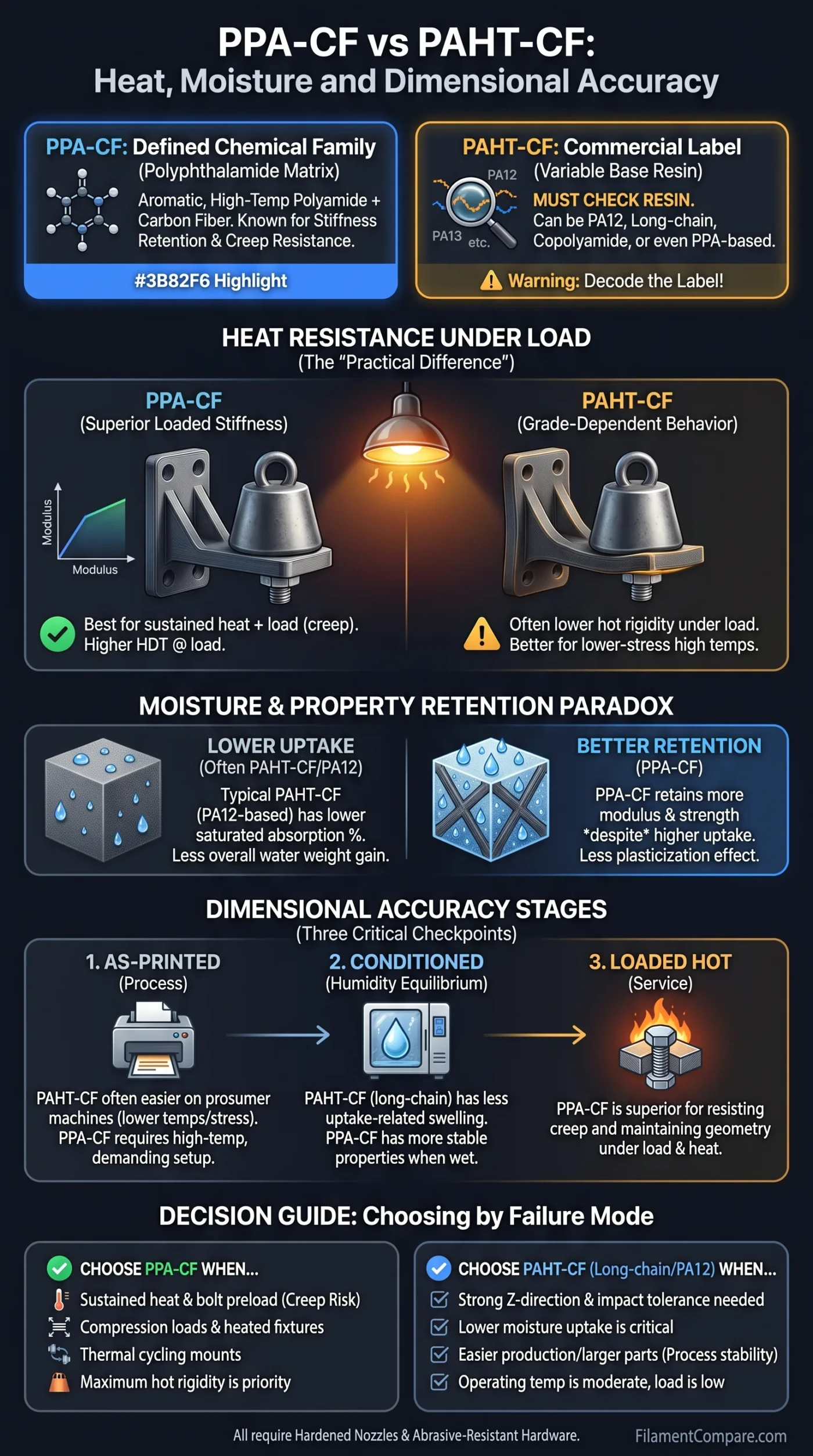
PPA-CF is usually chosen when a printed part must retain stiffness and geometry under sustained heat, while PAHT-CF often offers a more accessible balance of heat resistance, moisture control, layer bonding, and printability. The comparison becomes less straightforward because PPA-CF names a polymer family, whereas PAHT-CF is a commercial label that can describe several different high-temperature polyamide formulations. The correct choice therefore depends on the resin behind the PAHT-CF label and on whether accuracy is measured immediately after printing or after heat, humidity, and mechanical load.
The Practical Difference
Choose PPA-CF when the dominant failure risk is creep, loss of stiffness, or permanent dimensional movement under combined heat and load. Choose a long-chain or PA12-based PAHT-CF when lower printing temperatures, stronger Z-direction behavior, lower moisture uptake, or easier production matters more than maximum hot rigidity.
A PAHT-CF product described as PPA-based is not a separate material class from PPA-CF. In that case, the decision is between two PPA composite grades rather than between PPA-CF and a different high-temperature nylon.
| Decision Point | PPA-CF | PAHT-CF |
|---|---|---|
| Meaning of the name | Carbon-fiber composite with a polyphthalamide matrix | Commercial high-temperature polyamide category; the base resin must be checked |
| Common base-polymer position | Aromatic, high-temperature polyamide | May use PA12, another long-chain polyamide, a copolyamide, or PPA |
| Heat under mechanical load | Usually the stronger choice when stiffness and creep resistance must be retained | Grade-dependent; some products tolerate high temperatures but remain less rigid under load |
| Moisture absorption | Often lower than PA6-based composites, but not necessarily lower than PA12-based PAHT-CF | Can be very low when based on PA12 or another long-chain polyamide |
| Property retention after moisture exposure | High-quality grades may retain stiffness even when their measured water uptake is not the lowest | Usually better than standard PA6-CF, but the reduction in modulus remains formulation-dependent |
| As-printed dimensional accuracy | Can be excellent on a suitable high-temperature machine, but process control is less forgiving | Often easier to reproduce on enclosed prosumer printers |
| Accuracy after environmental exposure | Favored when hot-load deformation is the main tolerance risk | Favored when low moisture uptake and lower process stress are the main concerns |
| Typical published nozzle range | Common products may require approximately 280–320°C | Long-chain PA grades commonly print around 260–290°C |
| Bed and chamber demand | Usually requires more heat, stronger adhesion control, and tighter enclosure management | Still requires an enclosure, but many grades use a lower bed temperature |
| Carbon-fiber hardware | A hardened nozzle and abrasion-resistant filament path are required | A hardened nozzle is also required; a 0.6 mm nozzle is often recommended |
| Annealing | May improve thermal performance but can change final dimensions | Product-dependent; some grades are tested or sold with annealing recommendations |
| Main trade-off | Higher hot rigidity with greater printer and process demands | Easier production and moisture control with lower maximum loaded stiffness in many grades |
The PAHT-CF Label Must Be Decoded Before Comparing Properties
PPA-CF has a relatively clear chemical meaning. PPA, or polyphthalamide, is an aromatic polyamide family developed for higher thermal performance, stiffness retention, creep resistance, and lower moisture sensitivity than many conventional short-chain nylons. Carbon fiber further increases rigidity and limits shrinkage during deposition, although it also makes the printed part more direction-dependent.
PAHT-CF does not identify one equally specific resin. One manufacturer may use the name for a PA12 and long-chain polyamide composite, while another may sell a PPA-based filament under the same PAHT-CF label. Siraya Tech, for example, identifies its Fibreheart PAHT-CF formulation as PPA-based[a]. A comparison that treats this grade as chemically separate from PPA-CF would create a false distinction.
Bambu Lab uses PAHT-CF for a composite based on PA12 and other long-chain polyamides, which creates a more meaningful contrast with its separately sold PPA-CF grade[b]. This type of pairing represents the practical decision many users face: maximum PPA performance versus a lower-moisture, more forgiving high-temperature nylon.
Carbon-fiber percentage must also remain part of the comparison. A higher fiber loading can increase modulus, reduce thermal expansion, and improve as-printed flatness, but fiber length, dispersion, surface treatment, and matrix bonding can matter as much as the percentage printed on the spool. Two PPA-CF grades with different fiber systems may therefore be farther apart than a PPA-CF and a carefully formulated PAHT-CF.
Heat Resistance Changes When Load and Time Enter the Test
A high temperature printed on a product page does not automatically define a safe continuous service temperature. Melting point, glass transition temperature, Vicat softening temperature, and heat deflection temperature describe different material responses. They cannot be exchanged without considering the test load, specimen geometry, conditioning state, and deformation limit.
Heat deflection temperature is especially easy to misread. A result measured at 0.45 MPa will normally be higher than a result measured at 1.8 MPa. A thin printed bracket under bolt preload can also deform long before an unloaded duct made from the same filament. The relevant question is therefore not simply how hot the environment becomes, but how much stress remains on the part while it is hot.
In one same-manufacturer comparison, Bambu Lab lists a heat deflection temperature of 227°C at 0.45 MPa for its PPA-CF and 194°C at the same stated load for its PAHT-CF. The same published data also shows a much higher dry XY bending modulus for the PPA grade. These figures support the use of PPA-CF where hot rigidity is the priority, but they describe those two formulations rather than every filament carrying either label[c].
PPA-CF becomes more persuasive for motor-adjacent brackets, heated inspection fixtures, electrical components near a sustained heat source, and assemblies held under compression. These parts can fail through gradual creep even when they never approach the material’s melting point. The high modulus of a PPA composite helps resist that slow movement, especially when the load acts in the stronger XY plane.
PAHT-CF can still be the more efficient choice for electronics housings, warm-air ducts, drone components, tooling used intermittently, and fixtures that experience short heating cycles without heavy preload. Selecting PPA-CF solely because its maximum published temperature is higher can add drying, bed adhesion, and printer demands that the part does not need.
Lower Water Uptake Does Not Guarantee Better Wet Stiffness
Moisture affects nylon composites at two different stages. Moist filament can produce bubbles, rough surfaces, inconsistent extrusion, stringing, and weaker layer bonding during printing. After printing, absorbed water can plasticize the polyamide matrix, reducing stiffness and changing dimensions even when the original print was produced from a dry spool.
The second effect is often missed in material comparisons. A component can leave the printer within tolerance, pass an initial fit check, and then tighten around a shaft or lose alignment after weeks in a humid environment. Drying the spool prevents extrusion defects; it does not prevent the finished part from conditioning toward the humidity of its service environment.
Water-absorption percentage and property retention must be read separately. In Bambu Lab’s matched product data, PAHT-CF has the lower stated saturated water absorption, yet PPA-CF shows the smaller reduction in XY bending modulus and bending strength between the published dry and wet states. The PAHT grade absorbs less water, while the PPA matrix is less mechanically affected by the moisture it does absorb.
| Published Measure | Bambu PPA-CF | Bambu PAHT-CF | What It Changes |
|---|---|---|---|
| Saturated water absorption at the stated condition | 1.30% | 0.88% | PAHT-CF takes up less water in this comparison |
| XY bending modulus, dry | 9860 MPa | 4230 MPa | PPA-CF begins much stiffer |
| XY bending modulus, wet | 9620 MPa | 3640 MPa | PPA-CF retains more absolute rigidity |
| Published modulus decline | 2.4% | 13.9% | The PPA grade is less plasticized in this test |
| XY bending strength, dry | 208 MPa | 125 MPa | PPA-CF carries the higher flexural load |
| Published strength decline when wet | 2.9% | 8.0% | Both retain much of their strength, but PPA-CF changes less |
These values should not be transferred to another brand. The useful lesson is the relationship between the measurements. For a sealed electronics enclosure, low water uptake may be the main concern. For a bearing mount, clamping fixture, or calibrated gauge, retained modulus and dimensional change after conditioning may matter more than the absorption percentage by itself.
Moisture can also change toughness in a way that does not appear entirely negative. Plasticization may reduce stiffness while making some nylon matrices less brittle. A PAHT-CF grade designed around long-chain polyamide can therefore suit parts that need impact tolerance and strong layer bonding, even when it does not match PPA-CF in dry or hot modulus.
Dimensional Accuracy Must Be Checked at Three Different Stages
Calling a filament “dimensionally accurate” is incomplete unless the measurement stage is stated. Engineering parts can be accurate when removed from the build plate, move during annealing, and shift again after absorbing moisture or spending time under load.
Print-to-Drawing Accuracy
This is the immediate difference between the CAD dimension and the cooled, as-printed part. Shrinkage, corner lift, first-layer expansion, extrusion calibration, fiber orientation, and chamber temperature dominate the result.
Conditioned Accuracy
This is the geometry after the part reaches equilibrium with its working humidity. Hole diameter, total length, flatness, gear backlash, snap-fit force, and bearing-seat interference can all change.
Loaded Hot Accuracy
This is the remaining geometry after heat acts together with bolt preload, bending stress, clamping pressure, or component weight. Creep resistance and print orientation become more important than initial shrinkage.
PAHT-CF may produce the more accurate first part when the available printer has a limited bed temperature, a passive enclosure, or an extrusion system that cannot maintain the upper end of PPA processing temperatures. A material with lower nominal performance can deliver better usable tolerances when it is processed inside the machine’s stable operating range.
PPA-CF can become the more accurate material after the part enters service. Its value appears when a bolt pattern must remain aligned near a heat source, a fixture must preserve flatness through repeated cycles, or a loaded housing cannot tolerate gradual ovalization. This is environmental accuracy rather than printer accuracy.
Annealing adds another dimensional stage. It may improve crystallization, reduce residual stress, and raise heat performance, but it can also produce directional shrinkage, hole movement, warping, or a change in Z height. A tolerance-critical part should be measured after the exact annealing cycle intended for production, not only before heat treatment.
Bearing housings expose the difference clearly. A hole that prints 0.05 mm undersized can be corrected in CAD or machining. A hole that continues changing after humidity exposure or hot loading is harder to control. The second problem is where conditioned-material data becomes more useful than a manufacturer’s accuracy claim.
Printer Capability Can Reverse the Material Ranking
PPA-CF asks more from the complete extrusion system than its nozzle-temperature number suggests. The hotend must hold temperature during high flow, the heater block must transfer enough energy into the filament, the enclosure must limit thermal gradients, and the bed surface must resist both corner lift and excessive bonding.
Published PPA-CF products can require nozzle temperatures near or above 300°C, heated beds around 100°C or more, controlled dry feeding, and hardened extrusion hardware. Raise3D also specifies an abrasion-resistant nozzle and extrusion path for its 15 wt% carbon-fiber PPA composite[d]. A printer that can briefly reach the required nozzle temperature is not automatically capable of producing a large, repeatable PPA-CF part.
Many PAHT-CF grades remain demanding, but a PA12 or long-chain PA matrix may reduce the processing burden. Lower nozzle and bed requirements can mean less thermal stress in a large flat part, fewer failed corners, and more predictable hole placement. This production advantage can outweigh PPA-CF’s higher modulus when the finished component operates below the PAHT grade’s thermal limit.
PPA-CF Fits Better When
- The printer can sustain the specified hotend and bed temperatures.
- The filament can remain in a dry feed path throughout a long print.
- Hot-load creep is more damaging than a longer setup process.
- Post-annealing dimensions can be measured and compensated.
- The part needs high rigidity rather than maximum impact compliance.
PAHT-CF Fits Better When
- A long-chain PA or PA12 formulation provides enough service temperature.
- Strong Z behavior and impact tolerance matter more than peak XY modulus.
- The printer has an enclosure but limited chamber or bed heat.
- Lower moisture uptake is useful for parts with broad, unloaded dimensions.
- Production yield matters more than extracting the highest thermal result.
Both materials contain abrasive fibers. Hardened steel, tungsten carbide, or another manufacturer-approved wear-resistant nozzle should be used. A larger nozzle reduces clogging risk but also changes corner definition, minimum wall thickness, text clarity, and hole compensation. Accuracy comparisons are only fair when both materials are printed through suitable hardware rather than forcing one through a marginal setup.
Part Geometry Reveals Which Stability Problem Matters Most
Material selection becomes clearer when it begins with the expected failure mode rather than a general property ranking. The same PAHT-CF that is less suitable for a heavily preloaded hot bracket may be preferable for a lightweight arm that needs impact tolerance and reliable Z bonding.
| Part Scenario | Better Starting Point | Reason | Condition to Verify |
|---|---|---|---|
| Bolted bracket near a sustained heat source | PPA-CF | Higher hot modulus and creep resistance are more valuable under preload | Test the printed orientation and long-duration load |
| Large flat assembly fixture used near room temperature | PAHT-CF | Lower processing stress may produce better first-pass flatness | Confirm humidity-conditioned dimensions |
| Bearing or bushing housing in a humid machine | PPA-CF or tested PAHT-CF | Wet dimensional movement matters more than the dry hole measurement | Measure the bore after humidity conditioning |
| Lightweight drone or robotic arm | PAHT-CF | Layer bonding and impact tolerance may outweigh maximum hot stiffness | Check the exact base resin and Z-direction data |
| Heated inspection gauge | PPA-CF | Small dimensional movement can invalidate the gauge | Condition and cycle the finished part before calibration |
| Warm-air duct with little mechanical load | Either material | Loaded HDT may not control the design when stress is low | Check wall softening, fastening points, and local hot spots |
| Snap enclosure exposed to occasional impact | PAHT-CF | A less rigid long-chain PA matrix may tolerate deflection more readily | Test snap fatigue after moisture exposure |
| Gear or sliding mechanism | Grade-specific testing required | Wear, friction, lubrication, and fiber exposure are not predicted by modulus alone | Obtain wear and tribology data for the exact grade |
| Thermally cycled sensor mount | PPA-CF | Retention of geometry through repeated hot and cool cycles is the main target | Measure bolt spacing and flatness after cycling |
Long, thin, or asymmetric parts also reveal fiber orientation effects. Short carbon fibers align mainly with extrusion flow, improving stiffness along the bead more than across layers. A high XY modulus does not guarantee that a vertically printed tab, threaded boss, or thin Z-oriented hinge will carry the same load.
Large flat parts emphasize process stability. Small bearing seats emphasize moisture movement. Tall brackets emphasize Z adhesion. Bolted assemblies emphasize creep. The better material can change when the geometry changes even if the service temperature remains identical.
Choosing by Failure Mode
- Choose PPA-CF when the part must remain rigid under sustained heat, bolt preload, bending stress, or repeated thermal cycling.
- Choose PAHT-CF when a disclosed PA12 or long-chain PA formulation provides enough heat resistance and easier processing, impact behavior, or Z bonding carries more value.
- Either option can work when the part is lightly loaded, its operating temperature remains comfortably below the relevant conditioned limit, and tolerances are not controlled by humidity.
- Neither label is enough when the part depends on wear rate, chemical compatibility, fatigue life, electrical behavior, flame classification, or food-contact compliance. Those properties require grade-specific documentation.
- Reject the comparison until the resin is identified when a PAHT-CF supplier does not disclose whether the filament is based on PPA, PA12, PA6, or another polyamide system.
The most reliable choice is not the filament with the highest isolated number. It is the grade whose conditioned dimensions and mechanical behavior match the part’s actual heat, humidity, orientation, and load.
Technical Sources and Documentation
- [a] Siraya Tech Fibreheart PPA-CF Technical Data (Used to verify that a product sold under the PAHT-CF name can use a PPA matrix.)
- [b] Bambu Lab PAHT-CF (Used for the disclosed PA12 and long-chain polyamide composition, printing conditions, moisture data, and Z-direction information.)
- [c] Bambu Lab PPA-CF (Used for the matched PPA-CF and PAHT-CF heat, moisture, stiffness, strength, and printing-condition comparison.)
- [d] Raise3D Industrial PPA CF Filament (Used for the PPA matrix description, carbon-fiber content, and wear-resistant extrusion hardware requirement.)
