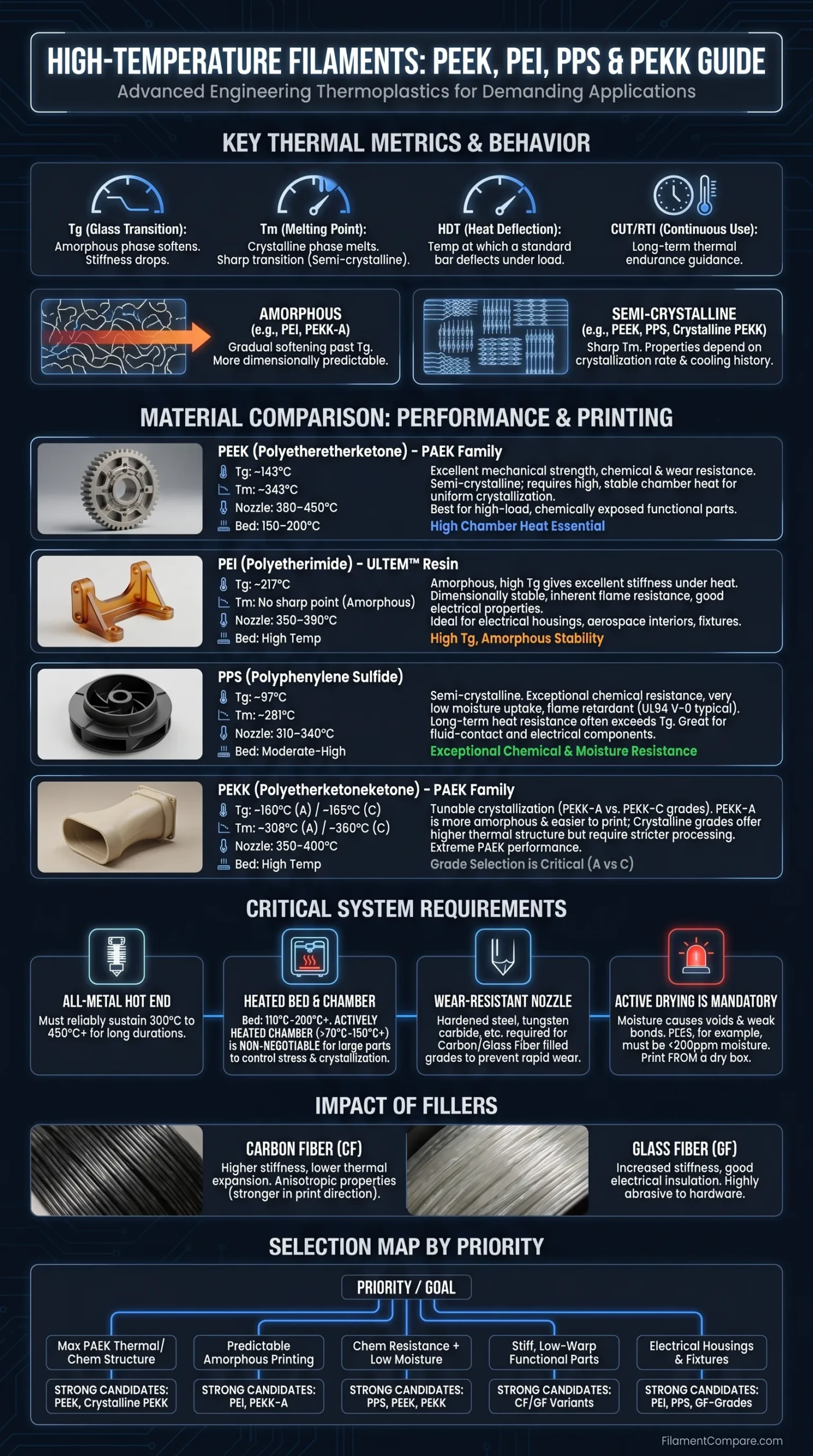
High-temperature filaments sit above ordinary engineering plastics because they keep useful strength, shape stability, and chemical resistance at temperatures where many common materials start to soften. PEEK, PEI, PPS, and PEKK are the main names in this group, but they do not behave the same in a printer. Some are semi-crystalline, some are amorphous, and some need a heated chamber that feels closer to industrial polymer processing than desktop 3D printing.
| Material | Polymer Family | Typical Tg / Tm | Typical Printing Window | Thermal Character | Where It Fits Best |
|---|---|---|---|---|---|
| PEEK | PAEK / Polyetheretherketone | Tg about 143°C; Tm about 343°C for common PEEK grades [a] | Nozzle often 380–450°C; bed around 150–200°C on capable systems [b] | Semi-crystalline; part properties depend strongly on cooling and crystallinity | High-load parts, chemically exposed parts, wear components, demanding functional prototypes |
| PEI | Polyetherimide; commonly known by ULTEM resin names | Tg about 217°C; no true melting point because it is amorphous [c] | Nozzle often around 350–390°C; heated bed and chamber strongly preferred | Amorphous; more dimensionally predictable than many semi-crystalline options | Heat-resistant brackets, electrical housings, low-smoke applications, accurate fixtures |
| PPS | Polyphenylene sulfide | Tg about 97°C; Tm about 281°C [d] | Nozzle commonly around 310–340°C; bed and chamber depend on grade | Semi-crystalline; low moisture uptake and strong chemical resistance | Electrical parts, pump and fluid-contact components, chemical-resistant tooling |
| PEKK | PAEK / Polyetherketoneketone | Amorphous PEKK grades around 158–162°C Tg; crystalline grades can melt above 350°C [e] | Many PEKK-A filaments print around 350–400°C with hot bed and chamber support [f] | Crystallization rate is more tunable than PEEK; grade choice matters a lot | High-temperature parts where PAEK performance is wanted with a wider processing path |
These numbers should be read as material-family ranges, not universal print settings. Real values move with filament brand, filler content, nozzle size, part geometry, chamber temperature, and post-processing.
Technical note: For high-temperature filaments, the printer is part of the material system. A filament can have excellent datasheet values and still produce weak parts if the chamber is too cool, the filament is wet, or the polymer crystallizes unevenly during cooling.
What Makes a Filament “High Temperature”?
A high-temperature filament is not defined only by nozzle temperature. The more useful question is this: can the printed part keep its shape, stiffness, and surface integrity while exposed to heat for the intended job? Glass transition temperature, melting point, heat deflection temperature, long-term service temperature, crystallinity, and filler type all matter.
For amorphous polymers such as PEI, the glass transition temperature is a major marker. Once the polymer approaches this region, stiffness begins to fall. For semi-crystalline polymers such as PEEK, PPS, and many PEKK grades, the material has both amorphous and crystalline phases. That gives another layer of heat resistance, but it also makes printing more sensitive to cooling rate and chamber control.
- Tg
- Glass transition temperature. Around this zone, the amorphous portion of a polymer becomes more mobile.
- Tm
- Melting temperature. Semi-crystalline polymers show a melting point; amorphous polymers do not have a sharp Tm.
- HDT
- Heat deflection temperature. A load-based test value that helps estimate part stiffness under heat.
- CUT
- Continuous use temperature. A long-term thermal rating used cautiously because it depends on stress, time, atmosphere, and test method.
PEEK Filament
PEEK is one of the best-known ultra-high-performance thermoplastics for FFF printing. It belongs to the PAEK family and is valued for heat resistance, chemical resistance, wear behavior, and mechanical strength. The common unfilled PEEK reference point is about 143°C Tg and about 343°C melting temperature for widely used grades [a].
The main printing challenge is not simply melting the filament. PEEK prints best when the part stays hot enough to reduce thermal gradients. If layers cool too fast, the part may show mixed crystallinity, visible color variation, internal stress, or lower bonding than the polymer can normally support.
PEEK Printing Behavior
- Nozzle temperature: often in the upper 300°C to mid-400°C range, depending on grade and flow path.
- Build plate: high-temperature systems commonly target around 150–200°C capability for PEEK-class printing [b].
- Chamber: a hot, stable chamber improves layer bonding and reduces stress.
- Drying: dry filament reduces voids, bubbles, and rough surface texture.
- Nozzle material: fiber-filled PEEK grades need wear-resistant nozzles.
PEEK is semi-crystalline. That single detail affects nearly everything. A printed part can be more amorphous, more crystalline, or unevenly crystallized depending on temperature history. Solvay’s PEEK AM processing guidance notes that annealing at 200°C for 2–4 hours can help develop a more uniform crystallized appearance in KetaSpire PEEK AM parts [b].
PEEK, Carbon Fiber PEEK, and Glass Fiber PEEK
Fiber-filled PEEK is common in functional printing. Carbon fiber PEEK raises stiffness, reduces thermal expansion, and helps parts hold shape during printing. It can also make the part more anisotropic, because chopped fibers align with extrusion paths. Short version: orientation matters.
Glass fiber PEEK is often chosen when stiffness, dimensional control, and electrical insulation are important. It is usually less electrically conductive than carbon-filled grades. For both CF and GF variants, the printed part should be treated as a direction-sensitive material, not as a perfectly uniform molded block.
PEI Filament
PEI is an amorphous high-temperature polymer. Many users know it through ULTEM-based filaments, especially ULTEM 9085-style and ULTEM 1010-style materials. SABIC describes the ULTEM resin family as amorphous polyetherimide materials with a 217°C glass transition temperature and RTI values up to 180°C in available grades [c].
PEI does not crystallize like PEEK or PPS. That gives it a different kind of print behavior. It can be easier to predict dimensionally because there is no crystallization step, yet it still needs very high extrusion temperature, a strong bed surface, and a heated chamber for larger parts.
PEI Strengths in Printed Parts
- Dimensional stability: PEI is useful when a part needs accurate geometry under warm conditions.
- Heat resistance: the high Tg helps PEI keep stiffness in elevated-temperature environments.
- Electrical use: PEI is common in housings, connectors, fixtures, and insulation-related parts.
- Surface finish: amorphous behavior can produce a more even visual appearance than some semi-crystalline prints.
PEI is a strong candidate when the printer cannot hold the very hot chamber conditions often preferred by PEEK, or when the part needs heat resistance without crystallinity control. It still belongs in the industrial filament category. A basic enclosed desktop printer is not the normal match.
PPS Filament
PPS is a semi-crystalline engineering polymer known for chemical resistance, low moisture absorption, dimensional stability, and flame resistance. Ensinger lists PPS with 230°C long-term heat resistance, 260°C short-term heat resistance, 97°C glass transition point, 281°C melting point, and UL94 V-0 flame resistance [d].
The low Tg may look surprising next to PEI, PEEK, and PEKK. It does not mean PPS is a low-temperature material. PPS gains much of its heat capability from its semi-crystalline structure, and that is why its long-term heat resistance can sit far above its Tg in suitable applications.
Where PPS Makes Sense
- Chemical-facing parts: PPS is often considered for contact with fuels, oils, solvents, and industrial fluids.
- Electrical parts: its stability and flame rating support many technical electrical applications.
- Low moisture environments: PPS has low water absorption compared with many engineering plastics.
- Filled grades: glass fiber PPS improves stiffness and dimensional control.
PPS printing depends heavily on grade design. Some PPS filaments are modified for easier FFF use, while glass-filled versions need abrasion-resistant hardware. The part design should allow for shrinkage control because PPS is semi-crystalline and can move as it cools.
PEKK Filament
PEKK is another PAEK-family polymer. It is close to PEEK in many end-use goals, but its chemistry allows more control over crystallization behavior. Arkema describes Kepstan PEKK as a material family for extreme-performance applications, with continuous use temperature around 250–260°C for the polymer range [e].
PEKK filaments often appear as PEKK-A and PEKK-C style grades. PEKK-A is more amorphous in behavior and can be friendlier to print. More crystalline PEKK grades can offer higher thermal structure after proper processing, but they ask more from the printer and post-process route.
PEKK-A and PEKK-C Are Not the Same
PEKK-A usually refers to an amorphous-focused grade. One Kimya PEKK-A datasheet lists 159°C Tg, 308°C Tm, 150°C maximum use temperature, 154°C HDT at 0.45 MPa, and test printing with a 155°C bed and chamber [f]. Those values show why grade identity matters. The polymer name alone is not enough.
Arkema’s 8000-series PEKK data shows crystalline PEKK grades with 355–360°C melting points and 165°C glass transition values [g]. That is a different processing and performance profile from amorphous PEKK-A filament. Same family. Different behavior.
Heat Resistance Is More Than One Number
Datasheets often list Tg, Tm, HDT, RTI, or continuous use temperature. These values are useful, but they answer different questions. A printed bracket under load near a motor housing does not behave like a small lab specimen tested under a single standard method.
| Term | What It Tells You | What It Does Not Tell You Alone |
|---|---|---|
| Tg | When the amorphous phase starts to lose glassy stiffness. | It does not equal maximum safe part temperature for every geometry. |
| Tm | Where a semi-crystalline polymer melts. | It does not show whether a printed part has strong layer bonding. |
| HDT | How a test bar deflects under a set load and heating rate. | It does not represent all stress levels, print orientations, or part thicknesses. |
| RTI / CUT | Longer-term thermal endurance guidance. | It still needs application testing for load, time, air exposure, chemicals, and safety margin. |
| Chamber temperature | How well the printer controls stress, crystallinity, and layer fusion. | It does not replace correct drying, toolpath design, or material qualification. |
Printer Requirements for PEEK, PEI, PPS, and PEKK
Most failures with high-temperature filament come from using the right polymer on the wrong machine. The nozzle may reach 400°C, yet the part can still curl, split, or bond poorly if the chamber and bed cannot support the polymer’s cooling needs.
Extruder and Hot End
The hot end should be all-metal, temperature-stable, and designed for long residence time at high temperature. PEEK and PEKK often demand the most heat. PEI is also hot-end intensive. PPS can sit lower, depending on grade, but still belongs beyond standard PETG/ABS hardware.
Heated Bed and Chamber
A heated bed helps adhesion. A heated chamber helps the whole part. Solvay’s AM filament guide notes that equipment for PEEK AM, PEEK AM CF, and PPSU AM should support die tooling up to 450°C and bed temperatures of 150–200°C [b]. That level of equipment support explains why these materials are normally printed on industrial or high-temperature professional machines.
Nozzles for Filled Grades
Carbon fiber and glass fiber variants abrade soft nozzles. Hardened steel, nickel-coated copper, tungsten carbide, or other wear-resistant nozzle materials are common choices. The exact nozzle should match temperature range, fiber loading, and flow target.
Drying and Moisture Control
High-temperature filaments should be printed dry. Moisture can create bubbles, voids, surface streaks, and weaker bonding. Solvay’s processing guide states that PEEK AM products should be maintained below 200 ppm moisture to prevent voids in the extrudate [b].
Dry storage matters during long prints too. A spool can be dry at the start and still pick up enough moisture to affect a long job if it sits exposed. For these polymers, a heated dry box or controlled feed reservoir is not a luxury detail. It is part of process control.
Annealing, Crystallinity, and Printed Part Structure
Annealing is often discussed with PEEK and PEKK because the printed structure can change after the part leaves the printer. Semi-crystalline parts may gain stiffness and heat stability as crystallinity develops, while ductility can decrease. That trade-off is normal polymer behavior, not a flaw.
PEI does not crystallize during annealing because it is amorphous. Stress relief can still matter, but the goal is different. PPS and crystalline PEKK grades also respond to thermal history, although exact annealing routes should follow the filament maker’s datasheet rather than a generic recipe.
Part qualification note: When a printed part will face heat plus load, compare test coupons printed in the same orientation, infill strategy, nozzle size, and chamber setting as the final part. Material datasheets give a baseline; process data gives the part-level answer.
Carbon Fiber Variants and Other Filled Grades
Carbon fiber versions of PEEK, PEKK, PEI, and PPS are popular because they improve stiffness, reduce shrinkage, and help control warping. They also change how the printed part fails. A carbon fiber grade may be stiffer but less forgiving under bending than an unfilled grade.
| Variant | Typical Benefit | Process Detail | Design Detail |
|---|---|---|---|
| Carbon Fiber | Higher stiffness, lower thermal expansion, better shape control | Needs abrasion-resistant nozzle and careful extrusion tuning | Fiber direction can create anisotropic strength |
| Glass Fiber | Higher stiffness with strong electrical insulation behavior | Also abrasive; may need slower speeds and higher flow force | Good for stable housings, brackets, and fixtures |
| Mineral Filled | Dimensional stability and lower shrinkage in some grades | May change surface finish and flow response | Useful where stiffness and flatness matter more than ductility |
| Unfilled | Cleaner flow, higher elongation in many grades, easier post-machining | Often less abrasive and easier on hardware | Useful for chemical exposure, prototypes, and parts needing some toughness |
PEEK vs PEI vs PPS vs PEKK by Use Case
The best choice depends on the job. Not the name. A small electrical bracket, a chemical-contact fitting, and a hot-air duct can all point to different polymers even when all four filaments look suitable on paper.
For Maximum Heat and Chemical Exposure
PEEK and PEKK are the main choices when PAEK-level performance is needed. PEEK has a long record in demanding polymer applications. PEKK gives more grade-level control over crystallinity, which can make some PEKK-A filaments more approachable for FFF printing.
For Dimensional Stability and Amorphous Behavior
PEI is often attractive when the part needs high Tg, dimensional control, and a less crystallinity-sensitive process. It is not a low-temperature material to print, but it avoids the crystallization management needed with PEEK and many PEKK grades.
For Chemical Resistance With Lower Moisture Uptake
PPS fits many chemically exposed and electrical applications. Its Tg is lower than PEI, PEEK, and PEKK, yet its semi-crystalline structure, low water absorption, and long-term heat resistance make it useful in warm technical environments.
Mechanical Performance and Print Orientation
High-temperature polymers can show impressive mechanical data, but FFF printing adds layer lines, raster direction, interlayer welds, and cooling history. The same material can behave very differently in XY and Z orientations. This is even more visible with carbon fiber grades.
For load-bearing printed parts, the material name should be paired with the print process: chamber temperature, extrusion temperature, bead width, layer height, raster angle, infill density, annealing state, and test orientation. Without that context, a tensile value is only a rough signal.
Chemical Resistance and Environmental Exposure
PEEK, PPS, and PEKK are often chosen for chemical resistance. PEI also has broad chemical resistance, especially compared with many amorphous thermoplastics, and SABIC notes resistance to automotive and aircraft fluids, aliphatic hydrocarbons, alcohols, acids, and weak aqueous solutions in ULTEM resins [c].
Real chemical exposure still needs grade-level checking. Concentration, temperature, stress, exposure time, and cleaning cycles can change the answer. A printed part also has layer boundaries and surface texture, so testing the actual print is safer than relying only on resin-family reputation.
Flame Resistance, Smoke, and Electrical Properties
Many high-temperature polymers are selected for flame resistance and electrical stability. PPS is commonly listed with UL94 V-0 behavior in suitable grades [d]. PEI and PAEK-family materials are also used in technical areas where flame behavior, low smoke, dielectric strength, and dimensional control matter.
Do not treat a polymer family name as a certification. A printed part’s compliance depends on grade, thickness, colorant, filler, print settings, and the exact test requirement. The safe wording is simple: the material may support flame-rated applications when the selected grade and printed part are tested to the needed standard.
How to Read High-Temperature Filament Datasheets
A good datasheet should show more than nozzle temperature. For these materials, the most useful documents list polymer identity, test standards, drying conditions, thermal values, mechanical properties, specimen orientation, and recommended chamber or bed temperature.
- Check the grade name: PEKK-A and crystalline PEKK are not interchangeable.
- Check test orientation: XY data can look different from ZX or Z data.
- Check the test standard: ISO 527, ISO 178, ISO 75, ASTM D648, and DSC methods are not decorative notes.
- Check print parameters: nozzle, bed, chamber, speed, infill, and annealing state affect results.
- Check moisture guidance: high-temperature printing is much easier with dry filament.
Material Selection Notes
Choose PEEK When
PAEK-level heat resistance, chemical resistance, and wear behavior are needed, and the printer can hold the high thermal environment needed for stable crystallization and bonding.
Choose PEI When
A high-Tg amorphous polymer is preferred for dimensional control, warm-service stiffness, electrical housings, fixtures, or low-smoke technical applications.
Choose PPS When
Chemical resistance, low moisture uptake, dimensional stability, and electrical use are central, especially when a PPS grade’s heat profile matches the load and environment.
Choose PEKK When
PAEK-family performance is wanted with grade-level control over crystallization. PEKK-A can be useful when an easier printing path is desired compared with more crystalline PAEK options.
Processing Windows by Material Family
The values below are practical ranges seen across high-temperature filament products and public datasheets. Always follow the filament maker’s current data for the exact spool because additives, molecular weight, fiber loading, and intended printer platform can shift the window.
| Material | Nozzle Range | Bed Range | Chamber Need | Drying Need |
|---|---|---|---|---|
| PEEK | Usually about 380–450°C | Often 150–200°C capable systems | High; stable hot chamber preferred | High; moisture control affects voids and finish |
| PEI | Often about 350–390°C | High bed temperature preferred | High for larger or accurate parts | Moderate to high; dry storage improves consistency |
| PPS | Often about 310–340°C, grade dependent | Moderate to high, grade dependent | Helpful for shrinkage and layer bonding | Moderate; low moisture uptake helps but dry filament is still preferred |
| PEKK-A | Often about 350–400°C; some datasheets list 385–400°C test values [f] | Often around 110–170°C; one PEKK-A test sheet lists 155°C | High; hot chamber improves stability | High; dry processing supports surface quality |
Common Misreadings About High-Temperature Filaments
A Higher Nozzle Temperature Does Not Guarantee a Stronger Part
Too little heat can weaken bonding. Too much heat can increase residence-time stress, discoloration, or flow instability. The best setting is the one that gives repeatable extrusion, good layer fusion, stable dimensions, and the intended part structure.
Tg Is Not the Same as Maximum Use Temperature
PPS proves this clearly. Its Tg is listed around 97°C, yet it can be used long term at much higher temperatures in suitable conditions [d]. Semi-crystalline structure changes the reading of the thermal data.
PEKK Is a Family, Not One Behavior
PEKK-A, PEKK-C, and crystalline PEKK grades can differ in Tg, melting behavior, crystallization rate, print window, and final heat performance. The exact grade name matters as much as the word PEKK.
Carbon Fiber Does Not Remove the Need for Chamber Heat
Carbon fiber can reduce shrinkage and raise stiffness, but it cannot fully replace a controlled thermal environment. Large PEEK-CF or PEKK-CF parts still need proper bed adhesion, chamber heat, and toolpath planning.
High-Temperature Filament Comparison by Practical Priority
| Priority | Strong Candidates | Why |
|---|---|---|
| Highest PAEK-class thermal structure | PEEK, crystalline PEKK | Both can serve demanding heat and chemical exposure needs when processed correctly. |
| More predictable amorphous printing | PEI, PEKK-A | No or slower crystallization behavior can reduce some crystallinity-control issues. |
| Chemical resistance with low moisture uptake | PPS, PEEK, PEKK | These polymer families are often selected for demanding fluid and chemical environments. |
| Stiff, low-warp functional parts | CF-PEEK, CF-PEKK, CF-PEI, GF-PPS | Fiber reinforcement improves stiffness and can reduce thermal movement. |
| Electrical housings and fixtures | PEI, PPS, GF-filled grades | These materials are often used where heat, dimensional stability, and electrical behavior matter together. |
Emerging High-Temperature FFF Material: LCP
On September 1, 2026, Sumitomo Chemical and Gutenberg announced that they had jointly developed a liquid crystal polymer (LCP) filament and molding technology for FFF 3D printing.[h] LCP is already used as a high-performance engineering plastic because it can combine heat resistance, high strength, low dielectric constant and dissipation factor, and strong dimensional stability. Its use as FFF filament has been limited by difficulties in filament formation and molding.
The development work combines Sumitomo Chemical’s material and filament-forming technology with Gutenberg’s printing process work. The companies say the molding method is designed to control LCP’s molecular orientation while maintaining stable printing. Under Sumitomo Chemical’s stated test conditions, the resulting parts showed high thermal conductivity and strength comparable to aluminum alloys while retaining the low weight associated with polymer parts.[h]
The stated application targets are industrial rather than general desktop printing: semiconductor-manufacturing components, communications hardware, humanoid and physical-AI components, and next-generation mobility applications including eVTOL. Those areas make LCP relevant to high-temperature FFF, but they do not yet put it in the same buying position as established PEEK, PEI, PPS, or PEKK filament lines.
Current status: LCP should be treated here as an emerging FFF material in application development, not as a fifth broadly available consumer alternative. Sumitomo Chemical says it plans to begin providing filament samples in 2026 and is continuing evaluations with customers. Public, grade-specific print windows and an established retail filament range are not yet available at the level seen for the four material families above.[h]
Resources Used
- [a] Victrex material property guide for PEEK thermal data: Victrex Materials Properties Guide
- [b] Solvay additive manufacturing filament processing guidance for PEEK AM and related high-temperature filaments: Solvay Additive Manufacturing Filaments Processing Guide
- [c] SABIC ULTEM resin family thermal and material information: SABIC ULTEM Resin
- [d] Ensinger PPS material data, including Tg, melting point, heat resistance, and UL94 V-0 listing: Ensinger PPS Plastic
- [e] Arkema Kepstan PEKK polymer range information: Arkema Kepstan PEKK Polymers
- [f] Kimya PEKK-A filament datasheet hosted by RS, including Tg, Tm, HDT, and print parameters: Kimya PEKK-A 3D Filament Datasheet
- [g] Arkema Kepstan 8000 Series PEKK technical data for crystalline PEKK grades: Arkema Kepstan 8000 Series Technical Data
- [h] Sumitomo Chemical and Gutenberg announcement on the development of LCP filament and FFF molding technology: Sumitomo Chemical: LCP Filament for 3D Printers
