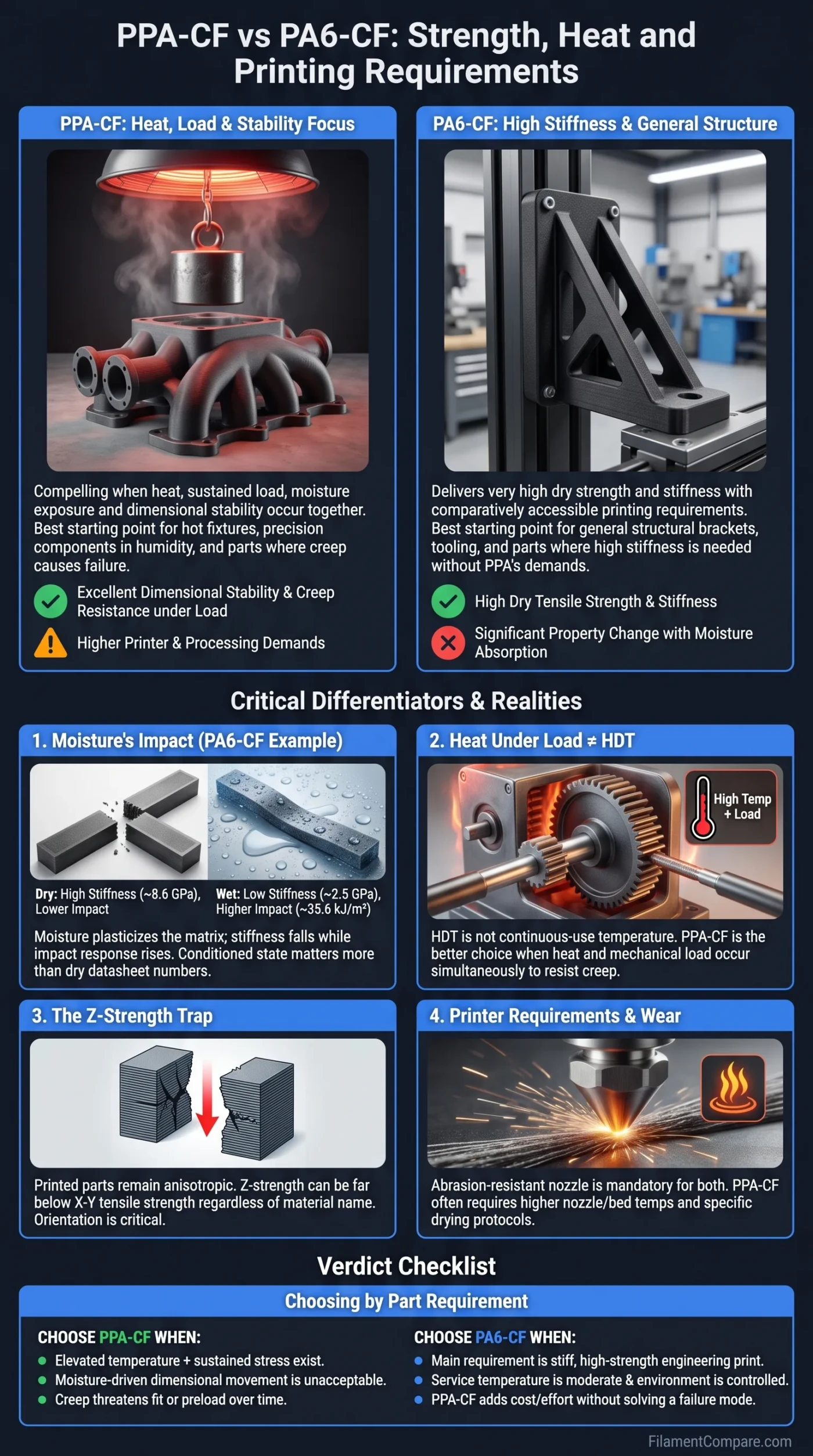
PPA-CF and PA6-CF can both produce stiff, load-bearing printed parts, but they solve different engineering problems. PA6-CF can deliver very high dry strength and stiffness with comparatively accessible printing requirements, while PPA-CF becomes more compelling when heat, sustained load, moisture exposure and dimensional stability occur together. The useful comparison is therefore not a single tensile-strength number, but how each material behaves in the conditions the finished part will actually see.
Where Each Material Makes Sense
Choose PPA-CF as the starting point for hot fixtures, precision components exposed to humidity, parts carrying a continuous load at elevated temperature, or applications where creep and dimensional movement can cause failure before the part actually breaks.
Choose PA6-CF as the starting point for general structural brackets, tooling, machine components and other engineering parts where high stiffness and tensile strength are needed but the operating environment does not justify the higher processing demands of PPA-CF.
Neither name guarantees a result by itself. Carbon-fiber percentage, conditioning state, annealing, specimen orientation and the manufacturer’s polymer formulation can move the numbers enough that two grades carrying the same material label may behave differently.
| Decision Point | PPA-CF | PA6-CF |
|---|---|---|
| Polyamide matrix | High-temperature PPA, commonly described as polyphthalamide or a semi-aromatic high-performance polyamide | PA6, or Nylon 6, reinforced with chopped carbon fiber |
| Mechanical character | Usually selected for a higher stiffness and thermal-performance ceiling, depending on grade | Can provide very high dry tensile strength and stiffness without moving into the PPA class |
| Heat under load | Better starting point when heat and mechanical load occur at the same time | Some grades already offer high HDT, so moderate heat alone does not automatically justify PPA-CF |
| Long-term creep | Often a reason to move to PPA-CF for loaded fixtures and end-use components | Must be evaluated more carefully when temperature and sustained stress are combined |
| Moisture effect | Lower moisture uptake is a common design target of PPA-CF formulations, though the material is not moisture-proof | Moisture can materially change stiffness, tensile behavior, toughness and dimensions |
| Dimensional stability | Usually the stronger candidate when tolerances must remain stable across changing humidity and temperature | Can be suitable, but environmental conditioning needs more attention in precision parts |
| Impact behavior | Grade-dependent; higher stiffness does not automatically mean higher impact resistance | Conditioning can reduce stiffness while increasing impact toughness in some grades |
| Layer direction | Printed parts remain anisotropic; orientation still matters | Printed parts remain anisotropic, and Z strength can be far below X-Y tensile strength |
| Nozzle requirement | Abrasion-resistant nozzle and extrusion path are appropriate for carbon-filled grades | Abrasion-resistant nozzle is appropriate; ordinary brass can wear rapidly |
| Drying | Drying and dry storage remain part of the print process | Drying and low-humidity handling are especially important |
| Chamber requirement | Depends on formulation, printer and part size; many PPA-CF workflows are more demanding | Grade-dependent, and some modern PA6-CF formulations specify no heated chamber |
| Best fit | Hot, loaded, dimension-sensitive or environmentally demanding functional parts | General engineering parts where high mechanical performance is needed without unnecessary material over-specification |
| Main trade-off | Higher material and process demands may buy performance that a moderate application never uses | Moisture conditioning and long-term environmental behavior can matter more than the impressive dry datasheet values |
Dry Strength Can Mislead the PA6-CF Comparison
PA6-CF often looks exceptionally strong when the comparison starts with a dry tensile specimen. The problem is that Nylon 6 is hygroscopic, so the mechanical state of a printed part can change as it takes up water. That matters for a workshop jig, outdoor enclosure or machine component that may spend months in a different humidity state from the specimen used to produce the datasheet.
Fiberon PA6-CF20 provides an unusually useful example because Polymaker publishes both dry and wet printed-specimen data. After annealing, its X-Y Young’s modulus is listed at 8636.5 MPa dry and 2508.1 MPa wet, while X-Y tensile strength changes from 109.3 MPa to 54.7 MPa. At the same time, notched X-Y Charpy impact strength moves from 11.0 kJ/m² dry to 35.6 kJ/m² wet. For the wet dataset, the specimens were immersed in water at 60°C for 48 hours and had an average moisture content of 5.30%, so this should be read as a defined conditioning test rather than an ordinary room-humidity result.[a]
| Printed-Specimen Property | Dry | Wet | What Changed |
|---|---|---|---|
| Young’s modulus, X-Y | 8636.5 MPa | 2508.1 MPa | Large reduction in stiffness |
| Tensile strength, X-Y | 109.3 MPa | 54.7 MPa | Lower tensile capacity after conditioning |
| Tensile strength, Z | 54.0 MPa | 25.5 MPa | Both moisture and layer orientation remain relevant |
| Notched Charpy impact, X-Y | 11.0 kJ/m² | 35.6 kJ/m² | Impact toughness rises while stiffness falls |
This is why describing moisture absorption only as “weakening the nylon” misses part of the behavior. Water can plasticize the polyamide matrix: stiffness and tensile strength may fall while ductility or impact response moves in the opposite direction. Whether that is harmful depends on what is supposed to fail first.
A wet spool can produce popping, bubbles, inconsistent extrusion and weaker bonding during printing. A successfully printed dry part can later absorb moisture during service and move toward a different mechanical and dimensional state. Drying the filament addresses the first problem; material selection and environmental testing address the second.
PPA-CF is attractive in this comparison because PPA formulations are commonly designed for lower moisture uptake and better property retention than conventional PA6-based composites. That does not make every PPA-CF grade immune to humidity, but it can make the premium easier to justify when bolt spacing, alignment, bearing location or fixture geometry must remain stable.
Heat Under Load Is Where PPA-CF Starts to Separate
High-temperature comparisons become misleading when HDT is treated as the temperature at which a part can operate indefinitely. Heat deflection temperature measures deformation under a specified test load. It is useful for comparing grades under defined conditions, but it does not by itself establish continuous service temperature, creep life, fastener preload retention or long-duration dimensional accuracy.
A filament listing an HDT above 200°C does not automatically make a printed bracket suitable for carrying a permanent load at 200°C. Test pressure, specimen preparation, annealing, print orientation and exposure time all matter.
Current manufacturer data also shows why “PPA-CF is high heat and PA6-CF is low heat” is too crude. Polymaker lists 215°C HDT at 0.45 MPa for Fiberon PA6-CF20, while Bambu Lab lists 227°C at 0.45 MPa for its PPA-CF. Bambu also describes its PPA-CF as 48% higher in strength and 102% higher in stiffness than the normal PA6-CF used in its own comparison. Those percentages belong to that manufacturer’s product comparison; they are not universal PPA-CF-to-PA6-CF ratios.[b]
The relatively close headline HDT values in those two examples reveal an important purchasing trap. A user choosing PPA-CF only because its HDT number is larger may be paying for the wrong property. The stronger reason to consider PPA-CF is often the combination of thermal stiffness, lower moisture response, creep resistance and dimensional control, rather than one isolated peak-temperature value.
A heated fixture illustrates the distinction. If a part becomes warm for a few minutes and carries little force, a suitable PA6-CF grade may already provide enough thermal margin. A locating fixture that stays hot for hours while clamps apply constant force is a different case: creep and geometry retention begin to matter alongside HDT. A sensor mount can create yet another requirement if a small shift in alignment causes the system to fail even though the polymer never cracks.
When PA6-CF’s Heat Performance May Already Be Enough
- Structural parts working mostly near room temperature
- Short heat excursions rather than continuous thermal loading
- Fixtures where small dimensional movement is acceptable
- Applications already validated with a specific PA6-CF grade
When PPA-CF Has a Stronger Reason to Exist
- Heat and sustained mechanical load occur together
- Creep can change fit, preload or alignment
- Humidity varies while tolerances must remain stable
- A high-stiffness component must retain geometry over long service periods
The Printer Can Become the Limiting Component
Moving from PA6-CF to PPA-CF is not only a material upgrade. It can move the job into a different printer operating envelope. Hotend capability, bed temperature, chamber control, drying equipment and the abrasion resistance of the filament path can determine whether the higher-spec polymer is usable at all.
Raise3D’s current Industrial PPA CF is a 15 wt.% carbon-fiber PPA formulation with a recommended 290–310°C nozzle, 65–80°C bed, cooling fan off and drying at 80–100°C for 4–6 hours. Raise3D also recommends at least a steel nozzle, preferably a more wear-resistant option such as SiC, and gives an 80–100°C, 8–12 hour post-print annealing recommendation for that grade.[c]
| Print Requirement | Fiberon PA6-CF20 Example | Raise3D Industrial PPA CF Example | Why It Matters |
|---|---|---|---|
| Nozzle temperature | 280–300°C | 290–310°C | A printer that only reaches the lower end of engineering-nylon temperatures may limit PPA-CF choices |
| Bed temperature | 40–50°C | 65–80°C | The matrix formulation can change both adhesion and thermal-stress management |
| Chamber | Manufacturer states room temperature and no heated chamber or enclosure is needed for this grade | Printer and part configuration remain formulation-dependent | “Nylon-CF requires a chamber” is not a reliable universal rule |
| Cooling | Off in the published recommendation | Off in the published recommendation | Layer bonding and thermal contraction usually matter more than aggressive cooling |
| Pre-print drying | 100°C for 10 hours in the published TDS | 80–100°C for 4–6 hours | Drying instructions cannot safely be copied from one formulation to another |
| Post-print annealing | 100°C for 16 hours recommended | 80–100°C for 8–12 hours recommended | Annealing can affect the properties and dimensions used in an engineering comparison |
| Nozzle material | Hardened steel or ruby recommended | Steel minimum; more wear-resistant nozzle preferred | Chopped carbon fiber is abrasive regardless of which polyamide carries it |
These settings should not become a generic PPA-CF and PA6-CF profile. They show the opposite: the exact grade controls the print window. Another PPA-CF may need a hotter bed, a different chamber strategy or a much higher drying temperature. A PA6-CF from another supplier may warp more aggressively than the Fiberon example.
A dryer is intended to remove absorbed moisture under the temperature and time conditions allowed by the manufacturer. A sealed dry box mainly slows moisture uptake after drying and during printing. Feeding a moisture-loaded nylon spool from a container with desiccant does not necessarily restore it to a properly dried state.
The carbon fiber also means a stock brass nozzle should not be treated as a long-term consumable for either material. Wear gradually changes the nozzle opening and can affect extrusion width, flow consistency and dimensional accuracy before failure becomes visually obvious. That matters most when the reason for buying PPA-CF was tighter geometry in the first place.
Layer Direction, Annealing and Tolerance Can Reverse the Expected Result
A high-performance polymer does not remove FFF anisotropy. Chopped fibers tend to align with extrusion flow, while layer-to-layer bonding follows a different failure path. The result is a part whose mechanical behavior depends on how the load crosses roads, walls and layer interfaces.
The Fiberon PA6-CF20 dataset makes the scale visible: dry X-Y tensile strength is 109.3 MPa while dry Z tensile strength is 54.0 MPa. In the conditioned data, X-Y tensile strength is 54.7 MPa and Z strength is 25.5 MPa. A PPA-CF part printed with an unfavorable load path can therefore be a worse structural design than a correctly oriented PA6-CF part, even when the PPA formulation has the higher material-performance ceiling.
Orientation Questions That Matter More Than the Material Name
- Does the main tensile load run along extruded roads or try to separate layers?
- Will a bolt place peel or tensile stress through the Z direction?
- Can the part be rotated so the main walls follow the load path?
- Do holes, bosses or thin necks concentrate stress at layer interfaces?
- Does the comparison use X-Y data while the real part is likely to fail in Z?
Annealing adds another source of false comparisons. Polymaker states that the specimens in its PA6-CF20 mechanical dataset were annealed at 100°C for 16 hours. That detail matters because an annealed HDT or tensile figure should not be treated as the guaranteed performance of a freshly printed, unannealed part.
Annealing can also change dimensions as crystallinity and residual stresses evolve. For a decorative cover, a small shift may be irrelevant. For a bearing housing, alignment fixture or bolt-pattern component, the tolerance strategy may need to account for the post-processing step. Strength without dimensional fit is not useful structural performance.
The same caution applies when comparing different brands. A 15 wt.% PPA-CF and a 20 wt.% PA6-CF do not isolate the effect of the polymer matrix. Carbon-fiber content, fiber length and dispersion, additives, print settings and test preparation are all changing at the same time. Cross-brand numbers can show the performance range available in the market, but they should not be presented as a controlled laboratory comparison of PPA against PA6.
Match the Material to the Failure You Are Trying to Prevent
The more useful way to choose between these materials is to identify what would make the actual part unacceptable. Breaking under a one-time tensile load is only one failure mode. A part can also fail by creeping out of alignment, becoming too flexible after moisture uptake, losing bolt preload, distorting after annealing or delaminating in the Z direction.
| Part or Environment | Better Starting Point | Reason | Condition That Could Change the Choice |
|---|---|---|---|
| General structural bracket near room temperature | PA6-CF | High stiffness and tensile capacity may already satisfy the job without PPA processing overhead | Continuous load, tight alignment requirements or higher service temperature |
| Heated manufacturing fixture | PPA-CF | Thermal stiffness and creep behavior become more important than dry room-temperature strength alone | Short exposure and low mechanical load may allow a suitable PA6-CF grade |
| Humid precision jig | PPA-CF | Lower moisture response and dimensional stability can justify the material change | Large tolerances or controlled dry indoor use reduce the advantage |
| Robot arm or lightweight machine link | Depends on load case | Stiffness-to-weight, orientation, fatigue and impact behavior matter together | PA6-CF may be entirely sufficient unless heat, creep or environmental stability becomes limiting |
| Automotive under-hood-adjacent component | PPA-CF candidate | Heat, vibration, fluids and long-duration loading can favor the higher-performance matrix | Actual fluid exposure and service temperature still require grade-specific validation |
| Impact-loaded guard or sacrificial component | Test both | The stiffest formulation is not automatically the toughest, and moisture conditioning can change nylon impact behavior | Failure mode, notch geometry and temperature can alter the result |
| Bearing or sensor alignment mount | PPA-CF candidate | Geometry retention may matter more than ultimate tensile strength | A stable, dry and temperature-controlled environment can make PA6-CF viable |
| Prototype that will be revised repeatedly | PA6-CF | High engineering performance with a potentially lower material and process burden | PPA-CF becomes easier to justify when the prototype must reproduce the final thermal environment |
Wear components such as gears deserve special caution. Tensile strength alone does not predict gear life. Surface pressure, lubrication, counterface material, temperature, tooth geometry, fiber orientation and abrasive wear all enter the problem. The same applies to automotive and electrical parts where chemical resistance or regulatory requirements may be more restrictive than the mechanical properties shown on a filament page.
Choosing by Part Requirement
Choose PPA-CF when: the part combines elevated temperature with sustained stress, moisture-driven dimensional movement is unacceptable, creep threatens fit or preload, or very high stiffness needs to remain stable over time.
Choose PA6-CF when: the main requirement is a stiff, high-strength engineering print at moderate service temperatures, the environment is controlled or its moisture response is acceptable, and PPA-CF would add printer or material cost without solving an existing failure mode.
Either option can work when: service temperature and humidity are moderate and geometry, wall design, print orientation and layer bonding dominate the result. In that case, a well-designed PA6-CF part can outperform a poorly oriented PPA-CF part in the direction that actually carries the load.
Check the printer before choosing PPA-CF when: hotend temperature is close to the filament’s lower recommended limit, the machine lacks an abrasion-resistant nozzle, drying equipment cannot hold the required temperature, or the intended part is large enough that chamber behavior becomes important.
Neither material name fully solves: chemical compatibility, fatigue life, fire classification, electrical requirements, long-duration thermal exposure or certified structural performance. Those decisions require data for the exact grade and, where failure matters, testing of the printed geometry in conditions that resemble service.
Technical Sources and Documentation
- [a] Fiberon™ PA6-CF20 — Polymaker (Used for PA6-CF20 dry and wet mechanical data, HDT, printing conditions, drying, annealing and nozzle guidance.)
- [b] PPA-CF — Bambu Lab EU Store (Used for the current PPA-CF HDT and Bambu Lab’s product-specific strength and stiffness comparison with PA6-CF.)
- [c] Industrial PPA CF — Raise3D (Used for PPA matrix description, carbon-fiber content, printing temperatures, drying, nozzle and annealing recommendations.)
