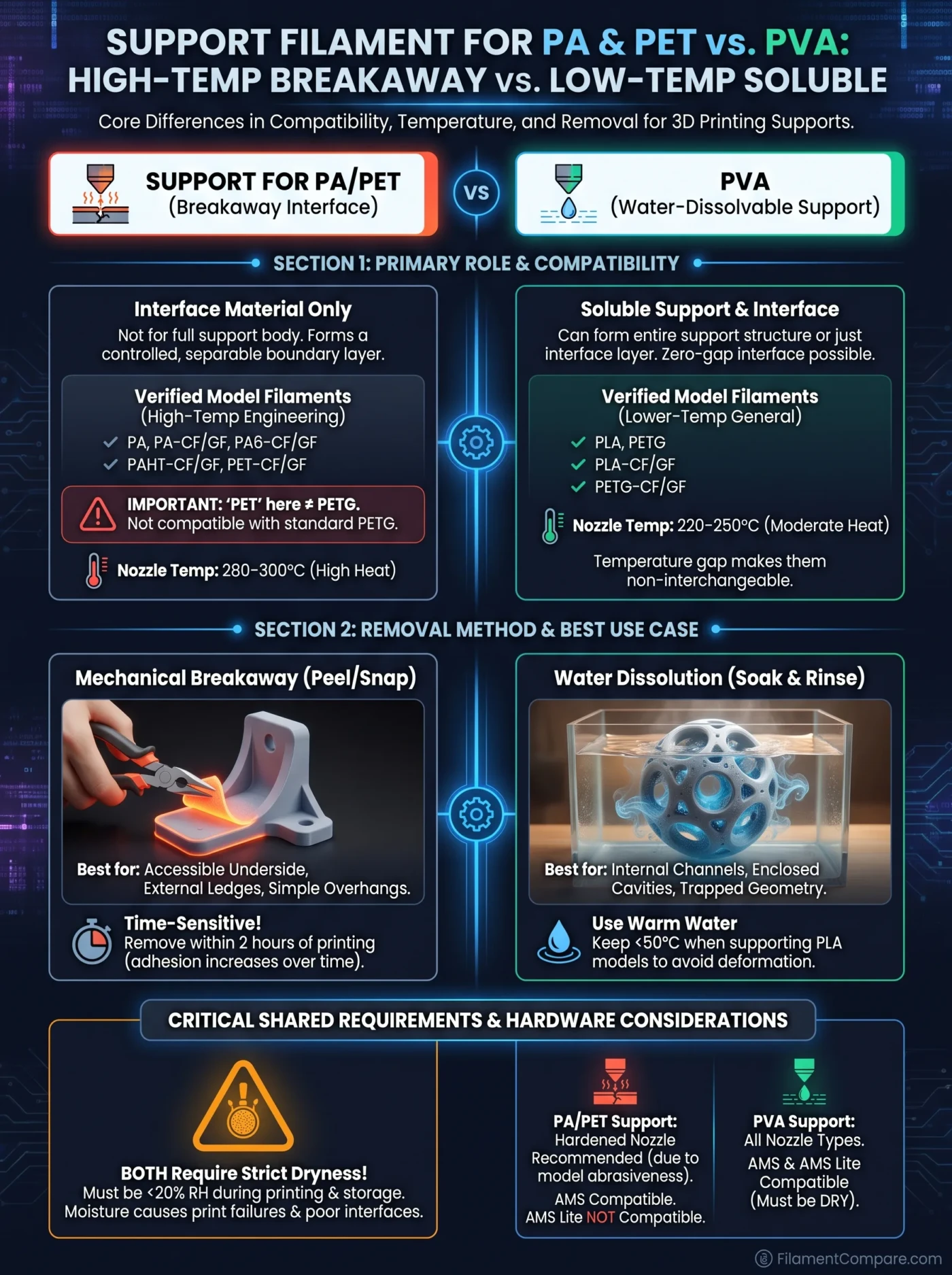
Support for PA/PET and PVA are both sacrificial 3D-printing materials, but they are designed around different model-filament families and different removal methods. Support for PA/PET is a high-temperature breakaway interface material intended for compatible PA and PET engineering filaments, while PVA is a water-dissolvable support material whose usefulness depends on the model polymer, printing temperature, geometry, and the ability to expose the finished part to water.
| Decision Area | Support for PA/PET [a] | PVA [b] | Practical Meaning |
|---|---|---|---|
| Support type | Breakaway, water-insoluble interface material | Water-dissolvable support material | One is removed mechanically; the other can be removed by soaking. |
| Verified model-material pairing | PA, PA-CF/GF, PA6-CF/GF, PAHT-CF/GF, PET-CF/GF in current Bambu compatibility guidance | PLA, PETG, PLA-CF/GF, PETG-CF/GF in current Bambu compatibility guidance | They are not direct substitutes for the same model polymers. |
| Primary role | Support interface only | Full soluble support or support interface | PA/PET support is not intended to form the entire support body in Bambu’s current guidance. |
| Nozzle temperature | 280–300°C | 220–250°C | The temperature window is one of the clearest reasons the two products target different model filaments. |
| Published print-speed limit | <100 mm/s | <200 mm/s | These are manufacturer profile limits, not guaranteed speeds for every geometry. |
| Dry protection during printing | Required; manufacturer lists <20% RH | Required; manufacturer lists <20% RH | Both support materials need moisture control during long prints. |
| Nozzle guidance | Hardened-steel hotend; 0.6 mm recommended in the current comparison chart, with 0.4/0.8 mm also listed | All nozzle sizes/materials listed as compatible in the current Bambu PVA page | The model filament may impose stricter nozzle requirements than the support material itself. |
| Automatic material system | AMS compatible; AMS lite not compatible | AMS and AMS lite compatible when dry | Printer architecture can decide whether a pairing is practical before support geometry is considered. |
| Removal | Peel or separate after printing | Dissolve in water; accessible bulk can be removed first | Accessibility favors breakaway support, while trapped geometry can justify soluble support. |
| Best geometric fit | Accessible supported faces, ledges, external overhangs, engineering parts | Internal channels, enclosed cavities, delicate interfaces, captured mechanisms | Geometry matters only after material compatibility has been confirmed. |
This comparison uses current Support for PA/PET and Bambu PVA manufacturer data plus verified printing guidance to describe normal material trends; results can vary with filament revision, absorbed moisture, printer hardware, support geometry, purge settings, and slicer profile.
They Solve Different Support Problems
The most useful distinction is not simply breakaway versus soluble. A support material must first survive the model filament’s thermal environment and form a controlled interface with that polymer. Only then does removal method become useful.
Support for PA/PET is built around high-temperature engineering-filament workflows. Its 280–300°C nozzle range places it alongside materials such as PAHT-CF, PA6-CF, PA6-GF, and PET-CF. PVA in the same manufacturer system runs at 220–250°C and is listed with PLA and PETG families. That gap makes the two products complementary rather than universal alternatives.
Compatibility comes before solubility. A water-soluble filament is not automatically suitable for nylon, PA-CF, PET-CF, or another high-temperature model material. The exact support grade must be approved for the model polymer and its printing conditions.
“PET” in Support for PA/PET Does Not Mean PETG
PET and PETG belong to related polyester families, but the names are not interchangeable in support-material selection. In Bambu’s current compatibility chart, Support for PA/PET is paired with PET-CF/GF and PA families, while PVA is paired with PLA, PETG, and their CF/GF variants. Buying PA/PET support merely because the model filament says “PETG” would therefore apply the product name too broadly.
Material-name check: PET-CF is not the same printing system as ordinary PETG. Read the support-material compatibility list for the exact model filament rather than matching on the letters “PET.”
The Temperature Window Changes the Entire Workflow
Support for PA/PET is specified at 280–300°C; Bambu PVA is specified at 220–250°C. That is not a small profile adjustment. It determines whether the support filament can be extruded cleanly during the same job as the model material without being pushed outside its intended operating range.
- PAHT-CF, PA6-CF, PA6-GF, and PET-CF operate in an engineering-material workflow where the dedicated PA/PET support is designed to remain printable.
- PLA and PETG are lower-temperature model materials and align with the current Bambu PVA compatibility list.
- A single-nozzle multi-material printer must repeatedly switch between model and support temperatures, so large temperature differences can add heating, cooling, purge, and waiting time.
- A dual-nozzle or multi-tool printer avoids some same-nozzle transition problems, but material-to-material adhesion and moisture control still matter.
The model filament can also set stricter hardware requirements. A carbon- or glass-fiber-filled PA or PET grade may need a hardened nozzle even if a support filament by itself would not. The complete material pair, not one spool in isolation, defines the practical printer setup.
Breakaway Interface vs Water-Dissolvable Support
A breakaway interface is valuable when the support contact is reachable after printing. It creates a material boundary between the model and its support scaffold, then the interface is peeled away rather than dissolved. This suits a broad underside, an external ledge, or an open pocket where fingers or a small tool can reach the support without forcing material through a narrow opening.
PVA changes the removal process. Water can reach support material in places that pliers cannot, so internal channels, captured cavities, and print-in-place assemblies can benefit from soluble support when the model material itself is compatible with that PVA grade. This is where water solubility has real geometric value.
| Geometry | Support for PA/PET | PVA | Reason |
|---|---|---|---|
| Open flat underside | Strong fit with compatible PA/PET models | Possible with compatible PLA/PETG models | The interface is easy to reach; dissolution may add unnecessary post-processing. |
| Deep but open pocket | Depends on tool access | Useful when the compatible model allows soaking | Removal access becomes as important as surface finish. |
| Enclosed internal channel | Limited if the broken pieces cannot exit | Well suited when the model/PVA pairing is approved | Water can remove material through openings too small for mechanical extraction. |
| Print-in-place mechanism | Suitable only if every interface can be reached and cleared | Useful for compatible model materials | Residual breakaway fragments can block movement in captured assemblies. |
| Large external engineering bracket | Natural use case with compatible PA/PET grades | Not a default substitute for high-temperature PA/PET materials | High-temperature compatibility and fast mechanical removal favor the dedicated interface material. |
Support Interface Only or Full Support?
This is one of the largest workflow differences. Bambu’s current Support for PA/PET instructions say it is only for the support interface, not a standalone model material or the normal support body. The larger scaffold can be printed from the model filament, with the specialty material placed only where the support touches the part.
Bambu PVA can be used as a soluble support material and can also be limited to the interface. The manufacturer specifically notes that interface-only PVA can reduce material waste and printing time. This matters on single-nozzle systems because every extra PVA region can create additional material changes and purging.
- Interface-only PA/PET support
- Model filament forms the main support scaffold; dedicated PA/PET support is reserved for contact layers.
- Interface-only PVA
- Model filament carries most of the support volume; a thin soluble layer separates the scaffold from the finished surface.
- Full PVA support
- Useful when the whole support mass must disappear from a trapped or inaccessible region and the model material is approved for the PVA grade.
Interface Spacing and Supported-Surface Finish
Same-material supports normally need separation so the model and support do not become one continuous mass. That separation can leave a rougher underside because the first model layer above the support spans a small gap.
Bambu’s current PVA guidance explicitly states that the water-soluble interface can accommodate zero top interface spacing, allowing close contact before the support is dissolved. [b] The exact value should still come from the tested profile rather than being copied to unrelated PVA brands.
Support for PA/PET should not be treated as universally “zero-gap” just because it is a dedicated interface filament. Interface distance, density, number of contact layers, model formulation, and moisture state can all change how easily the support separates. A slicer profile validated for the exact material pair is more reliable than a generic Z-gap rule.
Moisture Control Matters for Both Materials
Both products are listed as requiring drying and dry protection during printing. Their current recommended-settings tables specify less than 20% RH in a sealed container with desiccant. Moisture can change feeding, extrusion consistency, stringing, and the quality of the support interface.
The drying instructions deserve a careful read because Bambu’s Support for PA/PET page currently presents two related values: its recommended-settings table lists 80°C for 12 hours, while its separate printing tip lists 80°C for 8 hours in a blast drying oven or 90°C for 10 hours on a heat bed. [a] The exact method should therefore follow the manufacturer’s current instructions for the equipment being used rather than a temperature copied from another spool.
PVA is also moisture-sensitive enough that the manufacturer warns against feeding it when it has become soft or sticky. Bambu’s current PVA profile lists 80°C for 12 hours and dry feeding below 20% RH. Dry storage is part of the printing system here, not just a long-term storage preference.
PA/PET Support Has a Time-Sensitive Removal Step
Support for PA/PET has an unusual post-print detail: Bambu recommends removing the support structure within two hours after printing. The stated reason is that moisture absorption can make the support adhere more strongly over time; if that happens, the manufacturer recommends drying the model to make removal easier.
This makes an exposed support interface especially suitable for the material. The part leaves the printer, cools enough for handling, and the interface can be separated promptly. There is no soaking stage.
PVA Trades Mechanical Removal for a Water Step
PVA can remain in areas where a breakaway filament would be physically trapped. After printing, accessible PVA can be pulled away first and the rest can be dissolved. Bambu recommends warm water to accelerate dissolution and notes that, when PVA supports PLA, the soaking water should stay at or below 50°C to reduce the risk of deforming the model.
Complete dissolution is not always necessary before handling the support. The manufacturer’s current guidance allows partially softened PVA to be removed manually, which can shorten the water stage when the geometry is accessible enough. Full dissolution matters most where support cannot be reached directly.
Single-Nozzle Material Changes Add Purge and Time
On a single-nozzle multi-material printer, every support-interface transition can trigger unloading, loading, purging, wiping, and temperature adjustment. A print with a support interface on many layers may therefore spend far more time changing materials than a similar same-material support job.
- The model material prints the normal layer.
- The printer changes to the support interface material.
- The nozzle purges enough of the previous polymer to keep the interface chemically and mechanically consistent.
- The interface is printed.
- The printer changes back and purges again before model extrusion resumes.
This is why interface-only use can be efficient even when specialty support filament is inexpensive relative to the model material. The cost is not only grams from the support spool. It also includes purge material, extra machine time, and repeated thermal transitions.
Hardware Compatibility Can Decide the Choice Early
Support for PA/PET is currently listed as compatible with Bambu AMS but not AMS lite. Bambu PVA is listed for both AMS and AMS lite when kept dry. A printer that cannot feed the chosen support material automatically may turn an otherwise sensible material pairing into an impractical job.
Nozzle selection also needs to follow the complete print. PA-CF, PA-GF, PET-CF, and PET-GF model filaments contain abrasive reinforcement, so their own nozzle requirements remain relevant even when the support material only touches a few interface layers.
Failure Patterns Point to Different Causes
| Symptom | Support for PA/PET: Check | PVA: Check |
|---|---|---|
| Support is difficult to remove | Moisture uptake, delayed removal, interface distance, material pairing, interface density | Whether enough PVA has dissolved or softened; trapped insoluble model material in the support |
| Stringing or oozing | Dryness, standby temperature, purge/retraction behavior | Dryness first; soft or moisture-loaded PVA can feed and extrude inconsistently |
| Interface detaches during printing | Contact area, interface density, profile compatibility, model/support adhesion | Contact area, soluble-interface adhesion, cooling, support shape |
| Rough supported underside | Interface distance, density, layer count, local cooling, support stiffness | Interface spacing, purge cleanliness, PVA extrusion consistency |
| Material-change problems | High-temperature transitions, purge amount, feeder path, AMS compatibility | Moisture-softened filament, purge amount, feeder resistance, long hot-idle periods |
Material Selection by Print Scenario
| Print Scenario | Material Direction | Why |
|---|---|---|
| PAHT-CF bracket with a reachable flat underside | Support for PA/PET interface | The material is designed for the high-temperature PA workflow and the interface can be removed mechanically. |
| PA6-CF fixture with external ledges | Support for PA/PET interface | Compatible temperature range and accessible support removal align with the intended role. |
| PET-CF housing with broad supported faces | Support for PA/PET interface | PET-CF is included in current manufacturer compatibility guidance. |
| PLA model with an enclosed internal channel | PVA | The compatible soluble support can leave through water rather than mechanical extraction. |
| PETG print with support trapped behind a small opening | Compatible PVA grade | Current Bambu PVA guidance includes PETG and allows water-based removal. |
| Nylon model with a fully enclosed cavity | Verify a high-temperature soluble support made for the exact nylon grade | Standard PVA should not be assumed compatible simply because soluble removal would be useful. |
| Accessible support on a compatible model where only surface finish matters | Interface-only specialty support | Using the specialty material only at contact layers can reduce spool consumption and material changes. |
Questions That Change the Support Decision
Can PVA Support PA or Nylon?
Not by default. Bambu’s current PVA compatibility list focuses on PLA, PETG, and their CF/GF variants, while Support for PA/PET covers PA and high-temperature PET families. A different manufacturer may sell a soluble support formulated for nylon, but that should be treated as a separate product with its own temperature and adhesion data.
Does Support for PA/PET Dissolve in Water?
No. It is a water-insoluble breakaway interface material. Its removal advantage comes from controlled mechanical separation, not dissolution.
Should the Whole Support Be Printed from Support for PA/PET?
Current Bambu instructions say no: the material is intended only for the support interface. The main support structure can remain in the model material unless another validated profile says otherwise.
Should the Whole Support Be Printed from PVA?
Only when the geometry benefits from it. For an enclosed passage or captured support, full PVA can make sense. For an exposed underside, using PVA only at the interface can preserve the soluble contact layer while reducing PVA volume, purge waste, and soaking time.
Is PVA Automatically Better Because It Is Soluble?
No. Solubility solves a removal problem; it does not override temperature compatibility, polymer adhesion, hardware limits, or moisture control. For high-temperature PA and PET engineering filaments, a compatible high-temperature support system is the first requirement.
Which Material Fits a Fast Production Workflow?
When the model filament is compatible and every support contact is accessible, a breakaway PA/PET interface can move directly from cooling to removal without a water bath. PVA earns its extra post-processing when dissolution solves a geometry problem that mechanical removal cannot solve cleanly.
Technical References
- [a] Bambu Lab — Support for PA/PET. Used for current compatibility, breakaway role, interface-only instruction, nozzle range, print-speed limit, moisture guidance, AMS compatibility, and post-print removal guidance.
- [b] Bambu Lab — PVA. Used for current PVA compatibility, water solubility, nozzle range, dry-storage guidance, zero-top-interface-spacing statement, dissolution workflow, and AMS/AMS lite compatibility.
