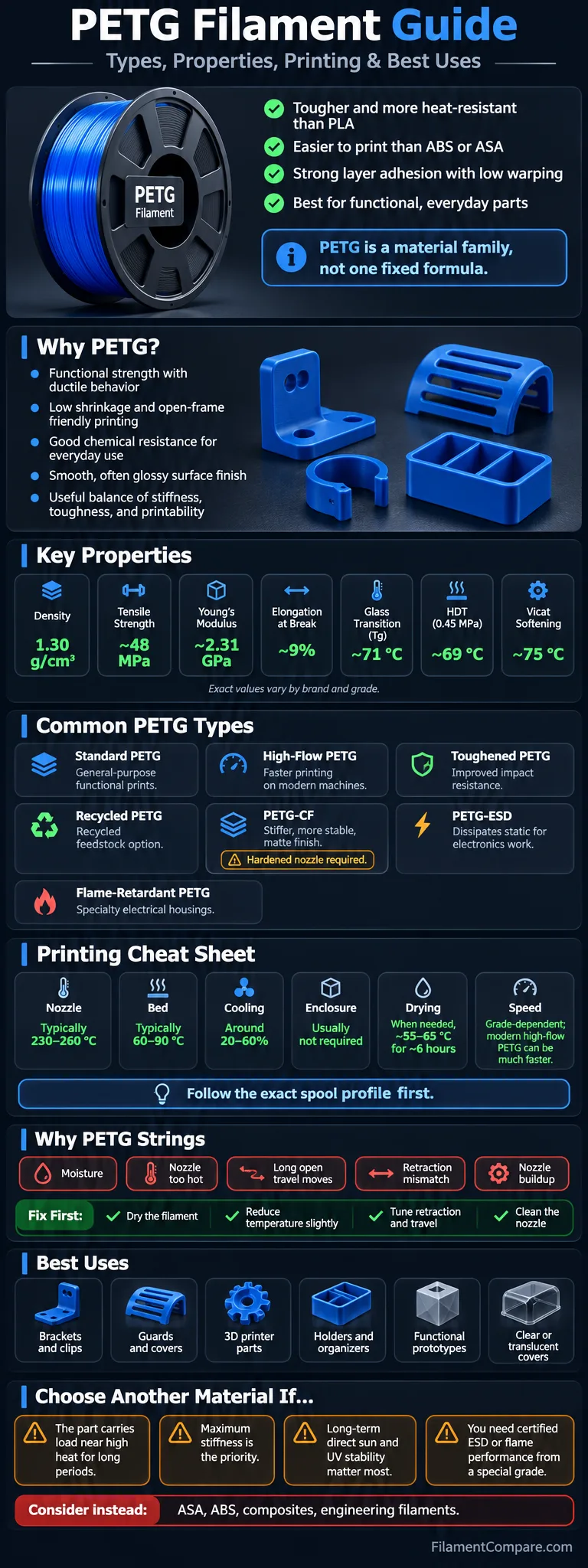
PETG is a glycol-modified PET-family copolyester used for functional FDM parts that need more impact tolerance and heat resistance than standard PLA without the enclosure demands of ABS or ASA. It prints with low warping, bonds layers well, and works on ordinary desktop machines. The category now includes standard, high-flow, toughened, recycled, carbon-fiber, ESD-safe, flame-retardant, and other specialty formulations, so the exact datasheet matters more than the PETG name alone.
| Property | Reference Value or Behavior | Why It Matters |
|---|---|---|
| Polymer Family | Glycol-modified PET-family copolyester | Combines low-warp FFF processing with useful toughness and chemical resistance |
| Density | 1.30 g/cm³ for current Polymaker PETG | Affects part weight and filament length per kilogram[a] |
| X-Y Tensile Strength | 47.96 ± 4.88 MPa | Manufacturer-specific printed-specimen strength reference |
| X-Y Young’s Modulus | 2311.11 ± 92.41 MPa | Shows a useful level of rigidity while retaining more ductile behavior than many PLA grades |
| X-Y Elongation at Break | 9.33 ± 6.57% | Illustrates that PETG can deform before fracture; actual values vary widely by grade |
| X-Y Notched Charpy | 4.95 ± 0.55 kJ/m² | One impact measurement; it should not be treated as a universal PETG toughness value |
| Glass Transition Temperature | 71.24 °C | Polymer transition reference, not a maximum service-temperature rating |
| HDT at 0.45 MPa | 69 °C | Useful for comparing deformation under a specified test load |
| Vicat Softening Temperature | 75 °C | Another thermal test; it is not interchangeable with Tg or HDT |
| Nozzle Temperature | 240–260 °C | Current Polymaker PETG recommendation |
| Build Plate Temperature | 60–70 °C | Current Polymaker PETG recommendation |
| Cooling Fan | 20–60% | Balances surface quality, overhangs, and layer bonding |
| Enclosure | Not required for standard Polymaker PETG | Makes PETG accessible to open-frame printers |
| Current Rated Print Speed | Up to 300 mm/s for Polymaker PETG | Modern high-flow formulations can operate far faster than older PETG profiles |
| Drying Reference | 55 °C for 6 hours when drying is needed | Moisture can increase stringing, bubbles, haze, and surface defects |
| Chemical Resistance Example | Good rating for weak acids, oils, and grease in the cited TDS | Chemical compatibility still depends on concentration, time, temperature, and grade |
| Typical Uses | Brackets, clips, holders, guards, containers, fixtures, printer parts, functional prototypes | PETG is strongest as an all-purpose functional filament rather than a visual-only material |
PETG formulations differ substantially between manufacturers. The values above come from one current Polymaker PETG technical sheet and should be read as a real product example, not fixed specifications for every PETG spool.
What Is PETG Filament?
PETG stands for glycol-modified polyethylene terephthalate. It belongs to the same broad polyester family as PET, but its chemistry is modified to reduce crystallization and produce a material that is easier to process in FDM, less brittle, and better suited to clear or translucent printing. Prusa describes the modification as making PET easier to print and less brittle.[b]
The result occupies a useful position between common hobby and engineering filaments. PETG normally requires more heat and tuning than PLA, yet it has far less cooling shrinkage than ABS or ASA. No heated enclosure is normally required. That combination explains why it is common in printer components, workshop fixtures, brackets, guards, containers, and prototypes that are handled repeatedly.
PETG is a material family, not one fixed recipe. High-flow PETG, PETG-CF, PETG-ESD, recycled PETG, toughened PETG, and flame-retardant PETG can differ in nozzle temperature, impact behavior, stiffness, drying requirements, abrasivity, and thermal performance.
Types of PETG Filament
| PETG Type | Main Change | Typical Reason to Use It | Hardware or Setup Note |
|---|---|---|---|
| Standard PETG | General-purpose unfilled copolyester | Brackets, containers, holders, printer parts, everyday functional prints | Standard nozzle; enclosure normally unnecessary |
| High-Flow / High-Speed PETG | Flow behavior tuned for higher extrusion rates | Faster production on modern high-flow printers | Use the exact high-speed profile; older PETG speed assumptions may be too conservative |
| Toughened PETG | Formulation tuned toward impact or fracture resistance | Robotics, guards, mechanical assemblies, impact-prone parts | Impact improvement is product-specific; compare the TDS |
| Recycled PETG | Reprocessed PETG feedstock | Functional printing with recycled material content | Color consistency and formulation depend on the recycling stream |
| PETG-CF / PETG-rCF | Chopped carbon-fiber reinforcement | Higher stiffness, dimensional stability, matte finish, lower deformation | Hardened nozzle required for abrasive fiber-filled grades |
| PETG-ESD | Conductive additives provide controlled electrostatic dissipation | Electronics trays, fixtures, housings, assembly tooling | Electrical performance can depend on print temperature and geometry |
| Flame-Retardant PETG | Flame-retardant additive package | Electronics housings and applications requiring a verified flame rating | Use only the certification of the exact tested grade and thickness |
| Decorative or Filled PETG | Glow pigments, mineral fillers, metallic effects, matte additives, or other modifiers | Visual or application-specific properties | Some fillers are abrasive and may require a hardened or larger nozzle |
Standard and High-Flow PETG
The boundary between “standard” and “high-speed” PETG is becoming less clear. Current Polymaker PETG is itself described as a high-flow formulation and lists print speeds up to 300 mm/s with a 240–260 °C nozzle range.[a] That is very different from older PETG workflows built around slow 30–60 mm/s profiles.
A speed rating should still be treated as printer- and geometry-dependent. The hotend must melt enough polymer at the requested volumetric flow, and small parts may hit cooling or acceleration limits long before the filament reaches its advertised motion speed.
Toughened PETG
Toughened formulations shift the mechanical balance rather than creating a new standardized polymer grade. PolyMax PETG, for example, is a manufacturer-specific reinforced formulation aimed at higher fracture toughness and impact performance. Its current printing guidance lists 230–260 °C at the nozzle, 70–80 °C on the bed, and 65 °C for six hours when drying is needed.[c]
Names such as PETG+, PETG Pro, Tough PETG, or Impact PETG are not universal specifications. One brand may emphasize impact strength while another adjusts flow, surface finish, or printing speed. The product sheet should decide the application.
Recycled PETG
Recycled PETG can retain the familiar low-warp processing behavior of conventional PETG while changing the feedstock source. Prusament PETG Recycled is made from 100% recycled Prusament PETG material; Prusa notes that individual production batches can have different colors because of the recycled input stream.[d]
Recycled content alone does not tell you how a filament will perform mechanically. Source control, contamination, additives, reprocessing history, and extrusion quality all matter. Treat recycled PETG as its own product grade rather than assigning it the properties of a virgin PETG spool.
Carbon-Fiber PETG
Chopped carbon fiber usually makes PETG stiffer and more dimensionally stable, but the trade is reduced ductility and a more abrasive filament path. Prusament PETG Carbon Fiber is listed with higher modulus, better dimensional stability, improved temperature resistance, and less stringing than the manufacturer’s regular PETG, while its toughness is lower.[e]
A hardened nozzle is required. Carbon-filled filament can wear brass rapidly, and the resulting nozzle enlargement changes extrusion width and flow accuracy. Fiber-filled PETG is therefore a poor choice when the printer only has a soft brass nozzle that must remain dimensionally accurate.
PETG-ESD
ESD-safe PETG is designed for electrostatic-dissipative tooling and housings. Fiberon PETG-ESD uses carbon nanotubes to control surface resistivity and is aimed at electronics assembly, trays, fixtures, and component housings.[f]
This is not simply black PETG with a different label. The manufacturer’s published surface-resistivity data changes with printing temperature, so electrical behavior depends partly on processing. Use the specified print window and verify the finished part if an ESD range is a functional requirement.
Flame-Retardant PETG
Flame-retardant PETG is a specialty category for electrical and electronic applications. Prusament PETG V0 is a self-extinguishing PETG formulation with a UL-certified V-0 classification for its tested configuration and is positioned for insulating and electronics housings.[g]
Flame classification belongs to the tested material, specimen thickness, and certification conditions. A generic PETG spool should never inherit a V-0 claim from another PETG product.
PETG Filament Properties
Stiffness, Strength, and Ductility
PETG combines useful rigidity with the ability to deform more before fracture than many standard PLA formulations. Current Polymaker PETG reports an X-Y Young’s modulus of about 2.31 GPa and X-Y tensile strength of about 48 MPa under its stated ISO tests.[a]
Those numbers should not be used as a generic PETG design specification. Pigment, molecular formulation, recycled content, fiber reinforcement, layer orientation, nozzle temperature, walls, and cooling all change printed behavior. A PETG-CF spool can be far stiffer than an unfilled PETG while also failing with less elongation.
Impact Resistance
Impact behavior is one reason PETG is common in guards, clamps, covers, and workshop hardware. It normally has a more ductile failure style than ordinary PLA, so a part can absorb deformation before breaking. Prusament describes its PETG as tough, durable, and difficult to break under normal functional use.[b]
Impact strength still needs a test method. Notched Charpy, unnotched Charpy, Izod, drop tests, and real assembly impacts are not interchangeable. When impact is the reason for choosing a filament, compare the same test across the candidate grades.
Layer Adhesion
PETG is known for strong layer-to-layer bonding. That helps functional parts loaded across multiple layers and can support watertight designs when wall geometry and extrusion are well controlled. Prusa specifically lists strong layer adhesion among PETG’s useful characteristics and uses the material for mechanical printer parts.[b]
More cooling is not always better. Lower fan speed and sufficient nozzle temperature generally favor fusion, while more cooling improves bridges, overhangs, and small details. The ideal balance depends on whether surface quality or mechanical bonding is the main requirement.
PETG Heat Resistance: Tg, HDT, and Service Temperature
PETG heat resistance should not be reduced to one number. Current Polymaker PETG lists a 71.24 °C glass-transition temperature, 69 °C HDT at 0.45 MPa, and 75 °C Vicat softening temperature.[a] Each test describes a different material response.
- Glass Transition Temperature (Tg)
- The polymer moves from a harder glassy state toward a softer, more mobile state. Tg is useful context, but it is not a maximum operating-temperature rating.
- Heat-Deflection Temperature (HDT)
- A standardized specimen reaches a defined deformation under a stated load. The load must be included when two HDT values are compared.
- Vicat Softening Temperature
- A standardized indentation test that measures another form of thermal softening.
- Service Temperature
- The acceptable operating limit for the actual part. It depends on load, geometry, time, tolerances, airflow, wall thickness, color, and safety margin.
A loaded PETG hook can creep or deform before an unloaded cosmetic cover made from the same spool appears soft. Short exposure and continuous exposure are also different. Use the product datasheet and the real load case when temperature is close to the material limit.
PETG Printing Settings
There is no single universal PETG profile. Current manufacturer recommendations already span noticeably different ranges: Prusa’s general PETG guidance uses 230 °C for the first layer and 240 °C afterward with an 85–90 °C bed, while current Polymaker PETG specifies 240–260 °C and a 60–70 °C bed.[h]
| Setting | Useful Starting Direction | Effect on the Print |
|---|---|---|
| Nozzle Temperature | Follow the exact spool profile; current examples commonly fall within roughly 230–260 °C | Higher temperature improves flow and bonding but can increase ooze and stringing |
| Bed Temperature | Current manufacturer examples range from roughly 60–90 °C | Supports first-layer adhesion; excessive grip can make removal difficult |
| Cooling | Moderate fan after the first layers | More fan improves detail; less fan usually favors interlayer fusion |
| Print Speed | Use the grade’s stated flow capability rather than one PETG-wide speed | High-flow PETG may reach modern high-speed profiles; older grades may need much lower flow |
| Retraction | Start from the printer profile and adjust only after the filament is dry | Controls travel strings; too much retraction can introduce other extrusion problems |
| Enclosure | Usually unnecessary for unfilled standard PETG | Open-frame printing is normally reliable because shrinkage is low |
| Nozzle Material | Standard nozzle for unfilled PETG; hardened nozzle for abrasive filled grades | Prevents dimensional wear when printing carbon fiber or abrasive pigments |
The manufacturer’s profile should come first. A modern high-flow PETG on a high-output hotend may print cleanly at speeds that would under-extrude an older formulation, while a decorative or heavily filled PETG can need very different flow and cooling.
PETG Cooling and Layer Strength
PETG does not need PLA-style maximum cooling for every print. Current Polymaker PETG lists a 20–60% fan range, while Prusament’s standard profile uses 50%. For parts where maximum layer bonding matters, Prusa notes that reducing fan can improve interlayer strength.[b]
Bridges and small overhangs need more airflow than a thick mechanical bracket. That creates a real trade: a highly cooled PETG print can look cleaner around small geometry, while a warmer print can fuse more strongly between layers. Variable cooling by feature is often more useful than one fan value for an entire model.
Why PETG Strings
PETG has a natural tendency to ooze from a hot nozzle, which is why fine strings are more common than with a well-tuned PLA profile. Moisture, excess nozzle temperature, and unnecessary open travel can make the problem more visible. Retraction is only one part of the equation.
Common Causes of PETG Stringing
- Filament has absorbed enough moisture to create unstable extrusion.
- Nozzle temperature is higher than the grade needs at the selected flow rate.
- Travel moves cross large open areas and allow the nozzle to ooze.
- Retraction and pressure-control settings do not match the extruder path.
- Material remains on the nozzle and is dragged across the print.
Dry the spool before making aggressive retraction changes when stringing appears suddenly. Wet PETG can imitate a profile problem, and slicer changes cannot remove water already inside the filament.
PETG Moisture and Drying
PETG can absorb moisture during storage, but drying instructions vary by formulation. Current Polymaker PETG recommends 55 °C for six hours when drying is needed, while PolyMax PETG lists 65 °C for six hours. Specialty PETG grades can require different handling.[a]
Typical wet-filament symptoms include extra stringing, popping, bubbles, haze, rough walls, and inconsistent gloss. Severe moisture can also interfere with dependable extrusion. Store opened spools in a sealed container or bag with active desiccant when repeatable results matter.
Do not apply one drying temperature to every PETG variant. Composite spools, flame-retardant grades, cardboard reels, and modified formulations can have their own limits. The label or current technical sheet should override a generic drying chart.
PETG Build Plate Adhesion
PETG’s first-layer problem is sometimes too much adhesion. Prusa recommends textured or satin sheets and warns that PETG can bond strongly enough to damage a smooth PEI surface. A glue-stick layer can act as a separator when smooth PEI must be used.[h]
This is different from PLA, where glue is often discussed primarily as an adhesion aid. With PETG, a release barrier may protect the plate. Let the bed cool before removal and follow the build-surface manufacturer’s instructions rather than forcing a hot part free.
First-layer pressure matters. PETG does not normally need to be crushed hard against the plate. Excessive squish can increase nozzle buildup, create an oversized first layer, and make an already strong bond harder to release.
Chemical and Water Resistance
PETG is useful around water, oils, and some everyday chemicals, but “chemical resistant” should never be treated as universal compatibility. Current Polymaker PETG rates its material as good against weak acids, oils, and grease, fair against weak alkalis, and poor against strong acids and strong alkalis under the manufacturer’s stated assessment.[a]
Compatibility changes with chemical concentration, temperature, contact time, stress, and additives. A bracket that survives an occasional cleaning wipe has a different exposure profile from a pressurized container immersed continuously in the same liquid.
PETG’s strong layer bonding can also support water-resistant or watertight prints. Prusa lists waterproof parts among its PETG applications.[b] Actual leakage depends on perimeters, seam placement, extrusion consistency, wall thickness, fittings, pressure, and part geometry, so the base polymer alone does not guarantee a sealed vessel.
PETG for Outdoor Use
PETG is more suitable for general outdoor parts than standard PLA. Prusa describes regular PETG as usable for most exterior applications below its practical temperature range.[h] That makes it a reasonable material for garden accessories, covers, brackets, mounts, and other utility parts that see weather but not extreme heat.
Long outdoor life is still grade-specific. Pigments, UV stabilizers, wall thickness, load, and direct sunlight affect aging. ASA remains the more deliberate choice when years of direct UV exposure and color retention are central requirements.
Is PETG Food Safe?
A base resin or filament compliance statement does not make every FDM print suitable for repeated food contact. Prusa specifically advises against assuming ordinary PETG prints are food-safe because layer grooves can retain contamination, while nozzle material, additives, pigments, printer cleanliness, coatings, and cleaning method introduce additional variables.[h]
For any regulated food-contact application, the exact filament grade, manufacturing process, nozzle, surface condition, local requirements, and intended temperature or cleaning cycle need separate verification.
PETG Surface Finish and Post-Processing
Standard PETG often has a smooth, glossy surface. Transparent and translucent grades can produce attractive light-transmitting parts, although printed objects remain optically affected by layer interfaces, internal gaps, wall geometry, and surface texture.
PETG can be drilled and sanded. Wet sanding is useful when friction heat becomes noticeable. Unlike ABS, ordinary PETG does not offer the familiar acetone-vapor smoothing workflow. Supports can also bond firmly because layer adhesion is strong, so support-interface distance deserves attention.
PETG, PET, PCTG, and CPE Are Not the Same Material
PETG belongs to a larger copolyester family. UltiMaker distinguishes its PETG, CPE, and CPE+ materials chemically and notes that its CPE+ uses PCTG, while PETG is glycol-modified PET.[i] These names should not be collapsed into one set of mechanical or thermal properties.
The same caution applies to fiber-filled products. PET-CF is not automatically PETG-CF, and PET-GF should not be relabeled PETG-GF unless the manufacturer identifies the base resin as PETG. Polymaker currently lists PET-CF, PET-GF, and PETG-rCF as separate materials in the same broader PET/PETG portfolio.[j]
Best Uses for PETG Filament
| Application | Why PETG Fits | Grade to Consider |
|---|---|---|
| Functional Brackets | Low warping, toughness, useful stiffness, strong layer bonding | Standard or toughened PETG |
| Clips and Guards | More ductile behavior than brittle visual filaments | Standard or toughened PETG |
| 3D Printer Parts | Moderate heat resistance and low-warp printing | Standard PETG |
| Workshop Holders and Organizers | Durability, chemical tolerance to normal workshop handling, easy large-part printing | Standard or recycled PETG |
| Large Functional Prints | Low thermal shrinkage without enclosure dependence | Standard or high-flow PETG |
| Impact-Prone Housings | Toughness and good layer bonding | Toughened PETG |
| Dimensionally Stiff Tooling | Fiber reinforcement raises modulus and reduces deformation | PETG-CF / PETG-rCF |
| Electronics Assembly Fixtures | Electrostatic dissipation can protect sensitive components | PETG-ESD |
| Electronics Housings Requiring Flame Performance | Special grades can carry tested flame classifications | Certified flame-retardant PETG |
| Outdoor Utility Parts | Better heat and exterior-use profile than standard PLA | Standard PETG with verified outdoor suitability |
| Transparent Covers and Diffusers | Glossy translucent formulations and useful toughness | Clear or translucent PETG |
| Parts Made With Recycled Feedstock | Maintains familiar PETG printing behavior while using recovered material | Recycled PETG |
When Standard PETG Is Not Enough
Higher Heat
If the part must hold a permanent load near or above ordinary PETG’s HDT range, compare ASA, ABS, PC, nylon, PET-based engineering composites, or another grade with tested thermal data.
Maximum Stiffness
Standard PETG is not designed to compete with highly reinforced materials. PETG-CF can raise stiffness, while PET-CF, PET-GF, PA-CF, and other engineering composites may go farther depending on the part.
Years of Direct Sun
Generic PETG can work outdoors, but a weather-focused material such as ASA is easier to justify when direct UV exposure and color retention define the application.
Electrical or Flame Requirements
Use a PETG-ESD or certified flame-retardant grade when those properties are functional requirements. Ordinary PETG should not inherit an ESD range or flame classification from a specialty formulation.
Common PETG Filament Questions
Does PETG Need an Enclosure?
Standard PETG normally does not. Current Prusa and Polymaker guidance both support open-frame printing for ordinary PETG. Specialty filled materials can have different recommendations, so check the exact product.
What Temperature Should PETG Print At?
Use the spool manufacturer’s profile. Current examples range from Prusa’s 230–240 °C general PETG settings to Polymaker’s 240–260 °C current PETG range. High-flow, CF, ESD, and other modified grades can require different temperatures.
Does PETG Need to Be Dried?
Not every fresh spool needs drying before every print, but PETG benefits from dry storage and drying when moisture symptoms appear. The required temperature and time are formulation-specific.
Why Is My PETG Stringing?
Common causes are absorbed moisture, excessive nozzle temperature, long open travel moves, nozzle buildup, and retraction settings that do not match the extruder. Drying should be checked before treating retraction as the only cause.
Is PETG Stronger Than PLA?
Not in every measurement. PLA can be stiffer and can have higher tensile values, while PETG commonly offers more ductile behavior and better impact tolerance. The correct choice depends on the expected failure mode.
Is PETG Waterproof?
The polymer tolerates water well and PETG’s strong layer bonding can support watertight prints, but an FDM object is not automatically leak-free. Perimeters, seams, flow consistency, fittings, pressure, and geometry determine whether the finished object holds water.
Can PETG Be Used Outdoors?
Yes, many ordinary outdoor utility parts are reasonable PETG applications. Long-term direct UV exposure should be checked against the specific grade, and ASA remains the more weather-focused choice when prolonged sunlight is central to the design.
Does PETG Need a Hardened Nozzle?
Unfilled PETG normally does not. Carbon-fiber PETG, glow-filled PETG, and other abrasive formulations can wear brass and should be printed with the nozzle material and diameter specified by the manufacturer.
Is PETG-CF Better Than Normal PETG?
It is better when the part needs more stiffness, dimensional stability, or a matte fiber finish. It is not automatically better for impact or flexing: Prusament explicitly notes lower toughness for its PETG Carbon Fiber compared with regular PETG.
Can PETG Be Printed Fast?
Yes. Modern high-flow PETG formulations can be rated for high-speed printing; current Polymaker PETG lists up to 300 mm/s. Actual speed is limited by hotend flow, layer time, acceleration, nozzle size, geometry, and the quality target.
Technical Resources Used
- [a] Polymaker PETG Technical Data Sheet V2.0 — Used for current standard/high-flow PETG physical, thermal, mechanical, chemical-resistance, printing, speed, cooling, and drying data.
- [b] Prusament PETG — Used for PETG material behavior, layer adhesion, low warping, mechanical applications, outdoor use, cooling, and post-processing context.
- [c] PolyMax PETG — Used for the toughened PETG category and manufacturer-specific print and drying guidance.
- [d] Prusament PETG Recycled — Used for recycled PETG composition, batch color behavior, and printing characteristics.
- [e] Prusament PETG Carbon Fiber — Used for carbon-fiber PETG stiffness, dimensional stability, temperature behavior, toughness tradeoff, nozzle requirement, and print temperatures.
- [f] Fiberon PETG-ESD — Used for PETG-ESD composition, electronics applications, print-temperature range, hardened-nozzle guidance, and surface-resistivity behavior.
- [g] Prusament PETG V0 — Used for flame-retardant PETG characteristics, certification context, electronics applications, printing settings, and drying requirements.
- [h] PETG | Prusa Knowledge Base — Used for general PETG print settings, build-surface behavior, food-contact caution, outdoor use, cooling, stringing, and functional applications.
- [i] UltiMaker: Difference Between PETG, CPE, and CPE+ — Used to distinguish PETG from related copolyester materials including PCTG-based CPE+.
- [j] Polymaker PET/PETG Material Family — Used to distinguish PETG products from separate PET-CF and PET-GF engineering materials.
