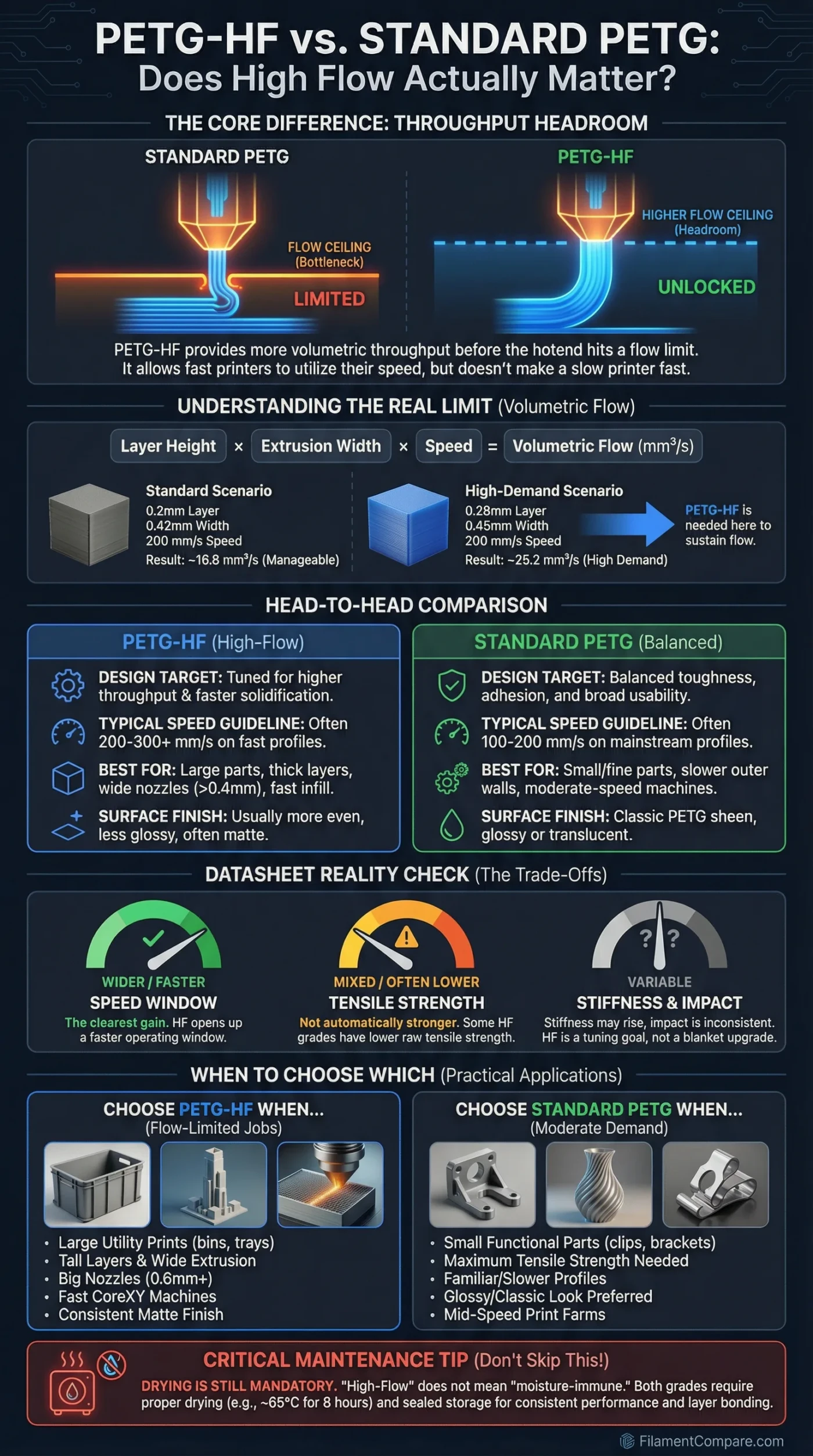
| Comparison Point | PETG-HF / High-Flow PETG | Standard PETG |
|---|---|---|
| Design Target | Tuned for higher throughput, faster solidification, and cleaner printing on fast machines. | Tuned for the familiar PETG balance of toughness, adhesion, and broad day-to-day usability. |
| Typical Official Speed Guidance | Commonly lands in the 200-300 mm/s range on current fast profiles. | Commonly lands in the 100-200 mm/s range on mainstream profiles. |
| What Changes on the Printer | More room before the hotend and filament hit a flow ceiling. | Reaches the flow ceiling sooner when line width, layer height, or infill speed rises. |
| Where the Gain Shows Up | Large parts, thick layers, wide lines, bigger nozzles, and fast infill-heavy jobs. | Small parts, fine layers, slower outer walls, and moderate-speed machines. |
| Common Surface Character | Often sold with a more even, less glossy, sometimes matte-leaning finish. | Usually keeps the classic PETG sheen or a smoother translucent look. |
| Trade-Off Pattern | Higher throughput does not automatically bring higher mechanical values across every metric. | Often the steadier choice when raw throughput is not the bottleneck. |
| 2026 Product Status | High-flow PETG remains an active material category, although Bambu Lab PETG HF has been discontinued. | Standard PETG remains widely available, including Bambu Lab’s current PETG Basic formula. |
This comparison uses Bambu Lab PETG HF as a documented high-flow reference and eSUN PETG+HS as a current high-speed PETG example, then checks the flow-limiting side against Prusa and E3D references. Real results still shift with nozzle size, hotend capacity, slicer settings, and model geometry.
PETG-HF matters most when your printer is already fast enough to run into a material-flow limit. On a CoreXY machine, a wide nozzle, or a thick-layer profile, it can keep pace where standard PETG often asks for slower settings. On smaller parts or gentle profiles, the gap shrinks fast.
What matters: high-flow PETG does not make a slow printer fast by itself. It gives the hotend and slicer more throughput headroom, and that advantage appears when the print is actually flow-limited.
- Fast CoreXY
- Large Parts
- Tall Layers
- Wide Extrusion
- Bigger Nozzles
- Infill-Heavy Jobs
2026 Availability and Product Line Update
There is an important change for anyone comparing these materials in 2026. Bambu Lab now marks PETG HF as discontinued and states that it will not be restocked after remaining inventory is sold.[h] Depending on the regional storefront and color, PETG HF may appear unavailable, sold out, or briefly available while existing inventory clears. That does not change its discontinued product-line status.
Bambu PETG HF should therefore be read here as a documented high-flow formulation, not as a filament buyers can assume will remain regularly stocked. The high-flow PETG category itself is still active.
Bambu directs PETG HF customers toward its newer PETG Basic line. The current PETG Basic V3.0 datasheet describes an upgraded formula focused on strength, toughness, outdoor use, and improved printability, while its recommended printing speed remains below 200 mm/s.[b] Bambu PETG HF was specified below 300 mm/s.[a] The newer Basic formula therefore replaces PETG HF in Bambu’s retail lineup without erasing the technical distinction between standard and high-flow PETG.
The category is easy to see outside that one product line. eSUN continues to list PETG+HS as a high-speed PETG and gives it a 40-300 mm/s printing range.[i] Its technical sheet also reports a higher melt-flow figure than eSUN’s standard PETG comparison used below. High-flow PETG is therefore better treated as a material class defined by formulation and throughput rather than as another name for Bambu PETG HF.
Bambu’s community forum also saw sustained discussion in June 2026 about PETG HF being phased out, remaining stock, the newer PETG Basic, and alternative high-speed PETG products.[j] Those user reports are useful for understanding the transition, while the product status and numerical specifications in this comparison come from manufacturer pages and datasheets.
What High Flow Changes Inside the Print Profile
Volumetric Flow, Not Just Head Speed
Most PETG-HF discussions get fuzzy because they talk about print speed in mm/s when the real limit is usually volumetric flow in mm³/s. Two profiles can both say 200 mm/s, yet one may be easy for the hotend while the other is already pushing too much plastic through the nozzle.
- Print Speed
- How fast the toolhead moves across the part, usually written in mm/s.
- Volumetric Flow
- How much molten plastic the hotend must push per second, written in mm³/s.
- Simple Relationship
- Layer height × extrusion width × speed.
- Why It Matters
- The same headline speed can be light work or a hard load depending on line width and layer height.
Prusa describes maximum volumetric speed as a cap on how much filament the slicer should try to push through the hotend, and notes that small prints often never touch that cap, while larger parts, fast infill, wider nozzles, and taller layers do.[e]
E3D makes the same point from the hotend side: volumetric flow rate is material- and temperature-dependent, and lower melt viscosity lets the nozzle sustain a higher flow rate before under-extrusion starts.[f]
A plain example makes this easy to see. A 0.42 mm line width at 0.20 mm layer height and 200 mm/s needs about 16.8 mm³/s. Push that to 0.45 mm by 0.28 mm at the same 200 mm/s and the demand jumps to about 25.2 mm³/s. Same speed on paper. Very different melt load.
When the Difference Stays Small
If you print mini organizers, brackets with modest wall speeds, or neat-looking parts at fine layers, the machine may never ask enough from the filament for high flow to matter much. In that zone, profile tuning, cooling, and drying often have more effect than the letters HF on the spool.
PETG-HF can make a large difference on one setup and very little difference on another. One machine may be reaching its material-flow limit, while another is motion-limited, cooling-limited, or simply running slowly enough that standard PETG already keeps up.
What the Official Datasheets Actually Show
| Data Point | Bambu PETG HF [a] vs Bambu PETG Basic [b] | eSUN PETG+HS [c] vs eSUN PETG [d] | What It Suggests |
|---|---|---|---|
| Manufacturer Speed Guidance | <300 mm/s vs <200 mm/s | 40-300 mm/s vs 40-100 mm/s | Speed is the clearest difference. HF grades are positioned for a wider, faster operating window. |
| Flow / Melt Indicator | Reported melt index 28.2 vs 22.9 g/10 min, though the test temperatures differ (210 °C vs 245 °C). | Melt flow index 24 vs 20 at the same 190 °C / 2.16 kg condition. | Higher flow behavior shows up cleanly in eSUN’s same-condition comparison; Bambu’s speed guidance points the same way even though its MFI test temperatures are not matched. |
| Tensile Strength | XY tensile strength 34 ± 4 MPa vs 51 ± 1 MPa | 29.2 MPa vs 52.2 MPa | HF is not automatically the stronger material in straight tensile terms. |
| Stiffness / Bending Clue | XY bending modulus 2050 ± 120 MPa vs 1950 ± 50 MPa | Flexural modulus 1708.7 MPa vs 1073 MPa; flexural strength 63 MPa vs 58.1 MPa | Some HF grades keep or raise flexural stiffness, so flow optimization does not require every stiffness measure to fall. |
| Impact Figure | XY impact 31.5 ± 2.2 kJ/m² vs 34.2 ± 4.1 kJ/m²; Z impact 10.6 ± 1.2 vs 10.5 ± 1.8 | Izod impact 5.6 kJ/m² vs 4.7 kJ/m² | Impact behavior varies by brand and test method. There is no single “HF always wins” pattern. |
| Heat Deflection | 62/69 °C vs 68/71 °C at 1.8/0.45 MPa | 68 °C vs 64 °C | Thermal numbers move by formulation. Do not assume every HF PETG brings higher heat resistance. |
Read each manufacturer pair as its own comparison. Bambu’s sheet is based on printed standard samples, while eSUN states that its listed physical and mechanical values are based on injection-molded spline tests, so the rows are useful for directional reading, not for treating every number as a direct brand-to-brand contest.
Across both brands, PETG-HF or HS grades open a faster print window, while mechanical results vary by formulation. Some values drop, some remain close, and others rise. “High flow” describes a formulation and processing target rather than a blanket quality grade.
There is another useful baseline here. Prusament’s printed PETG sheet still lands in a familiar zone for standard PETG, with heat deflection listed at 68 °C and 74 °C depending on load, printed tensile yield at 39-42 MPa, and printed impact strength at 23-33 kJ/m² depending on direction.[g]
Where PETG-HF Really Earns Its Name
- Large parts with long straight toolpaths. Storage bins, housings, panels, and wide organizers spend more time in infill and long wall runs where flow limits actually show up.
- Tall layers and wide extrusion widths. This is where mm³/s demand climbs quickly, even if the visible print speed number looks ordinary.
- Bigger nozzles. A 0.6 mm or 0.8 mm nozzle can save time, but only if the hotend and filament can keep feeding it.
- Fast motion systems that are already tuned. On a modern printer, standard PETG can become the throughput limit before the motion system does.
- Parts where surface consistency matters. Several HF grades are formulated around a more even finish as well as faster printing.
For many users, the value of PETG-HF is not shaving a few minutes from a tiny bracket. The larger gain appears on sustained fast prints where ordinary PETG may start showing more stringing, uneven gloss, or visible surface changes as the slicer moves between different speeds.
Where Standard PETG Still Fits Better
- Moderate-speed everyday functional parts. If you are printing well below the material’s flow ceiling, standard PETG is still a very good fit.
- Parts where raw tensile performance matters more than print time. The official sheets above do not support the idea that HF is always stronger.
- Profiles built around familiar PETG behavior. Standard PETG often has broader community presets and a long track record on slower machines.
- Jobs where glossy or traditional PETG appearance is preferred. Standard grades often retain more of the familiar PETG surface character.
- Print farms running repeatable mid-speed profiles. Extra material-flow headroom provides little benefit when the printer is already operating comfortably below the standard PETG limit.
Standard PETG remains the practical reference for many functional prints. PETG-HF makes more sense when the machine, nozzle, layer height, extrusion width, and part geometry are asking for more melt throughput than regular PETG can comfortably maintain.
Surface Finish, Drying, and Everyday Use
Finish
Many HF PETG products aim for a more even, lower-glare appearance. Bambu describes its discontinued PETG HF as having a matte finish intended to reduce uneven gloss during speed transitions.[h] Its current PETG Basic formula instead focuses on strength, toughness, outdoor resistance, and improved printability.[b] The finish difference remains useful when comparing the two Bambu formulations even though PETG HF is leaving the product line.
Drying and Storage
HF does not remove normal PETG housekeeping. Manufacturer sheets still ask for drying and sealed storage. In Bambu’s case, both PETG HF and current PETG Basic specify 65 °C for 8 hours in a blast drying oven before printing and storage below 20% RH, so speed-focused PETG still needs moisture control just like standard PETG.
Drying still matters. A damp spool can increase stringing, disturb surface quality, and make extrusion less consistent. A high-flow formulation does not compensate for moisture already absorbed by the filament.
Choosing by Part Type
Large Utility Prints
Drawer inserts, desk trays, electronics covers, cable organizers, and boxy enclosures are natural candidates for high-flow PETG. These parts are often large enough for the printer to spend sustained periods near its flow ceiling, giving the faster formulation room to reduce print time.
Brackets, Clips, and Small Functional Parts
For moderate-size brackets, clips, adapters, and fixtures printed at ordinary speeds, standard PETG remains a steady choice. It keeps familiar PETG behavior, and the time savings from a high-flow grade may be small when toolpaths are short or acceleration limits dominate the print.
Cosmetic Functional Parts
If the part needs a neat surface while staying in the PETG range of water resistance and everyday durability, a suitable HF grade can work well. Its advantage in this use is usually the speed-to-finish balance rather than an automatic increase in mechanical strength.
High flow matters when the job is flow-limited. If the printer, model, nozzle, and profile never reach that limit, the material difference can stay small. Once volumetric demand rises far enough, a high-flow PETG can maintain settings that would require ordinary PETG to slow down. Bambu PETG HF is now a discontinued example of that approach, while products such as eSUN PETG+HS show that the material category continues beyond one manufacturer’s product cycle.
Resources Used
- [a] Bambu Lab PETG HF Technical Data Sheet V1.0 (PDF)
- [b] Bambu Lab PETG Basic Technical Data Sheet V3.0 (PDF)
- [c] eSUN PETG+HS Technical Data Sheet V1.0 (PDF)
- [d] eSUN PETG Technical Data Sheet V4.0 (PDF)
- [e] Prusa Knowledge Base: Max Volumetric Speed
- [f] E3D: Revo Volumetric Flow Rate Calculator
- [g] Prusament PETG Technical Datasheet (PDF)
- [h] Bambu Lab PETG HF Product Page — 2026 Discontinuation Status
- [i] eSUN PETG+HS Product Page
- [j] Bambu Lab Community Forum: PETG-HF Discontinued — Alternatives?
