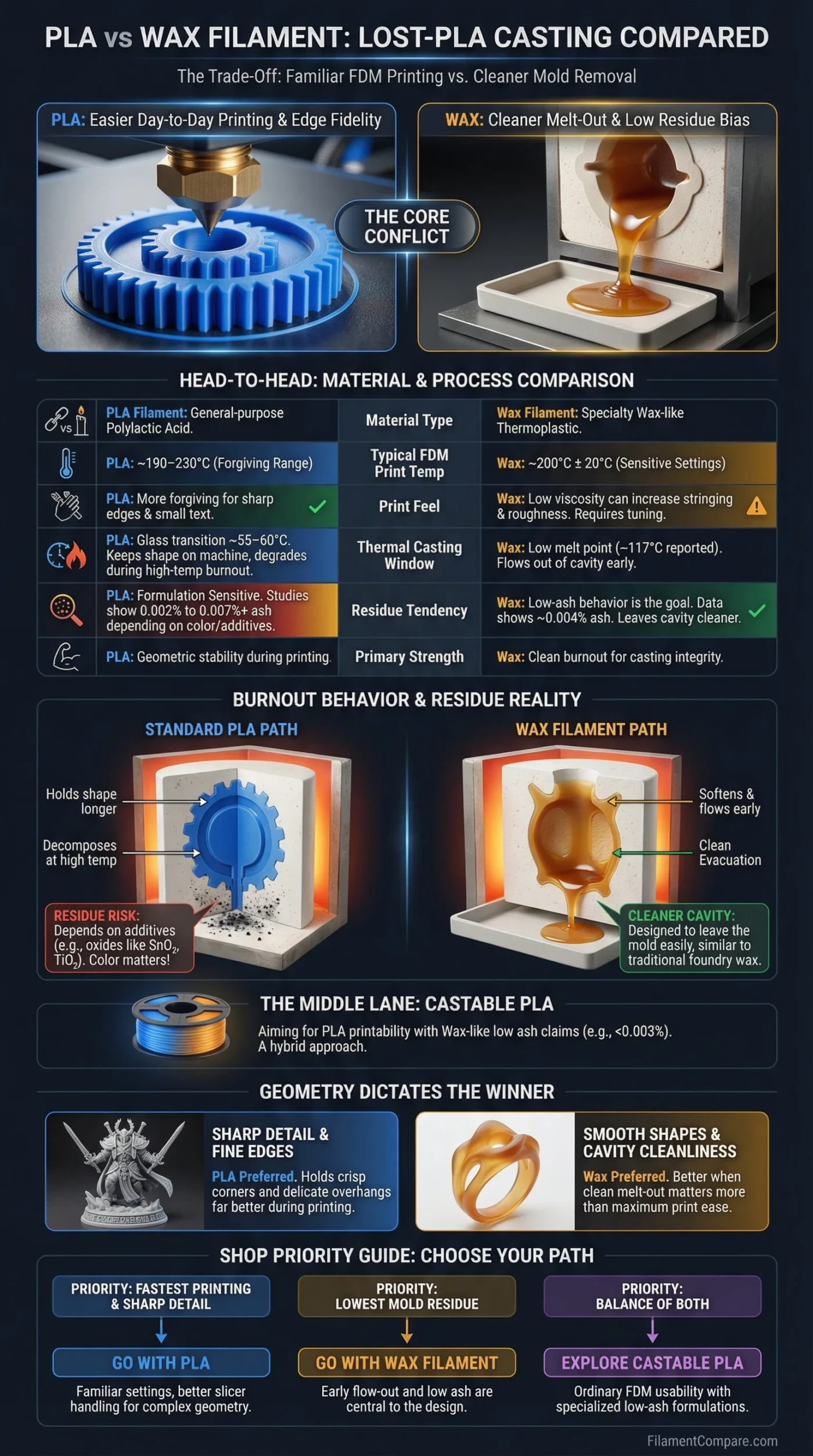
| Comparison Point | PLA Filament | Wax Filament |
|---|---|---|
| Material Type | General-purpose polylactic acid used across FDM printing.[a] | Specialty wax-like thermoplastic made for lost-wax or melt-out pattern work.[c] |
| Density | About 1.24 g/cm³ in common PLA grades.[a] | MoldLay lists density at about 1.2 g/cm³.[c] |
| Typical FDM Print Range | Usually around 190–230°C, with little or no bed heat required on many setups.[a] | MoldLay lists printing at about 200°C ± 20°C.[c] |
| Thermal Window That Matters in Casting | Glass transition around 55–60°C; printed PLA keeps shape well on the machine, then degrades during burnout rather than simply flowing out like wax.[a] | One university-cited wax filament property sheet listed a melt point of 117°C, which is part of why wax patterns can leave the cavity earlier than PLA.[d] |
| Residue Tendency | More formulation-sensitive. A 2025 plaster-mold study found residue as low as 0.007% for one black PLA and 0.002% for one transparent PLA, while other PLA colors left far more residue.[f] | Low-ash behavior is the whole point; one wax filament data set reported about 0.004% ash.[d] |
| Print Feel on a Typical Desktop FDM Printer | More forgiving for sharp edges, small text, and repeatable dimensional control.[a] | Often more sensitive to settings because low melt viscosity can increase stringing, top-layer slumping, and surface roughness if tuning is off.[g] |
| Where It Usually Feels Strongest | Patterns with fine edges, crisp lettering, and geometry that asks the printer for stable layer stacking.[d] | Patterns where clean melt-out or burnout matters more than maximum print ease.[c] |
This PLA vs wax filament reading blends manufacturer datasheets, foundry wax references, and university casting studies; the values show material trends under common casting practice, while real results still shift with geometry, shell system, burnout cycle, and printer tuning.
PLA and wax filament can both serve as sacrificial FDM patterns, yet they part ways once printing, shelling, and burnout begin. PLA usually feels familiar on the printer, while wax filament is chosen for cleaner pattern removal.[d] That split shapes nearly every trade-off in lost-PLA casting work.
- PLA: easier day-to-day printing
- Wax: cleaner melt-out bias
- Castable PLA sits in the middle
- Residue depends on formulation
- Geometry changes the winner
What the Two Materials Really Are
Standard PLA is a mainstream FDM polymer with density around 1.24 g/cm³, a glass transition around 55–60°C, and a print range commonly centered near 190–230°C.[a] Those numbers explain why it holds edges well during printing and why so many shops try it first for printed investment patterns.
Wax filament is a different family. MoldLay describes itself as a wax-alike thermoplastic for lost-wax casting, while university work on machinable wax filament reports low ash, low density, and a much lower melt point than PLA.[c] That is the whole appeal. It is built to leave the mold more like wax and less like a full polymer burnout route.
There is also a middle lane: castable FDM filament made for investment casting. PolyCast, for example, uses ordinary FDM-style print settings while claiming ash residue below 0.003% by weight.[b] In other words, the PLA vs wax question often hides a third choice.
Burnout Behavior and Residue in the Mold
This is where the comparison becomes practical. A BYU casting paper notes that conventional FDM plastics such as PLA often leave ash residue that can mark the cavity surface, while wax and wax-like materials are used to cut that problem down.[d] Clean burnout matters because residue can show up later as surface blemishes or extra cleanup at the casting stage.
PLA is not one fixed burnout story. A 2025 study on plaster mold casting found that different PLA colors produced very different residue levels, with one transparent PLA at 0.002% and one black PLA at 0.007%, while other pigmented samples left much more solid residue made up of oxides such as SnO₂, TiO₂, and Al₂O₃.[f] Small sentence, big takeaway: PLA color and additive package are not trivial.
Wax filament is purchased for the opposite reason. One wax filament property set reported about 0.004% ash and a 117°C melt point.[d] MoldLay also describes low-temperature burn-out and flow-out behavior similar to hot paraffin.[c] It wants to leave the cavity early, not fight through a full polymer decomposition path.
That said, foundry wax is not magic. A foundry wax reference points out that wax behavior is shaped by viscosity, melting point, expansion, and ash.[e] Cleaner removal does not erase process discipline.
Printing Behavior on Desktop FDM Machines
PLA usually wins the printer-side contest. It lays down detail cleanly, tolerates ordinary slicer habits, and stays dimensionally tidy on features that would make wax filament look soft around the edges.[a] For shops that already know PLA, the workflow feels normal.
Wax filament can print well, but it asks for more patience. The BYU study comparing wax filament and PLA found recurring issues with bed adhesion, layer separation, stringing, and small-detail printing; the authors still achieved clean castings, yet they also concluded that PLA remained the better option in many cases because the wax demanded more tuning effort.[d]
A later wax-filament study reached a similar theme from another angle. It found that nozzle temperature had the biggest effect on dimensional accuracy, and that the low viscosity that helps wax leave the mold can also raise printed surface roughness unless the settings are dialed in carefully.[g] Same material. Different phase. Different problem.
Relative Shop Tendencies for Pattern Printing
The meter above is not a lab scorecard. It simply reflects the trend seen across the cited datasheets and studies: PLA is usually easier to print well, while wax filament is usually easier to remove cleanly.[d]
Surface Finish, Edge Definition, and Cast Outcome
Printer behavior echoes into the casting. In the BYU side-by-side casting study, wax produced very clean burnout, yet the PLA casting came out with sharper defined edges and better visible detail in that test series.[d] That is a useful reminder that a cleaner burnout path does not automatically mean a cleaner-looking final part.
If the pattern has fine engraved text, thin fins, or crisp corners, PLA often starts with an advantage because the print itself is easier to keep stable. If the pattern is larger, smoother, and less obsessed with tiny edges, wax filament becomes more attractive because the shell cavity is less likely to inherit stubborn polymer residue.[d]
Castable PLA-style products try to narrow that gap. PolyCast, for example, keeps a PLA-like print range while claiming ash residue below 0.003% by weight, which is exactly why this category has drawn so much attention in FDM-based investment casting.[b]
Where Geometry Changes the Better Choice
- Fine lettering and sharp corners: PLA usually holds these features more cleanly during printing.[d]
- Smoother, fuller shapes with moderate detail: Wax filament becomes more appealing because its melt-out behavior aligns better with casting-focused removal.[c]
- Patterns where cavity cleanliness is the first priority: Wax or castable PLA-style materials deserve a close look before ordinary PLA.[b]
- Prints with lots of tiny retractions or delicate overhangs: PLA is usually easier to tune and repeat on common FDM hardware.[g]
- PLA with unknown pigment package or filler load: residue risk is harder to predict, so formulation matters more than the label “PLA” alone suggests.[f]
PLA vs Wax Filament by Shop Priority
| Shop Priority | Usually Leans Toward | Why |
|---|---|---|
| Fast path from CAD to printed pattern | PLA | Common print settings, familiar slicer behavior, and cleaner handling of small geometric detail.[a] |
| Lowest residue pressure inside the mold | Wax Filament | Low-ash and early-flow behavior are central to wax-pattern design.[d] |
| Sharper printed edges before investing | PLA | University comparison work found PLA prints and castings held edge definition well in side-by-side testing.[d] |
| Middle Ground Between Print Ease and Clean Burnout | Castable PLA-Style Filament | Materials such as PolyCast aim for ordinary FDM usability with very low ash claims.[b] |
| Unknown Filament Color Package or Filler Load | Avoid Assumptions | PLA residue in plaster-mold testing changed a lot with color and additive package.[f] |
Data Points That Deserve Attention on a Filament Sheet
- Ash Content
- For sacrificial patterns, this number has direct casting value. Lower is usually better, but compare only when the test basis is clearly stated.[b]
- Glass Transition or Melt Point
- PLA and wax filament leave the mold by different thermal routes. PLA keeps its printed shape well, while wax is chosen because it softens and flows sooner.[a]
- Density
- Density affects mass in the invested shell and can also hint at how a formulation differs from ordinary PLA or from a lighter wax blend.[c]
- Recommended Print Temperature
- This tells you how familiar the material may feel on a normal FDM machine. PLA lives in a very common zone; wax blends vary more and can be more touchy.[g]
- Notes on Viscosity, Flow, or Burn-Out
- These small lines in a datasheet often explain more than the headline spec. Wax references repeatedly tie casting behavior to viscosity, fluidity, expansion, and ash.[e]
Resources Used
- [a] NatureWorks Ingeo 4043D Technical Data Sheet
- [b] Polymaker PolyCast Product Page
- [c] MoldLay Wax-Alike Filament Sheet
- [d] Brigham Young University: Using Wax Filament Additive Manufacturing for Low-Volume Investment Casting
- [e] Blayson: Understanding Investment Casting Wax
- [f] Estonian Academy Publishers: Application Issues of Additive Manufacturing in Plaster Mold Casting
- [g] Applied Sciences: Process Parameter Optimization for 3D Printed Investment Casting Wax Pattern and Its Post-Processing Technique
