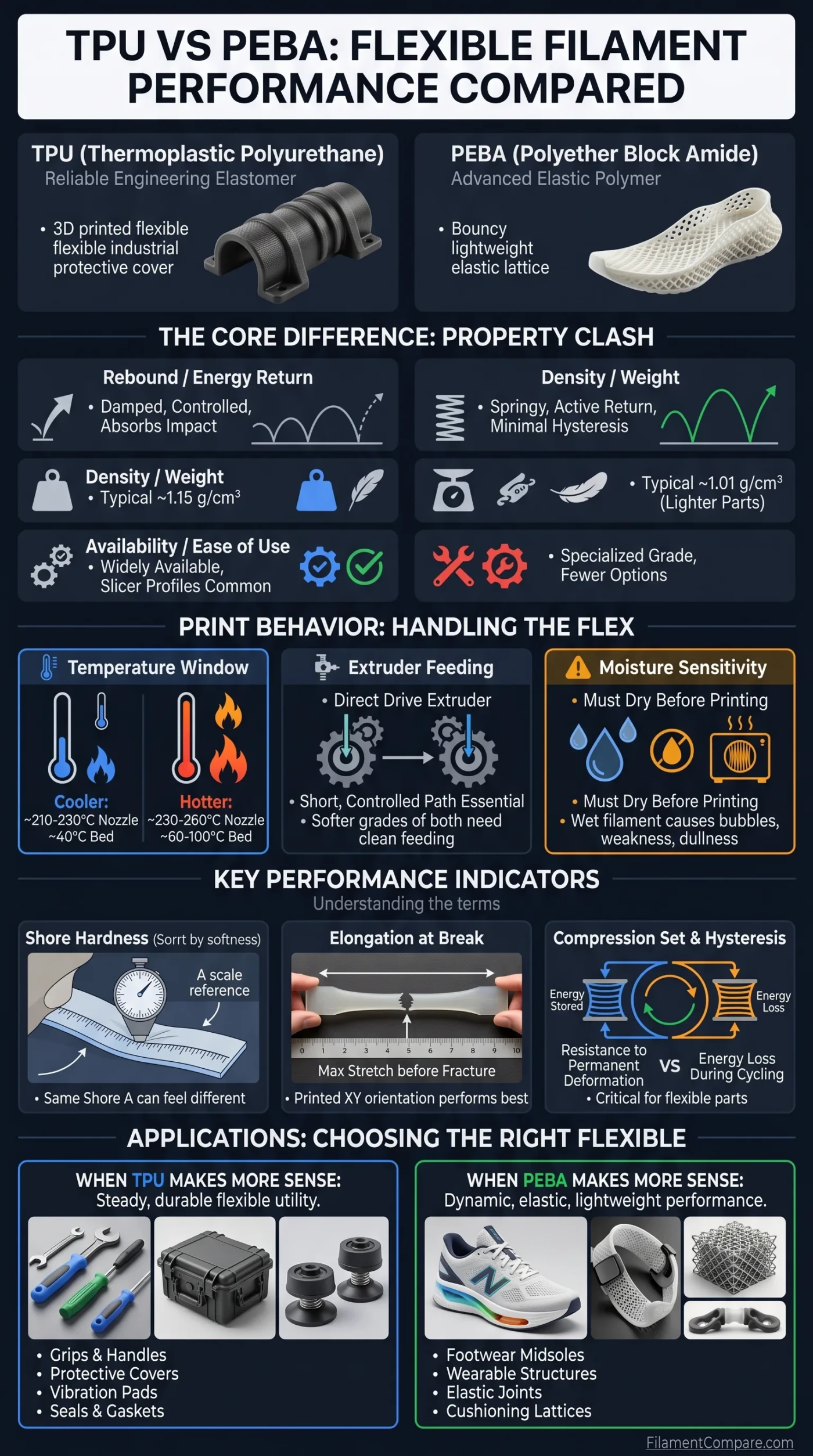
| Comparison Point | TPU Filament | PEBA Filament |
|---|---|---|
| Full Material Name | Thermoplastic polyurethane, usually sold as TPU 85A, 90A, 95A, 98A, and related flexible grades. | Polyether block amide, often sold as PEBA 85A, 90A, PEBA-S, or Pebax-based flexible filament. |
| Polymer Structure | Polyurethane elastomer chemistry, commonly chosen for layer bonding, abrasion resistance, and flexible functional prints. | Polyamide hard segments plus polyether soft segments; this gives PEBA a strong mix of light weight and elastic rebound. |
| Typical Hardness Examples | 95A-class TPU datasheets commonly report values around 92–96 Shore A, depending on brand and test timing.[a] | Current PEBA filaments commonly appear around 85A–93A, with grade and supplier changing the feel of the printed part.[b] |
| Density Trend | TPU 95A examples are often denser; one published TPU 95A filament density is 1.149 g/cm³. | PEBA filament examples often sit near 1.00–1.013 g/cm³, so comparable parts can be lighter. |
| Elongation Behavior | TPU can stretch far before break when printed well; one 95A TPU example reports 661% elongation at break in the flat XY orientation. | PEBA filaments are also highly stretchable; PEBA-S is listed with >550% tensile elongation at break in its filament sheet.[c] |
| Rebound and Energy Return | TPU has useful elastic recovery and damping, with a more controlled, rubber-like return in many printed parts. | PEBA is usually selected when higher rebound, lower energy loss, and springier response matter. |
| Print Speed Range | Many TPU profiles are calmer at slower speeds; one TPU 95A datasheet gives 15–40 mm/s as a recommended range. | Some PEBA 90A filaments publish broader speed ranges such as 25–110 mm/s, provided the feed path and drying are controlled. |
| Nozzle and Bed Temperatures | Typical TPU examples often run around 210–230°C nozzle and about 40°C bed, with grade-specific variation. | Many PEBA examples run hotter, often around 230–260°C nozzle and 60–100°C bed, depending on the product sheet. |
| Moisture Sensitivity | TPU benefits from dry storage and drying before critical prints, especially for smooth surfaces and clean extrusion. | PEBA also needs dry handling. Moisture control matters because soft, elastic materials show print defects quickly when wet. |
| Typical Part Uses | Grips, seals, cable strain relief, protective covers, soft feet, gaskets, vibration pads, phone cases, and flexible prototypes. | Wearables, sports parts, footwear-like components, rebound elements, lightweight flexible mechanisms, cushioning parts, and dynamic joints. |
| Material Availability | TPU has broader retail availability and more hardness choices across hobby, prosumer, and production-focused filament brands. | PEBA is a more specialized flexible filament class, with fewer grades but a clear role in springy, lightweight printed parts. |
This TPU and PEBA comparison uses manufacturer datasheets plus polymer and standards references; the figures are trend and standard comparisons, while real results can shift with hardness grade, brand, printer hardware, drying, and test orientation.
TPU and PEBA are both flexible 3D printing filaments, but they do not feel the same in a printed part. TPU often behaves like a dependable rubber-like engineering filament: grippy, wear-resistant, and widely supported by slicer profiles. PEBA feels more spring-driven. It is lighter, often bouncier, and better matched to parts that are repeatedly flexed, compressed, or snapped back into shape.
- TPU: widely available
- PEBA: lighter density trend
- TPU: strong wear profile
- PEBA: higher rebound focus
- Both: moisture-sensitive
- Both: direct drive friendly
TPU and PEBA as Flexible Filament Families
TPU belongs to the thermoplastic polyurethane family. In FDM and FFF printing, it is valued because it combines rubber-like flex with the melt-processing behavior of a thermoplastic. That is why TPU appears in so many flexible filament comparisons: it covers soft grips, seals, dampers, hinges, protective sleeves, and parts that need to bend without becoming brittle.
PEBA stands for polyether block amide. Arkema describes Pebax-type PEBA as a family made from rigid polyamide segments and soft polyether segments, with a broad flexibility range and low hysteresis behavior.[d] In printed filament form, that chemistry shows up as elastic snap-back, low density, and a lively feel under repeated compression.
Why the Same Shore Number Can Still Feel Different
A 90A TPU and a 90A PEBA may share a similar Shore A hardness, yet the printed parts can feel different in use. Shore hardness measures indentation resistance. It does not fully describe rebound, damping, compression set, tear behavior, or layer-to-layer strength.
Two materials can press the same under a durometer and still return energy differently. That matters.
Performance Difference by Material Behavior
Flexibility and Softness
TPU is often the more familiar flexible filament because it covers a wide hardness span. A soft TPU bends easily. A 95A TPU bends less but feeds more cleanly and keeps shape better. For parts such as protective covers, feet, grips, or bumpers, that predictable flex makes TPU easy to specify.
PEBA can also be soft, but its identity is not only softness. The material is usually discussed through rebound, energy return, and low density. A PEBA part may feel springier than a TPU part at a similar Shore A rating because less energy is lost as heat during deformation.
Elastic Recovery and Rebound
Elastic recovery is where PEBA often has the clearer technical identity. Some PEBA filament datasheets publish rebound figures around the 60–70% range, depending on the test and grade. That does not mean every PEBA spool will behave the same. It means PEBA is usually aimed at parts that need a more active return after bending or compression.
TPU can still rebound well, especially in thinner walls and lattice-like geometry, but it is often more damped. That can be useful. For vibration feet, soft bump stops, cushioning pads, and grippy contact surfaces, controlled damping may be more useful than a springy return.
Relative Feel in Printed Parts (general trend, not a lab chart)
Ease of Finding Print Profiles (market trend)
Tensile Strength and Elongation
Both TPU and PEBA can show high elongation at break. The more useful question is not only “Which stretches farther?” It is which material keeps the right shape after the part is stretched, bent, compressed, and released many times.
Printed TPU can deliver strong elongation and impact behavior when the part is oriented well. Ultimaker’s TPU 95A sheet shows how orientation changes values: the printed XY and YZ directions report far higher elongation than the upright Z direction, where interlayer bonding becomes more visible in the result.[e] That pattern applies to PEBA too. Flexible filaments are still printed layer by layer.
Density and Weight
PEBA’s lower density trend is one of its most practical advantages. A part printed from PEBA can be lighter than a comparable TPU part when geometry and infill are similar. For footwear-like components, wearable pads, robotics contact parts, and elastic lattices, weight reduction can be as important as softness.
TPU is usually heavier, but that extra density can pair well with a grounded, damped feel. A TPU bumper or machine foot may feel stable because it does not try to spring back as aggressively as a PEBA part.
Print Behavior and Machine Fit
Extruder Path and Feeding
Flexible filaments ask more from the extruder than rigid PLA or PETG. TPU and PEBA both prefer a short, controlled path between drive gears and hotend. A direct drive extruder usually makes the process easier, while some harder TPU grades can still run through carefully tuned Bowden systems.
TPU 95A is often the safer starting point for printers that already have mature TPU profiles. Softer TPU, PEBA 85A, and very elastic PEBA grades need cleaner feeding. The filament can compress inside the path, so the drive system has to push smoothly without chewing the surface.
Temperature Window
TPU often prints at lower nozzle temperatures than many PEBA filaments. That can make TPU more forgiving on all-metal hotends and common build surfaces. PEBA commonly uses a hotter nozzle and a warmer bed, which helps melt flow and bonding but asks more from thermal control.
Hotter does not mean harder. It only means the polymer needs a different melt window.
| Processing Detail | TPU Trend | PEBA Trend | What It Means for Printed Parts |
|---|---|---|---|
| Nozzle Temperature | Often around 210–240°C, depending on hardness and formulation. | Often around 230–260°C in many PEBA filament sheets. | PEBA may need more heat for stable flow; TPU often has a wider printer base already tuned for it. |
| Bed Temperature | Often around 40–70°C, with product-specific advice. | Often around 60–100°C, especially for harder or higher-flow PEBA grades. | Bed adhesion and warping behavior depend on surface, part size, and cooling. |
| Print Speed | Usually slower for clean flexible extrusion, especially with soft grades. | Some PEBA grades publish higher speeds when the filament path is low-friction. | Speed depends more on feed stability than on the name printed on the spool. |
| Drying Need | Drying improves surface finish, extrusion consistency, and layer quality. | Drying is also important; wet PEBA can show stringing, popping, and rougher walls. | Dry storage matters for both, especially for long prints and thin walls. |
| Retraction | Lower retraction and slower movement often work better than aggressive settings. | Short, controlled retraction is usually preferred to avoid stretching and pressure lag. | Stringing control comes from temperature, drying, travel moves, and clean feeding together. |
Moisture and Surface Quality
Moisture is not a minor detail with flexible filament. TPU and PEBA can both absorb enough water to change extrusion behavior. A wet spool may produce fine bubbles, extra stringing, dull surfaces, weak-looking seams, or uneven walls. The print may still finish, but the surface tells the story.
For data-heavy comparison, moisture also affects testing. A dried specimen and a humid specimen may not produce the same tensile or rebound behavior. That is one reason datasheets often list conditioning, print direction, infill, nozzle temperature, or drying steps beside the numbers.
Mechanical Metrics That Matter More Than the Label
Shore A Hardness
Shore A is useful for sorting flexible filaments by indentation feel. ISO 48-4 describes durometer Shore hardness for vulcanized or thermoplastic rubber using A, D, AO, and AM scales.[f] For flexible filaments, Shore A helps compare general softness, but it should not be treated as a full performance rating.
A 95A TPU part can be easier to print than an 85A TPU part because it resists buckling in the feed path. A 90A PEBA part may feel livelier than a 90A TPU part because rebound and hysteresis are different. Same number. Different feel.
Elongation at Break
Elongation at break shows how far a specimen stretches before it breaks under a tensile test. It is useful, but printed-part geometry changes the result. A flat dog-bone test specimen, a thin gasket, and a gyroid lattice do not distribute stress in the same way.
For TPU vs PEBA, elongation tells only part of the story. PEBA may be chosen for rebound even when TPU offers similar stretch. TPU may be chosen for wear surfaces even when PEBA offers lower density. The application decides which measurement matters more.
Tensile Strength and Modulus
Tensile strength gives a stress value before break; modulus describes stiffness in the early part of deformation. ASTM D638 is a standard tensile method used for plastics data and material control.[g] Some flexible filament datasheets use other elastomer-focused methods, so numbers should be compared only when test methods and sample conditions are close.
This is where many simple TPU vs PEBA comparisons get too broad. If one value comes from a printed XY specimen and another comes from molded resin, the comparison is not clean. For printed filament, print orientation, wall count, infill, and drying sit next to the polymer chemistry.
Compression Set and Hysteresis
Compression set describes how much a material stays deformed after being squeezed for a period of time. Hysteresis describes energy loss during cyclic deformation. These two terms are very useful for flexible parts, because a printed foot, cushion, seal, or spring element rarely bends just once.
TPU often gives a controlled, damped response. PEBA is often chosen for lower energy loss and a more active rebound. One is not automatically “better.” The part’s job decides the more suitable behavior.
Where TPU Fits Well
TPU Is a Strong Match for Familiar Flexible Parts
TPU is often the practical choice when a design needs rubber-like flexibility, steady printability, and broad filament availability. It has many hardness grades, many slicer profiles, and many real-world use cases in small printed parts.
- Grips and handles: TPU gives a tactile, slightly rubbery surface without needing complex geometry.
- Protective covers: It bends around corners and handles repeated contact well.
- Machine feet and vibration pads: Damping can be more useful than a very springy rebound.
- Seals and gaskets: TPU can work well when the design uses the right compression and wall thickness.
- Cable strain relief: It flexes repeatedly while keeping a controlled shape.
TPU also has a broad material ecosystem. There are soft grades, firm grades, chemical-resistant grades, transparent grades, carbon-filled variants, and high-speed branded versions. That variety matters for sites comparing flexible filament because “TPU” is not one fixed material.
Where PEBA Fits Well
PEBA Is Built Around Lively Elastic Response
PEBA is often chosen when the printed part needs spring-back, light weight, and repeated dynamic flex. It is less common than TPU, but it has a clear role where rebound and mass matter together.
- Footwear-like components: PEBA is well known in sports and cushioning applications because of its energy-return profile.
- Wearable flexible structures: Lower density helps when the part sits on a moving body or device.
- Elastic joints: PEBA can suit parts that flex, return, and flex again many times.
- Robotics contact pads: A springier surface can help with soft contact and return motion.
- Cushioning lattices: PEBA can pair well with geometry that stores and releases energy.
PEBA is not only “softer TPU.” Its chemistry and density change the way a part behaves. A PEBA lattice may feel alive under compression, while a TPU lattice may feel calmer and more damped. The difference is easy to feel in the hand.
Part Geometry Changes the Winner
Flexible filament performance depends heavily on geometry. A solid TPU pad can feel stiff even with a soft material. A thin-walled PEBA structure can feel very elastic. A lattice can change both materials more than a small Shore A difference does.
- Wall count: More walls usually make both TPU and PEBA feel firmer.
- Infill pattern: Gyroid, cubic, and low-density infills can make flexible parts more compressible.
- Layer height: Thicker layers may improve flow but can change surface feel and detail.
- Print orientation: Z-axis loading depends on interlayer adhesion, not just polymer stretch.
- Part thickness: Soft filament becomes much firmer when the section is thick.
For comparison articles, this geometry point matters because many short material summaries treat TPU and PEBA like raw pellets only. FDM parts are not raw pellets. They are printed shells, roads, seams, and layers.
TPU vs PEBA by Use Case
| Part Type | TPU Fit | PEBA Fit | Material Logic |
|---|---|---|---|
| Phone Case or Protective Shell | Very good fit, especially 95A-class TPU. | Possible, but often selected only when low weight or spring-back is wanted. | TPU’s grip, abrasion behavior, and profile availability suit protective parts. |
| Running-Shoe-Like Cushion Part | Useful for damping and flexible support. | Very strong fit when rebound and lighter mass are central. | PEBA’s energy-return identity is better aligned with dynamic cushioning. |
| Gasket or Seal | Often a better starting material because many grades are easy to source and tune. | Useful for specialized lightweight or elastic sealing concepts. | Compression behavior, chemical contact, and surface finish matter more than name alone. |
| Robot Gripper Pad | Good for grip and controlled damping. | Good when a springier, lighter contact pad is preferred. | TPU can feel tackier; PEBA can return shape faster depending on grade. |
| Flexible Lattice | Good for soft compression and damping. | Very good for elastic bounce and weight savings. | Geometry can amplify PEBA’s rebound or TPU’s damping. |
| Cable Relief or Bend Guard | Very good fit. | Possible, but usually not necessary unless low weight or rebound is part of the design. | TPU’s availability and steady flex behavior suit everyday flexible utility parts. |
Material Selection by Performance Priority
When TPU Makes More Sense
TPU makes more sense when the part needs steady flexible durability, a rubber-like feel, and a lower-risk printing path. It is also the more familiar choice for many desktop printers because slicer profiles and troubleshooting references are widely available.
- Choose TPU-style behavior for controlled damping.
- Choose TPU-style behavior for grippy contact surfaces.
- Choose TPU-style behavior for common flexible accessories.
- Choose TPU-style behavior when the printer already handles 95A material well.
When PEBA Makes More Sense
PEBA makes more sense when the part’s value comes from rebound, lower weight, and repeated elastic return. It is a more specialized material, so the printer setup and drying routine have to be treated with care, but the result can feel very different from a standard TPU print.
- Choose PEBA-style behavior for springy compression parts.
- Choose PEBA-style behavior for lightweight flexible mechanisms.
- Choose PEBA-style behavior for sports, wearable, and cushioning concepts.
- Choose PEBA-style behavior when rebound matters more than a damped rubber feel.
Common Misreadings in TPU and PEBA Comparisons
“Same Shore A” Does Not Mean Same Performance
Shore A is one measurement. Useful, yes. Complete, no. A 90A material can have very different rebound, tear strength, melt flow, density, and layer adhesion depending on polymer family and formulation.
Datasheet Values Are Not Universal Values
Datasheets are best read as controlled reference points. They reflect a material, specimen shape, test method, conditioning, and printing setup. If the same filament is printed wet, too cold, too fast, or upright in the Z direction, the measured result can change.
PEBA Is Not Only for Softness
PEBA’s main appeal is not simply being soft. It is the blend of low density, elastic return, and dynamic response. For a plain rubber foot, TPU may feel more natural. For a springy lattice, PEBA may make the design feel more responsive.
TPU Is Not One Material
TPU covers a wide range. A 98A TPU, a 95A TPU, and an 85A TPU do not print or flex the same way. Some are tuned for speed. Some are tuned for softness. Some focus on wear or chemical exposure. Treating all TPU as one fixed filament leads to weak comparisons.
Practical Reading of the Datasheet
- Density
- Lower density means less mass for the same part volume. PEBA often has the advantage here.
- Shore A Hardness
- Useful for first sorting by softness, but not enough to judge rebound or damping.
- Elongation at Break
- Shows stretch before break under a test, but printed geometry and orientation can change the real part behavior.
- Tensile Strength
- Useful for comparing test specimens, but the test method and print orientation must match for a fair reading.
- Rebound or Bayshore Rebound
- Helpful for PEBA-style applications where stored energy and return motion matter.
- Vicat Softening Point
- A thermal reference, not a full service-temperature guarantee for printed parts under load.
Short Answers to Common TPU vs PEBA Questions
Is PEBA more flexible than TPU?
PEBA can feel more elastic and springy, but flexibility depends on Shore hardness, grade, geometry, and print settings. A soft TPU can bend more easily than a firmer PEBA, while PEBA may still rebound faster after compression.
Is TPU easier to print than PEBA?
For many desktop printers, TPU is easier to start with because profiles, hardness choices, and user experience are more common. PEBA can print very well, but it benefits from dry filament, a smooth feed path, and stable extrusion.
Does PEBA replace TPU?
No. PEBA and TPU overlap, but they are not direct replacements in every design. TPU fits many flexible utility parts; PEBA is better aligned with lightweight, rebound-focused, dynamic parts.
Which material is better for gaskets?
TPU is often the more common gasket choice because it is easier to source and tune. PEBA can work for specialized elastic designs, but the seal design, compression level, surface finish, and chemical exposure decide the better material.
Why do PEBA parts feel bouncier?
PEBA’s polymer structure is associated with low energy loss and strong elastic return. In printed parts, that can feel like a quicker spring-back compared with the more damped feel of many TPU prints.
Resources Used
- [a] BASF Forward AM, Ultrafuse TPU 95A Technical Data Sheet: Technical data sheet
- [b] eSUN, PEBA-90A Technical Data Sheet: Technical data sheet
- [c] Kimya PEBA-S 3D Filament Data Sheet: Technical data sheet
- [d] Arkema High Performance Polymers, Pebax Elastomer Family: Polymer family page
- [e] Ultimaker TPU 95A Technical Data Sheet: Technical data sheet
- [f] ISO 48-4:2018, Rubber, Vulcanized or Thermoplastic — Determination of Hardness — Shore Hardness Method: ISO standard page
- [g] ASTM D638, Standard Test Method for Tensile Properties of Plastics: ASTM standard page
