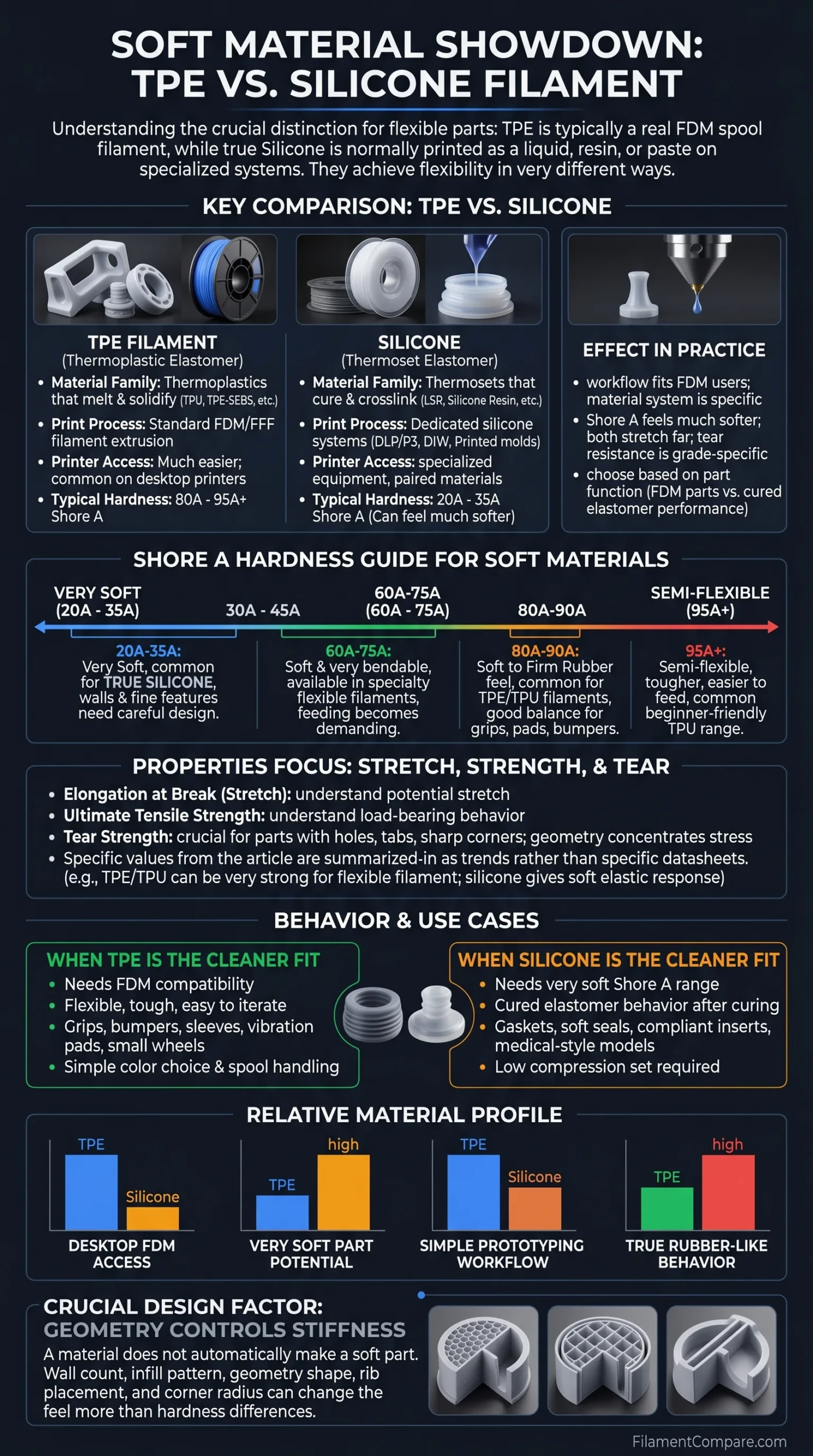
TPE vs Silicone Filament is a soft-material comparison that needs one clear distinction before the numbers start: TPE is usually a real FDM/FFF spool filament, while true silicone is usually printed as a liquid, resin, or paste-like material on dedicated systems rather than pushed through a normal hot end as a melted filament. Both can make flexible parts. They just get there in very different ways.
| Comparison Point | TPE Filament | Silicone 3D Printing Material | What It Means in Practice |
|---|---|---|---|
| Material family | Thermoplastic elastomer, often TPU, TPE-SEBS, TPC, or blended flexible polymer | Silicone elastomer, often LSR, silicone resin, or DIW/DLP printable silicone | TPE melts and solidifies; silicone normally cures or crosslinks. |
| Typical print process | FDM/FFF filament extrusion on open-material printers | Dedicated silicone printing, DLP/P3, DIW, LAM, or printed mold plus casting | TPE fits more desktop workflows; silicone needs a more specific material system. |
| Representative hardness | 85 Shore A for Jabil TPE-SEBS 1300 85A; 85 Shore A for NinjaFlex[a] | 25–30 Shore A for Stratasys P3 Silicone 25A[b] | Silicone can feel much softer at the same part geometry. |
| Elongation at break | 900% for Jabil TPE-SEBS 1300 85A; 660% for NinjaFlex[c] | 672 ± 18% for Stratasys P3 Silicone 25A[d] | Both can stretch far, but part shape, print direction, wall thickness, and infill still matter. |
| Tensile strength | 6 MPa for Jabil TPE-SEBS 1300 85A; 26 MPa ultimate for NinjaFlex[e] | 5.4 ± 0.4 MPa for Stratasys P3 Silicone 25A[f] | Some TPE/TPU filaments can carry higher tensile load; silicone is often chosen for softness and long elastic feel. |
| Tear strength | 66 N/mm for Jabil TPE-SEBS 1300 85A[g] | 16 ± 3 kN/m for Stratasys P3 Silicone 25A[h] | Tear data is very grade-specific, so compare the exact datasheets rather than the material names alone. |
| Density | 1.056 g/cm³ for Jabil TPE-SEBS 1300 85A; 1.19 g/cc for NinjaFlex[i] | 1.3 g/cm³ for P3 Silicone 25A[j] | Silicone parts may weigh more at the same volume, depending on grade. |
| Thermal behavior | Thermoplastic; Jabil reports 163°C melt temperature for its TPE-SEBS, while NinjaFlex reports 216°C melting point[k] | Thermoset/cured elastomer behavior; P3 Silicone 25A includes aging and DMA data across a wide temperature span[l] | TPE is re-meltable; silicone is selected when cured elastomer behavior is part of the requirement. |
| Printer access | Usually easier to start with, especially in 95A–85A grades | More equipment-specific and material-specific | For most desktop users, TPE is the practical first step. |
| Best-fit part types | Grips, bumpers, grommets, vibration feet, soft cases, wheels, flexible hinges | Soft seals, gaskets, skin-contact prototypes, soft pads, medical-style models, high-elasticity components | Use TPE for accessible flexible FDM parts; use silicone when the part needs true silicone behavior. |
The TPE and silicone comparison above is based on manufacturer datasheets plus recognized material-test references; the values show trend-level differences, while real printed results can change with grade, printer, orientation, post-processing, and part geometry.
TPE and Silicone Are Not the Same Kind of Soft
TPE means thermoplastic elastomer. It behaves like a rubbery plastic, but it can still be melted, extruded, cooled, and re-melted. That is why TPE, TPU, and TPE-SEBS filaments work in FDM printers. The printer heats the material, pushes it through a nozzle, and builds the part layer by layer.
Silicone is different. True silicone printing normally starts with a liquid, paste, or resin-like material that cures into an elastomer. Liquid silicone resins are described in academic additive-manufacturing literature as thermoset materials: viscous before curing, solid after polymerization or crosslinking.[m] Once cured, silicone is not used like PLA, PETG, or TPU filament. It does not simply melt back into a printable strand.
This is the main reason the phrase silicone filament can be confusing. Some products called “silicone-like” are flexible resins or elastomeric polymers, not pure silicone. Some systems print true silicone, but they use special hardware. A normal desktop FDM printer is built around thermoplastic filament, and that process depends on melt flow.[n]
For a filament comparison site, the safest wording is this: TPE is a filament category; silicone is a soft elastomer category that may be 3D printed, but usually not as a standard spool filament.
How the Printing Process Changes the Material Choice
The process matters as much as the material name. TPE filament belongs to the FDM/FFF workflow: spool, drive gears, hot end, nozzle, cooling, and layer bonding. Softer grades feed less like rigid plastic, so the extruder path, spool friction, print speed, and nozzle pressure become part of the material behavior.
Silicone printing is more tied to controlled curing. A silicone printer may meter two components, deposit a paste, cure a resin layer, or use a support medium. In direct ink writing, for example, the material must hold shape after extrusion without slumping. Tiny details matter. Very tiny.
FDM Behavior With TPE
TPE prints best when the filament path is short, well-guided, and predictable. Many flexible-filament users prefer direct-drive extrusion, although some engineered TPE-SEBS filaments are sold for open-platform direct-drive machines and can also be run on desktop printers with PTFE Bowden tubes.[o]
- Higher Shore A TPE/TPU feeds more like a semi-flexible plastic.
- Lower Shore A TPE bends more in the filament path and usually needs slower printing.
- High retraction and high speed can create buckling, under-extrusion, or inconsistent flow.
- Layer adhesion can be good, but printed parts remain direction-sensitive because FDM creates layered structure.
Dedicated Silicone Printing Behavior
True silicone systems are closer to controlled material deposition and curing than ordinary filament melting. Some DLP-style silicone materials are single-component UV-curable systems; some DIW systems use paste-like silicone chemistry. The material must be printable, hold its geometry, cure cleanly, and still keep the elastic feel expected from silicone.
That added process control is why silicone 3D printing can produce soft parts that feel closer to molded silicone, yet it also explains why it is not as casual as loading a spool. The equipment and material are paired more tightly. Less plug-and-play.
Hardness: Shore A Is the First Number to Read
For soft materials, Shore hardness is often the first comparison number. Shore A is used for soft rubber, elastomers, and similar flexible plastics, while Shore D is used for harder plastics and harder elastomers. ASTM D2240 describes durometer hardness as an indentation test, not a direct measure of strength.[p]
A lower Shore A value usually feels softer under the same shape and wall thickness. That is why 25A silicone can feel much more compliant than 85A TPE. But hardness is not the whole story. A thick 25A part can feel firm, and a thin 85A part can flex easily.
| Shore A Zone | Typical Feel | Material Notes | Design Effect |
|---|---|---|---|
| 20A–35A | Very soft rubber-like feel | More common in true silicone systems than standard FDM filament | Walls, supports, and fine features need careful design. |
| 60A–75A | Soft and very bendable | Available in some specialty flexible filaments | Feeding becomes more demanding in FDM. |
| 80A–90A | Soft rubber to firm rubber feel | Common area for flexible TPE/TPU filament | A good balance for grips, pads, bumpers, and wearable prototypes. |
| 95A+ | Semi-flexible, tougher, easier to feed | Common beginner-friendly TPU range | Useful when a part should flex but still hold shape. |
Stretch, Strength, and Tear Resistance
Elongation at break tells how far a specimen stretched before it broke in a tensile test. It does not mean every printed part can safely stretch that far. The value comes from a specific specimen, test method, print orientation, and processing setup. Still, it is useful.
Jabil’s TPE-SEBS 1300 85A reports 900% tensile elongation at break, 6 MPa ultimate tensile strength, and 66 N/mm tear strength on printed XY coupons. NinjaFlex reports 660% elongation at break and 26 MPa ultimate tensile strength. Stratasys P3 Silicone 25A reports 672 ± 18% elongation at break, 5.4 ± 0.4 MPa tensile stress at break, and 16 ± 3 kN/m tear strength.
Those numbers show a useful pattern: TPE/TPU can be very strong for a flexible filament, while silicone can deliver a softer elastic response with cured-silicone behavior. The better material depends on the part. A flexible wheel, protective bumper, or snap-on grip may favor TPE. A soft gasket, compliant pad, or skin-contact prototype may point toward silicone.
Why Tear Strength Deserves Attention
Soft parts often fail from a nick, notch, sharp corner, or thin bridge. Tear strength gives a better view of that behavior than elongation alone. A part can stretch far and still tear early if its geometry concentrates stress around a corner. Rounded transitions matter. So do wall thickness and print direction.
- Use elongation at break to understand stretch potential.
- Use tensile strength to understand load-bearing behavior.
- Use tear data when the part has holes, tabs, lips, gasket edges, or snap-on features.
- Use compression set data when the part will stay squeezed for long periods.
Heat, Moisture, and Chemical Behavior
TPE is a thermoplastic. Heat softens it, and enough heat lets it flow through a nozzle. That is helpful for FDM printing, but it also means a printed TPE part should be matched to the service temperature. Jabil lists a 163°C melt temperature for its TPE-SEBS 1300 85A; NinjaFlex lists a 216°C melting point. Those are material-characterization values, not a promise that a printed part will keep shape near those temperatures.
Silicone’s appeal often grows when the part needs cured elastomer behavior, thermal aging stability, or a more rubber-like feel after post-processing. Stratasys P3 Silicone 25A includes aging and dynamic mechanical analysis data, and its datasheet shows a storage modulus table from -49°C to 190°C. That type of data is more useful than a vague “heat resistant” claim.
Moisture behavior also differs by grade. Jabil describes its TPE-SEBS 1300 85A as non-hygroscopic and says drying is not needed during printing; NinjaFlex reports 0.22% moisture absorption over 24 hours. Do not assume all flexible filaments behave the same. TPU, TPE-SEBS, and other TPE families can differ sharply here.
Surface Finish and Detail Quality
FDM TPE parts usually show layer lines because the part is built from visible extruded roads. Flexible materials can hide some lines with their soft surface, but small features may round off, especially when the material is very soft or printed slowly. A direct-drive setup, dry filament when needed, and steady extrusion make the surface cleaner.
Silicone printing can produce a smoother, molded-like feel when the system is built for that material. Stratasys notes that P3 Silicone 25A is aimed at fine features with surface finish suitable for seals, gaskets, and selected wearable or consumer components. The printer-material pair matters.
Design Detail That Often Gets Missed
A soft material does not automatically make a soft part. Geometry controls stiffness. Wall count, infill, ribs, holes, lattice shape, gasket lip height, and corner radius can change the feel more than a small difference in Shore A hardness.
Printability: TPE Wins on Access, Silicone Wins on True Silicone Feel
For most desktop 3D printer users, TPE filament is easier to access. A typical open-material FDM printer can often print 95A TPU or firmer TPE with modest changes. Softer 85A and lower materials need more care, but the workflow is still familiar: spool, slicer, nozzle, bed, and part.
Silicone has a different entry point. True silicone printing often belongs to professional machines or specialized material platforms. Formlabs groups silicone production options into direct silicone 3D printing, silicone-like materials, and printed molds for casting silicone.[q] That is a useful split because many users who search for silicone filament really need either flexible filament or a cast/printed true silicone workflow.
When TPE Is the Cleaner Fit
- The project needs FDM compatibility.
- The part should be flexible, but not extremely soft.
- The design is a grip, bumper, sleeve, wheel, vibration pad, cap, or soft-touch housing.
- The part may need repeated flexing with simple replacement if worn.
- The work needs easy color choice, spool handling, and a familiar slicer workflow.
When Silicone Is the Cleaner Fit
- The part needs a very soft Shore A range.
- The application calls for true silicone behavior after curing.
- The part is a soft gasket, seal, pad, compliant insert, or skin-contact prototype.
- The design benefits from a low compression set material grade.
- The available equipment supports direct silicone printing or silicone casting from printed molds.
Relative Material Profile
The bars below are not lab measurements. They are a practical reading of the material categories, using common access, datasheet trends, and process needs. They help compare direction, not certify a part.
Desktop FDM Access
Very Soft Part Potential
Simple Prototyping Workflow
True Rubber-Like Silicone Behavior
Part Geometry Can Reverse the Feel
A material comparison can look clean on a datasheet and messy in a real part. A 95A TPU part with thin walls can feel softer than an 85A TPE part printed solid. A 25A silicone gasket with a thick rectangular cross-section can feel firmer than expected. Shape is a silent variable.
Flexible parts should be read as material plus structure. For TPE, slicer settings such as wall count, infill pattern, perimeter direction, top/bottom thickness, and seam placement affect bending. For silicone, support strategy, curing depth, post-processing, and uncured material handling can change accuracy and surface quality.
Good Geometry for TPE
- Rounded corners instead of sharp internal corners.
- Thicker tabs where the part will be pulled by hand.
- Thin flex zones separated from load-carrying zones.
- Low infill for softer compression pads.
- More perimeters for wear surfaces and grip edges.
Good Geometry for Silicone
- Smooth transitions around gasket lips and soft seals.
- Avoiding tall, unsupported, very soft features unless the printer process supports them.
- Generous radii where the part bends often.
- Enough wall thickness to survive handling after printing and curing.
- Simple stress paths for parts that stretch repeatedly.
Compression Set and Long-Term Squish
Compression set is one of the most useful values for seals, feet, pads, and gasket-like parts. It describes how much a material fails to return after being compressed under defined conditions. A low compression set is helpful when a part must stay squeezed and still recover.
Jabil reports a 45% compression set for its TPE-SEBS 1300 85A under the listed test condition, while P3 Silicone 25A reports 6% after 22 hours at 23°C under ASTM D395-03 condition B. These numbers come from different materials and datasheets, so they should not be treated as a universal TPE-versus-silicone rule. They do show why silicone often attracts gasket and seal attention.
| Part Function | Property to Check First | Why It Matters | Material Direction |
|---|---|---|---|
| Soft grip | Shore A, surface feel, abrasion behavior | The part must feel comfortable and resist handling wear. | TPE often fits well. |
| Vibration foot | Hardness, damping behavior, compression set | The part is loaded, compressed, and repeatedly vibrated. | TPE or silicone, depending on load and environment. |
| Gasket or soft seal | Compression set, tear strength, chemical exposure | The part must recover after pressure and avoid tearing at edges. | Silicone often fits well when true silicone behavior is needed. |
| Flexible hinge | Elongation, fatigue behavior, layer direction | The part bends many times along one zone. | TPE is usually easier in FDM. |
| Skin-contact prototype | Material certification, hardness, post-processing chemistry | The material must match the intended contact context and documentation. | Use documented silicone or certified flexible materials only. |
Cost, Availability, and Printer Setup
TPE filament is widely sold in 1.75 mm and 2.85 mm spools, with many grades between semi-flexible and very soft. The lower the hardness, the more the printer setup matters. A constrained filament path, gentle extrusion, low speed, and moderate retraction usually improve consistency. It is a material you can tune.
Silicone is a more controlled route. Direct silicone printing materials are typically paired with a specific printer platform, curing method, or post-processing process. That can raise the entry cost, but it can also produce parts closer to molded silicone behavior. For many users, a printed mold plus cast silicone is still a practical bridge when the final part must be true silicone.
Testing Standards Make the Numbers Comparable
Datasheets often mention ASTM or ISO methods because the test method defines the specimen, speed, environment, and measurement style. ASTM D638 is used for tensile properties of plastics, ASTM D624 for tear strength of rubber and thermoplastic elastomers, ASTM D792 for density, and ASTM D2240 for durometer hardness. Without the test method, a number can be easy to misread.
One more detail: FDM parts are anisotropic. UltiMaker’s TPU 95A datasheet shows different tensile stress and elongation values across XY, YZ, and Z orientations, with Z-direction elongation far lower than the side or flat orientation in the listed test set.[r] That is normal for layered printing. Design load paths with that in mind.
Material Vocabulary for Better Comparison
- TPE
- Thermoplastic elastomer. A broad category of melt-processable rubber-like plastics used in flexible FDM filaments.
- TPU
- Thermoplastic polyurethane. A common TPE family with strong flexible-filament use, often seen in 85A–98A grades.
- TPE-SEBS
- A styrene-based thermoplastic elastomer family. Some grades are soft, flexible, and designed for lower moisture sensitivity.
- Silicone
- A cured elastomer family known for soft feel, elastic recovery, and broad use in seals, pads, and molded rubber-like parts.
- LSR
- Liquid silicone rubber. A two-part liquid silicone system that cures into a solid elastomer.
- DIW
- Direct ink writing. A process that extrudes paste-like material and depends on rheology, shape retention, and curing.
- DLP/P3 Silicone
- A light-based process/material route that cures a silicone material through a controlled platform, not a normal FDM spool path.
Choosing Between TPE and Silicone
Choose TPE filament when the project belongs on an FDM printer and the target is flexible, tough, and easy to iterate. It is the more accessible route for many soft parts: phone-style cases, grippy surfaces, bumpers, hinge-like tabs, protective covers, small wheels, and vibration pads.
Choose true silicone printing or silicone casting when the part needs very soft Shore A behavior, a silicone-like rebound, a gasket-style response, or documented performance that belongs to a cured silicone material. The workflow may be more specialized, but the final feel can be much closer to molded silicone.
The cleanest comparison is not “which one is better.” It is which material matches the process and the part. TPE is the flexible filament choice. Silicone is the true soft elastomer choice when the equipment and material route support it.
Common Material Questions
Is Silicone Filament Real?
Most true silicone 3D printing is not ordinary FDM filament printing. Some products may be marketed as silicone-like, but they can be flexible resin, TPU, TPE, or another elastomeric material. For a real silicone part, check whether the datasheet states silicone chemistry, curing route, Shore hardness, tensile data, and post-processing method.
Is TPE the Same as TPU?
No. TPU is one type of TPE. TPE is the broader family. TPU is common in flexible filaments because it combines elasticity, abrasion behavior, and FDM printability. TPE-SEBS is another branch with its own moisture, softness, and surface-feel profile.
Which One Feels Softer?
Silicone often reaches lower Shore A hardness values than common FDM TPE/TPU filaments, so it can feel softer. Part geometry can change that feel. A thin TPE wall may flex more easily than a thick silicone block.
Which One Is Easier to Print?
TPE is usually easier for users with standard FDM printers. Silicone printing needs a compatible silicone process, printer, resin, paste, or casting workflow. For ordinary desktop printing, TPE is the simpler material path.
Which One Is Better for Gaskets?
Silicone is often preferred when a gasket needs true silicone behavior, low compression set, and soft recovery. TPE can still work well for prototype gaskets, low-pressure seals, pads, and flexible interfaces where FDM accessibility matters more than silicone chemistry.
Resources Used
- [a] Jabil TPE-SEBS 1300 85A Filament Technical Data Sheet
- [b] Stratasys P3 Silicone 25A Material Data Sheet
- [c] NinjaTek NinjaFlex 3D Printing Filament Technical Specifications
- [d] Stratasys P3 Silicone 25A Material Data Sheet
- [e] NinjaTek NinjaFlex 3D Printing Filament Technical Specifications
- [f] Stratasys P3 Silicone 25A Material Data Sheet
- [g] Jabil TPE-SEBS 1300 85A Filament Technical Data Sheet
- [h] Stratasys P3 Silicone 25A Material Data Sheet
- [i] NinjaTek NinjaFlex 3D Printing Filament Technical Specifications
- [j] Stratasys P3 Silicone 25A Material Data Sheet
- [k] Jabil TPE-SEBS 1300 85A Filament Technical Data Sheet
- [l] Stratasys P3 Silicone 25A Material Data Sheet
- [m] Direct 3D printing of a two-part silicone resin to fabricate highly stretchable structures
- [n] Formlabs Guide to 3D Printing Materials: Types, Applications, and Properties
- [o] Jabil TPE-SEBS 1300 85A Filament Technical Data Sheet
- [p] ASTM D2240 Standard Test Method for Rubber Property—Durometer Hardness
- [q] Formlabs Can You 3D Print Silicone? Best Silicone 3D Printers and Alternatives
- [r] UltiMaker TPU 95A Technical Data Sheet
