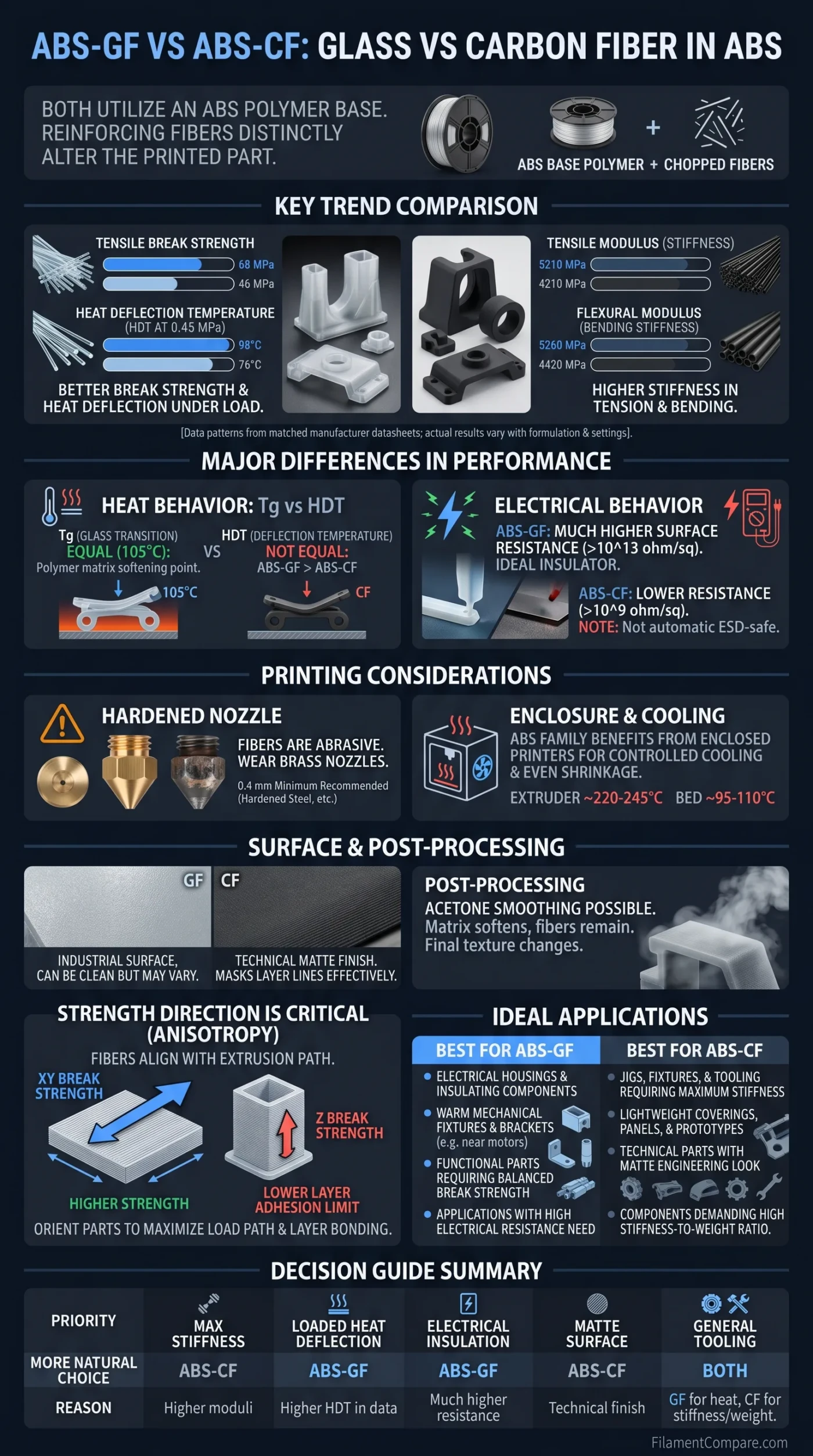
ABS-GF and ABS-CF start with the same ABS base polymer, yet the fiber inside the filament changes the printed part in a clear way. Glass fiber-reinforced ABS tends to favor heat deflection, electrical insulation, and balanced strength, while carbon fiber-reinforced ABS tends to favor higher stiffness-to-weight, matte surfaces, and dimensional control.
| Property | ABS-GF Reference Grade [a] | ABS-CF Reference Grade [b] | What the Number Means |
|---|---|---|---|
| Fiber type | Glass fiber in an ABS matrix | Carbon fiber in an ABS matrix | The reinforcing fiber changes stiffness, heat behavior, surface resistance, density, and print feel. |
| Density | 1.15 g/cc | 1.11 g/cc | ABS-CF is slightly lighter in this matched pair; ABS-GF carries the higher density of glass fiber. |
| Tensile strength at break | 68 MPa | 46 MPa | In this reference set, ABS-GF shows the higher break strength in XY-flat printed specimens. |
| Tensile modulus | 4210 MPa | 5210 MPa | ABS-CF is stiffer in tension, so it resists stretching more under load. |
| Tensile elongation at break | 2% | 2% | Both are fiber-filled ABS grades with limited stretch compared with many unfilled polymers. |
| Flexural strength | 70 MPa | 76 MPa | ABS-CF is slightly higher in this bending-strength value. |
| Flexural modulus | 4420 MPa | 5260 MPa | ABS-CF has the higher bending stiffness in the reference data. |
| Glass transition temperature | 105°C | 105°C | The ABS matrix is still the thermal base; the fibers do not turn ABS into a high-temperature polymer. |
| Deflection temperature at 0.45 MPa | 98°C | 76°C | ABS-GF performs better in this loaded heat-deflection test for the matched reference grades. |
| Surface resistance | >1013 ohm/sq | >109 ohm/sq | ABS-GF reads more electrically insulating; ABS-CF is lower in resistance, but not automatically an ESD-safe grade. |
| Typical nozzle need | Hardened 0.4 mm minimum | Hardened 0.4 mm minimum | Both are abrasive filled filaments and should be treated as nozzle-wearing materials. |
| General printing temperature range | 230–245°C extruder, 95–110°C bed | 220–240°C extruder, 100–110°C bed | Both sit in the ABS printing family and normally benefit from enclosure control. |
This ABS-GF vs ABS-CF comparison uses manufacturer datasheets and technical standard references; the values show material trends, while real printed results can shift with brand formulation, fiber length, nozzle size, chamber temperature, part orientation, and slicer settings.
What Changes When ABS Gets Glass or Carbon Fiber?
Plain ABS is known for tough functional parts, higher heat resistance than PLA, and useful post-processing behavior. Add chopped fiber and the material becomes more dimensionally steady, more rigid, and more abrasive at the nozzle. Same family. Different personality.
In ABS-GF, chopped glass fiber sits inside the ABS matrix and helps the part resist bending, shrinkage, and loaded heat deformation. It is often the more natural choice when the printed part needs strength with electrical insulation, especially in brackets, fixtures, housings, and parts that sit near warm equipment.
In ABS-CF, chopped carbon fiber gives the material a stiffer feel with a lower-density reinforcement. The printed surface often looks matte and technical, and thin walls can feel firmer than their weight suggests. The trade is not “better or worse.” It is about what the part is being asked to do.
Important reading note: fiber-filled ABS is still printed layer by layer. A high datasheet number in XY orientation does not guarantee the same behavior in Z direction, at screw holes, around sharp corners, or in a thin upright feature.
Data Patterns Worth Noticing
Stiffness and Strength Are Not the Same Measurement
The matched reference data shows ABS-CF with a higher tensile modulus and higher flexural modulus. That means it resists elastic stretching and bending more strongly before visible movement occurs. For a long, flat bracket or a fixture arm, that extra stiffness can be useful.
ABS-GF, in the same reference pair, shows a higher tensile strength at break. That does not cancel the ABS-CF stiffness advantage; it simply means the two materials win different tests. A stiff part is not always the same thing as a higher break-strength part.
Relative Pattern From the Reference Grades
These bars are a visual reading of the same datasheet trends, not a universal rating for every spool on the market.
Tensile Modulus
Tensile Strength at Break
Heat Deflection at 0.45 MPa
Heat Behavior: Tg Is Equal, HDT Is Not
Both reference materials list a glass transition temperature of 105°C. That is the temperature region where the ABS matrix begins to soften in a polymer-science sense. It is not the same as a loaded-use temperature.
The more practical comparison is the deflection temperature under load. In the matched 3DXTECH data, ABS-GF reaches 98°C at 0.45 MPa, while ABS-CF reaches 76°C under the same stated load condition. That makes ABS-GF the stronger candidate in this specific low-load heat-deflection reading.
This is one reason datasheets matter. A part can have the same ABS matrix and the same listed Tg, yet show a different loaded heat response because the fiber type, fiber length, fiber content, and bonding to the ABS all affect how the specimen bends as temperature rises.
Electrical Behavior Is a Real Difference
Glass fiber is usually chosen when the part should remain electrically insulating. Carbon fiber lowers surface resistance, so ABS-CF can sit closer to the dissipative side than ABS-GF, depending on the exact formulation. Still, a carbon-filled ABS should not be treated as ESD-safe unless the spool is sold and tested for that purpose.
The reference values make this easy to see: ABS-GF lists >1013 ohm/sq, while ABS-CF lists >109 ohm/sq. Both numbers are high, but they are not the same kind of high.
Printing Behavior and Machine Requirements
ABS-GF and ABS-CF are not casual PLA-style materials. They print in the ABS temperature range, they prefer stable thermal conditions, and they contain abrasive fibers. An enclosed printer is not just a comfort feature here; it helps the part cool more evenly.
Temperature, Bed Heat, and Enclosure Control
The 3DXTECH ABS-GF product page lists a 230–245°C extruder range and 95–110°C bed range, with a heated chamber recommended when possible [c]. The ABS-CF page lists 220–240°C extruder temperature, 100–110°C bed temperature, and a heated chamber recommendation [d].
Those ranges sit close to normal ABS printing, but the fiber changes shrinkage behavior. Reinforcement can help reduce warping and improve dimensional stability, yet the ABS matrix still appreciates controlled cooling. Large flat parts, tall parts, and parts with heavy infill remain more sensitive than small compact pieces.
Hardened Nozzles Are Part of the Material Choice
Both materials need a hardened nozzle because chopped fiber rubs against the nozzle bore during extrusion. Brass can print a little, then drift. Slowly. A worn nozzle changes line width, surface quality, and dimensional accuracy before the user always notices it.
A 0.4 mm hardened nozzle is commonly listed as the minimum in manufacturer guidance, but thicker nozzles may feel more stable with fiber-filled ABS because short fibers, additives, and pigments all move through the melt path together. The material is still printable; it simply asks for abrasion-aware hardware.
Moisture and Surface Quality
ABS is less moisture-sensitive than nylon, yet dry filament still matters for surface finish and consistent extrusion. Filled ABS can hide small surface defects because the fiber gives the surface a satin or matte appearance, especially in carbon-filled grades.
That matte look can be useful for fixtures, covers, and visible technical parts. It also makes ABS-CF popular where the printed surface should look neat without heavy finishing. ABS-GF can also look clean, though its value is more often tied to thermal and insulating behavior.
Strength Direction: XY, YZ, and Z Matter
Datasheet values for FDM materials are shaped by print orientation. Fibers tend to align with the extrusion path, and layers bond in a different direction than the bead itself. This gives printed parts anisotropic behavior, meaning the part is not equally strong in every direction.
UltiMaker’s ABS-CF Method datasheet separates values by XY, YZ, and Z orientation and shows how the same material can report different modulus and break strength depending on specimen direction [e]. That is a valuable reminder for any ABS-GF vs ABS-CF decision: the fiber is only part of the story.
Why XY Values Often Look Stronger
In an XY-flat specimen, the load often follows roads of extruded polymer and fiber. In a Z-oriented specimen, the load asks more from layer bonding. This is why a bracket printed flat can feel much stronger than the same bracket printed upright, even when both are made from the same spool.
Fiber Does Not Replace Good Part Orientation
Carbon fiber can raise stiffness, and glass fiber can raise heat-deflection performance, but neither fiber removes the need to think about layer direction, wall count, hole placement, and load path. A printed ABS-CF part with thin Z-loaded tabs may still behave differently from a thicker ABS-GF part printed flat.
Where ABS-GF Makes More Sense
ABS-GF is a strong fit when the part needs balanced mechanical strength, useful heat behavior under load, and high electrical resistance. The reference data gives it a higher tensile break value and a higher heat-deflection value than the matched ABS-CF grade, which makes it attractive for loaded warm-service parts.
- Electrical housings where insulation is part of the material decision.
- Warm fixtures, brackets, locating blocks, and support parts.
- Parts that need stiffness without moving toward carbon-filled electrical behavior.
- Functional ABS parts where heat deflection matters more than the lowest possible weight.
Glass-filled ABS also tends to feel less “specialized” than carbon-filled ABS in electrical contexts. It stays closer to an insulating engineering plastic, while still gaining the print-stability benefits associated with chopped-fiber reinforcement.
Where ABS-CF Makes More Sense
ABS-CF is the natural candidate when the part needs higher stiffness-to-weight, a technical matte surface, and strong dimensional stability. It is especially useful when a printed component must hold shape under moderate mechanical load without feeling bulky.
- Jigs, fixtures, gauges, and alignment parts where stiffness improves repeatability.
- Lightweight brackets and covers where a firm feel matters.
- Prototypes that need a matte engineering-material surface.
- Parts where lower density is useful, as long as the heat-deflection value suits the load.
Stratasys describes its ABS-CF10 as ABS with 10% chopped carbon fiber by weight and reports it as stiffer and stronger than standard ABS in that product family [f]. That lines up with the broader pattern: carbon fiber is usually chosen to raise stiffness and reduce part flex.
Part Function Comparison
| Part Requirement | ABS-GF Fit | ABS-CF Fit | Reason |
|---|---|---|---|
| High stiffness in thin parts | Good | Very strong fit | Carbon fiber raises tensile and flexural modulus strongly in the reference comparison. |
| Higher loaded heat deflection | Very strong fit | Good when grade data supports it | The matched ABS-GF reference shows the higher HDT at 0.45 MPa. |
| Electrical insulation | Very strong fit | Grade-dependent | ABS-GF has much higher listed surface resistance in the reference data. |
| Low part weight | Good | Very strong fit | Carbon fiber has a lower-density effect in the matched reference grades. |
| Matte technical surface | Good | Very strong fit | Carbon-filled ABS commonly gives a muted, low-gloss finish. |
| Fixtures and tooling | Strong fit | Strong fit | Both can work well; load direction, heat, and electrical needs decide the better match. |
| Acetone smoothing interest | Possible by grade | Possible by grade | The ABS matrix may allow vapor smoothing, but fiber changes the final surface texture. |
Measurement Terms Used in ABS-GF and ABS-CF Datasheets
- Tensile Strength
- The stress a printed test specimen reaches before breaking in a pulling test. ISO 527 gives general principles for tensile properties of plastics and plastic composites [g].
- Tensile Modulus
- The stiffness in tension. A higher number means the part stretches less under a given pulling load.
- Flexural Strength
- The stress reached in bending before failure or a defined strain point. ISO 178 covers flexural properties of rigid and semi-rigid plastics [h].
- Flexural Modulus
- The stiffness in bending. It matters for brackets, arms, panels, clips, and parts that must hold shape.
- Heat Deflection Temperature
- The temperature where a plastic specimen reaches a set deflection under a set load. ISO 75 explains that this is a relative test and should not be read as a guaranteed maximum use temperature [i].
- Surface Resistance
- The resistance to current flow along the surface. ASTM D257 covers DC resistance, volume resistance, and surface resistance procedures for insulating materials [j].
ABS-GF vs ABS-CF for Heat, Load, and Electronics
For warm mechanical parts, ABS-GF deserves close attention because its reference-grade heat deflection result is higher. If a fixture sits near a motor, lamp housing, enclosure wall, or warm machine area, the difference between Tg and HDT becomes more than a datasheet detail. It affects fit.
For electronics-adjacent parts, ABS-GF also has a cleaner story when insulation is preferred. The high surface resistance value keeps it closer to a conventional insulating polymer. ABS-CF can still be useful in housings and covers, but its lower resistance means the exact electrical requirement should be checked before use.
For load-bearing stiffness, ABS-CF has the stronger argument. The higher tensile and flexural modulus values point to a firmer printed part, especially in flat, ribbed, or shell-supported geometry. A long arm printed in ABS-CF can resist bend with less bulk, provided the temperature and layer-direction demands stay within the material’s tested range.
Surface Finish, Post-Processing, and Visual Result
ABS-CF often gives a matte black surface that hides layer reflections and looks more uniform than many glossy thermoplastics. That can be useful for visible fixtures, camera mounts, electronic covers, and instrument panels where a clean technical look is part of the design.
ABS-GF may look slightly less carbon-matte, depending on pigment and formulation, but it can still print with a steady industrial surface. The visual difference is not only about color. The fiber changes how light scatters across the bead lines, and carbon fiber usually masks those lines more strongly.
Acetone smoothing can work with ABS-based materials, yet filled grades do not behave exactly like plain ABS. The polymer matrix may soften while the fibers remain in place, so the final surface can become smoother without becoming as glassy as unfilled ABS. Small test pieces are sensible when finish matters.
Cost, Availability, and Brand Variation
ABS-GF and ABS-CF usually cost more than standard ABS because the material has added reinforcement, tighter compounding demands, and a narrower user base. ABS-CF is often priced higher, especially when high-modulus carbon fiber is used, but pricing moves by brand, spool size, and region.
Brand variation is large. One ABS-CF may be tuned for stiffness and surface finish, another for heat behavior, another for print reliability. ABS-GF can also vary in glass loading, fiber length, base ABS blend, and impact modifier package. The material name alone is not enough.
The cleanest comparison is always grade against grade. Match the values that matter: tensile modulus, flexural modulus, tensile strength, HDT at the same load, surface resistance, nozzle recommendation, and stated specimen orientation.
Reading ABS-GF and ABS-CF Datasheets Without Misreading Them
- Compare the same test direction. XY-flat values should not be treated as Z-direction values.
- Check the load on HDT. A 0.45 MPa heat-deflection value is not the same as a 1.8 MPa value.
- Look for surface resistance. Carbon-filled does not automatically mean ESD-safe.
- Check the nozzle note. Filled ABS usually needs hardened steel or another abrasion-resistant nozzle.
- Use datasheet values as reference data. They help compare materials, but they do not replace testing for a final part.
Common Questions About ABS-GF and ABS-CF
Is ABS-CF stronger than ABS-GF?
It depends on which strength measure is being discussed. In the matched reference data, ABS-CF has higher tensile and flexural modulus, while ABS-GF has higher tensile strength at break and higher heat deflection at 0.45 MPa.
Is ABS-GF better for heat than ABS-CF?
For the matched reference grades in this comparison, ABS-GF has the higher deflection temperature under load. That makes it the stronger heat-deflection candidate in this data set, while other brands should be checked by their own datasheets.
Does ABS-CF conduct electricity?
ABS-CF often has lower surface resistance than ABS-GF because of carbon fiber, but that does not automatically make it conductive or ESD-safe. A spool should list tested electrical properties if that behavior is required.
Do ABS-GF and ABS-CF need a hardened nozzle?
Yes. Both contain chopped fibers that can wear softer nozzles over time. A hardened nozzle is the normal hardware choice for both glass-filled and carbon-filled ABS.
Can ABS-GF and ABS-CF replace injection-molded ABS?
They can be useful for prototypes, fixtures, and functional printed parts, but FDM layer direction makes the printed part different from an injection-molded one. The safest comparison uses the exact print orientation, load direction, and test method.
Material Choice by Priority
| Priority | More Natural Choice | Why |
|---|---|---|
| Maximum stiffness from the reference pair | ABS-CF | Higher tensile modulus and flexural modulus. |
| Higher break strength from the reference pair | ABS-GF | Higher tensile strength at break in the matched XY-flat data. |
| Higher loaded heat-deflection result | ABS-GF | Higher HDT at 0.45 MPa in the matched data. |
| Lower density | ABS-CF | Lower listed density in the matched reference pair. |
| Electrical insulation preference | ABS-GF | Higher surface resistance in the reference data. |
| Matte technical appearance | ABS-CF | Carbon fiber-filled ABS commonly gives a low-gloss printed surface. |
| General tooling and fixtures | Both | ABS-GF leans heat/insulation; ABS-CF leans stiffness/low weight. |
ABS-GF is usually the more natural pick when heat deflection, insulation, and balanced break strength are the main concerns. ABS-CF is usually the more natural pick when stiffness, lower density, and matte finish sit higher on the list. Both can be excellent ABS-family engineering filaments when the printer, nozzle, part orientation, and datasheet limits are treated as part of the material decision.
Resources Used
- [a] 3DXTECH Technical Data Sheet: FibreX™ ABS+GF10 Glass Fiber ABS
- [b] 3DXTECH Technical Data Sheet: CarbonX™ Carbon Fiber ABS 3D Printing Filament
- [c] 3DXTECH FibreX ABS+GF Product Page
- [d] 3DXTECH CarbonX ABS+CF Product Page
- [e] UltiMaker ABS-CF Method Technical Data Sheet
- [f] Stratasys ABS-CF10 Data Sheet
- [g] ISO 527-1:2019 Plastics — Determination of Tensile Properties
- [h] ISO 178:2019 Plastics — Determination of Flexural Properties
- [i] ISO 75-1:2020 Plastics — Determination of Temperature of Deflection Under Load
- [j] ASTM D257 Standard Test Methods for DC Resistance or Conductance of Insulating Materials
