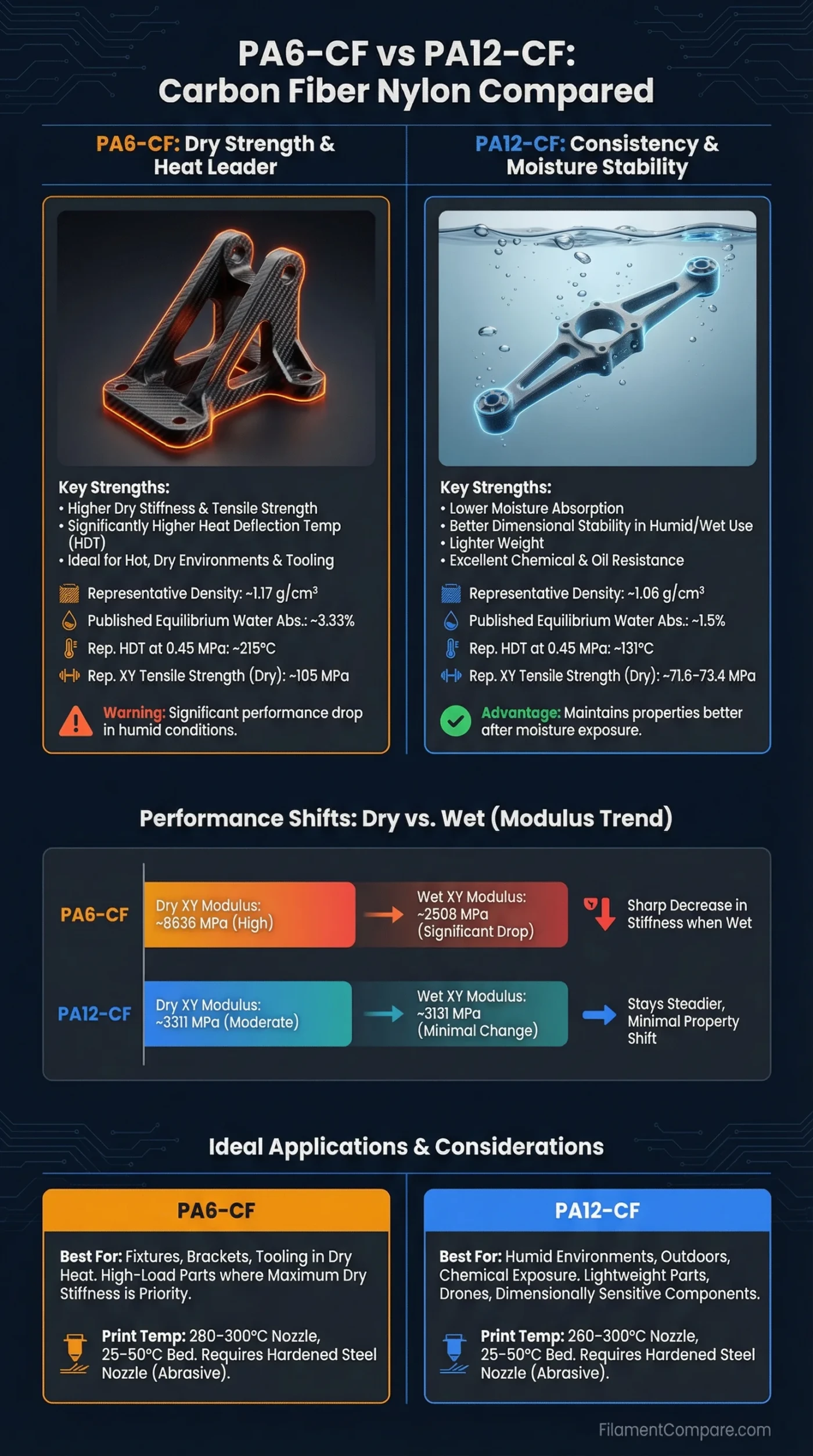
| Property | PA6-CF | PA12-CF | What It Usually Means |
|---|---|---|---|
| Representative CF filament density | 1.17 g/cm3 [a] | 1.06 g/cm3 [b] | PA12-CF is lighter, which helps when weight and inertia matter. |
| Published equilibrium water absorption in CF filament | 3.33% [a] | About 1.5% [b] | PA12-CF usually moves less as humidity rises. |
| Base nylon water absorption, 24h / 96h | 0.3 / 0.6% [d] | 0.04–0.07% [e] | The polymer family trend already leans toward PA12 in humid use. |
| Representative HDT at 0.45 MPa | 215°C [a] | 131°C [b] | PA6-CF carries more heat headroom in this published comparison. |
| Representative HDT at 1.8 MPa | 173°C [a] | 105°C [b] | Under a higher test load, the same pattern still holds. |
| Representative XY tensile strength | 105 MPa [a] | 71.6–73.4 MPa [b] | PA6-CF usually aims higher in dry structural loading. |
| Representative XY Young’s modulus | 7453 MPa [a] | 3054–3304 MPa [b] | Stiffer parts often come from PA6-CF, provided moisture is controlled. |
| Current published dry-to-wet XY modulus trend | 8636 MPa dry to 2508 MPa wet [c] | 3311 MPa dry to 3131 MPa wet [h] | PA12-CF usually stays steadier after moisture pickup. |
| Representative print temperature window | 280–300°C nozzle, 25–50°C bed [a] | 260–300°C nozzle, 25–50°C bed [b] | Both are engineering nylons, though PA12-CF often feels less fussy in storage and handling. |
| Typical fit | Hotter, stiffer, dry-running parts [f] | Humid, chemically exposed, dimensionally sensitive parts [f] | The split is rarely about one material being “better.” It is about which trade-off matters more. |
Methodology note: This PA6-CF and PA12-CF comparison blends published manufacturer datasheets with established polymer reference pages, so the figures show family-level tendencies under stated test conditions rather than a promise that every spool will print the same way.
PA6-CF and PA12-CF can look similar on a store page, yet they separate fast once moisture uptake, part temperature, and long-term dimensional stability enter the picture. PA6-CF usually pushes harder on dry stiffness and heat, while PA12-CF usually gives a calmer, lower-uptake response in humid use. [f]
- PA6-CF: higher dry stiffness
- PA6-CF: higher published HDT
- PA12-CF: lower water uptake
- PA12-CF: lower density
- PA12-CF: steadier wet properties
How PA6-CF and PA12-CF Actually Split
Dry Strength and Heat
PA6-CF usually leads on dry structural numbers. In Polymaker’s archived PolyMide PA6-CF datasheet, the printed XY values reach 105 MPa tensile strength, 7453 MPa Young’s modulus, and 215°C heat deflection temperature at 0.45 MPa. [a]
In the matching archived PolyMide PA12-CF datasheet, the printed XY values sit around 71.6–73.4 MPa tensile strength, 3054–3304 MPa Young’s modulus, and 131°C HDT at 0.45 MPa. That is still engineering-grade territory, just with a different balance. [b]
This is why PA6-CF often suits hot, stiff tooling and brackets better when the environment stays dry. It is not subtle. [a]
Moisture Changes the Story
Current Fiberon data shows how sharply PA6-CF can move after moisture pickup: PA6-CF20 is listed at 8636 MPa XY modulus dry and 2508 MPa wet, while dry XY tensile strength is 109.3 MPa and wet XY tensile strength is 54.7 MPa. [c]
Current Fiberon PA12-CF10 stays far closer to its dry state. The published XY modulus moves from 3311 MPa dry to 3131 MPa wet, and XY tensile strength shifts from 77.4 MPa to 71.7 MPa. [h]
Evonik describes the same pattern from the PA12 matrix side, noting that PA12 absorbs less water than PA6 or PA66 and that the drop in tensile strength after conditioning is only very small. [g]
That is the real pivot point. If the part will live in changing humidity, the dry-number lead of PA6-CF can narrow fast, while PA12-CF tends to hold its shape and properties with less drama.
Density, Chemical Exposure, and Dimensional Stability
Base-polymer data explains why PA12-based carbon-fiber nylons often feel easier to live with over time. Ensinger lists PA6 at 1.14 g/cm3 with water absorption of 0.3 / 0.6% after 24 / 96 hours. [d]
Ensinger lists PA12 at just 1.02 g/cm3 with water absorption of 0.04–0.07% after 24 / 96 hours, and describes it as one of the lowest-water-uptake polyamides. [e]
Arkema also states that PA12 carries lower moisture uptake, better dimensional stability, and stronger resistance to oils, fuels, and hydraulic fluids than PA6. [f]
Put plainly, PA6-CF usually wins the dry stiffness race. PA12-CF usually wins the “what happens after a week in real air” race.
Why Many Nylon-CF Comparisons Drift Off Course
The first reason is filler loading. Fiberon PA6-CF20 is published as a 20 wt% carbon-fiber material. [c]
Fiberon PA12-CF10 is published as a 10 wt% carbon-fiber material. [h]
So a PA6-CF20 versus PA12-CF10 chart is not judging nylon chemistry alone. It is also judging how much fiber is in the blend. That matters a lot, and many short comparison posts skip it.
The second reason is conditioning. A dry tensile number, a wet modulus number, and an annealed HDT number can all belong to the same filament but tell very different stories. If the test state is not clear, the ranking can look cleaner than the real material behavior.
The third reason is that the market has moved. Archived pure PA6-CF and PA12-CF datasheets show a very clean family split, while some current products blend in different fiber percentages and modified nylon systems. That does not make the old family trend wrong. It just means you should read the small print before treating any single table as final.
What the Layer Direction Still Does
Carbon fiber raises stiffness, but it does not erase layer-direction spread. Archived PA6-CF data shows 105 MPa XY tensile strength versus 67.7 MPa in Z, and 7453 MPa XY modulus versus 4354 MPa in Z. [a]
Archived PA12-CF shows the same shape: about 71.6 MPa XY tensile strength versus 43.3 MPa in Z, and 3304 MPa XY modulus versus 1801 MPa in Z. [b]
That is easy to miss. A very nice XY number can make a filament look tougher than the final part will feel if the load crosses the layer stack (and many real parts do).
Print Behavior and the Process Window
PA6-CF is abrasive enough that the archived Polymaker datasheet warns against brass nozzles and pegs rough brass-nozzle life at around 9 hours. [a]
The archived PA12-CF datasheet repeats the same warning, with the same rough brass-nozzle lifespan and the same push toward hardened steel or ruby-style wear-resistant nozzles. [b]
PA6-CF also carries the stricter storage note. Polymaker says it should be stored and used under dry conditions below 20% relative humidity. [a]
PA12-CF is still a nylon, so drying still matters, yet Fiberon describes low moisture sensitivity as the main advantage of Nylon 12 over Nylon 6 filaments and ranks moisture resistance within its nylon-CF line as PA12-CF10 above PA6-CF20. [h]
Annealing shows up again and again in these datasheets. That is not filler copy. It tells you both materials respond strongly to post-print thermal treatment, especially when you care about heat handling and dimensional steadiness.
Where Each Material Fits Best
PA6-CF Usually Makes More Sense For
- fixtures, brackets, and tooling that value dry stiffness and higher published HDT
- parts running near heat where humidity can be controlled before and after printing
- applications where the extra density is acceptable and the top priority is a harder, stiffer feel
PA12-CF Usually Makes More Sense For
- parts stored or used in humid air, variable workshops, or field conditions
- components where lower water uptake, lighter weight, and dimensional steadiness matter more than chasing the highest dry modulus
- parts exposed to oils, fuels, or hydraulic fluids, or anything that benefits from PA12’s calmer chemical and moisture profile
The short version is this: PA6-CF usually asks for more discipline and pays back with more dry heat-and-stiffness upside. PA12-CF usually gives away some of that peak and pays you back in consistency.
Terms Worth Checking on Any Nylon-CF Datasheet
A few lines on the sheet tell most of the story, and they are easy to overlook when the product name sounds familiar. [a]
- HDT at 0.45 MPa vs 1.8 MPa
- These are not two different materials. They are the same material tested under two different loads. The lower load gives the higher temperature.
- Dry vs Wet or Conditioned
- Nylons do not keep the same numbers after moisture pickup. PA6-based grades usually shift more. PA12-based grades usually shift less.
- XY vs Z
- XY is the in-plane direction of the printed road pattern. Z is the layer-stack direction. For structural parts, the gap can be a bigger story than the headline tensile value.
- Equilibrium Water Absorption
- This is the moisture level the material trends toward over time. It is one of the clearest clues for dimensional stability in real storage and real use.
- Carbon-Fiber Percentage
- Two filaments can both be called carbon-fiber nylon and still carry very different fiber loadings. That changes stiffness, weight, abrasion, and often print behavior.
Resources Used
- [a] Polymaker — PolyMide PA6-CF TDS — Source
- [b] Polymaker — PolyMide PA12-CF TDS — Source
- [c] Fiberon by Polymaker — PA6-CF20 Product Page — Source
- [d] Ensinger — PA 6 / TECAMID 6 Natural — Source
- [e] Ensinger — PA 12 / TECAMID 12 Natural — Source
- [f] Arkema — Rilsamid Polyamide 12 Material — Source
- [g] Evonik — Thermoplastics / PA12 Composite Matrix Notes — Source
- [h] Fiberon by Polymaker — PA12-CF10 Product Page — Source
