| Material Family | Official Example | Published Tensile Strength | Published Modulus | Published Elongation at Break | Published Impact Strength | Published Heat Resistance | What the Numbers Usually Suggest |
|---|---|---|---|---|---|---|---|
| Tough PLA | UltiMaker Tough PLA | 45.3 MPa tensile stress at yield, XY | 2797 MPa tensile modulus, XY | 9.4%, XY | 8.9 kJ/m² Charpy, XY | 58.3 °C HDT at 0.455 MPa | More ductile than plain PLA, solid impact behavior, still fairly stiff |
| Tough PLA | colorFabb Tough PLA | 55 MPa tensile strength | 2550 MPa Young’s modulus | 8.6% | 5.8 kJ/m² Charpy notched | Not listed in the 3D printed section | Lower stiffness than many plain PLA grades, but less brittle and easier to trust in functional parts |
| PLA+ | PolyLite PLA Pro | 49.8 MPa tensile strength, X-Y | 2932.2 MPa Young’s modulus, X-Y | 6.3%, X-Y | 17.1 kJ/m² Charpy, X-Y | 59.3 °C HDT at 0.45 MPa | Very balanced profile: high rigidity, good tensile strength, and unusually strong impact data for a PLA+ style grade |
| PLA+ | eSUN PLA+ | 63 MPa tensile strength | 1973 MPa flexural modulus | 20% | 9 kJ/m² Izod | 53 °C heat distortion temperature | A softer and more forgiving published profile, with the usual warning that not every test setup matches printed-part datasheets |
This Tough PLA and PLA+ comparison blends official datasheets and standard references, so the numbers show published trends under stated test methods rather than a promise for every spool, printer, or part geometry.
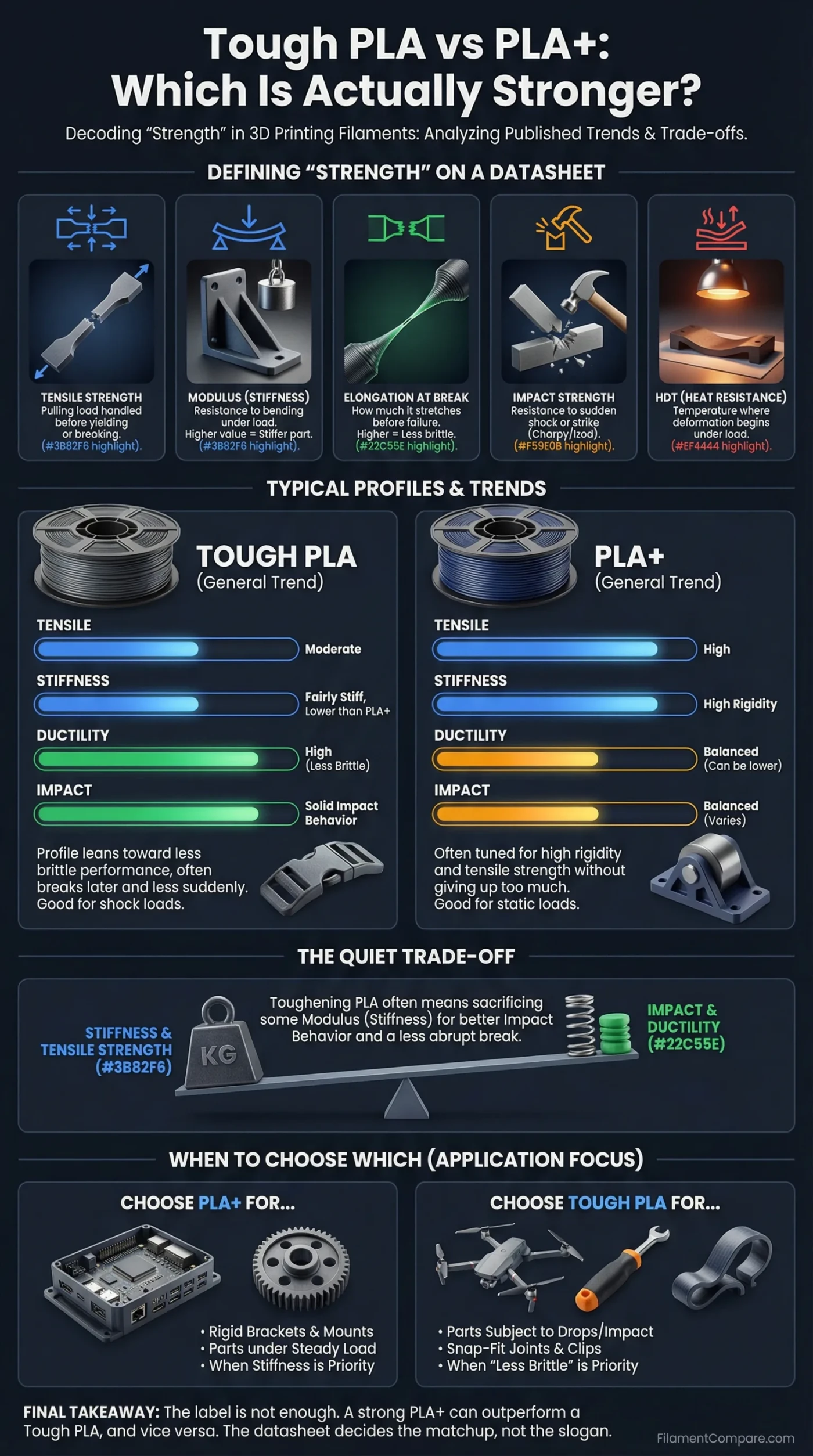
Most people use stronger as if it meant one simple thing, but filament datasheets split that idea into tensile strength, stiffness, elongation, impact behavior, and heat resistance. That is why one Tough PLA can beat a PLA+ spool in one chart and trail it in the next. In practice, one label leans toward less brittle performance while the other may lean toward higher tensile or rigidity numbers.
Tough PLA and PLA+ already split on paper. UltiMaker Tough PLA lists 45.3 MPa tensile stress at yield in XY, 9.4% elongation at break, and 8.9 kJ/m² Charpy impact strength.[a] PolyLite PLA Pro lists 49.8 MPa tensile strength, 2932.2 MPa modulus, 6.3% elongation, and 17.1 kJ/m² Charpy impact strength in X-Y.[b]
What Tough PLA and PLA+ Usually Mean
PLA+ and Tough PLA are market names for modified PLA blends rather than one locked formula. UltiMaker presents Tough PLA as an easy-print technical PLA with toughness near ABS for functional prototypes and tooling.[c] Polymaker presents PolyLite PLA Pro as a PLA grade built to combine high toughness with high rigidity.[b] eSUN presents PLA+ as a tougher, stronger, easier-printing PLA with improved layer adherence.[d]
That naming spread matters. A spool labeled Tough PLA is not guaranteed to beat every PLA+ spool, because each brand chooses its own modifiers, target balance, and test setup. The label points you in the right direction. It does not finish the comparison for you.
What “Stronger” Means on a Filament Datasheet
- Tensile Strength
- This is the pulling load the material handles before yielding or breaking under a defined tensile test method.[e]
- Modulus
- This shows stiffness. A higher value usually means the part bends less under the same load.
- Elongation at Break
- This shows how much stretch the material can take before failure. Higher numbers often point to a less brittle break.
- Impact Strength
- Charpy or Izod impact testing measures how well a specimen resists a sudden strike under defined conditions.[f]
- HDT
- Heat deflection temperature shows when the material starts to deform under load as temperature rises.[g]
If you care about a rigid bracket, modulus and tensile numbers deserve more attention. If the part might be dropped, snapped into place, or bumped in use, impact strength and elongation start to matter more. Different tests answer different questions. That is the whole reason this topic causes so much confusion.
Where Tough PLA Usually Pulls Ahead
Tough PLA is usually tuned to be less brittle. UltiMaker says its grade is less brittle than regular PLA and lists impact strength similar to ABS, with printed-part elongation at break up to 9.4% in XY.[a] colorFabb says its Tough PLA raises impact strength by roughly 70% over its plain PLA line, while keeping good tensile strength.[h]
That kind of profile is useful when the part sees shock loads, clip-like movement, or a bit of flex before failure. A brittle part can post an impressive tensile figure and still crack early in real use. Tough PLA tries to shift that failure mode into something more forgiving. It often breaks later and less suddenly.
These bars summarize the official examples used here, not a fixed industry score.
Where PLA+ Often Looks Better on Paper
PLA+ grades are often sold as a more durable PLA without giving up too much stiffness. PolyLite PLA Pro is a good example. Its X-Y modulus is 2932.2 MPa and its tensile strength is 49.8 MPa, both a little above the UltiMaker Tough PLA X-Y values shown earlier.[b] eSUN PLA+ also publishes 63 MPa tensile strength and 20% elongation at break, though its sheet does not line up specimen reporting the same way as the printed-part datasheets from UltiMaker, Polymaker, or colorFabb.[d]
That is why many users look at a PLA+ datasheet and think it must be stronger. In a pure pull test, that can be true. For a rigid part that mainly sees steady load, a well-formulated PLA+ may give you a very convincing set of numbers. It is not hype. It is just a different property balance.
The Quiet Trade-Off Behind Toughened PLA Blends
When a manufacturer toughens PLA, the material often gives up some modulus and sometimes some tensile strength in exchange for better impact behavior and a less abrupt break. colorFabb shows this clearly inside its own lineup. Its PLA Economy sheet lists 3300 MPa modulus, 70 MPa tensile strength, 3.5% elongation, and 4.0 kJ/m² Charpy impact strength for printed samples, while its Tough PLA lists 2550 MPa modulus, 55 MPa tensile strength, 8.6% elongation, and 5.8 kJ/m² impact strength.[i]
Those numbers do not mean Tough PLA is weaker in every useful sense. They show a different balance. Plain PLA can look stronger in a stiff, straight-line test and still lose when the part is knocked, flexed, or clipped into place. That single comparison fills in a gap many short comparison posts leave out.
Why One Brand’s Tough PLA Can Trail Another Brand’s PLA+
- Test method changes the picture. Some sheets report tensile yield, some tensile break, some Charpy, some Izod, and some use different specimen standards.[e]
- Print orientation changes the result. UltiMaker publishes separate XY, YZ, and Z values, and the Z direction is clearly lower in tensile yield than XY or YZ.[a]
- Printed-part data and general material data are not the same thing. Polymaker and colorFabb describe printed specimen conditions in their datasheets, while other sheets can be less detailed about how the samples were produced.[b]
- Part design still matters. Wall count, layer height, moisture level, nozzle temperature, and cooling can shift real part strength even when the filament stays the same.[b]
What the Current Published Data Actually Supports
If “Stronger” Means Higher Tensile Strength or More Rigidity
A good PLA+ often wins or lands very close. PolyLite PLA Pro’s published X-Y tensile and modulus values sit above the UltiMaker Tough PLA X-Y values used here.[b]
If “Stronger” Means Harder to Crack in Real Handling
Tough PLA still has a very good case, because that label is often tuned around less brittle failure, more forgiving elongation, and better impact behavior than plain PLA.[a]
If You Are Comparing Only by the Name on the Box
The label is not enough. A strong PLA+ can outperform one Tough PLA, and a well-tuned Tough PLA can outperform a softer PLA+ grade. The datasheet decides the matchup, not the slogan.
So, is Tough PLA actually stronger than PLA+? Often yes for impact-minded, less brittle parts. Often no for pure stiffness or straight tensile pull. The honest answer changes with the metric, and that is exactly what the official numbers show.
Resources Used
- [a] UltiMaker Tough PLA Technical Data Sheet
- [b] Polymaker PolyLite PLA Pro Technical Data Sheet
- [c] UltiMaker Tough PLA Material Page
- [d] eSUN PLA+ Technical Data Sheet
- [e] ISO 527-1: Plastics — Determination of Tensile Properties
- [f] ISO 179-1: Plastics — Determination of Charpy Impact Properties
- [g] ISO 75-1: Plastics — Determination of Temperature of Deflection Under Load
- [h] colorFabb Tough PLA Technical Datasheet
- [i] colorFabb PLA Economy Technical Datasheet
