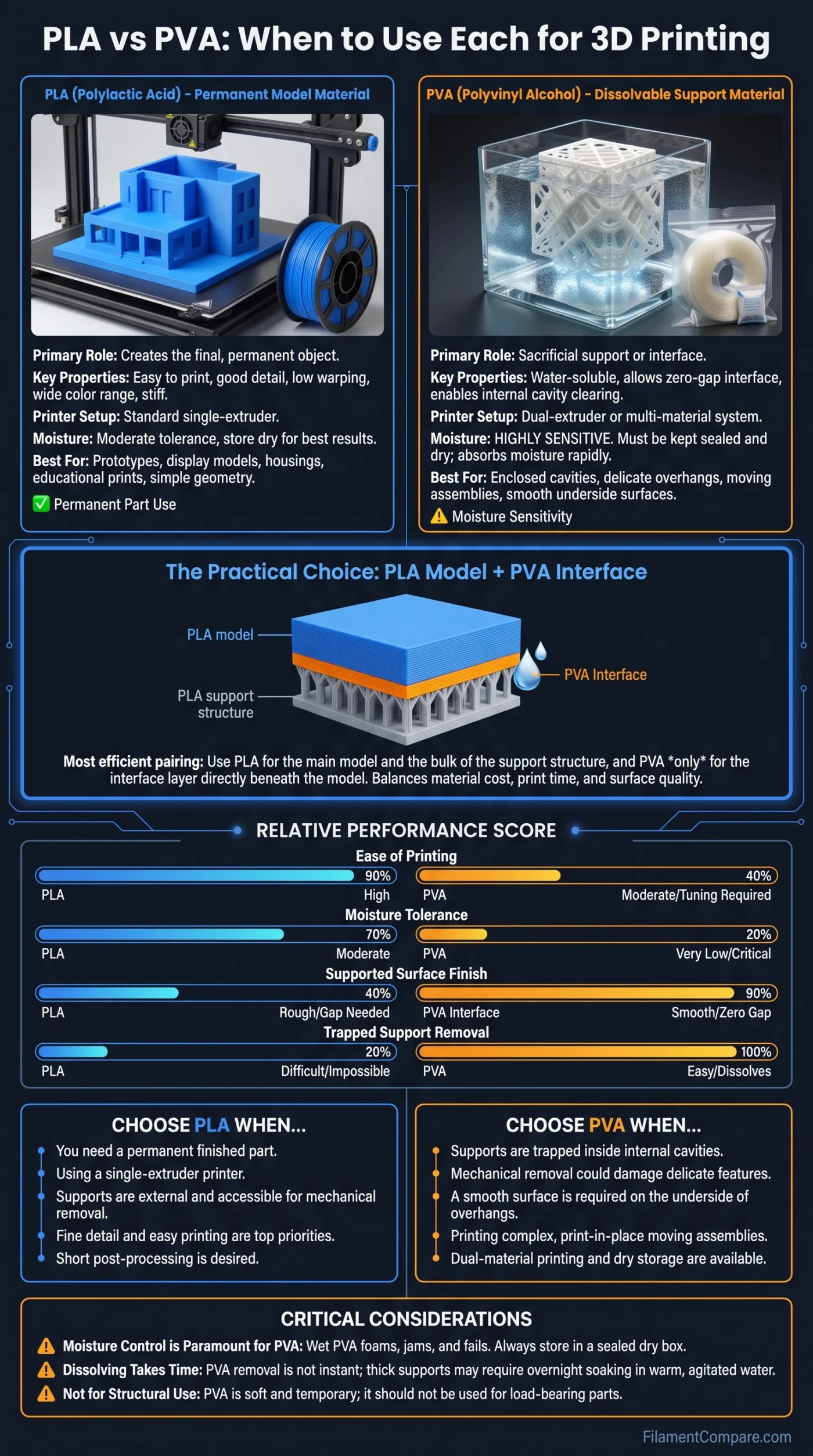
PLA is a permanent model material, while PVA is a water-soluble filament used mainly to support PLA parts during printing. Choose PLA for the object that must remain after printing; add PVA when enclosed cavities, delicate overhangs, moving assemblies, or hard-to-reach support surfaces make manual removal impractical. They are usually complementary materials rather than direct substitutes.
The Practical Choice
Choose PLA for prototypes, display models, housings, fixtures, educational prints, and most everyday single-material projects.
Choose PVA with PLA when the part requires dissolvable supports, a zero-contact-gap support interface, protected surface detail, or support removal from an internal space.
The most useful pairing is often a PLA model with PVA used only at the support interface (rather than printing the entire support structure in PVA).
Permanent Printed Part
PLA
PLA retains the intended shape and provides the stiffness needed for models, prototypes, and light-duty parts.
Water-Soluble Supports
PVA
PVA can be dissolved after printing, allowing support removal from areas that tools cannot reach.
Single-Extruder Printing
PLA
A normal single-material printer can produce the model and its removable supports from the same PLA spool.
Enclosed Channels and Cavities
PLA with PVA
PVA supports can be removed through soaking when trapped PLA supports would remain inside the part.
Lowest Storage Maintenance
PLA
PLA still benefits from dry storage, but PVA reacts much more quickly to ambient moisture.
Clean Supported Surfaces
PVA Interface
A soluble interface can sit directly against the PLA surface, reducing the rough underside left by a normal support gap.
Built-in Moving Assemblies
PLA with PVA
Caged gears, articulated joints, and enclosed mechanisms may be printed together and released after the PVA dissolves.
Simple, Fast Prototypes
PLA
PLA avoids tool changes, purge waste, soaking time, and the added tuning required by a soluble support workflow.
| Decision Area | PLA | PVA | Practical Choice |
|---|---|---|---|
| Material family | Bio-based thermoplastic polyester in many commercial formulations | Polyvinyl alcohol-based water-soluble polymer | Different material roles |
| Primary purpose | Permanent model and part material | Sacrificial support or support-interface material | Use together when needed |
| Typical nozzle temperature | Usually about 190–220°C (profile and formulation dependent)[a] | Often about 200–225°C (follow the specific support-filament profile)[e] | Temperature ranges overlap |
| Typical bed temperature | Unheated to about 60°C, depending on the printer and build surface | Usually about 25–60°C when printed as a separate material | Similar heated-bed range |
| Enclosure | Usually unnecessary | Usually unnecessary for PLA-compatible grades, though stable conditions help | Both suit open printers |
| Printer setup | Standard single-extruder printer | Dual-nozzle, multi-tool, or automatic material-changing system for normal combined use | PLA for basic hardware |
| Print difficulty | Low for standard grades | Moderate to high because of moisture, purging, loading, and interface tuning | PLA |
| Moisture behavior | Moisture can cause rough extrusion and weaker results after prolonged exposure | Very moisture-sensitive; wet filament may become soft, stringy, bubbly, or difficult to feed | PLA |
| Water behavior | Does not dissolve during normal water soaking | Designed to dissolve in water (speed varies by grade, water movement, temperature, and support volume) | PVA for sacrificial support |
| Dimensional role | Forms the final geometry | Temporarily supports the final geometry | Not interchangeable |
| Stiffness | Generally stiff, with formulation-dependent brittleness | Not normally evaluated as a finished structural material | PLA |
| Heat resistance | Limited; standard PLA can soften in warm service conditions | Not intended to remain in a heat-exposed finished part | Neither for high-heat service |
| Surface beneath supports | A removal gap may leave roughness or sagging | Can contact the model at a much tighter interface because it is dissolved later | PVA interface |
| Post-processing | Supports are snapped, cut, or sanded away | Accessible material can be removed first; the remainder is soaked and dissolved | Depends on geometry |
| Typical uses | Models, prototypes, housings, fixtures, patterns, organizers, and visual parts | Internal supports, delicate overhang interfaces, channels, cavities, and print-in-place mechanisms | Different applications |
| Main limitation | Lower heat tolerance and impact toughness than several engineering filaments | Moisture sensitivity, added cost, slower printing, purge waste, and soaking time | Part requirements decide |
This PLA and PVA comparison uses manufacturer material guidance and official printing documentation to describe common behavior; actual results can change with the brand, color, additives, moisture level, printer design, support geometry, and slicer settings.
Material and Workflow Profiles
PLA Model-Material Profile
- Polymer type: Polylactic acid-based thermoplastic
- Normal role: Final model or permanent printed part
- Print difficulty: Low for unfilled standard grades
- Nozzle range: Commonly around 190–220°C
- Bed range: Unheated to about 60°C
- Enclosure: Usually not required
- Drying need: Occasional, based on storage and print symptoms
- Typical behavior: Low warping, good detail, firm feel, clean bridging with adequate cooling
- Best uses: Visual models, prototypes, housings, jigs with light loads, patterns, and educational prints
PVA Support-Material Profile
- Polymer type: Polyvinyl alcohol-based soluble support filament
- Normal role: Full support or soluble interface
- Print difficulty: Tuning-sensitive
- Nozzle range: Often around 200–225°C (grade dependent)
- Bed range: Commonly about 25–60°C
- Enclosure: Usually not required for PLA pairings
- Drying need: Frequent moisture control may be necessary
- Typical behavior: Hygroscopic, slower-flowing, stringing-prone when wet, soluble after printing
- Best uses: Trapped supports, internal passages, delicate interfaces, and assembled mechanisms
Relative Printing-Use Scores
PLA
PVA
These bars are relative workflow indicators rather than laboratory property ratings. Brand formulation, absorbed moisture, pigment, extrusion system, print orientation, support density, purge settings, and slicer profile can alter the result.
Printability and Dual-Material Tuning
PLA is normally the simpler filament. It flows at moderate temperatures, cools quickly, produces limited warping, and works with most standard build surfaces. A user can load a PLA profile, confirm the first layer, and begin printing without creating a second-material process.
PVA adds another chain of variables. The printer must load, unload, heat, cool, purge, park, and reactivate the support filament without introducing a blockage or contaminating one material with the other. A dual-nozzle machine avoids repeated loading through one nozzle, while a single-nozzle multi-material unit usually needs larger purge volumes and more tool-change time.
PLA and PVA are commonly paired because compatible grades have overlapping printing-temperature ranges. Official Prusa guidance identifies PLA as the preferred main model material for PVA or BVOH and warns that both soluble materials must remain dry[b]. Compatibility still needs to be confirmed for the exact spool (especially with tough PLA, silk PLA, high-speed PLA, mineral-filled PLA, or other modified blends).
The Interface Must Bond Before It Can Dissolve
Normal PLA supports need a small vertical separation from the model. Without that gap, the support may fuse to the finished part and become difficult to remove. That air gap also allows the first model layer above the support to sag slightly, producing a rougher underside.
A soluble interface can use a zero or near-zero vertical gap because removal does not depend on snapping the materials apart. Prusa’s soluble-support workflow uses a 0 mm contact distance and recommends larger purge volumes when switching between PLA and soluble filament[c]. The exact value should come from the printer and filament profile rather than being copied between unrelated systems.
Purging affects more than color. PLA residue trapped inside a PVA support can form insoluble strands that remain after soaking. PVA residue entering the PLA toolpath can also disturb the surface or leave weak, water-sensitive contamination at the change point. A clean transition tower, adequate purge volume, stable nozzle wiping, and controlled retraction are therefore part of support reliability.
Speed, Cooling, and Idle-Nozzle Control
PVA is commonly printed more slowly than PLA. Excessive flow demand can produce under-extruded support walls, while long idle periods may allow material to cook inside a hot nozzle. On an independent dual-nozzle machine, the inactive nozzle should be parked or lowered according to the printer design so it does not drag across the model.
Cooling requirements are product-dependent. Many PLA profiles use strong part cooling after the first layers, while PVA profiles may use moderate or full cooling to keep thin supports stable. The safest starting point is a tested material pairing supplied by the printer or filament manufacturer (not a generic temperature copied from an unrelated PVA grade).
Full PVA Supports or a Soluble Interface?
Printing every support wall from PVA is not automatically the better workflow. Full soluble supports consume more PVA, increase the number of material changes, create more purge waste, and leave a larger mass that must later dissolve. They are most useful when the support is enclosed, deeply trapped, or impossible to break into removable sections.
Use PVA for the Entire Support When
- The support is sealed inside an internal cavity.
- A narrow channel prevents tools from reaching the support.
- The part contains caged mechanisms or moving components.
- Manual support fragmentation could damage a thin feature.
- The support must disappear through a small access opening.
Use PVA Only at the Interface When
- The main support tower is accessible after printing.
- Only the underside finish needs improvement.
- PVA cost and material-change time should be reduced.
- The PLA scaffold can be removed in large sections.
- A smaller soluble volume would shorten the soaking process.
With an interface-only setup, PLA forms the larger support scaffold and a few dense PVA layers separate that scaffold from the model. After printing, the PLA structure can often be pulled away, leaving only a thin PVA layer to dissolve. This method provides much of the surface-quality benefit without filling the full support volume with soluble material.
Full PVA support may still be more dependable for certain organic geometries because a mixed PLA–PVA scaffold introduces another material boundary. Small isolated support branches can fail when their contact area between materials is too limited. A test piece that includes the same support angle and interface area is useful before committing to a long print.
Moisture, Storage, and Spool Handling
Both filaments should be stored properly, but PVA demands tighter moisture control. Wet PLA may show stringing, popping, rough walls, or reduced consistency. Wet PVA can become soft, flexible, sticky, bubbly during extrusion, and unreliable in a feeder (especially during repeated material changes).
UltiMaker recommends sealed storage for PVA, a storage temperature between 0°C and 30°C, and relative humidity below 50%. Its published recovery procedure for the company’s own material uses approximately 55°C for several hours[d]. That drying temperature is not universal; spool material, winding method, cardboard construction, and manufacturer instructions must be checked before heating a complete spool.
Do not leave PVA mounted in open room air between occasional prints. Return it to a sealed bag or dry box with active desiccant as soon as the job ends. For long prints, feeding directly from a controlled dry box can reduce gradual moisture uptake.
A filament dryer does not correct every failure. If the support profile has excessive retraction, inadequate purging, a damaged nozzle, an over-tight feeder, or poor PLA-to-PVA contact, drying alone will not stabilize the print. Moisture symptoms should be separated from mechanical feeding and slicer problems.
Dissolving Supports and Handling the Water
PVA does not normally disappear immediately after contact with water. Dissolving can take several hours, and thick enclosed supports may need an overnight soak. Water movement, exposed surface area, support density, PVA formulation, contamination, and water temperature all affect the process.
Remove any PVA that can be peeled away safely before soaking. This reduces the amount placed in the water and opens channels that help water reach the remaining support. Agitating the water or replacing it periodically can speed removal (a stagnant, concentrated solution works more slowly).
Published temperature guidance differs between support-material products. Some workflows specify warm water with a conservative maximum, while another official product sheet permits warmer water. Use the instructions for the exact PVA grade and confirm that the PLA part, adhesive, coating, embedded component, and dimensional tolerance can tolerate the chosen temperature.
Water-soluble does not mean that concentrated PVA wastewater should be discarded without consideration. Polymaker’s product information recommends removing accessible support before soaking and advises users to consult their local wastewater authority about disposal[f]. Allowing solid waste to dry and placing it in the appropriate local waste stream may be preferable to sending a large quantity into a drain.
Mechanical and Thermal Roles
PLA and PVA should not be ranked as two competing structural filaments. PLA forms the finished component. PVA exists temporarily and is expected to lose its shape in water. Tensile strength, stiffness, impact resistance, creep, and layer adhesion therefore matter to PLA as service properties, while PVA needs only enough temporary strength and adhesion to survive the print.
Standard PLA is firm and dimensionally stable during normal printing, but it has limited impact toughness and can soften in warm environments. A PLA part near a sunny window, heater, appliance, or vehicle interior may deform even though the print looked stable at room temperature. Tough PLA, annealable PLA, fiber-filled PLA, and high-temperature PLA are separate formulations and should be assessed through their own datasheets.
PVA should not remain as a hidden structural layer. Incomplete dissolution inside a joint, bearing path, fluid channel, or snap mechanism can restrict movement and later absorb water. The design should include drainage routes and enough access for water exchange (not merely an opening large enough to admit water once).
Use-Case Recommendations
| Use Case | Better Material or Pairing | Reason |
|---|---|---|
| Decorative model | PLA | Good detail, low warping, broad color selection, and no soluble support process when geometry is simple. |
| Fast concept prototype | PLA | Short setup time and fewer printer variables make iteration easier. |
| Model with accessible overhang supports | PLA model with PLA supports | Manual support removal is usually faster and less expensive when all supports can be reached. |
| Smooth underside on a dimensional prototype | PLA with PVA interface | A soluble contact layer can reduce the support gap and improve the downward-facing surface. |
| Internal fluid channel prototype | PLA with full or targeted PVA support | Water can remove support from a channel where pliers cannot reach (adequate drainage still needs to be designed). |
| Caged gear mechanism | PLA with PVA | The sacrificial material can separate moving parts during printing and dissolve afterward. |
| Single-extruder beginner print | PLA | PVA adds little value without automatic material switching or a second tool. |
| Thin sculpture with delicate support contacts | PLA with PVA interface | Dissolving the contact layer reduces cutting force near fragile features. |
| Long unattended multi-material job | PLA unless PVA is necessary | Every material change adds time and another opportunity for feeding, purging, or moisture-related failure. |
| Production batch with simple supports | PLA | Same-material supports reduce spool cost, soaking time, and wastewater handling. |
| Complex architectural model | PLA with targeted PVA | Use PVA only around enclosed stairs, arches, internal voids, or other inaccessible features. |
| Finished part exposed to water | PLA after complete PVA removal | Any PVA residue may soften or dissolve; another model filament may be preferable when moisture and heat exposure are demanding. |
Where Each Material Fits Better
Choose PLA When
- The filament will form the finished object.
- The printer has one normal extruder and no material-changing unit.
- The model uses little support or supports remain accessible.
- Fast setup and short post-processing matter.
- Fine visual detail and low warping are higher priorities than heat tolerance.
- The project needs a broad range of colors, surface effects, or standard profiles.
PLA Is Less Suitable When
- The finished part will remain under elevated heat.
- The part requires high impact absorption or repeated flexing.
- Internal support cannot be removed mechanically.
- A supported underside requires near-model surface quality.
Choose PVA When
- A PLA model contains inaccessible support regions.
- Support removal tools could scratch or break the part.
- A soluble zero-gap interface would improve the underside.
- A print-in-place assembly needs temporary internal separation.
- The printer can manage two materials reliably.
- Dry storage and post-print soaking are available.
PVA Is Less Suitable When
- The filament is expected to form a permanent component.
- The printer cannot perform controlled material changes.
- The support is simple and easy to remove in PLA.
- The spool cannot be kept dry during a long print.
- Material cost, purge waste, or soaking time outweighs the surface benefit.
- The printed object cannot safely be immersed in water.
Material Selection Matrix
Final Material Decision
Choose PLA if the question is which filament should form the model. It is the appropriate starting material for ordinary prototypes, decorative prints, housings, educational projects, and accessible support structures.
Choose PVA if the question is how to remove support from geometry that PLA supports cannot leave cleanly. It earns its cost when it protects a delicate surface, releases an internal mechanism, or dissolves from a trapped cavity.
Choose PLA plus a PVA interface for the most balanced soluble-support workflow. PLA carries most of the support volume, while PVA is placed only where clean separation matters.
There is no useful overall winner because the materials perform different jobs. PLA creates the part; PVA temporarily makes a difficult PLA part printable.
Common PLA and PVA Questions
Can PVA Be Used as a Normal Model Filament?
PVA can be extruded into a shape, but it is not a practical replacement for PLA in a permanent model. Its water solubility and strong moisture response make it more suitable as a temporary support material.
Can PLA and PVA Be Printed Together?
Yes. Compatible PLA and PVA grades are a common pairing because their extrusion-temperature ranges overlap. The exact combination still needs a tested profile, dry PVA, adequate purging, and dependable material-to-material adhesion.
Does PVA Require a Dual-Extruder Printer?
Automated PLA-and-PVA printing requires two independently managed materials. This can be provided by dual nozzles, a multi-tool printer, or a single-nozzle material-changing system. Manual swaps are possible only for limited layer-based experiments and are not practical for complex support geometry.
Should the Entire Support Be Printed in PVA?
Not always. Use full PVA when support is trapped or enclosed. For accessible supports, a PLA scaffold with several PVA interface layers usually reduces soluble-material consumption, tool changes, purge waste, and dissolving time.
How Long Does PVA Take to Dissolve?
Small interface layers may clear within several hours, while thick internal supports can require an overnight soak. Warm moving water, periodic water changes, low support density, and removal of accessible material can shorten the process.
Can PVA Support PETG as Well as PLA?
Compatibility is grade-dependent. Some PVA-based products list selected PETG formulations, while other printer manufacturers recommend BVOH or a dedicated support material for PETG. Confirm both interface adhesion and printing-temperature compatibility through the filament manufacturer’s material chart.
Technical References
- [a] PLA | Prusa Knowledge Base (Used for PLA printing-temperature guidance, low-warp behavior, common applications, surface characteristics, and standard PLA temperature limitations.)
- [b] Water Soluble (BVOH/PVA) | Prusa Knowledge Base (Used for PLA–PVA pairing, moisture sensitivity, build-surface behavior, soluble-support contact distance, and dissolution considerations.)
- [c] Water-Soluble Materials (PVA/BVOH) | Prusa Knowledge Base (Used for full-support versus interface-only workflows, material switching, purge-volume guidance, and multi-material setup behavior.)
- [d] 3D Printing Tips: How to Store PVA Material | UltiMaker (Used for sealed PVA storage, recommended storage temperature and humidity, moisture symptoms, and the manufacturer’s drying procedure for its own material.)
- [e] PolyDissolve™ S1 Product Information Sheet | Polymaker (Used for a verified PVA-based product’s nozzle range, bed range, speed guidance, zero Z-gap, and interface-only support option.)
- [f] PolyDissolve™ S1 | Polymaker (Used for water-soluble support applications, compatible model-material families, support-removal workflow, and disposal cautions associated with PVA-containing wastewater.)
