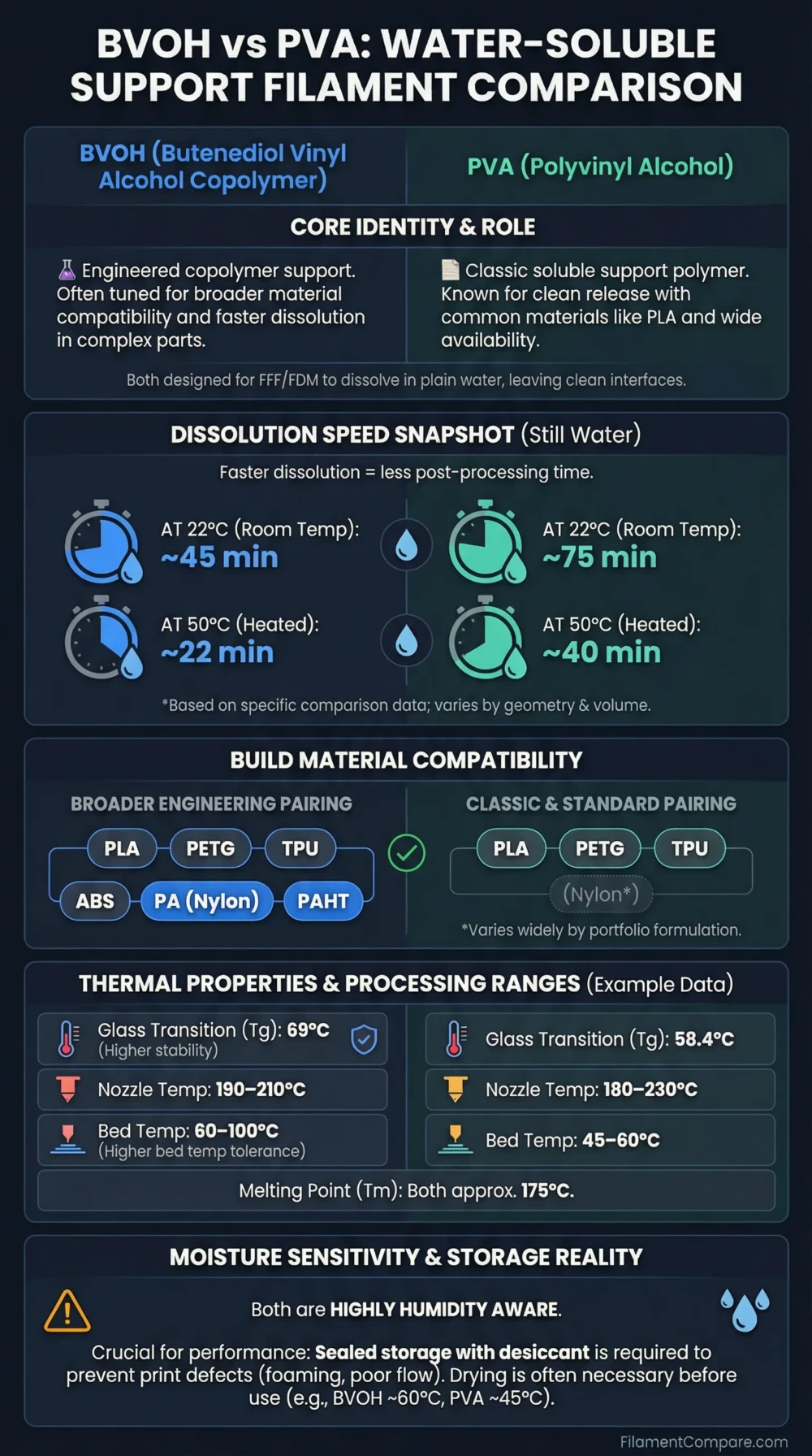
BVOH usually dissolves faster and prints with slightly cleaner support behavior, while PVA is often easier to find and can be the more budget-friendly soluble support material. Both are mainly used with dual-extrusion or multi-material FDM printers, not as normal model filaments. Choose between them by looking at support removal speed, moisture control, material compatibility, clogging risk, and cost per supported print.
Choose BVOH when you want faster water removal, better tolerance for dense support interfaces, and cleaner underside quality on complex parts. It is the better fit for high-value prints where failed soluble supports would cost more than the filament price difference.
Choose PVA when you need a proven soluble support material for PLA, PETG, or Nylon-based workflows and want wider availability. It can work very well, but it is more storage-sensitive and often needs careful drying, purging, and print-profile control.
Best for Faster Dissolving
BVOH is usually the better choice because it is designed to dissolve quickly in water, especially when the water is warm and refreshed during soaking.
Better for Lower Material Cost
PVA is commonly the more economical choice, especially for users who print soluble supports only occasionally.
Better for Complex Internal Cavities
BVOH is the safer pick when support material is trapped inside channels, tubes, lattice areas, or hollow geometry.
Better for Established PLA Workflows
PVA has long-standing slicer profiles and is widely used for soluble support with PLA-based prints.
Better for Support Interface Quality
BVOH often handles zero-gap support interfaces better because it is intended for easy removal after printing.
Better for Occasional Support Use
PVA can make more sense if you print soluble supports rarely and can dry the spool before each job.
| Category | BVOH | PVA | Better Choice |
|---|---|---|---|
| Material Family | Butenediol vinyl alcohol copolymer support filament | Polyvinyl alcohol support filament | Use-case based |
| Primary Role | Water-soluble support for complex FDM parts | Water-soluble support for dual-extrusion FDM parts | Both |
| Print Difficulty | Advanced, but often more forgiving than PVA when dry | Advanced; more prone to moisture-related feeding and clogging issues | BVOH |
| Typical Nozzle Temperature | 190–210 °C for Ultrafuse BVOH[a] | About 195 °C for Prusa PVA+ guidance[b] | Similar range |
| Typical Bed Temperature | 60–100 °C depending on profile and build surface[c] | About 60 °C in Prusa water-soluble material guidance[d] | Printer-dependent |
| Enclosure Requirement | Usually not a high-temperature chamber material; avoid excessive chamber heat | Usually no high-temperature chamber needed for PLA/PETG-style support workflows | Both |
| Water Solubility | Generally faster; Forward AM states it dissolves two times faster than other PVA materials[e] | Water soluble in tap water; removal time depends on support mass, water temperature, and water changes | BVOH |
| Moisture Sensitivity | Very hygroscopic; sealed dry storage is needed | Very hygroscopic; wet filament can soften, string, clog, or grind | Both need dry storage |
| Drying Need | Often dried around 60 °C for 4–16 hours in Forward AM guidance[f] | UltiMaker support guidance recommends drying PVA at 50 °C for 10–20 hours when moisture affected[g] | Both |
| Support Interface | Good for dense, close-contact support interfaces when slicer purge is tuned | Good interface quality when dry and correctly purged, but more tuning-sensitive | BVOH |
| Material Compatibility | Often used with PLA, PETG, ABS, PA, PA-CF, and selected technical materials depending on brand profile | Commonly used with PLA, PETG, and Nylon-based materials; not suitable for every high-temperature material | Check profile |
| Typical Cost | Usually higher | Usually lower | PVA |
| Main Limitation | Cost and strict moisture handling | Moisture sensitivity, clogging risk, slower removal in some workflows | Different limits |
| Better Choice | Complex supports, internal channels, premium dual-extrusion prints | General soluble support, PLA/PETG workflows, cost-controlled use | Depends on part value |
This BVOH and PVA comparison is based on manufacturer datasheets, official material pages, and printer-maker guidance; real results can shift with brand, color, moisture level, support density, purge volume, slicer profile, and printer hardware.
BVOH Support Material Profile
- Polymer type: Butenediol vinyl alcohol copolymer.
- Print role: Water-soluble support, not a normal model material.
- Nozzle range: Typically around 190–210 °C for Ultrafuse BVOH.
- Bed range: Commonly 60–100 °C depending on build surface and printer profile.
- Enclosure: Closed printer is fine, but high chamber heat can soften the filament path.
- Drying need: High. Use a dry box during long prints when possible.
- Typical behavior: Fast dissolving, good support contact, sensitive to moisture.
- Best use cases: Complex overhangs, trapped supports, soluble interfaces, internal cavities.
PVA Support Material Profile
- Polymer type: Polyvinyl alcohol.
- Print role: Water-soluble support for dual-extrusion and multi-material FDM printing.
- Nozzle range: Often near PLA support temperatures; exact profile depends on brand.
- Bed range: Commonly around 60 °C for many PLA-style workflows.
- Enclosure: Usually not needed for low-temperature model materials.
- Drying need: High. PVA should be kept dry before and during printing.
- Typical behavior: Good soluble support material, but moisture can raise clogging and feeding risk.
- Best use cases: PLA supports, PETG supports, Nylon-based supports, removable molds, occasional soluble support jobs.
These scores are practical support-printing indicators, not fixed lab ratings. Brand formula, spool dryness, purge volume, support interface distance, print orientation, nozzle condition, and slicer settings can change the result.
Support Removal and Dissolving Behavior
BVOH is usually the stronger option when support removal speed matters. Forward AM describes Ultrafuse BVOH as water soluble and notes that its solubility rises with higher water temperature. The same product page also states that it dissolves faster than other PVA materials, which is the main reason BVOH is often chosen for complex support work.
PVA also dissolves in water, but removal time can feel less predictable. Dense support blocks, trapped cavities, old filament, insufficient purge, or model-material contamination inside the support can slow the process. Warm water helps, but it should not be so hot that it deforms the printed model material.
Practical Dissolving Notes
- Use enough water volume so the dissolved support does not saturate the bath too quickly.
- Change the water during long dissolving sessions.
- Use gentle movement when the model geometry can tolerate it.
- Do not use hot water blindly; PLA, thin PETG features, and delicate tolerances can deform.
- Increase purge volume if model filament is contaminating the soluble support path.
Printability, Purging, and Clogging Risk
Both BVOH and PVA are advanced support materials because the printer must manage two materials, purge towers or wiping routines, temperature switching, and support-to-model contact. The material itself is only one part of the workflow. A poorly tuned purge setup can leave PLA, PETG, or Nylon inside the soluble support, which may stop parts of the support from dissolving cleanly.
BVOH tends to be more forgiving in demanding support-interface work, especially when the spool is dry. PVA can print cleanly too, but it is more likely to show moisture-related symptoms: popping, stringing, soft filament, poor bed contact, grinding, and nozzle clogs. Prusa’s material guidance also notes that PVA is usually cheaper but more prone to nozzle clogging, while BVOH can adhere a little better than PVA in their workflow.
Important print setup note: soluble support works best when the interface distance is set for actual soluble support, often with little or no Z-gap. Using breakaway-support spacing can reduce underside quality and waste the main benefit of BVOH or PVA.
Moisture Sensitivity and Storage
Moisture control is the main workflow risk for both materials. BVOH and PVA absorb water from air, and that changes how they feed and melt. Wet filament can become soft, sticky, brittle, inconsistent, or more likely to clog. A spool that printed well last month can become difficult after sitting open in a humid room.
BVOH should be stored in a sealed bag or container to prevent moisture uptake. Forward AM’s extended data guidance lists drying at 60 °C for 4–16 hours for Ultrafuse BVOH. UltiMaker support guidance recommends drying moisture-affected PVA at 50 °C for 10–20 hours. These numbers are useful starting points, not universal limits, because spool size, dryer airflow, and material brand change drying time.
Good Storage Practice
- Keep the spool sealed with desiccant when not printing.
- Print from a dry box for long dual-material jobs.
- Dry before critical prints, especially after open-air storage.
- Reduce idle time at temperature to limit degradation and oozing.
Moisture Warning Signs
- Popping or steam-like sound at the nozzle.
- Excessive stringing from the support nozzle.
- Soft filament that deforms in the drive gears.
- Support material that does not bond or dissolve evenly.
Compatibility With PLA, PETG, Nylon, and Technical Materials
For most users, PLA is the easiest model material to pair with BVOH or PVA because the print temperatures are close and warping pressure is low. PETG can also work, but it may require careful tuning to control stringing, interface bonding, and purge behavior. Nylon-based materials can be compatible with selected PVA and BVOH profiles, but the higher drying burden makes the full workflow more sensitive.
BVOH has an advantage when the printer profile supports a wider material set. Forward AM lists broad compatibility for Ultrafuse BVOH, including PLA, PRO1, ABS, PA, and PAHT CF15 on its BVOH material information. PVA compatibility is more brand-specific. UltiMaker’s PVA technical data sheet lists support use for PLA, PETG, and Nylon build materials, while also marking it as non-suitable for reliable support structures with UltiMaker ABS, CPE+, PC, and PP.
Do not assume all BVOH or all PVA spools behave the same. Use the printer maker’s material profile first, then adjust purge, standby temperature, support density, and interface layers after a small test print.
Cost, Waste, and When the Upgrade Makes Sense
PVA usually makes more sense when cost is the main limit. It is a good fit for occasional soluble support use, simple PLA support jobs, or printers with stable PVA profiles. The tradeoff is that failed PVA support can waste the model material, support filament, and print time.
BVOH can justify its higher price when the part has trapped support, expensive model material, long print time, or surfaces that would be damaged by manual removal. In that case, the question is not only spool price. It is the cost of failed support removal, broken details, scarred undersides, and reprints.
| Print Scenario | More Suitable Material | Reason |
|---|---|---|
| PLA model with simple overhangs | PVA | Lower cost can be enough when support geometry is easy. |
| PLA model with trapped internal supports | BVOH | Faster dissolving helps when manual removal is impossible. |
| Dense support interface under visible surfaces | BVOH | Better fit for close-contact soluble interfaces. |
| Occasional soluble support printing | PVA | More practical when budget matters and the spool can be dried before use. |
| Long dual-extrusion jobs | BVOH | More forgiving support behavior can reduce the risk of a failed high-value print. |
| Tight internal channels | BVOH | Removal speed and water access matter more inside narrow geometry. |
| Cost-controlled prototyping | PVA | Good choice when underside finish is less critical. |
| PETG support workflows | Depends on printer profile | Both can work, but adhesion, purge, and stringing control decide the result. |
| Nylon-based support workflows | Depends on brand profile | Compatibility varies; both model and support material must be dry. |
| High-temperature model materials | Check manufacturer profile | Some PVA grades are not suitable for certain ABS, PC, PP, or high-temperature workflows. |
Choose BVOH When
- The part has internal cavities, channels, or trapped supports.
- You want faster support removal in water.
- The underside surface quality matters.
- The model material or print time is expensive.
- Your printer has a validated BVOH profile.
- You can store and print the spool dry.
BVOH Is Less Suitable When
- Support cost must stay low.
- Your printer has no tested BVOH profile.
- You cannot control moisture during storage or printing.
- The print only needs simple, removable external support.
Choose PVA When
- You need a widely used soluble support material.
- Your main material is PLA, PETG, or a supported Nylon-based filament.
- You want lower support material cost.
- Your slicer already has a stable PVA profile.
- The support geometry is not deeply trapped.
- You can dry the spool before important jobs.
PVA Is Less Suitable When
- The print has long, dense soluble support sections.
- You see clogging, grinding, or sticky filament behavior.
- The spool has absorbed moisture.
- Your model material is outside the PVA manufacturer’s compatibility list.
Choose BVOH if the print is complex, the support is trapped, the surface under the support matters, or faster dissolving will reduce post-processing risk.
Choose PVA if you want a lower-cost soluble support material for standard PLA, PETG, or compatible Nylon workflows and you already have a reliable profile.
Neither material replaces the other in every setup. BVOH is the more capable support option for demanding geometry, while PVA remains a practical soluble support choice when cost and availability matter more than removal speed.
Common BVOH and PVA Questions
Is BVOH better than PVA?
BVOH is usually better for fast dissolving, dense support interfaces, and complex internal supports. PVA can still be the better choice when cost, availability, or an existing printer profile matters more.
Can BVOH and PVA be used as normal model filaments?
No. They are mainly support materials. They are water soluble, moisture-sensitive, and not intended for durable printed parts.
Do BVOH and PVA need a dual-extrusion printer?
Usually yes. The model is printed with the main material, while BVOH or PVA is printed through a second nozzle, toolhead, or multi-material system for the support structure.
Why does PVA clog?
PVA clogs most often when it has absorbed moisture, sits too long at printing temperature, or is not purged cleanly between material changes. Drying, lower idle temperature, and tuned purge volume usually help.
Does warmer water dissolve BVOH and PVA faster?
Warm water usually helps, especially for BVOH, but the model material sets the safe temperature limit. Thin PLA parts, tight tolerances, or delicate surfaces can deform if the water is too warm.
Which support material is better for PLA?
Both can work with PLA. PVA is often chosen for standard PLA support jobs, while BVOH is better when the PLA model has trapped support, fine underside detail, or difficult support removal areas.
Resources Used
- [a] Ultrafuse® BVOH – FORWARD AM (Used for BVOH material role, solubility behavior, support compatibility notes, and the 190–210 °C nozzle guideline.)
- [b] Water soluble (BVOH/PVA) | Prusa Knowledge Base (Used for practical BVOH/PVA support workflow guidance, PVA+ and BVOH temperature references, moisture warnings, and clogging notes.)
- [c] Ultrafuse® BVOH Extended TDS (Used for BVOH bed temperature, print speed, drying guidance, filament tolerance, and processing notes.)
- [d] Water soluble (BVOH/PVA) | Prusa Knowledge Base (Used for the 60 °C bed guidance and practical soluble support setup notes.)
- [e] Ultrafuse® BVOH – FORWARD AM (Used for the manufacturer statement that BVOH dissolves faster than other PVA materials and for general BVOH support use.)
- [f] Ultrafuse® BVOH Extended TDS (Used for the 60 °C, 4–16 hour BVOH drying recommendation and chamber-temperature caution.)
- [g] How to print with UltiMaker PVA (Used for PVA moisture handling and the 50 °C, 10–20 hour drying recommendation.)
- Ultimaker PVA Technical data sheet (Used for PVA chemical composition, support applications, material compatibility notes, glass transition, melting temperature, and density.)
