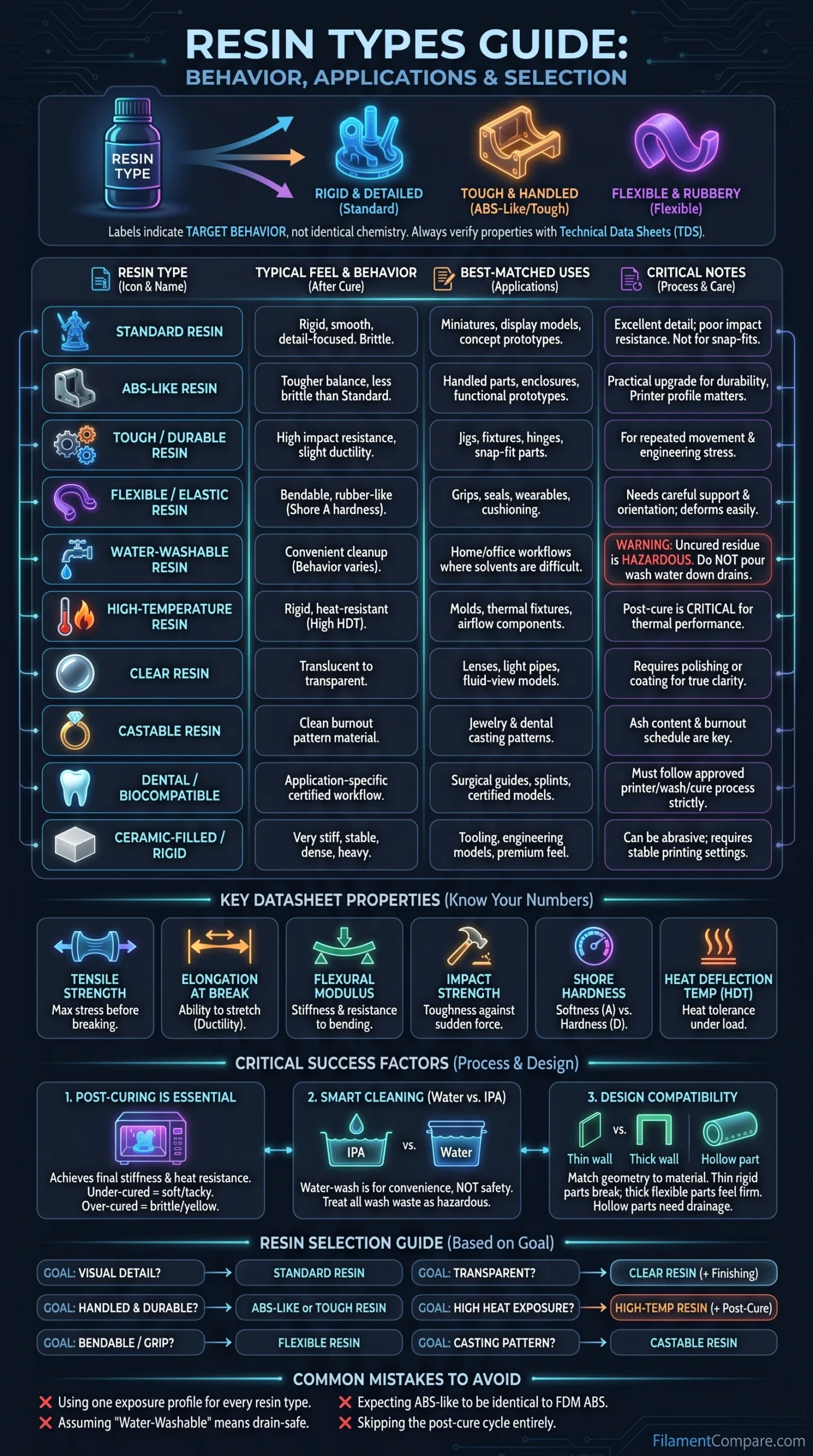
Resin 3D printing materials are not one single material family in practical use. A bottle labeled standard resin, ABS-like resin, flexible resin, water-washable resin, dental resin, castable resin, or high-temperature resin can behave very differently after curing. The printer may look the same, the layer height may be the same, and the slicer may use similar settings, yet the finished part can feel rigid, rubbery, brittle, tough, heat-tolerant, smooth, transparent, or easy to sand depending on the resin chemistry and post-curing routine.
| Resin Type | Typical Feel After Cure | Best-Matched Uses | Cleaning Method | Technical Notes |
|---|---|---|---|---|
| Standard Resin | Rigid, smooth, detail-focused | Miniatures, display models, concept prototypes, visual parts | Usually IPA or resin cleaner | Good detail and surface finish; less suited to repeated impact or snap-fit movement |
| ABS-Like Resin | Tougher and less brittle than many basic resins | Enclosures, clips, functional prototypes, tabletop parts, handled models | Usually IPA or resin cleaner; some formulas are water-wash variants | Balanced stiffness and impact behavior; exact strength varies by brand and cure profile |
| Flexible Resin | Bendable, elastic, rubber-like depending on Shore hardness | Gaskets, grips, soft-touch parts, cushioning features, flexible prototypes | Usually IPA or resin cleaner | Needs careful support and orientation because soft parts can deform during peel forces |
| Water-Washable Resin | Often similar to standard or ABS-like resin, depending on formula | Models, beginner-friendly workflows, parts where easier cleanup matters | Water, followed by proper wastewater handling | Convenient cleanup does not mean uncured resin can go into drains |
| Tough / Durable Resin | Impact-resistant, less brittle, sometimes slightly ductile | Jigs, fixtures, hinges, snap fits, working prototypes | Usually IPA or resin cleaner | Often chosen when a part needs more movement tolerance than standard resin |
| High-Temperature Resin | Rigid and heat-resistant after the correct post-cure | Molds, hot-air exposure parts, thermal test fixtures | Usually IPA or resin cleaner | Heat deflection temperature depends strongly on post-curing and test method |
| Clear Resin | Translucent to transparent with finishing | Lenses, fluid-view models, light pipes, display parts | Usually IPA or resin cleaner | True clarity usually needs sanding, polishing, coating, or careful cure control |
| Castable Resin | Rigid pattern material designed to burn out cleanly | Jewelry patterns, dental casting patterns, small metal casting workflows | Usually IPA or resin cleaner | Ash content, burnout schedule, and investment compatibility matter more than toughness |
| Dental / Biocompatible Resin | Application-specific: model, surgical guide, denture, splint, or soft tissue feel | Dental models, guides, splints, medical-adjacent parts where certified material is required | Manufacturer-defined process only | Use only with the printer, wash, cure, and documentation approved by the material supplier |
| Ceramic-Filled / Rigid Resin | Very stiff, dimensionally stable, sometimes heavier | Tooling, engineering models, heat-stable prototypes, display pieces with a solid feel | Usually IPA or resin cleaner | Can be more abrasive and may need slower, well-supported printing |
The values above are material-category trends, not universal numbers. Resin behavior changes with printer wavelength, pigment load, layer height, part thickness, exposure, wash time, post-cure temperature, and the exact supplier datasheet.
What Resin Type Means in SLA, MSLA, LCD, and DLP Printing
Most desktop resin printers use vat photopolymerization: a liquid photopolymer is selectively cured by light in a vat. ISO/ASTM 52900 uses this term for the additive manufacturing process where liquid photopolymer is cured by light-activated polymerization.[a] In everyday printing language, people usually say SLA, MSLA, LCD resin printing, or DLP resin printing.
The resin type on the bottle is a practical label. It tells you what the material is trying to do: print cleaner details, bend more, resist impact, wash with water, burn out for casting, tolerate heat, or meet a defined application standard. It does not guarantee the same result across brands.
Important material reading: always check the resin’s technical data sheet and safety data sheet before treating a printed part as functional, heat-safe, skin-contact suitable, food-contact suitable, or chemically resistant. Formlabs, for example, publishes both TDS and SDS documents for its SLA materials, which is the right type of documentation to compare before choosing a resin.[b]
Standard Resin
Standard resin is the baseline material for many resin printers. It is usually chosen for visual quality, sharp detail, smooth surfaces, and predictable printing rather than demanding mechanical performance.
It suits display models, miniatures, figurines, decorative parts, test prints, concept models, and shape-check prototypes. Thin details print well when supports and exposure are tuned. Edges can look clean. Surface finish is often the reason people start with this resin.
Typical Strength Profile
- Rigidity: usually medium to high for small display parts.
- Impact tolerance: suitable for careful handling, not ideal for repeated drops.
- Detail quality: one of its strongest practical traits.
- Post-processing: sands and primes well for painting.
Standard resin can feel crisp and clean, yet that same crispness often means less flex before cracking. For parts that need clips, hinges, screw bosses, or repeated handling, ABS-like or tough resin is usually the better family.
ABS-Like Resin
ABS-like resin is made to feel less fragile than many basic resin formulas. It is not the same material as FDM ABS filament. The name points to a target behavior: more toughness, more impact tolerance, and a more practical feel for handled prototypes.
For resin users moving from display models into usable parts, ABS-like resin is often the first upgrade. It can work well for small enclosures, brackets, hobby parts, controller shells, miniatures that need extra handling tolerance, and prototypes where brittle edges are not desired.
Where ABS-Like Resin Fits Best
- Parts that will be touched, moved, assembled, or lightly stressed.
- Miniatures and game pieces where thin weapons, limbs, or corners need better resilience.
- Prototype housings that need screw testing or light snap-fit evaluation.
- Functional-looking models where standard resin feels too brittle.
Some manufacturers publish printer-specific exposure settings for ABS-like and water-wash ABS-like variants. Anycubic, for example, lists separate recommended parameters for ABS-Like Resin Pro 2, ABS-Like Resin 3.0, and Water-Wash ABS-like Resin V2 across several Photon printers.[c] That matters because a resin name alone is not enough; the printer profile matters too.
ABS-Like vs Tough Resin
ABS-like resin is a broad practical category. Tough resin is usually a more engineering-focused category. In many product lines, tough resin is tuned more directly for impact resistance, elongation, and working prototypes, while ABS-like resin aims for a balanced blend of price, detail, and durability.
| Property | ABS-Like Resin | Tough / Durable Resin |
|---|---|---|
| Main purpose | General toughness with easier everyday printing | Higher functional performance for prototypes and fixtures |
| Surface finish | Often smooth and model-friendly | Can be smooth, but function is the main reason to use it |
| Detail behavior | Usually strong for hobby and prototype parts | Good, though some formulas favor strength over ultra-fine detail |
| Cost trend | Often moderate | Often higher than basic or ABS-like resin |
| Part examples | Cases, brackets, handled models, gaming parts | Snap fits, jigs, fixtures, moving prototype features |
Flexible Resin and Elastic Resin
Flexible resin prints parts that can bend. Elastic resin goes further toward a rubber-like response. These materials are usually described by Shore hardness, often Shore A for softer materials. A lower Shore A value feels softer; a higher value feels firmer.
Flexible resin is useful for grips, seals, soft-touch covers, cushioning pads, wearable mockups, compliant parts, and prototypes that need controlled bending. It is also often blended with rigid resin in small ratios by experienced users, although that changes curing behavior and should be tested carefully.
Flexible Resin Printing Behavior
- Support removal: softer parts can tear if supports are oversized or removed too aggressively.
- Peel forces: flexible parts may deform during layer separation.
- Wall thickness: thin walls bend more; thick sections can feel surprisingly firm.
- Post-cure: over-curing can make some flexible materials stiffer than expected.
For biocompatible flexible materials, the approved use is much narrower than the word flexible suggests. Formlabs lists BioMed Elastic 50A Resin as a soft elastic material for defined biocompatible applications, while BioMed Flex 80A Resin is described as a firmer flexible material for defined contact cases.[d] The certification path is part of the material, not an optional detail.
Water-Washable Resin
Water-washable resin is formulated so uncured residue can be cleaned from prints with water instead of isopropyl alcohol. The main benefit is workflow convenience. It can reduce the smell and storage hassle of large IPA baths, especially for small desktop setups.
Water-washable does not mean water-safe in the sink. Uncured resin residue in wash water still needs proper handling, curing, filtering, and disposal according to local rules and the resin supplier’s SDS. Simple point: do not pour uncured resin waste into drains.
Water-Washable Resin Strength
There is no single strength profile for water-washable resin. Some formulas feel like standard resin. Some are marketed as water-wash ABS-like or water-wash tough resin. Phrozen’s documentation page, for instance, separates water-washable and ABS-like SDS downloads across different resin colors and types, showing that “water-washable” is a cleaning category as much as a performance category.[e]
Practical distinction: ABS-like describes a target mechanical feel. Water-washable describes cleanup chemistry. A resin can be both, but one label does not automatically prove the other.
Tough and Durable Resin
Tough resin and durable resin are made for parts that need more mechanical tolerance than visual model resin. They are common choices for test assemblies, jigs, fixtures, housings, snap-fit trials, and prototypes that need a controlled amount of flex before failure.
The difference between tough and durable depends on the brand. In many material lines, tough resin leans toward impact resistance and balanced stiffness. Durable resin may lean toward ductility, abrasion behavior, or a polypropylene-like feel. Datasheets matter here. Marketing names are not enough.
When Tough Resin Makes More Sense Than ABS-Like
- The part will be assembled and disassembled many times.
- A clip or hinge needs controlled movement.
- Screws, bosses, or press-fit features are being tested.
- The prototype needs a more repeatable engineering material profile.
Tough resin is not automatically better for every print. It may cost more, require more careful post-curing, or print with slightly different support needs. The benefit appears when the part design actually uses the extra mechanical behavior.
High-Temperature Resin
High-temperature resin is designed for parts exposed to heat during testing, molding, airflow, or fixture work. It is usually rigid. It often needs a specific post-cure cycle to reach its stated thermal performance.
Heat resistance is commonly discussed through heat deflection temperature, but that number depends on the test load, sample geometry, and curing routine. A thin printed bracket near a warm motor does not behave exactly like a standardized test bar. Real geometry matters.
Typical Uses
- Thermoforming or molding aids for short-run work.
- Fixtures exposed to moderate heat during testing.
- Airflow prototypes near warm environments.
- Engineering parts where temperature stability matters more than flexibility.
For heat-focused resins, post-curing is not a cosmetic step. It is part of the material system. Under-cured parts can show lower stiffness, lower heat tolerance, tacky surfaces, or dimensional drift.
Clear and Transparent Resin
Clear resin is chosen for optical appearance, fluid visibility, lighting effects, and display work. Freshly printed parts often look cloudy because of layer lines, micro-scratches, support marks, and internal scattering. Polishing changes everything.
For a more transparent finish, users usually combine careful orientation, low-scarring support placement, progressive sanding, polishing compound, gloss coating, or resin dipping. The resin matters, but finishing often decides the final look.
Clear Resin Selection Notes
- Choose high-clear formulas for lenses, light pipes, and display windows.
- Avoid heavy support contact on visible surfaces.
- Use controlled post-curing to limit yellowing where the material supplier recommends it.
- Expect thicker parts to look less transparent than thin walls unless polished well.
Castable Resin
Castable resin is made for lost-wax-style casting workflows. The printed part is not the final product; it is the pattern. The important properties are clean burnout, low ash, dimensional accuracy, surface finish, and compatibility with investment and burnout schedules.
Jewelry makers use castable resin for rings, pendants, prongs, and fine decorative patterns. Dental labs may use specialized castable or burnout materials for dental casting workflows. These resins are often more delicate than general-purpose tough resins because their job is different.
| Selection Area | Why It Matters | What to Check |
|---|---|---|
| Ash Content | Residue can affect the final casting surface. | Supplier burnout documentation and casting recommendations |
| Wax Content | Some castable resins include wax-like behavior for cleaner burnout. | Material description and recommended investment |
| Detail Resolution | Small prongs, text, and relief patterns need clean edges. | Layer height, exposure, and support settings |
| Burnout Schedule | The furnace ramp affects expansion, residue, and mold quality. | Exact supplier schedule, not a generic resin schedule |
Dental, Medical, and Biocompatible Resin
Dental resin is not one material. It includes model resin, surgical guide resin, splint resin, denture base resin, temporary crown resin, gingiva-colored model resin, and other application-specific materials. Each one has its own approved workflow.
Biocompatible resin should be treated as a controlled material system: approved printer, approved resin, approved wash, approved cure, correct documentation, and intended contact category. A printed part made from a biocompatible bottle does not automatically become suitable for every skin, dental, or medical use.
What Makes Certified Resin Different
- Defined use case, such as model, guide, splint, or soft tissue simulation.
- Required post-processing instructions.
- Material documentation connected to the final application.
- Printer and curing compatibility limits.
For general hobby printing, dental labels should not be used as a shortcut for safety claims. Use the material exactly within its documented scope.
Ceramic-Filled, Rigid, and Engineering Resin
Ceramic-filled resin and rigid engineering resin use fillers or specialized chemistry to increase stiffness, thermal stability, surface feel, or dimensional control. They can produce parts that feel dense and precise. Some are used for tooling, aerodynamic models, fixtures, and visual prototypes that need a premium solid feel.
Filler content can change viscosity, settling behavior, peel force, and abrasion on tanks or films. Shake well. Let bubbles settle. Support heavy sections properly. Small habits improve results.
Plant-Based and Bio-Based Resin
Plant-based resin usually means part of the resin formulation comes from bio-derived ingredients, often promoted for users who prefer lower-odor or alternative-source materials. It still cures by photopolymerization and still needs normal resin safety handling before full cure.
Bio-based does not automatically mean biodegradable, drain-safe, food-safe, or skin-contact certified. Read the SDS and TDS. The label tells you about ingredient direction, not every end-use property.
Resin Type by Printed Part Goal
| Part Goal | Most Relevant Resin Types | Reason |
|---|---|---|
| Sharp miniature detail | Standard, 8K/14K detail resin, ABS-like for handled miniatures | Fine features and smooth surfaces matter most |
| Handled prototype | ABS-like, tough resin | Better resistance to small impacts and assembly stress |
| Snap fit or living hinge test | Tough, durable, selected engineering resin | Needs controlled flex and repeatable movement |
| Soft grip or gasket | Flexible or elastic resin | Bending and compression behavior matter more than crisp detail |
| Transparent display part | Clear resin | Optical finish and polishing response matter most |
| Jewelry casting pattern | Castable resin | Burnout behavior is the main property |
| Heat-exposed fixture | High-temperature resin, ceramic-filled resin | Dimensional stability and thermal performance matter |
| Dental model or guide | Dental application-specific resin | Workflow documentation and material approval are part of the choice |
Cleaning Method: IPA, Resin Cleaner, or Water
Cleaning is part of resin performance. Too little washing leaves sticky residue. Too much aggressive washing can affect thin details, soften surfaces temporarily, or create a chalky look on some materials.
IPA and Resin Cleaning Solutions
Most standard, ABS-like, tough, flexible, castable, clear, and engineering resins are cleaned with isopropyl alcohol or a dedicated resin cleaning solution. The best wash time depends on part size, surface detail, bath cleanliness, and resin type.
Water-Wash Cleaning
Water-washable resin simplifies the bath material, not the waste responsibility. Wash water can hold uncured photopolymer residue. Letting resin solids cure under UV, filtering, and following local waste rules keeps the workflow cleaner and safer.
Post-Curing Changes the Final Material
Resin prints are not finished when they leave the build plate. Washing removes liquid residue. Post-curing continues polymerization so the material reaches its intended stiffness, surface feel, strength, heat tolerance, or certified workflow condition.
Under-cured parts may feel soft, tacky, flexible in the wrong way, or weaker than expected. Over-curing can make some resins more brittle, darker, yellowed, or stiffer than desired. Short part. Big effect.
| Resin Family | Post-Cure Sensitivity | What Can Change |
|---|---|---|
| Standard | Medium | Surface hardness, brittleness, final feel |
| ABS-Like | Medium | Toughness balance, rigidity, impact response |
| Flexible | High | Elasticity, Shore feel, tear response |
| High-Temperature | High | Heat deflection behavior and stiffness |
| Clear | Medium to high | Yellowing, transparency, surface finish |
| Biocompatible | Very high | Approved use depends on the documented workflow |
Important Resin Properties to Read on a Datasheet
- Tensile Strength
- Useful for comparing how much pulling stress a material can handle before breaking under a standardized test.
- Elongation at Break
- Shows how far a material can stretch before failure. Higher values usually mean more ductility.
- Flexural Modulus
- Describes bending stiffness. A high value feels rigid; a lower value bends more easily.
- Impact Strength
- Helpful when comparing toughness for dropped, bumped, or handled parts.
- Shore Hardness
- Common for flexible and elastic resins. Shore A is used for softer rubber-like materials; Shore D is used for harder plastics.
- Heat Deflection Temperature
- Useful for heat-exposed parts, but only meaningful when the test method and post-cure process are known.
- Viscosity
- Affects flow, print release, detail recovery, and how well resin drains from hollow parts.
Resin Type and Part Design Compatibility
A resin choice can look correct on paper and still perform poorly if the part design works against it. Thin snap hooks in standard resin, thick solid blocks in flexible resin, hollow clear parts with trapped residue, and castable patterns with heavy unsupported sections all show the same lesson: geometry and material must match.
Wall Thickness
Thin walls make rigid resins feel more fragile and flexible resins feel softer. Thick walls make flexible parts feel less rubber-like. This is why a flexible resin sample strip may bend easily while a thick printed bumper feels firm.
Hollowing and Drainage
Hollow resin prints need drain holes and proper cleaning. Trapped liquid resin can affect part weight, odor, curing, and long-term surface quality. For clear resin, trapped residue is also easy to see.
Supports and Orientation
Rigid resins usually tolerate sharper support contact than flexible resins. Clear resin needs support placement away from visible optical surfaces. Castable resin benefits from support strategies that protect tiny features without leaving heavy scars.
Resin Storage, Mixing, and Shelf Behavior
Resin can separate in the bottle or vat, especially pigmented, ceramic-filled, or specialty formulas. Gentle mixing before printing helps pigments, fillers, and photoinitiators distribute more evenly.
- Store resin sealed, away from direct light.
- Keep bottles at the temperature range recommended by the supplier.
- Mix filled or colored resins before printing.
- Filter resin after failed prints to remove cured fragments.
- Do not mix unknown resin families when the final part needs predictable properties.
Old resin does not always fail dramatically. Sometimes it prints with weaker supports, rougher surfaces, soft details, pigment streaks, or inconsistent cure. Small changes can be a storage clue.
Common Resin Type Pairings
Some resin types solve similar problems from different angles. Comparing them by goal is usually more useful than comparing names.
| Pairing | Choose the First When | Choose the Second When |
|---|---|---|
| Standard vs ABS-Like | Visual detail and low-cost model printing are the main goals. | The part will be handled more often or needs better impact tolerance. |
| ABS-Like vs Tough | You want a balanced everyday material for models and prototypes. | The part needs more predictable functional behavior. |
| Water-Washable vs Standard | Cleanup convenience is a major workflow need. | You prefer the widest material selection and traditional cleaning workflow. |
| Flexible vs Durable | The part must bend, compress, or feel rubber-like. | The part needs plastic-like toughness with some ductility. |
| Clear vs Standard | Light transmission or transparent appearance matters. | Painted surface finish and detail matter more than transparency. |
| Castable vs Standard | The print will be used as a burnout pattern. | The print itself is the final model or prototype. |
Resin Types by Printer Compatibility
Most consumer resin printers use 405 nm UV-sensitive resin, but compatibility should not be guessed. Check wavelength, printer type, exposure range, release film behavior, vat material, and slicer profile. DLP resins may be tuned differently from LCD/MSLA resins because the light engine and pixel behavior are different.
A resin that prints well on one machine can need different exposure on another. Layer height, screen power, room temperature, lift speed, rest time, and build plate adhesion all change the result. That is why official resin parameter tables are useful starting points, not final truth.
Resin Type Selection by User Priority
- For the cleanest detail: standard detail resin, high-detail model resin, or a well-tuned ABS-like resin.
- For less brittle parts: ABS-like resin, tough resin, or durable resin.
- For bendable parts: flexible or elastic resin with the right Shore hardness.
- For easier cleanup: water-washable resin, with proper wastewater handling.
- For heat exposure: high-temperature resin or selected ceramic-filled resin.
- For transparent parts: clear resin plus careful finishing.
- For jewelry casting: castable resin matched to the burnout process.
- For dental or certified contact use: application-specific certified resin with the exact approved workflow.
Resin Safety and Handling Basics
Liquid resin should be handled with gloves, eye protection, ventilation, and clean work surfaces. The safest workflow is simple: avoid skin contact, avoid splashes, keep uncured resin away from household surfaces, clean tools properly, and cure waste material before disposal when the supplier’s guidance allows it.
Fully cured resin parts are easier to handle, but “fully cured” depends on resin type and curing process. If a part has a sticky surface, strong uncured odor, or soft patches, treat it as unfinished.
Resin Type Mistakes That Affect Print Quality
- Using one exposure profile for every resin: pigments, fillers, and chemistry change cure depth.
- Choosing water-washable resin only for strength: water-wash is a cleanup feature, not a strength rating.
- Expecting ABS-like resin to behave exactly like ABS filament: the label describes a similar target feel, not identical chemistry.
- Over-washing tiny features: long washing can affect delicate details on some prints.
- Skipping post-cure: final properties often depend on controlled curing.
- Ignoring part thickness: the same resin can feel flexible in thin sections and rigid in thick sections.
Best Resin Type by Common Print Example
| Print Example | Good Resin Match | Reason |
|---|---|---|
| Miniature figure | Standard or ABS-like | Standard gives fine detail; ABS-like adds handling tolerance. |
| Phone stand prototype | ABS-like or tough | Needs better resistance to everyday handling. |
| Small gasket prototype | Flexible | Compression and bend behavior are required. |
| Transparent fluid model | Clear resin | Visibility through the part is the main reason for the material. |
| Ring casting pattern | Castable | Burnout performance matters more than normal strength. |
| Warm-air duct test part | High-temperature | Heat behavior is more important than flexibility. |
| Dental study model | Dental model resin | Dimensional workflow and application documentation matter. |
| Rigid tooling insert | Ceramic-filled or rigid engineering resin | Stiffness and dimensional stability are the main goals. |
Resources Used
- [a] ISO/ASTM terminology for vat photopolymerization: ISO Online Browsing Platform
- [b] Resin technical and safety data sheet library: Formlabs Data Sheets
- [c] Resin printing parameters and MSDS page: Anycubic Resin User Manual & MSDS
- [d] Biocompatible resin material selection notes: Formlabs Biocompatible Resins
- [e] Water-washable and ABS-like resin SDS library: Phrozen Document Library
