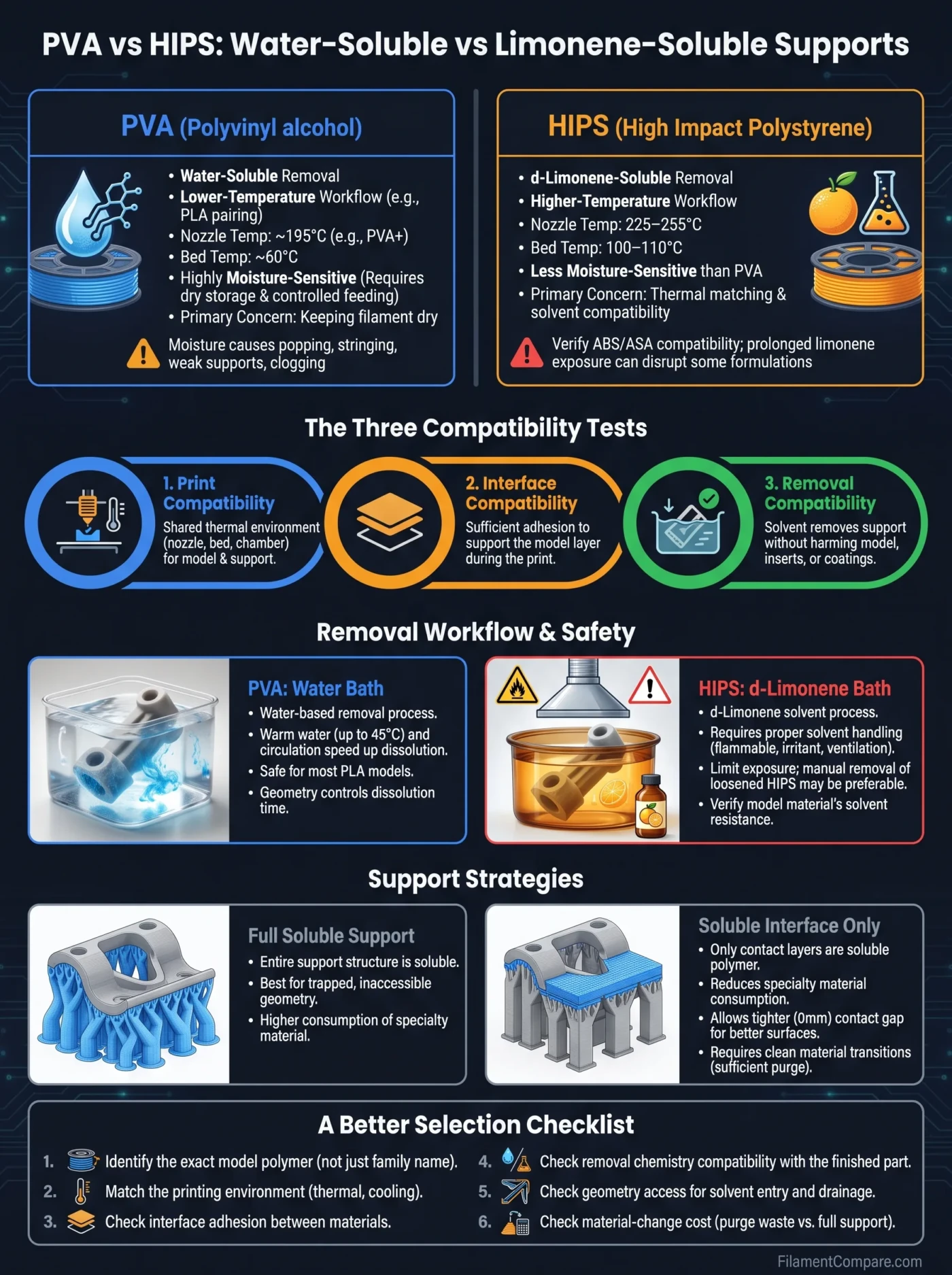
PVA and HIPS can both remove support from places where pliers or cutters cannot reach, but they belong to very different printing workflows. PVA dissolves in water and is most naturally associated with lower-temperature support systems such as PLA, while HIPS dissolves in d-limonene and prints in a much hotter temperature range. The useful comparison is therefore not simply water versus solvent: the model polymer, interface adhesion, printing temperature, printer architecture, support geometry, and what the finished part can safely be exposed to all affect the choice.
| Decision Area | PVA | HIPS |
|---|---|---|
| Full name | Polyvinyl alcohol | High Impact Polystyrene |
| Support removal | Water-soluble | d-Limonene-soluble |
| Documented Prusa nozzle setting | 195°C for PVA+ | 225–255°C |
| Documented Prusa bed setting | 60°C | 100–110°C |
| Natural workflow direction | Lower-temperature model materials; PLA is the clearest baseline pairing | Higher-temperature workflows where both interface and solvent compatibility are verified |
| Moisture sensitivity | Very hygroscopic; dry storage and controlled feeding matter | Moisture is usually less central to the support workflow than it is with PVA |
| Removal hardware | Water container; circulation can help | Solvent-resistant container suitable for d-limonene |
| Chemical handling | Water-based removal | Requires solvent handling and disposal appropriate for d-limonene |
| Trapped support | Well suited when water can reach the support and drain from the part | Well suited when d-limonene can reach the HIPS and the model tolerates the solvent |
| Dense or zero-gap interface | Supported by validated soluble-support profiles | Possible only when the selected model/HIPS pairing bonds correctly during printing |
| Primary workflow concern | Keeping the filament dry and uncontaminated | Thermal matching plus model resistance to the removal solvent |
| Full support required? | No; interface-only use can reduce soluble material consumption | No universal requirement; use depends on slicer, printer, and validated pairing |
| Best selection rule | Choose when the model, print temperature, and water bath are compatible | Choose when the model, print temperature, interface, and d-limonene exposure are compatible |
This PVA and HIPS comparison uses manufacturer documentation, datasheet values, and institutional chemical references; the figures describe documented material trends and example profiles, while actual results vary with formulation, printer, geometry, moisture, slicer settings, and the model filament.
For one documented reference point, Prusa lists 195°C nozzle and 60°C bed temperatures for PVA+, compared with 225–255°C nozzle and 100–110°C bed temperatures for HIPS.[a][b] These values should not be treated as universal settings for every spool, but the separation between them shows why PVA and HIPS normally occupy different support-material workflows.
- PVA: Water-Soluble
- HIPS: d-Limonene-Soluble
- PVA: Moisture-Sensitive
- HIPS: Higher Print Temperature
- Both: Material Matching Matters
The Solvent Is Only One Part of the Difference
PVA and HIPS perform the same temporary job: they hold unsupported geometry while the model is being printed and are removed afterward. Their chemistry changes almost everything around that job. PVA is designed around water removal. HIPS is a printable thermoplastic in its own right, but its use as soluble support depends on d-limonene attacking the HIPS without unacceptably affecting the model.
This creates three separate compatibility tests. A support pair must print in the same thermal environment, it must bond well enough at the interface to hold the overhang, and the support must later be removable without harming the model. Passing only one or two of those tests is not enough.
- 1. Print Compatibility
- The support and model materials need usable nozzle, bed, cooling, and chamber conditions at the same time.
- 2. Interface Compatibility
- The two polymers need enough adhesion to support the model layer without separating during the print.
- 3. Removal Compatibility
- Water or d-limonene must remove the support while leaving the model, inserts, coatings, and other components suitable for use.
PVA Fits the Water-Soluble Support Workflow
PVA is polyvinyl alcohol, a water-soluble polymer widely used as sacrificial support in multi-material FDM printing. The model remains intact while the PVA support softens and disperses in water. This makes it useful for internal passages, captured mechanisms, deep recesses, and supported faces where pulling a conventional support structure away would be awkward.
The familiar pairing is PLA with PVA. Prusa specifically identifies PLA as an appropriate model material for PVA/PVA+ because their printing temperatures are close enough for the same job.[a] That thermal overlap is more important than the fact that PVA dissolves in water: a support filament that cannot share stable printing conditions with the model is not a useful pairing.
PVA is not one universal formulation. Different commercial grades can have different print windows, adhesion behavior, moisture tolerance, and model-material compatibility. UltiMaker, for example, documents its own PVA for PLA, Tough PLA, Nylon and CPE, while other combinations carry restrictions or require another support grade.[e] A compatibility claim for one manufacturer’s PVA should therefore not automatically be applied to every PVA spool.
HIPS Uses a Higher-Temperature Solvent-Support System
HIPS is High Impact Polystyrene, a rubber-modified polystyrene material that can be printed as an ordinary thermoplastic as well as used for support. Its support role comes from its solubility in d-limonene, not from water solubility.
The thermal environment is markedly different from PVA. Prusa’s HIPS material profile lists a 225–255°C nozzle range and a 100–110°C bed range.[b] A model material chosen to print beside it must tolerate the same bed, chamber, and layer-cooling conditions while still forming a usable bond with the HIPS interface.
This is why substituting HIPS for PVA is rarely a simple material swap. A PVA-based support job designed around PLA temperatures can require an entirely different thermal setup when changed to HIPS. The model filament may also need to change. The removal chemistry and the print environment move together.
Choose the Support Around the Model Material
The most reliable selection order is model material first, support material second. The question is not merely whether water or limonene sounds more convenient. The useful support is the one that can coexist with the model during printing and then leave the part through an acceptable removal process.
| Model Material or Condition | PVA Direction | HIPS Direction | Main Check |
|---|---|---|---|
| PLA | Strong baseline candidate | Usually an awkward thermal match | Printing-temperature overlap |
| PETG | Product-dependent; some systems favor another water-soluble grade | Supported by some manufacturer workflows | Interface adhesion and profile validation |
| ABS | Product- and printer-dependent | Historically common, but d-limonene compatibility must not be assumed | Solvent exposure of the exact ABS formulation |
| ASA | Usually requires a verified support product | Do not assume prolonged limonene exposure is safe | Solvent compatibility and chamber conditions |
| Nylon or CPE family | Some manufacturer-specific PVA systems list compatible grades | System-dependent | Support datasheet, temperature, and interface adhesion |
| High-temperature engineering polymer | Standard PVA may be outside the required thermal window | HIPS is not automatically suitable | A support product rated for the model and chamber |
A material family name alone cannot prove compatibility. Pigments, impact modifiers, copolymers, fillers, and other formulation changes can alter both intermaterial adhesion and solvent resistance. For a long print, the exact model and support products matter more than a generic chart.
The Traditional ABS and HIPS Pairing Needs a Solvent Check
HIPS has long been associated with ABS support printing because both sit in a similar high-temperature printing family and HIPS can be removed with limonene. That pairing is still frequently repeated as a general rule. It is not universal.
Prusa’s HIPS documentation warns that some ABS and ASA filaments are also affected by limonene. Long exposure can disrupt layer adhesion, which is why its guidance suggests that a short exposure used to loosen HIPS followed by manual removal may be preferable to leaving certain model materials immersed until every support feature has disappeared.[b]
Limonene Compatibility: Do not treat “ABS + HIPS” or “ASA + HIPS” as an automatic solvent-safe combination. Verify the exact model filament before planning a prolonged d-limonene bath.
This distinction matters most for hidden supports. An exposed HIPS tower can be softened and removed relatively early. A packed internal channel may need far more solvent contact, which increases the importance of the model polymer’s long-duration chemical compatibility.
Water Removal and Limonene Removal Create Different Post-Processing Workflows
PVA Removal in Water
PVA removal is based on access to water. Exposed support sections can be removed first when practical, leaving less material for the bath. The remaining PVA then needs enough water contact and circulation for softened polymer to leave the interface and internal spaces.
- Remove large accessible PVA sections when they separate without stressing the model.
- Immerse the remaining supported area in water that is safe for the model material.
- Allow fresh water to reach enclosed interfaces and channels.
- Change or circulate the water when dissolved material slows further removal.
- Rinse remaining residue and allow the model to dry as required by its material.
In Prusa’s soluble-support workflow, warm water up to 45°C is specified and removal can take several hours to overnight depending on the support and conditions.[c] That is a product/workflow reference, not a universal instruction to heat every PVA-supported model to 45°C. Thin PLA geometry and other temperature-sensitive parts may set a lower practical limit.
HIPS Removal in d-Limonene
HIPS replaces the water bath with a d-limonene solvent process. The liquid must reach the support, attack it, and allow softened or dissolved HIPS to leave the geometry. Thick masses and long internal channels can therefore behave differently from a thin interface layer.
- Remove accessible HIPS mechanically when the validated pairing allows it.
- Expose the remaining support to d-limonene in a suitable container.
- Limit exposure according to the model material and support manufacturer’s instructions.
- Remove loosened HIPS where full dissolution is unnecessary.
- Clean residual solvent from the model and allow appropriate drying time.
There is no dependable universal statement such as “PVA dissolves in X hours while HIPS dissolves in Y.” Support thickness, exposed surface area, liquid movement, temperature, contamination, channel geometry, and formulation can all move the result.
Water-Soluble Does Not Mean Instant
A thin PVA interface has far more surface area relative to its mass than a large solid support block. Water reaches most of the thin structure quickly. In a thick section, the outer material can soften while the center remains intact, so removal progresses inward over time. Geometry controls dissolution.
What Changes Soluble-Support Removal Time?
- Support thickness and total mass
- Surface area exposed to water or solvent
- Interface-only versus full-support construction
- Liquid movement and replacement
- Permitted bath temperature
- Contamination from the model filament
- Width, length, and drainage of internal channels
- The exact PVA or HIPS formulation
The same geometry principle applies to HIPS. A small exposed contact layer may loosen much sooner than a long internal HIPS core. This is one reason full dissolution should not automatically be the target when a short solvent exposure can safely loosen a removable support section.
Full Soluble Support and Soluble Interface Are Not the Same Strategy
Printing every support tower from soluble filament is easy to understand, but it can consume far more specialty material and create more material changes than necessary. Many dual-material jobs only need the soluble polymer where the support actually touches the model.
Full Soluble Support
The entire support structure uses the soluble material. This is useful when support itself is trapped inside complex geometry and cannot be extracted as a solid structure after printing.
Soluble Interface Only
The main support tower uses ordinary model material while a small number of dense contact layers use the soluble material. The support body can be removed normally, then the remaining interface is dissolved.
PrusaSlicer exposes these as SOLUBLE FULL and SOLUBLE INTERFACE workflows for supported multi-material systems. Its documentation notes that interface-only printing reduces consumption of the more expensive soluble material.[c]
| Print Condition | Full Soluble Support | Interface Only |
|---|---|---|
| Deep internal support | Useful when the whole support body is trapped | May leave an inaccessible non-soluble support core |
| Open external overhang | Often consumes more specialty filament than necessary | Can provide a soluble contact surface with lower soluble-material use |
| Material changes | Can be numerous depending on geometry | Often reduced because only interface layers need the second material |
| Dissolving load | Higher support mass enters the bath | Less soluble polymer must be removed |
| Support cost | Higher when soluble filament volume is large | Often lower when the bulk support uses model filament |
Soluble Interfaces Can Use a Much Tighter Contact Gap
Ordinary same-material support normally needs a vertical separation gap so the support can break away. That air gap also allows the first supported model layer to sag slightly between support lines. A soluble interface changes the trade-off because it does not need to peel cleanly from the model.
Prusa specifies a 0 mm Z-axis support distance for its validated water-soluble workflow.[a] A dense PVA interface can therefore sit directly against the model surface and later leave through dissolution. This can produce a flatter underside than a conventional support configuration where an intentional air gap must remain.
Zero gap is not a universal instruction for every PVA or HIPS combination. The interface still has to adhere correctly during printing, and the removal liquid must be able to separate the materials afterward. A poor material pairing can fail even when the slicer geometry looks ideal.
PVA’s Main Workflow Constraint Is Moisture
PVA’s water affinity is useful after printing and demanding before printing. The filament can absorb moisture from ambient air, changing how it feeds and extrudes. UltiMaker notes that moisture-affected PVA can become soft, pliable, or sticky; bubbles, popping, weak support layers, and print-core clogging can also appear.[d]
- Popping or visible bubbles: moisture is flashing to vapor in the hotend.
- Heavy stringing or oozing: moisture and temperature can make material transitions less controlled.
- Soft or sticky filament: feeding through a multi-material path can become less predictable.
- Weak support walls: inconsistent extrusion can undermine the structure before the model reaches it.
- Clogging: degraded extrusion can interrupt a long dual-material print.
For its PVA, UltiMaker recommends storage below 50% relative humidity and between 0°C and 30°C, with sealed storage when the spool is not being used.[d] Those numbers belong to that manufacturer’s product guidance; another PVA brand may specify a tighter dry-box target or a different drying procedure.
Practical Difference: A PVA support system depends on material condition before the print starts. A thermally compatible model/PVA pairing can still perform poorly if the support filament has absorbed enough moisture to feed or extrude inconsistently.
HIPS Shifts the Challenge Toward Thermal Control and Solvent Compatibility
HIPS does not place the same emphasis on water-sensitive handling as PVA. Its documented print temperatures are much higher, so the important questions move toward the heated bed, enclosure environment, shrinkage behavior, interface bonding, and model material.
A HIPS support structure cannot be evaluated separately from the model. If the model wants strong cooling while HIPS wants a warmer, more stable environment, or if the model’s bed-temperature requirement is far below the HIPS profile, the shared print environment becomes the limiting factor.
The same logic applies after printing. Even if the two materials print well together, the combination is incomplete until the model has been checked against d-limonene. Print compatibility does not prove removal compatibility.
Printer Architecture Changes the Cost of Both Materials
Independent Nozzles or Toolheads
With two independent melt paths, the model filament and soluble support do not repeatedly share the same hotend. This can reduce cross-contamination and purge demand. The printer still has to manage inactive-nozzle oozing, nozzle alignment, standby temperature, and the two materials’ thermal requirements.
Single-Nozzle Material Switching
A single-nozzle multi-material system has to unload one polymer, load the other, and flush the previous material from the melt zone. A model containing many small supported islands can require hundreds of material transitions even when the actual mass of soluble interface is modest.
Prusa’s MMU soluble-material instructions illustrate the scale of the issue: a normal change uses a default total purge volume of 140 mm³, while water-soluble support jobs are recommended at at least 200–240 mm³, with 240 mm³ or more potentially needed when changing away from PVA+/BVOH.[c] These are Prusa-system values, not settings to copy directly into unrelated printers.
Contamination Can Stop a Soluble Interface From Behaving Like One
Material switching is not only a cosmetic issue. If PLA remains in the nozzle when PVA begins printing, the support interface can contain water-insoluble PLA strands. The PVA around them may disappear while those strands remain across the supported face or inside a narrow channel.
The reverse direction also matters. PVA carried into the model extrusion can change local surface quality or layer behavior. HIPS systems face the same general contamination problem: support material and model material should remain as distinct as the printer can reasonably make them. Clean transitions preserve both dissolution and model integrity.
- Clean Support Interface
- The support region contains enough of the intended soluble polymer to respond predictably to water or solvent.
- Contaminated Support Interface
- Residual model polymer crosses through the support region and can leave insoluble strands, plugs, or stubborn patches after the surrounding material is removed.
Supported-Surface Quality Depends on More Than Solubility
Neither PVA nor HIPS automatically produces a perfect underside. Soluble support mainly removes the need to preserve a large mechanical separation gap. The actual face is still controlled by interface density, contact distance, line spacing, layer height, cooling, flow, purge quality, and model-support adhesion.
A dense PVA interface with a validated zero-gap profile can support a horizontal model layer very closely. A badly contaminated or under-extruded PVA interface can do the opposite. HIPS follows the same principle: solvent removability cannot compensate for an unstable interface during printing.
Internal Geometry Is Where Soluble Support Has the Clearest Purpose
The strongest reason to use either material is geometry that cannot be reached mechanically. Examples include curved cooling ducts, captured joints, caged mechanisms, internal lattices, enclosed overhangs, and narrow passages. A conventional support can separate cleanly and still be useless if there is no path for extracting it.
- Curved internal channels where rigid support cannot be pulled around a bend
- Print-in-place joints with support trapped between moving surfaces
- Captured gears or bearings with limited tool access
- Thin decorative structures that could be damaged by pulling support away
- Deep cavities where support scars would be difficult to reach for sanding
- Topology-optimized forms with many enclosed overhangs
Solubility does not eliminate the need for an exit path. A completely sealed cavity can retain softened polymer and contaminated liquid even after the support has chemically broken down. Internal channels need liquid access and drainage, not merely soluble support.
The Finished Part Also Has to Tolerate the Removal Bath
Support selection is often discussed as though only the support polymer enters the bath. The entire printed part normally goes with it. That makes the finished assembly part of the compatibility decision.
Before a Water Bath
- Check whether the model polymer absorbs meaningful amounts of water.
- Consider whether dimensional measurement should wait until the part is dry.
- Check metal inserts, bearings, electronics, adhesives, labels, or coatings.
- Make sure enclosed channels can drain after the PVA is removed.
Before a d-Limonene Bath
- Confirm the exact model filament’s solvent compatibility rather than relying only on its polymer-family name.
- Consider coatings, adhesives, seals, elastomers, and inserted components separately.
- Limit exposure when the support can be loosened rather than fully dissolved.
- Use a container compatible with the solvent and follow its handling information.
d-Limonene Needs Solvent Handling, Not Water-Bath Handling
d-Limonene has a familiar citrus odor, but it is still a chemical solvent. PubChem lists d-limonene as a flammable liquid and vapor, a skin irritant and sensitizer, and a substance with aquatic hazards.[f] The support-removal setup should therefore follow the solvent supplier’s safety data rather than treating the liquid like ordinary wash water.
d-Limonene Handling: Keep the solvent away from ignition sources, use appropriate skin protection and ventilation, keep it in a suitable closed container when not in use, and follow local disposal rules and the product’s safety data sheet.
This difference can influence the practical choice even when both support materials could technically work. A workspace already set up for chemical post-processing may accommodate HIPS easily. Another environment may prefer water-soluble support when the model material permits it.
Spool Price Alone Does Not Describe Support Cost
Specialty support is consumed in more places than the visible support structure. On a material-switching printer, purge waste may rival or exceed the mass of the actual soluble interface. Post-processing also has a consumable cost, especially when HIPS requires d-limonene.
Material Overhead Formula
Support overhead = soluble filament cost + purge-material cost + removal consumables
Soluble filament cost = soluble grams ÷ 1000 × filament price per kg
Purge-material cost = purge grams ÷ 1000 × relevant filament price per kg
Removal consumables include the water-management or solvent cost that is actually used for the job.
Interface-only printing can change this calculation sharply. If the ordinary model filament forms most of the tower and PVA or another soluble material is limited to the contact layers, specialty-filament consumption falls. On a single-nozzle system, though, each additional interface region can still create purge and time overhead.
PVA and HIPS Fail in Different Ways
| Symptom | PVA Area to Check | HIPS Area to Check |
|---|---|---|
| Popping or bubbles during extrusion | Moisture absorption | Filament condition and temperature; not a defining HIPS/PVA difference by itself |
| Heavy stringing during tool changes | Moisture, standby temperature, purge and retraction | Standby temperature, ooze control and switching profile |
| Support separates during printing | Model/support adhesion and interface settings | Model/HIPS adhesion and thermal environment |
| Support does not fully disappear | Contamination, thick sections, stagnant water or blocked access | Limited solvent access, thick sections or shortened exposure |
| Residue remains in a channel | Model polymer contamination or insufficient flushing | Softened HIPS or solvent residue not fully evacuated |
| Model changes during removal | Water exposure, temperature or absorbed moisture in the model | d-Limonene compatibility or excessive exposure |
| Large corners lift while printing | Usually governed mainly by the model material and bed setup | Thermal control, bed adhesion and the high-temperature print environment |
Which Support Direction Fits Different Print Scenarios?
| Print Scenario | More Suitable Direction | Reason |
|---|---|---|
| PLA model with trapped support | PVA | PLA is a documented baseline pairing for water-soluble PVA support. |
| PLA model with only open external support | PVA interface or ordinary support | Full soluble support may add material changes without solving an access problem. |
| PLA part with a visible supported underside | PVA interface | A validated dense, zero-gap soluble interface can support the underside closely. |
| PETG part with hidden support | Product-specific soluble pairing | Check the chosen PVA/BVOH/HIPS product rather than assuming generic compatibility. |
| ABS part with HIPS support | Verify before use | The temperatures may align, but some ABS formulations are affected by d-limonene. |
| ASA part with HIPS support | Verify before use | Some ASA formulations can also be affected by prolonged limonene exposure. |
| Water-sensitive completed assembly | HIPS or another validated support system | The PVA removal bath may be unsuitable even when printing temperatures match. |
| Model that is not compatible with d-limonene | PVA or another validated support | HIPS removal chemistry becomes the limiting condition. |
| Workspace without reliable dry storage | Evaluate alternatives to PVA | PVA performance depends heavily on moisture control. |
| Single-nozzle job with many tiny support islands | Interface-only or redesign | Repeated material changes can create large purge and time overhead. |
| Long curved internal duct | Soluble support matched to the model | Rigid breakaway support may be impossible to extract around the bend. |
| Fully sealed cavity | Redesign the removal path | Neither dissolved support nor removal liquid has a reliable way to leave the cavity. |
When PVA Is the More Natural Fit
- The model is PLA or another filament covered by the specific PVA manufacturer’s compatibility data.
- The model can tolerate the required water exposure.
- Support is trapped in channels, cages, joints, or other areas that cannot be reached mechanically.
- A dense soluble interface is useful for the underside of the part.
- The printer can perform reliable multi-material changes or has independent material paths.
- The PVA can remain dry during storage and throughout a long print.
- A water-based removal process suits the workspace better than an organic solvent.
PVA is especially effective when all of those conditions line up. The water-soluble behavior then becomes part of a compatible printing system rather than an isolated material property.
When HIPS Is the More Natural Fit
- The model material shares a workable high-temperature printing environment with HIPS.
- The model/support interface has been validated for the selected products.
- The finished model and any inserts or coatings can tolerate the planned d-limonene exposure.
- The workspace already supports appropriate solvent storage and handling.
- PVA’s lower-temperature range does not fit the model material.
- HIPS itself is also useful elsewhere in the printing workflow as a normal printable thermoplastic.
HIPS is therefore better understood as a solvent-removable high-temperature support option, not as the automatic counterpart to every ABS or ASA print.
When Neither PVA nor HIPS Is Necessary
Soluble support earns its extra material handling when geometry or surface requirements justify it. A short external overhang that can be reached from every side may be easier to print with ordinary breakaway or same-material support. Adding a second polymer, purge tower, soaking stage, and drying step can otherwise create more work than the support geometry requires.
- The support is fully exposed and easy to grip.
- A small support mark is acceptable or easy to finish.
- The printer has no practical second-material system.
- The required soluble material does not share a workable temperature range with the model.
- The model cannot tolerate either water exposure or d-limonene exposure.
- A specialized engineering support material is available for the model polymer.
- The cavity is sealed and provides no useful liquid path.
A Better Selection Test Than “Water or Limonene?”
1. Identify the Model Polymer
Start with the exact filament product, not only the broad family name.
2. Match the Printing Environment
Check whether the model and support can share nozzle, bed, chamber, cooling, and interface conditions.
3. Check Interface Adhesion
The support must stay attached while the overhang is being built.
4. Check Removal Chemistry
For PVA, verify water exposure. For HIPS, verify d-limonene exposure of the exact model formulation.
5. Check Geometry Access
Decide whether the entire support must dissolve or whether only the interface needs to be soluble.
6. Check the Printer’s Material-Change Cost
Estimate purge waste and tool changes before deciding that a full soluble-support structure is worthwhile.
That sequence prevents a common selection error: choosing a support because its removal liquid sounds convenient and only afterward discovering that the two filaments cannot print together reliably. Print, bond, and remove all have to work.
Common PVA and HIPS Support Questions
Is PVA Better Than HIPS for PLA?
PVA is the more natural baseline support for PLA because established PVA workflows operate in a similar temperature range and remove in water. Prusa specifically identifies PLA with PVA/PVA+ as a compatible direction.[a] The exact PVA grade and printer profile still matter.
Is HIPS Always the Right Soluble Support for ABS?
No universal rule supports that assumption. HIPS and ABS can occupy similar printing temperatures, but some ABS formulations are affected by d-limonene. Prusa specifically cautions that prolonged solvent exposure can disrupt some ABS and ASA materials.[b]
Does All of the Support Need to Be PVA?
No. Many geometries can use ordinary model filament for the main support tower and reserve PVA for the dense interface layers. Full soluble support is more useful when the support body itself becomes trapped inside the finished geometry.
Why Can PVA Remain After a Long Water Bath?
Possible causes include a thick support section, poor water movement, a blocked internal path, or contamination with model filament. Prusa notes that residual PLA introduced during frequent filament changes can keep a PVA/BVOH support from dissolving completely, which is why adequate purge volume matters.[c]
Can Warmer Water Remove PVA Faster?
Warmer water can speed removal, but the model determines the safe temperature. Prusa’s own soluble-support instructions specify warm water up to 45°C for that workflow.[c] Thin or temperature-sensitive parts may need cooler water.
Can HIPS Be Removed Without Dissolving Every Last Bit?
Yes, where the geometry allows it. Prusa specifically suggests using a brief limonene exposure to loosen HIPS before mechanical removal when prolonged solvent exposure could affect the model material.[b] Hidden support that cannot be reached may still require a different removal strategy or material pairing.
Technical References
- [a] Prusa Research — Water Soluble (BVOH/PVA). Used for PVA+ nozzle and bed temperatures, PLA pairing, dry-storage requirement, 0 mm support distance, and PVA dissolution behavior.
- [b] Prusa Research — HIPS. Used for HIPS nozzle and bed temperatures, d-limonene solubility, support use, and the warning that some ABS/ASA formulations can be affected by prolonged limonene exposure.
- [c] Prusa Research — Water-Soluble Materials (PVA/BVOH). Used for SOLUBLE FULL and SOLUBLE INTERFACE behavior, purge-volume guidance, contamination concerns, and warm-water removal instructions.
- [d] UltiMaker — How to Store PVA Material. Used for PVA moisture symptoms, storage conditions, and dry-storage recommendations.
- [e] UltiMaker — Support Materials: A Beginner’s Guide. Used for manufacturer-specific PVA/model-material compatibility examples and the need for higher-temperature specialty support materials outside standard PVA workflows.
- [f] U.S. National Library of Medicine, PubChem — d-Limonene. Used for flammability, skin irritation/sensitization, and aquatic-hazard classifications.
