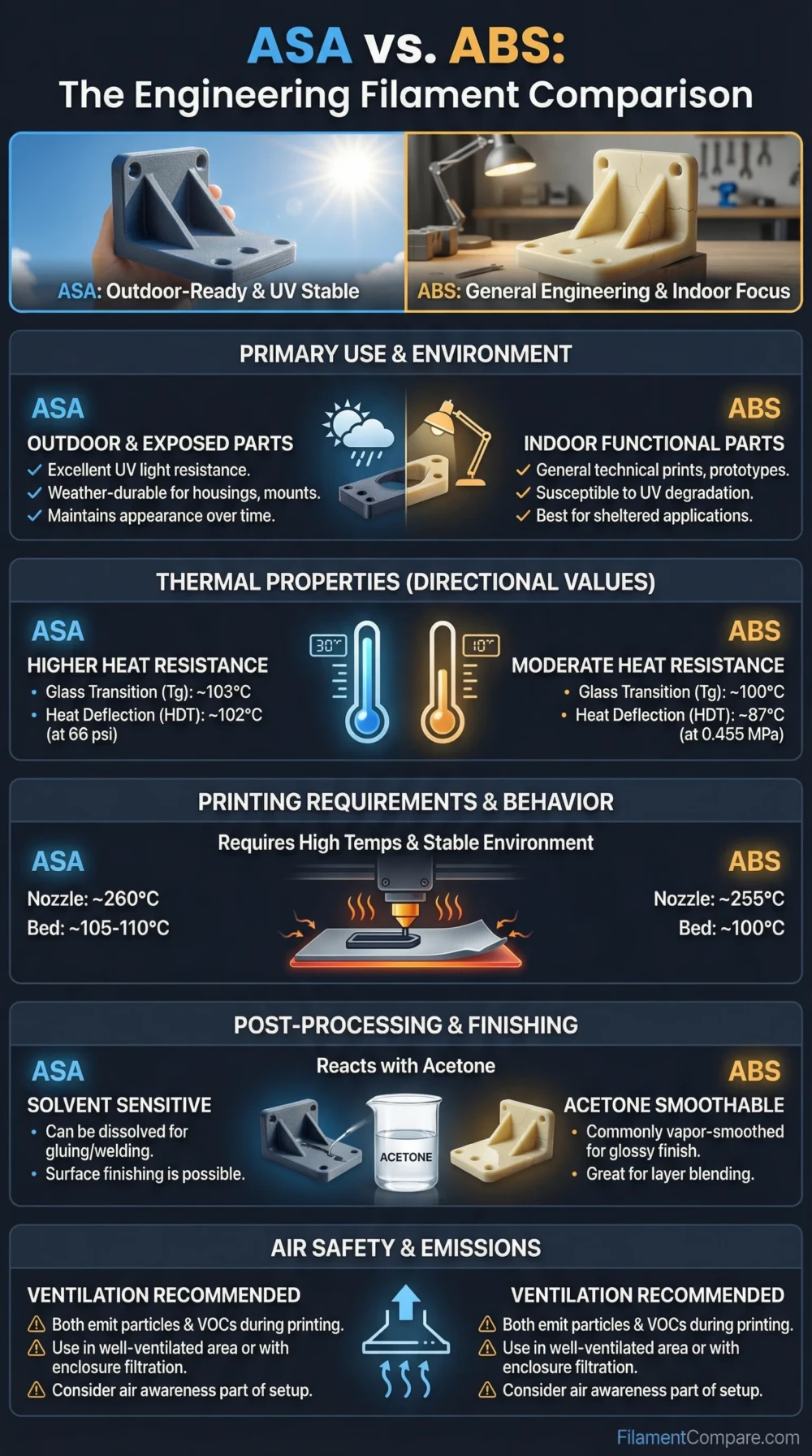
ASA is the better fit for UV-exposed and outdoor-facing parts, while ABS is the more common choice for enclosed indoor functional prints, prototypes, and acetone-smoothing workflows. Both are styrenic engineering filaments with similar heat behavior, but ASA usually adds better weather resistance and slightly easier dimensional control. ABS can still make tough, heat-tolerant parts when printed in a stable warm chamber.
Choose ASA when the part may see sunlight, mild outdoor exposure, or weather changes. It is usually the cleaner long-term choice for exterior brackets, garden fixtures, automotive trim prototypes, signs, and parts that need better UV stability than standard ABS.
Choose ABS when you want a widely available, affordable, enclosure-friendly engineering filament for indoor mechanical parts, housings, jigs, and prototypes. It is also the more familiar option for acetone vapor smoothing, but it needs good ventilation and controlled printing conditions.
Better Outdoor Fit
ASA handles UV and weather exposure better than standard ABS.
Better Indoor Engineering Use
ABS works well for enclosed printer setups and indoor functional parts.
Lower UV Aging Risk
ASA is the safer pick when color and surface condition matter outdoors.
More Common Material Choice
ABS is easier to find across brands, colors, blends, and price tiers.
Better for Open Printers
Neither is ideal. Both print better with an enclosure and stable chamber temperature.
Better Shape Retention
ASA usually keeps form well in warm outdoor use, but hot enclosed spaces can still exceed its comfort range.
Better for Acetone Smoothing
ABS is the more established choice for acetone vapor smoothing workflows.
Lower Warping Risk
ASA is often a little more manageable, but large flat parts still need tuning.
| Category | ASA | ABS | Better Choice |
|---|---|---|---|
| Material Family | Acrylonitrile styrene acrylate, styrenic thermoplastic | Acrylonitrile butadiene styrene, styrenic thermoplastic | Use-case based |
| Print Difficulty | Moderate to demanding; enclosure strongly recommended | Moderate to demanding; enclosure strongly recommended | Similar |
| Typical Nozzle Temperature | Usually around 240–260°C, brand-dependent | Usually around 230–260°C, brand-dependent | Similar |
| Typical Bed Temperature | Usually around 90–110°C | Usually around 90–110°C | Similar |
| Enclosure Requirement | Strongly recommended for layer bonding and warp control | Strongly recommended for layer bonding and warp control | Similar |
| Heat Resistance | Prusament ASA lists HDT at 93°C under 0.45 MPa[a] | Ultimaker ABS lists HDT at 86.6 ± 0.4°C under 0.455 MPa[b] | ASA |
| Toughness | Good impact behavior for functional parts; grade-dependent | Good toughness and impact behavior; grade-dependent | Similar |
| Stiffness | Ultimaker Method ASA lists tensile modulus at 2,300 MPa[c] | Ultimaker ABS TDS lists XY tensile modulus near 1,962 MPa[d] | ASA, by some datasheets |
| Layer Adhesion | Good when chamber temperature is stable and cooling is limited | Good when printed hot enough in an enclosure | Similar |
| Moisture Sensitivity | Can absorb moisture; drying helps surface quality and consistency | Can absorb moisture, though usually less demanding than nylon or TPU | Similar |
| Surface Finish | Matte to semi-gloss depending on brand and color | Semi-gloss; often used for acetone-smoothed parts | Depends on finish target |
| Outdoor Suitability | More suitable for sunlight and mild weather exposure | Less suitable for long UV exposure unless modified or protected | ASA |
| Typical Uses | Outdoor brackets, covers, signs, automotive trim prototypes, housings | Indoor housings, jigs, fixtures, prototypes, smoothed display parts | Use-case based |
| Main Limitation | Still warps on large parts and produces styrene-related odor | Warping, odor, UV aging, and chamber dependence | ASA has fewer outdoor limits |
This ASA and ABS comparison is based on manufacturer datasheets and material guides, but the values should be read as general trends because brand, color, additives, moisture level, part orientation, and print settings can change real print results.
ASA Material Profile
- Polymer type: Acrylonitrile styrene acrylate
- Print difficulty: Moderate to demanding
- Nozzle range: Usually 240–260°C
- Bed range: Usually 90–110°C
- Enclosure: Strongly recommended
- Drying need: Useful before demanding prints or after long storage
- Typical behavior: Heat-tolerant, UV-resistant, still warp-sensitive
- Best use cases: Outdoor parts, covers, brackets, signage, exterior prototypes
ABS Material Profile
- Polymer type: Acrylonitrile butadiene styrene
- Print difficulty: Moderate to demanding
- Nozzle range: Usually 230–260°C
- Bed range: Usually 90–110°C
- Enclosure: Strongly recommended
- Drying need: Helpful when popping, surface defects, or weak bonding appear
- Typical behavior: Tough, heat-tolerant, warp-sensitive, common in functional printing
- Best use cases: Indoor housings, jigs, fixtures, prototypes, smoothed parts
These meters are relative print-use indicators, not fixed lab rankings. Brand formula, additives, color, absorbed moisture, chamber temperature, part orientation, and slicer profile can move the result noticeably.
Printability and Chamber Control
ASA and ABS are not beginner-style open-frame filaments. They shrink as they cool, so large flat parts can lift at corners, split between layers, or lose dimensional accuracy if the chamber temperature is unstable. A closed printer, clean build plate, controlled cooling, and a wide brim often matter more than small nozzle-temperature changes.
ASA is often described as slightly easier to manage than ABS, especially for outdoor-grade parts where surface condition matters. That does not make it a low-warp material. Tall walls, sharp corners, and dense infill can still create stress during cooling.
ABS rewards a tuned setup. With enough bed heat, low fan, and a stable enclosure, it can print strong housings and mechanical fixtures. On an open printer, the same spool may show corner lift, layer cracks, and inconsistent strength.
Printer Setup Notes
- Use an enclosure for both materials, especially for parts with wide bases or tall vertical walls.
- Ventilation is important because both materials can release noticeable odor during printing.
- Use part cooling carefully. Too much fan can reduce layer bonding and raise warping risk.
- Drying is useful when the filament has been stored in humid air or when the surface becomes rough.
Mechanical Behavior and Part Strength
ASA and ABS are close enough mechanically that print quality can decide more than the polymer name. A well-printed ABS part can outperform a poorly bonded ASA part, and the reverse is also true. Layer orientation, wall count, infill pattern, nozzle temperature, chamber heat, and moisture level all affect the final part.
ABS has a long track record for functional prototypes, enclosures, and parts that need a balance of toughness and moderate heat resistance. It is less stiff than some PLA grades, but it is usually less brittle in impact-style use.
ASA provides a similar functional feel with better weathering behavior. For parts mounted outdoors, the practical advantage is not only strength on day one. It is the ability to keep more of its surface condition and color under sunlight compared with standard ABS.
Heat Resistance and Shape Retention
Both filaments tolerate warmer environments better than PLA and many easy-print materials. That makes them useful for covers, ducts, brackets, light-duty fixtures, and parts near electronics. Still, heat resistance is not the same as unlimited temperature safety.
ASA often has a small advantage in heat-deflection data from manufacturer sheets. It is usually more suitable than ABS for outdoor warmth and sun-facing use, but dark-colored parts can heat up more than expected. Hot car interiors, enclosed outdoor boxes, and parts under constant load should be tested with the actual print geometry.
ABS remains a strong indoor heat-resistant option. It is not a direct replacement for PC, nylon blends, PPS, PEI, or other higher-temperature engineering materials when the part needs to carry load near elevated temperatures for long periods.
Outdoor and UV Performance
This is the cleanest separation between ASA and ABS. ASA was developed for better weather resistance, so it is normally the better choice for sunlight, rain-sheltered outdoor parts, signs, garden fixtures, exterior covers, and automotive trim prototypes.
ABS can work outdoors for short-term or protected use, but standard grades are more likely to discolor, become chalky, or lose surface quality under long UV exposure. Paint, coating, or UV-stabilized grades can help, but that adds another process variable.
Outdoor note: ASA is more suitable for mild outdoor use than standard ABS, but “weatherproof” is too broad for FDM parts. Layer lines, pigment, wall thickness, water traps, UV exposure, and mechanical load all affect service life.
Surface Finish, Smoothing, and Post-Processing
ABS is popular for acetone vapor smoothing because it responds predictably and can produce a glossy, sealed-looking surface. This is useful for visual prototypes, cosplay parts, housings, and display models where layer lines should be reduced. The process needs care, ventilation, and safe handling.
ASA can also be smoothed with solvent workflows, but ABS is usually the better-known material for that process. ASA’s advantage is different: it is better when the finished part must stay outdoors without relying only on paint or coating.
For sanding, priming, and painting, both materials can work well. ABS may be easier to find in low-cost bulk spools, while ASA is often chosen when the painted or unpainted part may see sunlight.
Warping, Bed Adhesion, and Dimensional Accuracy
Warping is not only a bed-adhesion problem. It comes from cooling stress inside the part. A very sticky build surface can hold the first layer down, but the upper layers may still contract and pull the print out of shape.
ASA tends to be slightly more forgiving than ABS in many desktop printing setups. For small and medium parts, that difference can make ASA easier to use. For large technical parts, both materials still need rounded corners, proper brim design, tuned first layer, and steady chamber heat.
Better Geometry Choices
Rounded corners, ribs instead of thick solid blocks, and controlled infill reduce internal stress.
Better Bed Strategy
Use a clean high-temperature surface and a brim for large parts. Adhesive layers can help release and grip.
Better Cooling Strategy
Use low fan or no fan unless bridges and small details need limited cooling.
| Use Case | More Suitable Material | Reason |
|---|---|---|
| Beginner prints | Neither | PLA or PETG is usually easier. ASA and ABS need enclosure control. |
| Outdoor brackets | ASA | Better UV and weather fit than standard ABS. |
| Indoor mechanical housings | ABS | Common, cost-effective, and proven for enclosed-printer functional parts. |
| Sun-facing signs or labels | ASA | Better color and surface stability under UV exposure. |
| Acetone-smoothed display parts | ABS | More established smoothing workflow and broad user experience. |
| Large flat prints | ASA | Often a little easier to control, though both can warp. |
| Automotive trim prototypes | ASA | Better outdoor and UV fit, with useful heat resistance. |
| Enclosure panels and covers | Use-case based | ASA for sun exposure; ABS for indoor cost and availability. |
| Jigs and workshop fixtures | ABS | Good toughness and availability when UV exposure is not a concern. |
| Parts near moderate heat | ASA | Often has a slight heat-deflection advantage, but load and color still matter. |
| Painted exterior prototypes | ASA | Paint helps both, but ASA gives a better material base for UV exposure. |
| Low-odor printing | Neither | Both can produce odor; use ventilation and an enclosed printer setup. |
Choose ASA When
- The part may be used outdoors or near sunlight.
- You want better UV resistance than standard ABS.
- The print needs good heat tolerance and better weather fit.
- You are making brackets, covers, signs, exterior prototypes, or garden fixtures.
- You can print in an enclosure with a hot bed and controlled cooling.
ASA Is Less Suitable When
- Your printer is open-frame and cannot keep chamber temperature stable.
- You need the lowest material cost or the widest local availability.
- The part is very large, flat, and not designed to reduce warping stress.
- You cannot manage odor and ventilation during printing.
Choose ABS When
- The part is mainly for indoor use.
- You want a common engineering filament for housings, jigs, and prototypes.
- You plan to use acetone vapor smoothing.
- You need broad availability across colors, brands, and bulk spool options.
- You have an enclosed printer and already know how to manage ABS shrinkage.
ABS Is Less Suitable When
- The part will sit in direct sun for long periods.
- Color retention and UV aging matter without paint or coating.
- You are printing large parts without an enclosure.
- You need a low-odor desktop material for a shared room.
Choose ASA if the part needs outdoor exposure resistance, better UV behavior, and good heat tolerance in a controlled-printing workflow.
Choose ABS if the part is mainly indoor, the budget matters more, acetone smoothing is part of the workflow, or you already have a tuned ABS enclosure setup.
Neither material replaces the other in every job. ASA is the better exterior-facing option; ABS remains a practical indoor engineering filament when the printer can control warping and fumes.
Common ASA and ABS Questions
Is ASA stronger than ABS?
Not in every meaning of strength. ASA and ABS can be close in tensile behavior and toughness, and the printed result depends on layer bonding, orientation, wall count, moisture, and chamber temperature. ASA is usually better for outdoor durability; ABS is still strong enough for many indoor functional parts.
Does ASA warp less than ABS?
ASA often feels a little easier to control, but it is still a warp-sensitive material. Large parts, sharp corners, and cold drafts can cause lifting or cracking with either filament.
Can ASA replace ABS for outdoor parts?
Usually yes, when the printer can handle ASA. ASA is normally the better choice for sunlight and mild weather exposure. For long-term loaded outdoor parts, test the actual design and consider UV-stabilized grades, coatings, or a different engineering material if needed.
Do ASA and ABS need drying?
Drying is not as central as it is with nylon, but it can help both materials. If the filament pops, strings more than usual, looks rough, or bonds inconsistently, drying the spool before printing is a sensible step.
Is ABS better for acetone smoothing?
Yes, ABS is the more common and predictable choice for acetone vapor smoothing. ASA can also respond to solvent smoothing, but ABS has broader workflow familiarity and material availability for that use.
Are ASA and ABS safe to print indoors?
Both should be printed with ventilation and sensible enclosure handling. They can produce noticeable odor during printing, and they are not the best choice for poorly ventilated shared spaces.
Resources Used
- [a] Technical datasheet – Prusament ASA by Prusa Polymers (Used for ASA density, moisture behavior, heat deflection temperature, and mechanical reference values in the comparison table.)
- [b] ABS 3D printing material (Used for Ultimaker ABS thermal and mechanical property references, including HDT and printed-part behavior values.)
- [c] Method series ASA (Used for ASA tensile modulus, tensile strength, and thermal resistance values from a manufacturer material page.)
- [d] Ultimaker ABS Technical data sheet (Used for ABS printed specimen tensile modulus, yield stress, elongation, and orientation-dependent mechanical data.)
