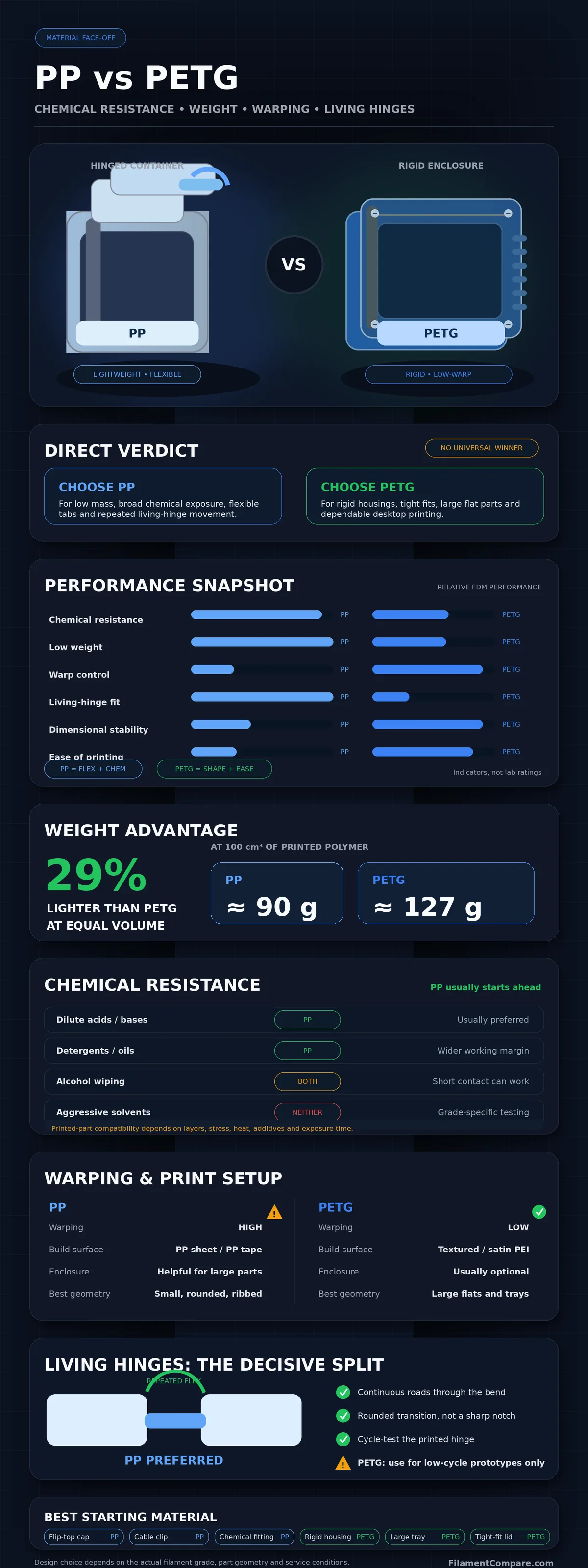
PP is lighter, more chemically resistant, and far better suited to repeated living-hinge movement, while PETG is easier to print with lower warping and more predictable dimensional accuracy. The practical choice depends on whether the part must flex thousands of times, retain a rigid shape, resist a particular chemical, or print successfully as a large flat component. Neither material replaces the other across all four requirements.
Direct Material Verdict
Choose PP for lightweight chemical-contact parts, flexible tabs, fatigue-resistant closures, and printed living hinges where repeated bending matters more than maximum rigidity.
Choose PETG for rigid housings, trays, brackets, large flat parts, dimensionally controlled assemblies, and prints that need reliable bed adhesion on a standard desktop setup.
Better Chemical Resistance
PP
Usually the stronger first choice for dilute acids, many bases, detergents, oils, and chemically exposed flexible parts.
Lower Part Weight
PP
Its lower density reduces mass without requiring lower infill or thinner walls.
Lower-Warp Printing
PETG
Usually holds large bases and long dimensions more reliably on common build surfaces.
Repeated Living Hinges
PP
Its ability to tolerate repeated bending makes it the more suitable hinge material.
Rigid Enclosures
PETG
Provides a firmer shell with less springiness and more predictable openings and screw locations.
Standard Printer Setup
PETG
Does not normally require a PP-specific build surface or the same level of warp control.
Flexible Clips and Tabs
PP
Better suited to parts that must deflect farther before returning toward their original position.
Tight Mechanical Fits
PETG
Lower shrinkage makes fitted lids, bearing seats, and aligned assemblies easier to tune.
| Property | PP | PETG | Practical Advantage |
|---|---|---|---|
| Polymer family | Polyolefin; usually semi-crystalline | Glycol-modified copolyester; commonly amorphous | Different part behavior |
| Print difficulty | Tuning-sensitive | Beginner to intermediate | PETG |
| Typical nozzle range | Usually about 220–270°C | Usually about 230–250°C | Brand-dependent |
| Typical bed range | Usually about 85–105°C | Usually about 75–90°C | Brand-dependent |
| Enclosure need | Helpful for large or warp-prone parts | Usually optional | PETG |
| Build surface | PP sheet, PP tape, or PP-specific adhesive often needed | Textured or satin PEI commonly works well | PETG |
| Density | Typically around 0.90 g/cm³ | Typically around 1.27 g/cm³ | PP for lower mass |
| Warping | High risk on broad, long, or flat geometry | Usually low | PETG |
| Bed adhesion | Weak on many standard surfaces | Strong; sometimes requires a release layer | PETG |
| Chemical resistance | Broad resistance, but not universal | Useful for selected chemicals; more grade-dependent | PP |
| Stiffness | Lower; more flexible and spring-like | Higher; better for rigid shells | Use-case based |
| Repeated bending | Strong material fit | Better for limited deflection than high-cycle folding | PP |
| Living hinges | Preferred of the two | Usually limited to low-cycle prototypes | PP |
| Dimensional stability | More affected by shrinkage and cooling | More predictable in ordinary FDM printing | PETG |
| Moisture behavior | Low moisture sensitivity in unfilled grades | Can absorb enough moisture to increase stringing and surface defects | PP |
| Typical use | Hinges, chemical-contact fittings, light containers, flexible clips | Housings, brackets, trays, machine guards, rigid fixtures | Use-case based |
| Main limitation | Warping and difficult surface adhesion | Lower suitability for repeated sharp folding | Different limitations |
The PP and PETG values below combine manufacturer datasheets and established technical material references; they describe common trends rather than guaranteed results because grade, pigment, fillers, moisture, print orientation, wall design, and slicer settings can change the finished part.
Material Profiles for Functional Printing
PP Material Profile
- Polymer type: Polypropylene polyolefin
- Print difficulty: Intermediate to advanced
- Nozzle range: Commonly 220–270°C
- Bed range: Commonly 85–105°C
- Enclosure: Helpful for larger parts
- Build plate: PP-compatible surface strongly preferred
- Drying need: Usually lower than PETG for standard unfilled PP
- Typical behavior: Lightweight, flexible, chemically resistant, shrink-prone
- Best fit: Living hinges, flexible closures, fluid-contact prototypes, lightweight moving parts
Prusa lists a broad 220–270°C nozzle range, an 85–100°C recommended bed range, high warping, and weak adhesion to ordinary PEI for PP[a].
PETG Material Profile
- Polymer type: Glycol-modified copolyester
- Print difficulty: Beginner to intermediate
- Nozzle range: Commonly 230–250°C
- Bed range: Commonly 75–90°C
- Enclosure: Usually optional
- Build plate: Textured or satin PEI commonly preferred
- Drying need: Useful when stringing, bubbles, or a rough surface appear
- Typical behavior: Tough, rigid enough for housings, low-warp, strong layer bonding
- Best fit: Brackets, enclosures, trays, fixtures, large functional prints
Prusa recommends approximately 230–240°C at the nozzle and 85–90°C at the bed for its PETG profile, while also identifying low warping and strong build-plate adhesion as characteristic behavior[b].
Relative Performance by the Four Main Priorities
PP
PETG
These meters are relative indicators for ordinary FDM use, not laboratory ratings. Filament grade, fillers, color, moisture, nozzle temperature, print orientation, wall thickness, and hinge geometry can move the practical result in either direction.
Chemical Resistance Is the First Major Split
PP is normally the safer starting point when chemical contact is one of the main design requirements. Its non-polar polyolefin structure performs well with many dilute acids, alkalis, detergents, alcohols, oils, and aqueous solutions. That does not make every PP filament suitable for every chemical.
PETG also resists water, many household liquids, and selected cleaners, but the result depends more heavily on the exact copolyester grade. A PETG part that survives a short splash may still soften, craze, lose strength, or develop stress cracks during long immersion (especially when the wall is bent, clamped, or pressurized).
Polymer compatibility is not the same as printed-part compatibility. Layer gaps, pigments, recycled content, unknown additives, seams, threaded joints, internal pressure, and residual print stress can cause failure even when the base polymer has a favorable chemical rating.
Dilute Acids and Alkalis
Unfilled PP is commonly chosen for laboratory containers, dosing components, detergent systems, and fittings exposed to dilute acids or bases. It is also used where repeated washing is expected. Concentration and temperature still matter: a chemical that causes little change at room temperature may attack the same plastic faster when heated.
PETG can be suitable for mild aqueous solutions and selected cleaning products. Strong alkalis, concentrated reagents, heated mixtures, and stressed walls require grade-specific evidence rather than a general PETG label.
Alcohols, Detergents, and Disinfectants
Short contact with ethanol or isopropyl alcohol is often manageable for both materials, but repeated wiping is different from continuous storage. Detergents and surface-active chemicals may also promote environmental stress cracking when a part already contains internal or external stress.
PP usually offers the wider working margin for a flexible dispenser component or closure that is repeatedly exposed to cleaners. PETG remains useful for rigid splash guards and housings, provided the specific cleaner is tested against the actual printed grade.
Oils, Grease, and Hydrocarbons
PP is frequently selected for contact with lubricants, greases, and many aliphatic hydrocarbon products. Aromatic and halogenated hydrocarbons are a different category and should not be treated as automatically compatible.
PETG should not be assumed suitable for fuels or aggressive solvents because it is described as chemically resistant. Fuel blends contain multiple compounds, and permeation may occur without immediate surface damage. Neither filament should be used for a pressure-retaining fuel component without engineering validation.
Heat, Stress, and Exposure Time
Chemical charts normally describe a defined resin, temperature, concentration, and exposure condition. Thermo Fisher notes that chemicals may alter strength, flexibility, dimensions, weight, or appearance through polymer attack, absorption, swelling, dissolution, permeation, or stress cracking. The same reference also warns that higher temperature, pressure, concentration, exposure time, and mechanical stress can change the result[e].
| Exposure | PP Assessment | PETG Assessment | Main Design Concern |
|---|---|---|---|
| Dilute acid splash | Usually a strong candidate | Often workable after grade verification | Concentration and cleanup interval |
| Dilute alkali contact | Usually preferred | More formulation-dependent | Long exposure and wall stress |
| Alcohol-based wiping | Often suitable | Often suitable for short contact | Pigment, repeated wiping, and surface stress |
| Detergent container fitting | Usually preferred | Possible with verified cleaner compatibility | Environmental stress cracking |
| Oil or grease contact | Often the better starting point | Requires product-specific testing | Swelling, softening, and seal retention |
| Aromatic solvent | Do not assume continuous-use compatibility | Do not assume compatibility | Rapid damage or permeation |
| Halogenated solvent | Generally unsuitable without a validated grade | Generally unsuitable without a validated grade | Dissolution, deformation, and loss of strength |
| Strong oxidizing chemical | Application testing required | Application testing required | Oxidation and embrittlement |
| Hot continuous immersion | Use grade-specific compatibility data | Use grade-specific compatibility data | Heat accelerates chemical effects |
| Pressurized fluid | Not validated by polymer name alone | Not validated by polymer name alone | Layer leakage and stress-assisted failure |
Chemical Testing Should Use the Finished Part
- Print the test coupon with the same filament color and production settings.
- Expose it to the real chemical concentration rather than a simplified substitute.
- Test at the highest expected service temperature.
- Include a loaded or bent sample when the finished part will remain under stress.
- Record mass, dimensions, surface condition, stiffness, and leakage before and after exposure.
- Repeat the test after the filament supplier or formulation changes.
Weight Difference Changes Wall Design
PP has one of the lowest densities among widely available rigid and semi-rigid printing polymers. Thermo Fisher lists a specific gravity of approximately 0.90 for its polypropylene labware material[c]. A typical PETG copolyester reference grade is approximately 1.27 g/cm³[d].
Equal-Volume Weight Example
A part containing 100 cm³ of printed polymer would use approximately:
- PP: about 90 g
- PETG: about 127 g
- Difference: about 37 g
For the same polymer volume, the PP version is roughly 29% lighter than the PETG version. Actual slicer estimates also depend on the filament profile, extrusion calibration, walls, top and bottom layers, and infill.
Equal Weight Does Not Produce Equal Stiffness
The lower density allows more PP volume to be used for the same target mass. A designer can add wall thickness, ribs, or a larger section without reaching the weight of an equivalent PETG part. This can improve impact absorption and reduce local bending.
PETG remains the firmer material in ordinary unfilled filament form. A thin PETG enclosure may feel more rigid than a PP enclosure of identical dimensions, even though the PETG shell is heavier. PP may need thicker walls or curved geometry to control flex.
Where the Mass Saving Becomes Useful
Moving Assemblies
Low mass reduces inertia in hinged lids, robotic covers, rotating guards, and reciprocating mechanisms.
Handheld Products
PP can reduce the weight of protective shells, dispensers, cases, and portable tools.
Large Hollow Parts
The density difference becomes more noticeable in broad containers and low-load protective covers.
Lower mass is not automatically a reason to choose PP. A lightweight part that must hold a flat sealing face, align several shafts, or support threaded inserts may benefit more from PETG’s easier dimensional control.
Why PP Warps While PETG Usually Holds Its Shape
PP contracts strongly as it cools and develops its semi-crystalline structure. The outer edges of a print cool first, while the interior remains warm. The resulting difference in contraction pulls corners upward, curves long walls, and distorts open boxes.
PETG normally shrinks less during FDM cooling. It also adheres readily to common printing surfaces, so the first layer is better able to resist the forces acting on the part. PETG can still warp, but the risk is usually lower at the same part size.
PP Has Both a Thermal and an Adhesion Problem
High cooling contraction is only one side of the issue. PP also adheres weakly to standard PEI and many ordinary adhesives. A wide brim cannot control warping when the brim itself releases from the plate.
A PP sheet, PP packaging tape, or an adhesive developed for polypropylene gives the first layer a more compatible surface. A heated enclosure further reduces temperature differences between the lower and upper areas of the print.
PETG Can Adhere Too Strongly
PETG’s easier adhesion creates a different risk. On smooth PEI or bare glass, it may bond strongly enough to damage the surface during removal. A textured or satin sheet is usually a better match. A thin release layer may be needed when a smooth surface is used.
| Part Geometry | PP Risk | PETG Risk | Design Response |
|---|---|---|---|
| Large flat panel | Very high | Low to moderate | Choose PETG or divide the PP panel into smaller sections |
| Long narrow rail | High bowing risk | Usually manageable | Add ribs, shorten unsupported spans, and control chamber temperature |
| Open tray | Base lift and inward wall pull | Usually low | Round corners and use balanced wall thickness |
| Tall thin enclosure | Wall twist and base separation | Low to moderate | Reduce drafts and avoid abrupt wall-thickness changes |
| Small flexible clip | Often manageable | Low | Orient for continuous extrusion paths through the flex area |
| Living-hinge lid | Body may distort before hinge use | Body prints easily, but hinge life is limited | Balance print success against hinge duty cycle |
| Circular container | Lower risk than a square box of similar size | Low | Curved walls distribute shrinkage more evenly |
| Part with sharp corners | High corner-lift concentration | Usually manageable | Use corner radii or local anti-warp features |
Methods That Directly Address PP Warping
Build-Surface Control
- Use a dedicated PP sheet where possible.
- Use PP tape only when it lies flat without trapped air.
- Follow the adhesive manufacturer’s cleaning instructions.
- Run a first-layer test before committing to a long print.
- Increase the brim only after surface adhesion is working.
Geometry and Cooling Control
- Use an enclosure for broad or long parts.
- Limit strong part cooling during the first layers.
- Round outside corners and avoid large uninterrupted bases.
- Keep wall thickness balanced across opposite sides.
- Let the part cool gradually before removing it.
Printing PP with a PETG routine usually fails for two reasons: the standard plate may not hold PP, and the open printer may allow uneven cooling. Raising the bed temperature alone does not correct both problems.
Living Hinges Separate PP from PETG
A living hinge is a thin flexible section connecting two thicker areas of the same part. There is no pin or separate hinge component. The polymer itself bends along a controlled line every time the lid, flap, or lever moves.
The requirement is not simply that the strip can bend once. A useful living hinge must distribute strain without tearing, cracking, separating between layers, or developing an unusable permanent set after repeated cycles.
Why PP Is the Better Hinge Material
PP combines flexibility in a thin section with enough stiffness in thicker walls to form the rest of the part. Polypropylene and polyethylene are widely used for molded living hinges because the thin web can repeatedly flex while the surrounding body remains functional. Protolabs identifies PP and PE as the main material candidates and notes that hinge thickness and bend radius determine how strain is distributed[f].
Unfilled PP filament can reproduce part of this behavior in FDM. The hinge may survive far more movement than a similar PETG fold, especially when extrusion roads run continuously along the hinge and the bend is spread across a controlled radius.
Why PETG Has a Lower Hinge Ceiling
PETG is ductile enough for snap-fits and lightly flexing tabs, but a sharply folded thin web places repeated tension on the same narrow area. Whitening, permanent creasing, layer separation, or a growing edge crack may appear after repeated use.
A PETG hinge can still serve as a fit-check prototype, a packaging mock-up, or a part that opens only a few times. It is less suitable when the hinge is expected to become a permanent high-cycle feature.
A flexible clip is not automatically a living hinge. A clip usually bends through a limited angle and then returns. A living hinge concentrates repeated rotation into a thin web, often through 90° or 180°. PETG may work well for the clip while remaining unsuitable for the hinge.
Printed Hinges Are Not Molded Hinges
Injection molding pushes continuous molten polymer through the hinge region and can align flow through the thin web. FDM constructs the same region from individual roads and layers. Voids, start-stop points, under-extrusion, moisture, and layer orientation all influence where the printed hinge begins to fail.
A molded-PP cycle claim should therefore not be transferred directly to an FDM hinge. A printed PP design needs its own cycle test using the intended printer, filament, orientation, and production settings.
Hinge Thickness, Length, and Radius
A hinge that is too thick resists bending and transfers force into the adjacent walls. A hinge that is too thin may print inconsistently or contain only one weak extrusion path. The usable dimension depends on nozzle width, extrusion width, layer height, filament flow, and the number of roads placed across the hinge.
A longer flexible land and a rounded transition distribute movement across more material. A sharp notch places most of the strain at one line and gives a crack an easy starting point. The thick wall should blend into the hinge rather than end at a knife-edge corner.
Orientation Can Decide the Result
The hinge should be oriented so that continuous extrusion paths carry the bending load. A fold that pulls directly between stacked layers may separate at the layer boundary before the polymer reaches its own fatigue limit.
The best hinge orientation may conflict with the best orientation for the body. A box may print cleanly in one position while placing the hinge in a weak direction. In that case, redesigning the hinge, printing a separate test coupon, or dividing the assembly may produce a better result than relying on additional infill.
PP Hinge Design Priorities
- Keep extrusion paths continuous through the bend zone.
- Use a gradual transition from the body to the thin web.
- Spread the bend over a radius instead of forcing a sharp crease.
- Print cycle-test coupons before finalizing the complete enclosure.
- Test the hinge after chemical exposure when both requirements apply.
Hinge Warning Signs
- Whitening that becomes wider after every cycle
- A crack beginning at the end of the hinge
- Separation between stacked extrusion layers
- A lid that no longer returns to its expected position
- Distortion in the thick body beside the hinge
Snap-Fits, Clips, and Flexible Tabs Need a Different Decision
A snap-fit normally bends during assembly and then remains close to its resting position. Some clips are opened repeatedly, but their travel is still smaller than the rotation of a living hinge. This makes PETG more competitive.
PETG can provide a firm locking feel in cantilever clips, battery covers, wire retainers, and removable panels. The permitted deflection should remain controlled because a short, thick PETG arm can concentrate strain at its root.
PP can tolerate a larger deflection and repeated flexing, but its lower stiffness may produce a softer latch. A PP clip may need a thicker arm, a longer spring length, or more engagement depth to provide the same holding force as a PETG version.
Creep Can Weaken Either Closure
Both PP and PETG can deform gradually under sustained load. A clip held open for months, a tab permanently bent against a stop, or a gasket flange kept under compression may lose part of its original force.
Repeated movement and permanent loading should be tested separately. A material that handles thousands of short bending cycles may still relax when held in the bent position for a long period.
| Feature | Better Starting Material | Reason |
|---|---|---|
| High-cycle living hinge | PP | Better repeated-folding behavior |
| Occasionally opened prototype hinge | PP or PETG | PETG may work when cycle life is not a main requirement |
| Rigid snap-fit cover | PETG | Firmer engagement and easier dimensional tuning |
| Wide-deflection retaining tab | PP | Allows more elastic movement before failure |
| Cable clip opened repeatedly | PP | Better fit for repeated flexing |
| One-time assembly latch | PETG | Higher stiffness can create a clear locking action |
| Chemical-container flip cap | PP | Combines chemical resistance with hinge performance |
| Dimensionally controlled access panel | PETG | Lower warp supports consistent latch alignment |
Chemical Exposure and Flexing Must Be Tested Together
A hinge or clip can pass a dry cycle test and still fail after contact with a detergent, oil, alcohol, or solvent. The chemical may reduce ductility, increase stress cracking, soften the material, or weaken layer interfaces. The mechanical load then exposes damage that was not visible during immersion alone.
Combined Exposure Test
- Print several identical hinge or clip specimens with production settings.
- Measure their starting mass and main dimensions.
- Keep one specimen dry as a control.
- Expose the remaining specimens to the working chemical for defined periods.
- Test both unloaded samples and samples held in the expected service position.
- Cycle each part through the intended movement after exposure.
- Inspect whitening, cracks, swelling, surface softening, leakage, and permanent set.
- Repeat at the highest realistic service temperature.
Failure Patterns to Watch in PP
Many PP failures begin during printing rather than service. A chemically compatible part is not useful if shrinkage distorts the sealing face, hose connection, or hinge alignment before installation.
Failure Patterns to Watch in PETG
PETG may retain an acceptable appearance while losing part of its mechanical strength. Loaded exposure testing is therefore more informative than visual inspection alone.
Application-Based PP vs PETG Recommendations
| Application | Better Choice | Reason |
|---|---|---|
| Laboratory bottle accessory | PP | Broad chemical resistance and low mass |
| Detergent dosing component | PP | Better fit for alkaline cleaners and flexible closures |
| Rigid electronics enclosure | PETG | Better dimensional control and a firmer shell |
| Large open tray | PETG | Lower corner-lift and wall-distortion risk |
| Repeated flip-top hinge | PP | Better fatigue behavior under repeated folding |
| Occasionally opened inspection cover | PETG | Rigid body and predictable latch alignment |
| Lightweight robotic cover | PP | Lower moving mass and better impact flex |
| Machine bracket | PETG | Higher ordinary stiffness and easier printing |
| Reusable cable clip | PP | Greater deflection tolerance |
| One-time snap-fit assembly | PETG | Firm engagement with manageable design strain |
| Oil-contact protective cover | PP | Usually the better chemical starting point |
| Transparent splash guard | PETG | Clear grades and low-warp panel printing are widely available |
| Large chemical reservoir prototype | PP with testing | Chemical fit may be better, but warping and leakage need validation |
| Tight-tolerance lid and base | PETG | More predictable shrinkage and fit adjustment |
| Chemically exposed living hinge | PP with combined testing | Only PP addresses both priorities well, but the exact chemical must still be verified |
Where Each Material Fits Better
Choose PP When
- The part must be lighter at the same printed volume.
- Dilute acids, bases, detergents, oils, or cleaning chemicals are involved.
- A hinge, clip, or tab will bend repeatedly.
- The part needs to absorb movement rather than remain fully rigid.
- A dedicated PP surface and additional print tuning are available.
- Thicker walls can be used to offset lower stiffness.
PP Is Less Suitable When
- The model has a broad uninterrupted base.
- Flatness and close dimensional tolerances dominate the design.
- The printer has no enclosure or PP-compatible build surface.
- The part requires easy adhesive bonding.
- A thin rigid shell is preferred over a flexible body.
Choose PETG When
- The part needs a rigid, dimensionally predictable body.
- Large trays, covers, or flat sections must print with low warp.
- Standard desktop printing convenience matters.
- Strong layer bonding is needed in a bracket or housing.
- The flexible feature is a controlled snap-fit rather than a high-cycle hinge.
- A transparent or translucent functional part is required.
PETG Is Less Suitable When
- The design depends on repeated sharp folding.
- Minimum mass is one of the main targets.
- The chemical is aggressive, heated, or not supported by grade-specific data.
- The part will remain highly strained for long periods.
- A thin hinge is expected to match molded-PP fatigue life.
Material Selection Matrix
Best Choice by Priority
Choose PP if chemical resistance, low mass, wide elastic deflection, or repeated hinge movement defines the part. Allow extra development time for the build surface, enclosure conditions, shrinkage compensation, and dimensional testing.
Choose PETG if low warping, a rigid body, straightforward printing, or controlled mechanical fit defines the part. Keep hinge travel limited and validate any chemical exposure against the actual filament grade.
For a chemically exposed living hinge, PP is the more suitable candidate. For a large rigid chemical splash guard, equipment cover, or accurately fitted enclosure, PETG may still be the more practical material when the chosen chemical is compatible.
There is no general winner. PP wins the hinge, weight, and broad chemical-resistance priorities; PETG wins printability, rigidity, and warp control.
Common PP and PETG Questions
Is PETG chemically resistant?
Yes, PETG resists water and many mild chemicals, but compatibility varies by copolyester grade, temperature, concentration, contact time, and mechanical stress. It should not be treated as universally solvent-resistant.
Can PETG be used for a living hinge?
It can work for fit checks, occasional movement, or low-cycle prototypes. PP is normally the better choice when the hinge must open and close repeatedly without developing a crack or permanent crease.
Does every PP filament warp badly?
No. Small rounded parts are easier than large flat panels, and filled PP grades may shrink less than unfilled PP. A dedicated PP surface, controlled chamber temperature, balanced walls, and gradual cooling can reduce deformation.
How much lighter is PP than PETG?
Using typical densities of about 0.90 g/cm³ for PP and 1.27 g/cm³ for PETG, an equal-volume PP part is roughly 29% lighter. Fillers and specialty formulations can change the difference.
Which material is better for snap-fit parts?
PP is better when the snap arm needs wide or repeated deflection. PETG is often better when the latch needs a firmer feel, limited travel, and accurate alignment. Arm length, root radius, print orientation, and sustained loading still need testing.
Can a printed PP container hold chemicals safely?
The PP polymer may be compatible while the printed container is not. Layer gaps, seams, fittings, pigments, additives, pressure, temperature, and stress can cause leakage or failure. Test the complete printed vessel under its real service conditions.
Technical References
- [a] Polypropylene (PP) | Prusa Knowledge Base (Used for PP nozzle and bed ranges, build-surface behavior, warping tendency, chemical resistance, and enclosure guidance.)
- [b] PETG | Prusa Knowledge Base (Used for PETG print temperatures, low-warp behavior, layer adhesion, build-plate selection, and ordinary mechanical-part use.)
- [c] Polypropylene (PP) Labware | Thermo Fisher Scientific (Used for the approximate 0.90 specific gravity and the conditional chemical-compatibility discussion for polypropylene.)
- [d] Eastar™ Copolyester 6763 | TDS (Used as an official copolyester reference for the approximate 1.27 g/cm³ PETG density; filament formulations may differ.)
- [e] Nalgene Plastic Labware Chemical Resistance Reference Guide (Used for chemical-damage mechanisms, stress cracking, and the effects of heat, pressure, concentration, and exposure time.)
- [f] Living Hinge Basics for Injection Molding | Protolabs (Used for living-hinge material selection and the relationship between hinge thickness, bend radius, material flow, and tensile strain.)
