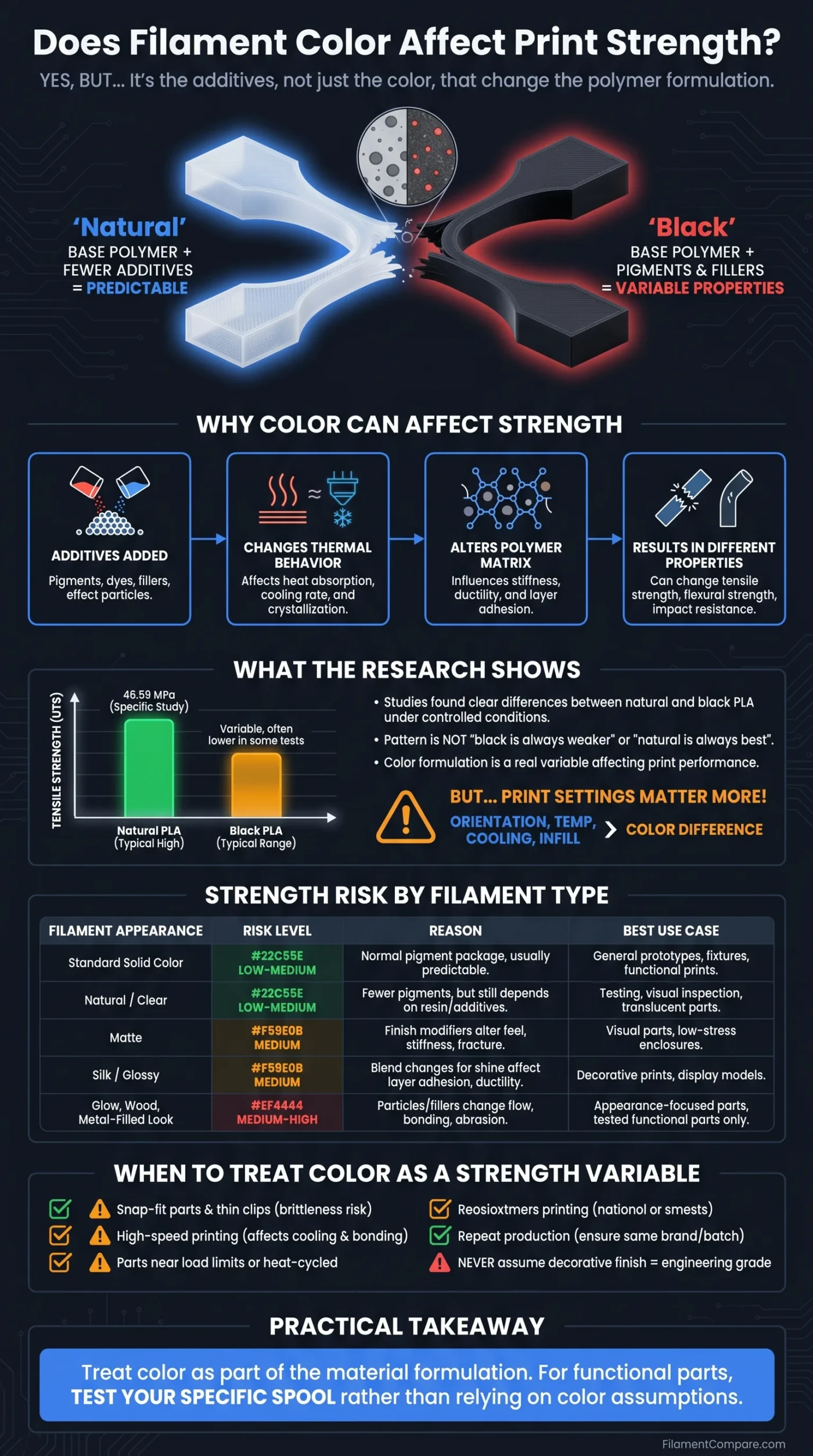
Yes, filament color can affect print strength, but color itself is not the real cause. The difference usually comes from pigments, dyes, mineral fillers, carbon black, pearlescent particles, glow additives, and batch formulation changes mixed into the base polymer. A red PLA and a black PLA may both be called PLA, yet their thermal behavior, stiffness, layer bonding, crystallinity, and impact response can differ enough to show up in tensile or flexural tests.
| Color or Finish Type | Typical Additive Behind the Look | Possible Effect on Strength | What to Watch in Real Prints |
|---|---|---|---|
| Natural / translucent | Little or no colorant, depending on brand | Often gives a cleaner view of the base polymer behavior; may show different tensile response than pigmented versions | Layer bonding, crystallinity, and moisture history still matter more than appearance alone |
| Black | Often carbon black or dark pigment package | Can change heat absorption, cooling behavior, dimensional accuracy, and tensile values; one PLA study found black PLA below natural PLA in UTS under the same test setup[a] | May need small tuning changes in nozzle temperature, cooling, or speed |
| White | Titanium dioxide or other white pigment systems are common in plastics | Can increase opacity and stiffness in some formulations, but the result depends on loading level and polymer grade | Check brittleness, first-layer flow, and overhang cooling rather than assuming all white filaments behave alike |
| Metallic / silk | Effect pigments, modified polymer blends, glossy additives | May print beautifully while showing different layer adhesion, ductility, or fracture behavior than plain colors | Decorative finish should not be treated as equal to a certified engineering grade |
| Glow-in-the-dark | Phosphorescent mineral particles | Particles can change abrasion, stiffness, and interlayer behavior; nozzle wear is also more likely | Hardened nozzle, conservative speeds, and test pieces are useful for loaded parts |
| Carbon-fiber-looking black | May be only black pigment, or may be real chopped fiber if labeled CF | Real fiber-filled filament changes stiffness and strength profile far more than normal color pigment | Do not confuse black color with carbon-fiber reinforcement |
Published PLA research using ISO-style tensile specimens has measured clear differences between natural and black PLA under controlled printing conditions, with natural PLA reaching up to 46.59 MPa UTS in one high-speed test set while black PLA stayed lower across the tested speeds.[b] That does not mean natural filament is always stronger. It means color formulation can be a real variable.
Practical reading: filament color may change strength by a few percent in some cases and much more in others, especially with PLA. The safer view is simple: same material name does not always mean same mechanical behavior.
Why Color Can Affect Strength
A filament color is created by adding something to the polymer. That “something” may be a tiny amount of dye, a pigment masterbatch, a mineral filler, a carbon-based additive, or a visual-effect package. In FDM printing, those additives can influence melt flow, heat absorption, cooling rate, crystallization, stiffness, ductility, and layer adhesion.
Small changes matter because a printed part is not one solid molded piece. It is a stack of roads, layers, and weld lines. If a pigment changes how long the material stays hot, how well it wets the previous layer, or how quickly it stiffens after extrusion, the final part can show a different tensile strength, flexural strength, impact resistance, or elongation at break.
Pigments Can Change Thermal Behavior
Dark pigments can absorb heat differently than pale or natural filament. White, opaque, pearlescent, and neon colors can use different additive packages. These differences may affect how the extruded bead cools after leaving the nozzle. Layer bonding is sensitive to that short thermal window. Very sensitive.
In PLA, cooling and crystallinity can influence mechanical response. A recent study on high-speed PLA printing noted that thermal history and cooling behavior affect layer bonding and mechanical performance, while color-related additives can alter the material’s physical behavior during printing.[c]
Additives Can Change the Polymer Matrix
A colorant is rarely just “color.” Some additives behave like fine fillers. Some interact with the polymer melt. Others change stiffness while reducing elongation. This is why two PLA spools from the same brand, printed with the same G-code, can break with a slightly different sound and fracture surface.
The effect is most visible in tests that measure more than one property. A color may show good stiffness but lower ductility. Another may bend farther before failure but have a lower peak tensile value. For real parts, strength is not one number; it is a set of behaviors under load.
What the Research Shows
Academic testing does not support the idea that every color of the same filament behaves identically. PLA has received the most attention, and several studies report measurable color-related changes in tensile strength, dimensional accuracy, friction behavior, and layer-height response.
| Study Focus | Material | Test Direction | Useful Finding |
|---|---|---|---|
| High-speed printing and color | Natural PLA vs black PLA | ISO 527-2 type tensile specimens | Natural PLA reached 46.59 MPa UTS at 300 mm/s; black PLA showed lower UTS across tested speeds in that setup[d] |
| Layer height and filament color | Colored PLA | Dimensional accuracy and tensile strength | Filament color and layer height both affected printed specimen performance, with color treated as a measurable variable[e] |
| Material color in PLA and ABS | PLA and ABS | Mechanical characteristics of FDM products | Color influenced mechanical characteristics in printed specimens, showing that the effect is not limited to one simple visual difference[f] |
| Standard tensile testing context | Rigid and semi-rigid plastics | Tensile properties | ISO 527-2 defines controlled tensile test conditions for comparing plastic materials under load[g] |
The pattern is not “black is always weaker” or “natural is always best.” The pattern is more useful: color is part of the formulation, and formulation affects how a filament prints and performs. Brand, polymer grade, moisture, nozzle temperature, cooling, extrusion width, layer height, and print orientation still share the stage.
Does Color Matter More Than Print Settings?
Usually, no. Print settings often have a larger and more predictable effect than color. Raster direction, wall count, infill, layer height, nozzle temperature, extrusion multiplier, cooling, chamber temperature, and moisture control can shift part strength by a wide margin.
Color is still worth caring about because it can hide inside the material choice. If a part was validated with blue PETG, switching to matte white PETG or translucent PETG is not a purely cosmetic change. The new spool may have a different additive system, melt viscosity, and layer bonding response.
Strength Variables That Often Beat Color
- Print orientation: Z-axis strength is often limited by interlayer bonding.
- Nozzle temperature: too cool can reduce weld quality; too hot can cause degradation or poor shape control.
- Cooling fan: strong cooling can improve detail while changing layer fusion.
- Moisture: wet nylon, PETG, TPU, and some PLA blends can print weaker and rougher.
- Wall count and infill: shell design can matter more than a small material-property shift.
- Batch and brand: two spools with the same color name may not share the same formulation.
Which Properties Can Change With Color?
Color-related changes do not always appear as simple tensile strength changes. A filament can keep a similar peak strength yet feel more brittle. Another can bend more before breaking. That is why a good comparison looks at several mechanical properties, not only one headline number.
Tensile Strength
Tensile strength measures how much pulling stress a specimen can carry before failure. It is useful, but FDM parts are anisotropic, meaning strength changes with print orientation. Color can affect tensile values when it changes melt flow, bonding, crystallinity, or defect formation.
Flexural Strength
Flexural strength describes behavior in bending. Standards such as ASTM D790 and ISO 178 use three-point loading methods for plastics, which makes them useful references when comparing rigid or semi-rigid materials under defined test conditions.[h]
Impact Resistance
Impact behavior can shift more sharply than tensile strength because brittle fracture is sensitive to fillers, internal defects, and layer adhesion. A decorative pigment package may look clean on the surface while changing how cracks move through the part.
Ductility and Elongation
Ductility tells you how far the material stretches before breaking. This matters for clips, snap fits, living hinges, and parts that need a little flex. A color formulation that raises stiffness may also reduce elongation. Not always. Often enough to test.
Material-by-Material View
PLA
PLA is the material where color effects are most often discussed because it is widely used, easy to test, and sensitive to thermal history. Natural, black, grey, white, silk, matte, and translucent PLA variants can behave differently because PLA blends often include nucleating agents, plasticizers, pigments, and finish modifiers.
For PLA parts that carry load, color should be treated as part of the selected grade. A tested spool is more reliable than a color assumption. Plain-looking PLA is not automatically stronger, and shiny PLA is not automatically weaker; the exact formulation decides the result.
PETG
PETG color can affect opacity, surface finish, and sometimes flow behavior, but PETG’s strength in printed parts is often dominated by temperature, cooling, moisture, and stringing control. Translucent PETG can behave differently from opaque PETG because the additive package is not the same.
ABS and ASA
ABS and ASA depend heavily on chamber temperature, shrinkage control, and layer adhesion. Color can still matter, especially through pigment and heat absorption, but poor enclosure control can overpower any small color-related material difference.
Nylon and Nylon Blends
With nylon, moisture often has a stronger effect than color. A dry colored nylon may outperform a wet natural nylon in real prints. Fiber-filled nylon is different: when carbon fiber or glass fiber is present, reinforcement content becomes far more important than the visual color.
TPU and Flexible Filaments
For TPU, shore hardness, polymer chemistry, and print speed usually matter more than pigment. Still, color and finish can affect surface feel, extrusion consistency, and layer appearance. Flexible parts should be judged by elasticity, tear behavior, and fatigue response, not only peak strength.
Color Families That Deserve Extra Attention
- Matte Filaments
- Matte finishes often use additives that scatter light and reduce gloss. These additives may change stiffness, layer feel, and fracture behavior.
- Silk Filaments
- Silk PLA often uses modified blends for gloss and smooth shine. It can be excellent for visual parts, while loaded parts deserve separate testing.
- Glow Filaments
- Glow particles can be abrasive and may change the way layers bond. Hardened nozzles are commonly preferred for these materials.
- Wood, Marble, Stone, and Metal-Filled Looks
- These are appearance-driven composite blends. Their printed strength depends on filler type, filler amount, particle size, and print settings.
- Transparent and Translucent Filaments
- These may contain fewer opacity pigments, but clarity-focused formulations can still differ from opaque versions of the same polymer.
Can Two Brands of the Same Color Perform Differently?
Yes. Color names are not material standards. “Black PLA” from one manufacturer may use a different base resin, pigment loading, additive package, drying level, diameter tolerance, and masterbatch supplier than “black PLA” from another manufacturer.
This also explains why online strength rankings by color can be misleading. A test that finds one brand’s grey PLA strong does not prove all grey PLA is strong. It proves that one grey formulation performed well under that test setup. That distinction matters.
How to Think About Color for Functional Parts
For display models, color choice can be mostly visual. For brackets, clips, tool holders, drone parts, gears, fixtures, and enclosure parts, color should be treated as a material variable. Not a scary one. Just a real one.
- Use the same brand, material line, and color for repeat parts that must behave consistently.
- When changing color on a load-bearing part, print a small test coupon or spare part first.
- Do not assume a decorative finish has the same ductility as a plain engineering-grade filament.
- For certified or production work, rely on manufacturer datasheets and controlled testing, not color names.
- Record spool color, batch number, nozzle temperature, fan level, layer height, and drying condition for repeatable results.
When Color Probably Does Not Matter Much
Color may have little practical effect when the part is lightly loaded, oversized, printed with generous wall thickness, or used as a visual prototype. A desk ornament, draft model, cable label, or low-stress cover usually does not need color-based strength validation.
Even then, color can affect print tuning. A darker filament may hide small defects. A glossy filament may show layer lines differently. A translucent filament may reveal infill and bubbles. These are print-quality differences more than strength differences, but they still shape the final result.
When Color Should Be Treated as a Strength Variable
Color deserves more attention when the part is thin, clipped, snapped, bent, heat-cycled, screwed into, or used near its load limit. The same is true for parts printed at high speed, because speed changes thermal history and bonding time. In one high-speed PLA study, both print speed and color affected dimensional and tensile results under otherwise controlled settings.[i]
- Snap-fit parts: color-related brittleness can show up during assembly.
- Thin hooks and clips: small ductility changes can decide whether the part flexes or cracks.
- High-speed PLA printing: pigment and cooling behavior may interact with speed.
- Matte, silk, glow, filled, or effect filaments: visual additives can change mechanical response.
- Repeat production: color swaps can introduce hidden formulation changes.
Simple Strength Reading by Color Type
| Filament Appearance | Strength Consistency Risk | Reason | Best Use Case |
|---|---|---|---|
| Standard solid color | Low to medium | Normal pigment package, usually predictable within the same product line | General prototypes, fixtures, normal functional prints |
| Natural or clear | Low to medium | May contain fewer opacity pigments, but still depends on resin and additives | Testing, visual inspection, translucent parts |
| Matte | Medium | Finish modifiers can alter feel, stiffness, and fracture behavior | Visual parts, low-stress enclosures, design models |
| Silk or glossy effect | Medium | Blend changes for shine can affect layer adhesion and ductility | Decorative prints, display models, non-critical covers |
| Glow, wood, marble, stone, metal-filled look | Medium to high | Particles and fillers can change flow, bonding, abrasion, and fracture path | Appearance-focused parts, tested functional parts only |
| Real fiber-filled filament | High, but intentional | Reinforcement changes stiffness, anisotropy, nozzle wear, and failure behavior | Engineering parts designed around the material’s datasheet |
The Most Accurate Answer
Filament color can affect print strength, especially in PLA and in decorative or filled materials. The cause is not the visible color alone; it is the additive package used to create that color and finish. In controlled tests, color-related differences have been measured in tensile strength, dimensional accuracy, and other mechanical behavior.
For everyday prints, good settings and dry filament usually matter more. For functional parts, color changes should be treated like a small material change. Same polymer name, same nozzle, same G-code — but not always the same result.
Resources Used
- [a] Ardeljan et al., The Impact of Elevated Printing Speeds and Filament Color on the Dimensional Precision and Tensile Properties of FDM-Printed PLA Specimens
- [b] Ardeljan et al., Polymers 2025 PLA speed and color tensile study
- [c] Ardeljan et al., Thermal history, cooling, and PLA mechanical performance discussion
- [d] Ardeljan et al., Natural and black PLA UTS values under high-speed FDM printing
- [e] Frunzaverde et al., The Influence of the Layer Height and the Filament Color on the Dimensional Accuracy and the Tensile Strength of FDM-Printed PLA Specimens
- [f] Gao et al., Study of Material Color Influences on Mechanical Characteristics of FDM Products
- [g] ISO, ISO 527-2: Plastics — Determination of tensile properties
- [h] ASTM International, ASTM D790 Standard Test Methods for Flexural Properties of Plastics
- [i] ISO, ISO 178:2019 Plastics — Determination of flexural properties
