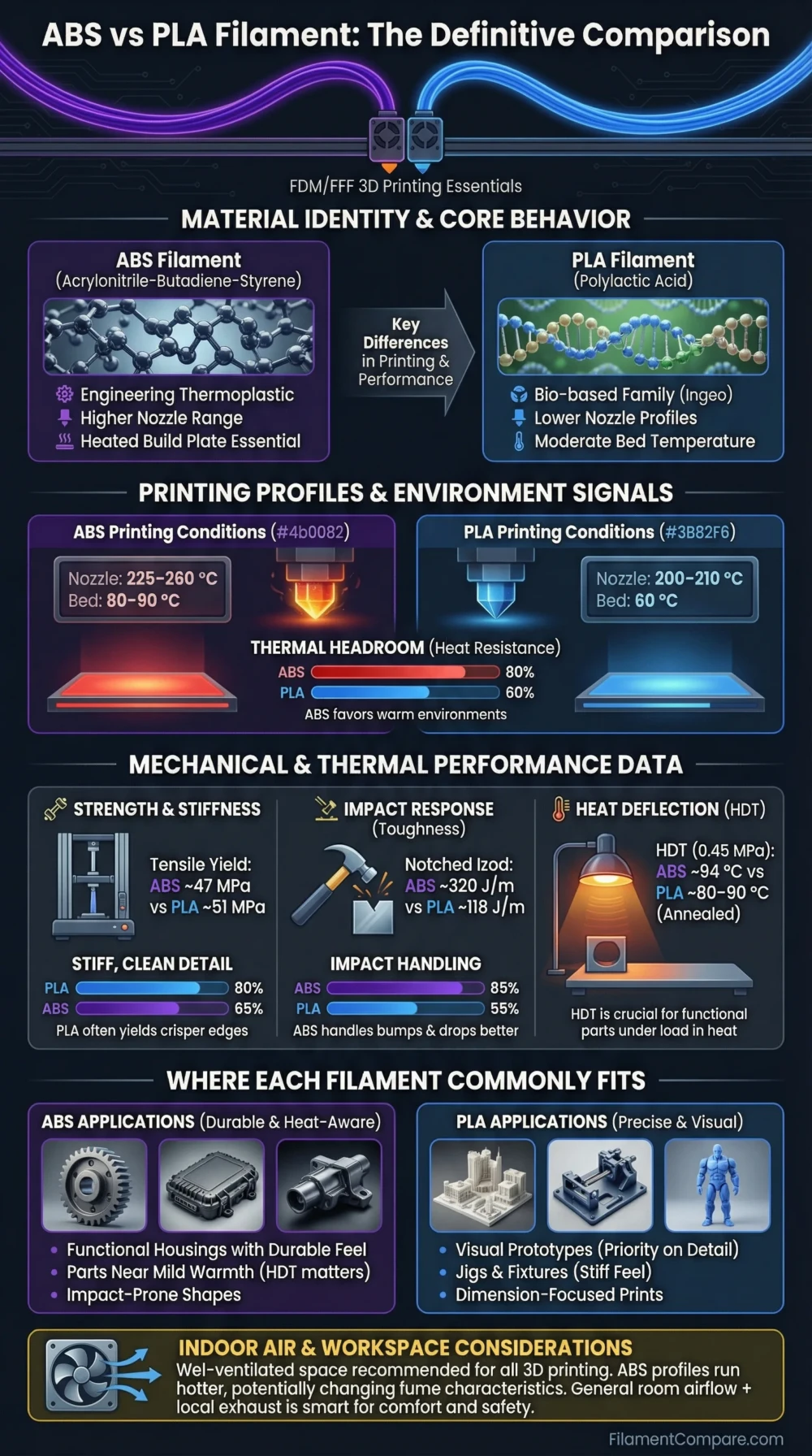
ABS is tougher and more heat-tolerant, while PLA is easier to print, sharper in detail, and more beginner-friendly. PLA fits visual models, prototypes, and low-stress parts; ABS fits enclosed-printer functional parts that need better impact resistance and moderate heat tolerance. The right choice depends less on “strength” in general and more on whether your part needs easy printing or thermal durability.
Choose PLA if you want simple printing, clean detail, low warping, and good stiffness for models, prototypes, fixtures, and decorative parts.
Choose ABS if you have an enclosure and need better impact behavior, higher heat resistance, acetone smoothing, or more durable functional parts.
There is no universal winner here. PLA is the easier everyday material; ABS is the more demanding engineering-style option.
Best for Beginners
PLA prints with lower temperatures, little warping, and no enclosure requirement.
Better for Heat Exposure
ABS keeps its shape better near warm motors, electronics housings, and moderate heat sources.
Better for Visual Detail
PLA usually gives cleaner corners, sharper text, and smoother small features.
Better for Impact Loads
ABS is usually less brittle than standard PLA when parts see knocks or repeated handling.
Better for Open Printers
PLA is the safer choice on open-frame machines because it does not need a hot chamber.
Better for Acetone Smoothing
ABS can be vapor smoothed or chemically welded with acetone when the workflow is controlled.
| Category | ABS | PLA | Better Choice |
|---|---|---|---|
| Material Family | Acrylonitrile butadiene styrene, an amorphous thermoplastic | Polylactic acid, a bio-based thermoplastic polyester in many commercial formulations | Use-case based |
| Print Difficulty | More tuning-sensitive; warping and fumes need control | Easy; low warp and forgiving settings | PLA |
| Typical Nozzle Temperature | Usually 240–270 °C depending on brand and profile[a] | Typically around 200–220 °C; Prusament PLA lists 210 ± 10 °C[b] | Printer-dependent |
| Typical Bed Temperature | Usually 80–110 °C depending on part size and print surface | Commonly 40–60 °C, and some setups can print small PLA parts without a heated bed | PLA |
| Enclosure Requirement | Strongly recommended for stable results | Not normally required | PLA |
| Heat Resistance | Higher; UltiMaker ABS lists HDT around 86.6 °C at 0.455 MPa[c] | Lower; many PLA grades soften near 55–65 °C, with UltiMaker Tough PLA listing 59 °C glass transition[d] | ABS |
| Toughness | Usually better impact behavior and less brittle fracture | Rigid and strong in tension, but standard PLA can crack more sharply under impact | ABS |
| Stiffness | Moderate stiffness with more ductility | Higher stiffness feel in many standard grades | PLA |
| Layer Adhesion | Can be good when printed hot in a warm enclosure; weak if cooled too fast | Usually reliable on well-tuned printers, especially for simple shapes | Settings-dependent |
| Moisture Sensitivity | Moderate; dry storage helps surface quality | Moderate; wet PLA may string, pop, or lose finish quality | Similar handling |
| Surface Finish | Can show layer lines but supports sanding and acetone smoothing | Clean detail, good color range, often attractive straight from the printer | Depends on finish goal |
| Outdoor Suitability | Better than PLA for heat, but long UV exposure can still age standard ABS | Less suitable for long sun and warmth exposure | ABS, with limits |
| Typical Uses | Housings, brackets, tool parts, automotive-adjacent prototypes, smoothed display parts | Models, miniatures, prototypes, educational prints, low-stress jigs, decorative parts | Use-case based |
| Main Limitation | Warping, odor, chamber need, and ventilation planning | Lower heat resistance and less impact tolerance than ABS | Different limits |
This ABS and PLA comparison uses manufacturer datasheets and material guides as reference points, but real print results can shift with brand, pigment, additives, moisture level, slicer profile, part geometry, and print orientation.
ABS Material Profile
- Polymer type: Acrylonitrile butadiene styrene, amorphous thermoplastic
- Print difficulty: Medium to high on open printers; easier in a warm enclosure
- Nozzle range: Usually about 240–270 °C
- Bed range: Usually about 80–110 °C
- Enclosure: Strongly recommended
- Drying need: Helpful if the spool shows popping, rough texture, or stringing
- Typical behavior: Tougher, more heat-tolerant, more warp-prone
- Best use cases: Functional housings, brackets, smoothed parts, moderate heat exposure
PLA Material Profile
- Polymer type: Polylactic acid, often made from renewable feedstocks
- Print difficulty: Easy on most FDM printers
- Nozzle range: Usually about 200–220 °C
- Bed range: Usually about 40–60 °C
- Enclosure: Not normally needed
- Drying need: Useful for old or moisture-exposed spools
- Typical behavior: Stiff, clean-detail, low-warp, lower heat tolerance
- Best use cases: Models, prototypes, decorative parts, educational prints, low-stress fixtures
These bars are relative printing-use indicators, not lab ratings. Brand formula, additives, color, moisture, part orientation, infill, wall count, cooling, and slicer settings can change the result.
Printability and Printer Setup
PLA is the easier material on most desktop printers. It sticks well to common build surfaces, tolerates open-frame machines, and usually needs only normal part cooling. For a new printer, a classroom printer, or a fast prototype workflow, PLA removes many tuning variables.
ABS needs more control. The bed must stay hot, the first layer must hold firmly, and the part should cool slowly inside an enclosure. Without that warm environment, large ABS parts can lift at the corners, split between layers, or shrink away from the intended dimensions.
Ventilation note: Odor is not a reliable measure of total printer emissions. ABS needs more attention to source control because recent testing has found higher VOC and ultrafine-particle emissions from the tested ABS formulations than comparison materials, while results also varied between manufacturers. Use an enclosure as a print-stability tool, but pair it with planned ventilation or suitable filtration rather than letting emissions accumulate in the room.[e][f]
ABS Emissions, Ultrafine Particles, and Ventilation
ABS emissions are more useful to compare by measured compounds and particles than by smell alone. A May 2026 chamber study tested commercial ABS- and PET-G-based filaments from multiple manufacturers. Under the study conditions, the tested ABS formulations produced higher VOC concentrations and roughly an order of magnitude higher particle-number concentrations than the tested PET-G formulations. The dominant particles were ultrafine, mainly around 55–90 nm, while styrene was the main ABS VOC and reached up to 264.75 µg/m³ in the reported measurements.[e]
The same study also showed why the material name alone is not enough. Emission profiles differed between products made from the same polymer family, pointing to brand- and formulation-dependent behavior. Pigments, additives, processing temperature, printer conditions, and the specific formulation can change the emission profile, so one ABS spool should not be treated as a fixed emissions reference for every ABS filament.[e]
Particle output was not constant through the job. The highest particle-emission rate was observed during filament heating and the start of printing, with another rise reported near the final stage of the tested prints. This means ventilation should already be operating before the nozzle reaches printing temperature, not switched on only after the print is visibly underway.[e]
A July 2026 Chemical Research in Toxicology study adds a direct ABS-versus-PLA VOC comparison. In thermal-desorption gas-chromatography measurements of the tested filaments, ABS samples emitted more VOCs than PLA samples. Styrene was associated with ABS, while toluene and benzaldehyde were detected at lower levels in both ABS and PLA samples.[f] This supports stronger ventilation planning for ABS, but it does not make PLA emission-free.
Practical setup: Keep the printer away from the normal breathing zone, run ventilation or source extraction through warm-up and printing, and avoid assuming that an enclosure by itself removes emissions. If filtration is used, particle filtration and gas/VOC adsorption address different parts of the emission mixture.
Mechanical Behavior: Stiffness, Toughness, and Layer Strength
PLA often feels strong because it is stiff. A PLA bracket or jig can hold shape well under light loads, and small features stay crisp. The tradeoff is fracture behavior: standard PLA can snap more suddenly under impact, bending, or stress concentration.
ABS is usually more forgiving under knocks and repeated handling. It can deform more before breaking, which makes it useful for housings, clips, covers, and functional prototypes. This does not mean every ABS print is stronger than every PLA print. Layer bonding, print orientation, wall count, temperature, and cooling can change the practical strength of either material.
PLA Strength Style
- Stiff and shape-holding
- Good for crisp geometry
- Can be brittle in thin clips or impact-loaded parts
- Works well for low-stress fixtures and prototypes
ABS Strength Style
- Better impact tolerance in many standard grades
- More ductile than standard PLA
- Needs controlled cooling for dependable layer strength
- Better for functional parts when the printer is prepared
Heat Resistance and Shape Retention
Heat is one of the clearest separators between ABS and PLA. PLA can soften in warm environments such as sunny windowsills, enclosed electronics boxes, or parts left inside a hot vehicle. Annealed or modified PLA grades can improve this, but standard PLA should not be treated as a heat-resistant material.
ABS has a higher useful temperature range and is more suitable for moderate warmth. It is still not a replacement for high-temperature materials such as PC, PA-CF, PEI, or PEEK when the part faces heavy load and high heat at the same time. For everyday functional parts that may get warm, ABS is usually the safer pick than PLA.
Warping, Shrinkage, and Dimensional Accuracy
PLA wins for simple dimensional control. It shrinks less during cooling, so long flat parts, boxes, letters, and fitted decorative pieces are easier to print accurately. This is why PLA is common for prototypes where the shape matters more than heat or impact resistance.
ABS shrinks more as it cools. On small enclosed parts, this can be manageable. On large flat prints, the same shrinkage can pull corners upward or create internal stress. A heated chamber, brim, draft shield, proper bed surface, and low part cooling make a large difference.
Surface Finish and Post-Processing
PLA usually gives a cleaner surface straight from the printer. It is good for small text, miniatures, architectural models, color-rich prints, and matte or silk visual effects. Sanding PLA is possible, but it can soften from heat if sanding is too aggressive.
ABS offers a different finish path. It can be sanded, glued, machined, and acetone vapor smoothed. Acetone smoothing can hide layer lines and create a glossy surface, but it can also round edges, soften fine details, and change dimensions slightly. It is useful for display shells and housings, not for every tolerance-critical part.
Storage, Moisture, and Spool Handling
Neither ABS nor PLA is as moisture-sensitive as nylon, but dry storage still matters. A wet spool can cause popping sounds, rough surfaces, extra stringing, and weaker-looking layers. Keep both materials sealed with desiccant when not in use, especially in humid rooms.
ABS also benefits from stable room conditions during printing. A dry spool helps, but it cannot fix drafts, low chamber temperature, or poor bed adhesion. PLA is more tolerant of normal room changes, which is one reason it works well for casual and repeated use.
| Use Case | Better Fit | Why |
|---|---|---|
| Beginner prints | PLA | Low warping, easy adhesion, and no enclosure requirement. |
| Visual models | PLA | Sharper detail and cleaner surface quality straight from the printer. |
| Functional brackets | Depends | PLA works for low heat and light load; ABS is better for impact and warmth. |
| Outdoor parts | ABS, with limits | ABS handles warmth better, but standard ABS can still age under long UV exposure. |
| Car interior prototypes | ABS | More suitable than PLA for moderate warmth, though hot interiors can still exceed safe use conditions. |
| Miniatures and small details | PLA | Cleaner small features and easier cooling control. |
| Acetone-smoothed shells | ABS | ABS can be vapor smoothed; PLA cannot be smoothed the same way with acetone. |
| Large flat prints | PLA | Lower shrinkage and less corner lifting. |
| Enclosed-printer production | ABS | A warm chamber helps ABS reach better layer bonding and lower warping. |
| Classroom or office prototypes | PLA | Easier setup, less odor, and broad printer compatibility. |
Choose ABS When
- The printer has an enclosure or a stable warm build chamber.
- The part needs better impact behavior than standard PLA.
- The part may see moderate heat during use.
- You want acetone smoothing, acetone welding, sanding, or machining.
- The print is a housing, tool part, cover, bracket, or functional prototype.
ABS Is Less Suitable When
- The printer is open-frame and placed in a drafty room.
- You need a large flat part with minimal shrinkage.
- Ventilation, odor control, or enclosure safety is not planned.
- The part needs sharp miniature-level detail without post-processing.
Choose PLA When
- You want the easiest path to a clean print.
- The part is decorative, educational, visual, or a low-stress prototype.
- You print on an open desktop machine.
- You need crisp details, text, corners, or color effects.
- The part will stay away from warm environments and heavy impact loads.
PLA Is Less Suitable When
- The part may sit in heat, sun, or near warm electronics.
- The part needs repeated snap-fit bending or strong impact tolerance.
- You need acetone smoothing or solvent welding.
- The part is expected to survive demanding outdoor use.
Best Settings Range
Use these as starting ranges, not fixed rules. A matte PLA, silk PLA, recycled PLA, high-speed PLA, ABS+, or fiber-filled ABS can need different tuning.
Choose PLA if the part is mostly visual, low-stress, easy to print, or needs clean detail with minimal tuning.
Choose ABS if the part needs better heat resistance, better impact behavior, post-processing with acetone, or a more functional plastic feel.
For a first print, PLA is the practical choice. For a functional part on an enclosed printer, ABS becomes the stronger candidate.
Common ABS and PLA Questions
Is ABS stronger than PLA?
ABS is usually tougher and more impact-resistant, while PLA is often stiffer and can show good tensile strength in simple shapes. “Stronger” depends on the load type: stiffness, impact, layer adhesion, heat, and bending are different tests.
Does PLA melt in a car?
PLA can soften or deform in hot car interiors, especially if the part is under load or direct sun. ABS is more suitable than PLA for moderate warmth, but even ABS should be tested for the exact location and season.
Can ABS be printed without an enclosure?
Small ABS parts can sometimes print on an open machine, but results are less reliable. An enclosure helps reduce drafts, warping, layer splitting, and corner lift.
Is PLA safer than ABS for indoor printing?
PLA is often easier to manage indoors, but lower odor does not mean zero emissions. A 2026 ACS study found more VOCs from the tested ABS filaments than from the tested PLA filaments, while both material groups emitted identifiable VOCs.[f] ABS therefore deserves stricter ventilation planning, especially because separate 2026 chamber testing also found high ultrafine-particle output from the tested ABS formulations and strong emission peaks during warm-up and print start.[e]
Should I use ABS or PLA for functional parts?
Use PLA for low-stress jigs, prototypes, and fixtures that stay cool. Use ABS when the part needs better impact behavior, moderate heat tolerance, or post-processing. For heavy-duty engineering parts, compare ABS with PETG, ASA, nylon, PC, or fiber-filled materials too.
Resources Used
- [a] Bambu ABS Technical Data Sheet V3.0 (Used for ABS print temperature, bed temperature, chamber guidance, and heat-deflection reference points.)
- [b] Prusament PLA Technical Datasheet (Used for PLA nozzle temperature, bed temperature, material identity, and standard FDM setup ranges.)
- [c] UltiMaker ABS Technical Data Sheet (Used for ABS heat deflection, Vicat softening, glass transition, density, and printed-specimen context.)
- [d] UltiMaker Tough PLA Technical Data Sheet (Used for PLA glass transition, heat deflection, Vicat softening, and thermal limitation context.)
- Prusa Knowledge Base: ABS (Used for practical ABS printing guidance, nozzle and bed settings, enclosure need, and common printing limits.)
- Prusament PLA Material Page (Used for PLA printer requirements, heated bed guidance, cooling behavior, and build surface notes.)
- [e] Dobrzyńska, Jankowski & Borucka (2026) — Particle and Chemical Emissions During Fused Filament Fabrication (FFF) Using Commercial ABS- and PET-G-Based Filaments (Published May 4, 2026; used for formulation-dependent ABS emissions, VOC and ultrafine-particle measurements, styrene data, and warm-up/start emission behavior.)
- [f] Beard et al. (2026) — 3D Printing Filament Composition, Emissions, and Induced Proinflammatory Responses (Published online July 15, 2026; used for the ABS-versus-PLA VOC comparison and the identification of styrene, toluene, and benzaldehyde in the tested materials.)
