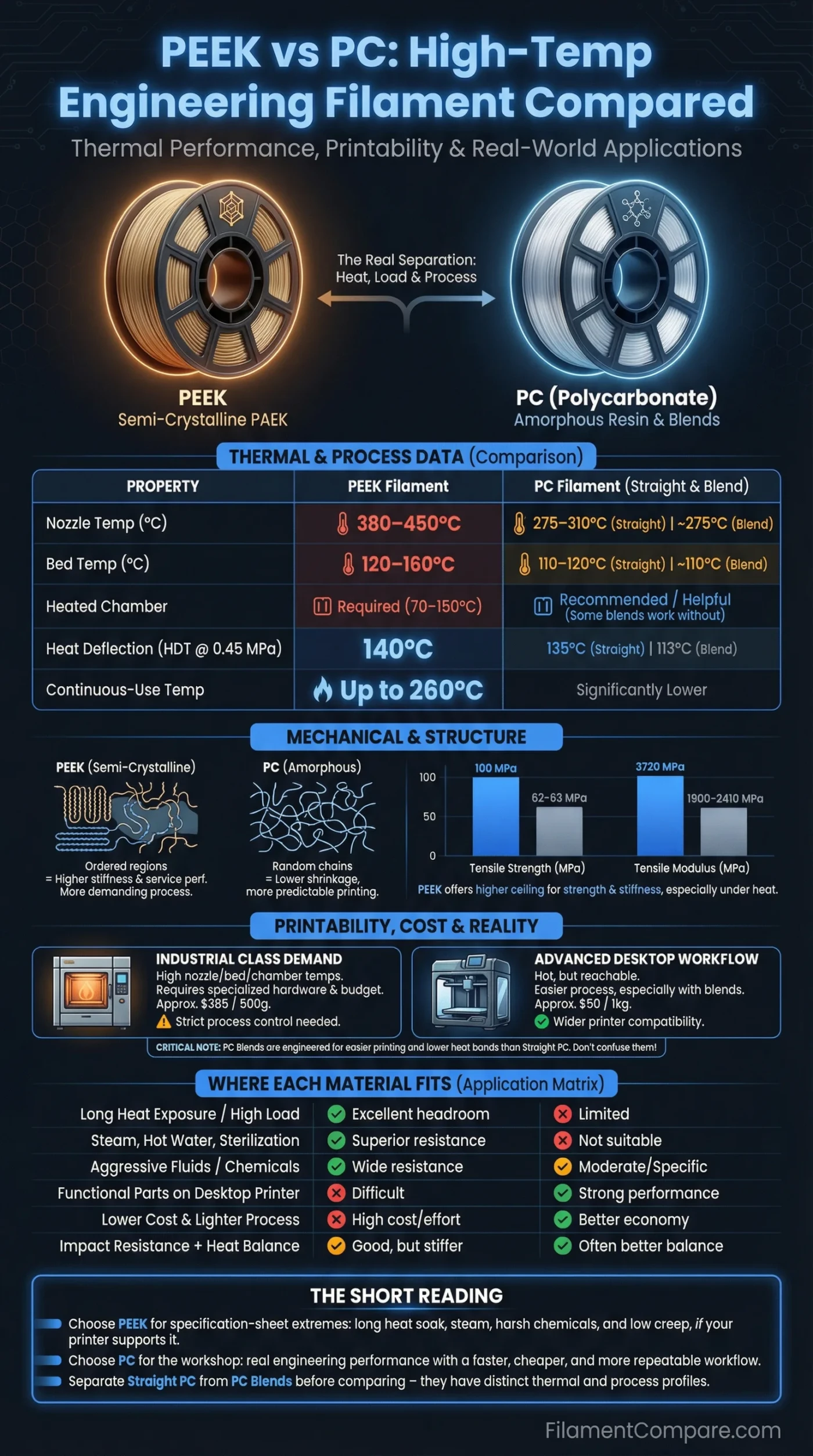
| Property | PEEK Filament [a] | PC Filament [b] | Why It Changes the Result |
|---|---|---|---|
| Polymer structure | Semi-crystalline PAEK-family polymer | Amorphous PC; market listings may be straight PC or PC blend | Structure affects shrinkage, heat behavior under load, and how demanding the print window feels. |
| Nozzle temperature | 380–400°C | 275–295°C for straight PC; 275°C on a common PC blend reference [c] | PEEK asks for a different printer class. PC still runs hot, but it stays within reach of more enclosed desktop systems. |
| Bed temperature | 130–140°C | 110–120°C for straight PC; around 110°C on many PC blends | Both materials need heat management, yet PEEK pushes every setting higher. |
| Heated chamber | Usually expected for stable parts | Helpful for many parts; some PC formulations are built to work without an actively heated chamber | This is often the line between “desktop-capable” and “industrial-process” printing. |
| Density | 1.30 g/cm³ | 1.20 g/cm³ straight PC; 1.22 g/cm³ on the PC blend reference | The density gap is small, so the choice is rarely about weight alone. |
| Tensile strength | 100 MPa | 62 MPa straight PC; 63 MPa on printed PC blend specimens | PEEK usually holds the higher strength ceiling, provided the print environment is controlled well enough. |
| Tensile modulus | 3720 MPa | 2410 MPa straight PC; 1900–2000 MPa on printed PC blend specimens | PEEK tends to be stiffer. PC often lands in a more forgiving middle band for everyday engineering parts. |
| Glass transition | 143°C | 147°C straight PC; 118°C on one print-friendly PC grade | Tg alone can be misleading. The rest of the thermal picture matters more here. |
| Heat deflection temperature | 140°C at 0.45 MPa | 135°C at 0.45 MPa for straight PC; 113°C at 0.45 MPa on the PC blend reference | Straight PC can stay close on some sheet values, while easier-print blends usually give away some heat margin. |
| Typical value proposition | Highest heat, fluid, creep, and service-life headroom | Strong heat-and-impact balance with a much lighter process burden | PEEK wins the top end. PC wins many real shop decisions because the whole workflow is easier. |
For this PEEK vs PC comparison, the table combines official filament datasheets and trusted manufacturer references, so the figures show the usual performance direction rather than a promise for every brand, printer, chamber setup, or build orientation.
PEEK and PC look close only when the comparison stays broad. Once heat under load, long exposure, chamber control, and total printing cost enter the picture, the gap opens fast. There is another detail that changes the whole discussion: PC filament is not one fixed formula. Straight PC and easier-print PC blends share a family name, yet they can sit in clearly different thermal bands and behave differently on the machine.
- PEEK: semi-crystalline
- PC: amorphous base resin
- PC blend: easier process, lower heat band
- PEEK: industrial print environment
- PC: wider printer compatibility
- Choice depends on part duty, not hype
Where the Real Separation Appears
A quick skim of glass-transition numbers can send people in the wrong direction. Some straight PC filament data sheets show a Tg in the same neighborhood as PEEK, which makes the two look closer than they really are. The cleaner split shows up when the rest of the thermal picture is included: Victrex lists unfilled PEEK with a 343°C melting point and a 152°C heat-deflection value at the tougher 1.8 MPa condition in unannealed form, giving it a much larger working envelope than ordinary PC grades and most print-friendly PC blends. [d]
That does not make PC a minor material. Not even close. PC remains a real engineering option because it combines stiffness, impact behavior, and high service temperatures with a process window that far more printers can reach. In plain language, PEEK usually takes the top slot when the part itself is the hard problem, while PC often wins when the part is demanding but the production route still needs to stay practical.
- Tg
- The point where a polymer starts moving from a hard glassy state toward a rubbery one. It matters, but it is not the full service-temperature story.
- HDT
- The temperature at which a loaded sample deflects by a set amount. For brackets, fixtures, covers, and housings under force, this often says more than Tg alone.
- Semi-Crystalline
- PEEK forms ordered regions as it cools. That helps service performance, yet it also makes chamber control and cooling behavior far less forgiving while printing.
- Amorphous
- PC does not crystallize in the same way. That usually means lower shrinkage and more predictable dimensional behavior during printing.
- Continuous-Use Temperature
- A long-term heat rating, not a short burst or no-load test. This is where PEEK starts pulling away in a very visible way.
Heat, Load, and Long Exposure
Victrex places PEEK’s continuous-use temperature up to 260°C and pairs that with low moisture absorption, hydrolysis resistance, and very good creep and fatigue behavior. [e] That single group of traits is why PEEK is still treated as a metal-replacement polymer in parts that see hot air, hot fluids, steam, or long periods of load where slow shape loss matters more than headline strength.
PC brings a different type of value. SABIC describes Lexan PC as an amorphous engineering thermoplastic with strong mechanical, optical, electrical, and thermal properties, plus the impact resistance and transparency that make it useful for guards, housings, covers, and electrically oriented parts. [i] So the better question is not “Which one is stronger?” The better question is “How hot, how long, and under what kind of environment?”
Print Environment and Process Control
PEEK asks for a different class of machine. 3DXTech’s ThermaX PEEK page calls for a 360–450°C hot end, a 120–160°C bed, and a fully enclosed heated chamber in roughly the 70–150°C band. The same page places the 500 g spool at $385, which tells you right away that PEEK is not only a material choice but also a hardware-and-budget decision. [g]
PC can still be demanding, yet it stays much closer to an advanced desktop workflow. Prusa’s PC Blend page lists 275 ± 10°C at the nozzle, 110 ± 10°C on the bed, and says an enclosure is recommended. It also notes less warping than conventional polycarbonates, very low hygroscopic behavior for that blend, and a common 1 kg store price of $49.99. [f]
Straight PC sits between those two realities. 3DXTech’s 3DXMAX PC page gives it a 280–310°C processing band and points out its amorphous structure, which leads to low, near-isotropic shrinkage. [h] That matters more than many buyers expect, because a part that prints flatter and cools more predictably can beat a “better” polymer on actual production time, scrap rate, and repeatability.
One mistake shows up again and again: people compare PEEK against the easiest PC blend on printability, then compare it against straight PC on heat numbers, then talk about both results as if they came from one identical PC material. That is where a lot of confusion starts.
What the Numbers Mean in Real Parts
The top table already shows the broad pattern. PEEK usually lands higher in strength and stiffness, and it keeps those properties much farther into hot service. Yet those gains only show up when the printer can keep the part warm enough for stable layer bonding and controlled crystallization. If the chamber runs too cool, or the thermal gradient through the part gets too steep, printed performance can fall well short of the raw-material promise.
PC’s mechanical position is less dramatic but often more usable. Straight PC offers very good stiffness and heat resistance for FDM parts, while PC blends can stay more impact-friendly and less temperamental during cooling. That is why PC keeps appearing in fixtures, machine covers, brackets, electrical housings, inspection guards, and one-off production aids. It is not trying to match PEEK everywhere. It does not need to.
There is also a subtle point here. A stronger polymer is not always the better printed part. If the job needs a moderate heat band, repeated handling, and tighter process economy, PC often lands closer to the sweet spot. If the job has long heat soak, steam, harsh fluids, or very low creep tolerance, PEEK moves ahead again.
Chemical Contact, Steam, and Aging
PEEK has a wider comfort zone once the part leaves the printer and enters a harsher service life. The Victrex references above describe chemical resistance, low moisture uptake, resistance to steam and hydrolysis, and suitability for steam sterilization. That mix makes PEEK easier to justify in hot wet service, repeated cleaning cycles, and places where slow creep or chemical softening would quietly ruin a part over time.
PC is still very capable in the real world, especially where impact resistance, electrical behavior, and visual clarity matter. But its strongest argument is usually not “I can survive everything.” Its strongest argument is closer to this: I can handle a lot, print with fewer demands, and cost much less to put into service. For many engineering prints, that is the smarter trade.
Dimensional Control and Surface Behavior
PEEK is well known for dimensional stability in service. During printing, though, it asks for patience. Semi-crystalline materials build internal stress as they cool, and that can show up as warp, curl, or layer tension if the chamber is not hot and steady enough. Large flat parts, sharp corners, and uneven wall thickness make the problem more obvious.
PC is kinder here, especially straight PC with its amorphous behavior and modified PC blends built for easier cooling. Surface quality usually comes with less drama, and dimensional drift across a production batch can be easier to control. Short sentence. That does not mean PC never warps. It means the path to consistent results is shorter.
Where Each Material Fits More Naturally
| Part Demand | Leans PEEK | Leans PC | Why |
|---|---|---|---|
| Long heat exposure well above the usual desktop-filament band | Yes | No | PEEK keeps more thermal headroom over time and under load. |
| Steam, hot water, or frequent sterilization cycles | Yes | No | PEEK’s hydrolysis and steam resistance sit in another class. |
| Functional parts on an enclosed advanced desktop printer | No | Yes | PC reaches strong mechanical performance without needing a PEEK-class chamber. |
| Transparent or translucent covers and guards | No | Yes | PC’s optical behavior is part of its appeal. PEEK is not chosen for that. |
| Very low creep over long service life | Yes | Sometimes | PEEK usually holds shape better when heat and load stay present for a long time. |
| Lower material spend and lighter machine requirements | No | Yes | PC gives up some top-end performance but keeps the whole workflow far lighter. |
| Aggressive fluids and chemically busy environments | Yes | Sometimes | PEEK’s chemical envelope is wider and more stable under heat. |
| Impact-led parts that still need high heat resistance | Sometimes | Yes | PC often lands in a better balance of toughness, stiffness, and printability. |
The Short Reading of the Comparison
- Choose PEEK in the specification sheet when the part must stay reliable through long heat, steam, or harsh fluid exposure and the printer can truly support the material.
- Choose PC in the workshop when the part still needs real engineering performance, but the process must stay faster, cheaper, and more repeatable.
- Separate straight PC from PC blends before you compare anything. That single step makes the whole discussion much cleaner.
Resources Used
- [a] 3DXTech ThermaX PEEK Technical Data Sheet (PDF)
- [b] 3DXTech 3DXMAX PC Technical Data Sheet (PDF)
- [c] Prusament PC Blend Technical Datasheet (PDF)
- [d] Victrex PEEK 450G Datasheet (PDF)
- [e] Victrex PEEK Materials Properties
- [f] Prusament PC Blend Material Page
- [g] 3DXTech ThermaX PEEK Product Page
- [h] 3DXTech 3DXMAX PC Product Page
- [i] SABIC LEXAN Resin PC Page
