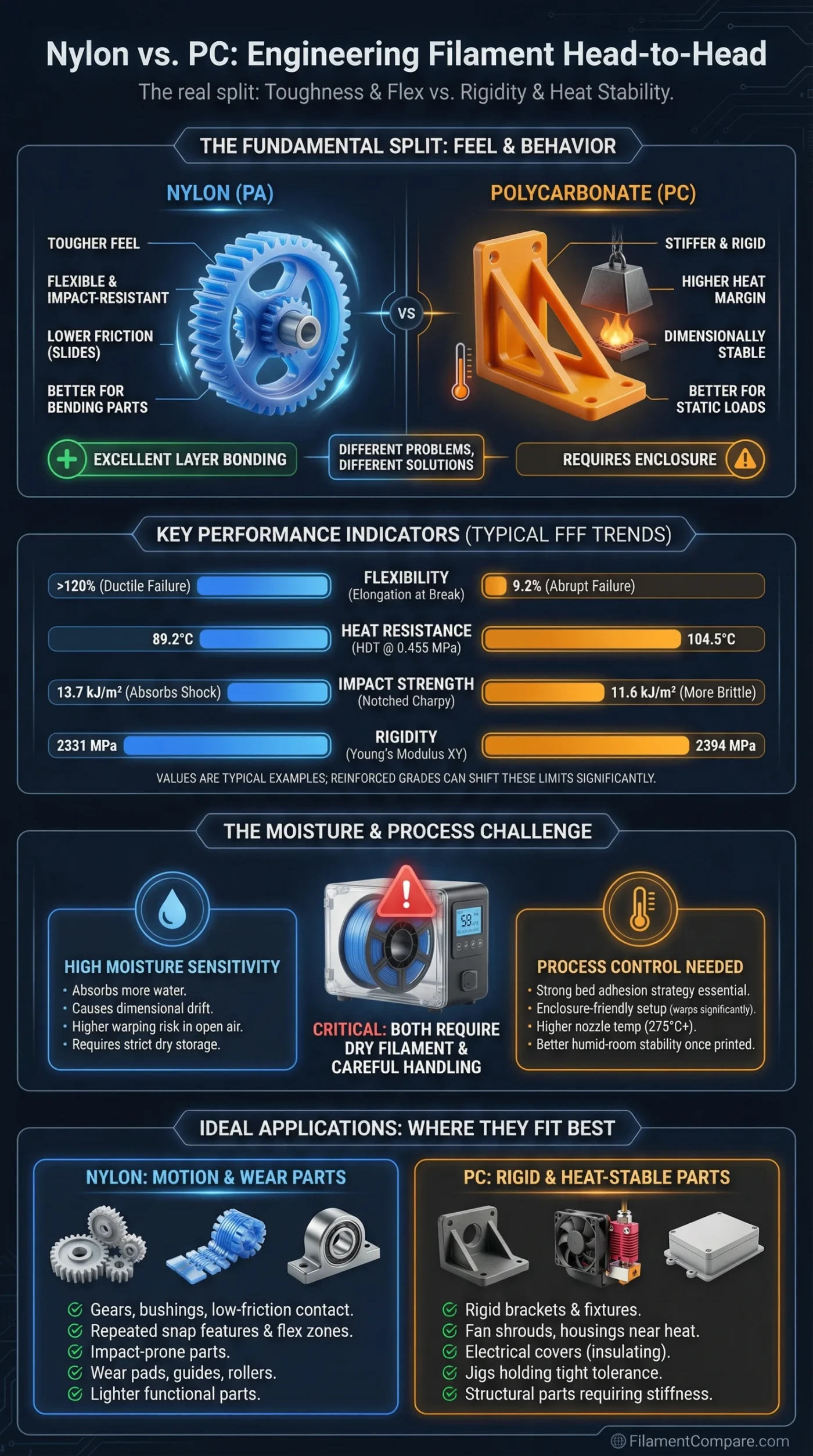
| Category | Nylon | PC |
|---|---|---|
| General feel in a printed part | Tougher, more flexible, and often better where the part bends or slides | Stiffer, more rigid, and usually more stable near heat |
| Typical nozzle window | About 250–285°C, depending on PA grade | About 250–275°C and sometimes higher on harder-running blends |
| Typical bed window | Anywhere from low-bed copolyamides to around 110°C on classic grades | Usually around 90–115°C |
| Moisture sensitivity | High to very high; storage discipline matters | High too, though parts usually shift less from humidity than standard Nylon |
| Heat behavior | Good in standard grades, but often below PC unless the Nylon is reinforced or specially tuned | Usually the stronger option for printed parts that sit closer to warmth |
| Dimensional stability | More movement in humid service | Usually steadier in humid rooms and tighter-tolerance fits |
| Wear and sliding contact | Often the better match for gears, bushings, wear pads, and rubbing parts | Better suited to rigid structures than to low-friction wear surfaces |
| Process control needed | Dry filament, careful handling, and often warm ambient conditions | Dry filament, strong bed adhesion strategy, and enclosure-friendly setup |
| Parts it often suits | Clips, gears, bushings, living features, impact-prone parts, wear items | Jigs, fixtures, rigid brackets, fan shrouds, housings, electrical covers |
Nylon and PC sit in the same engineering tier, but they do not solve the same problem. Nylon usually earns its place when a part has to flex, slide, or survive repeated impact, while PC tends to make more sense when the part must stay rigid and hold shape closer to heat. The interesting part is this: the real split is not just “strength versus heat.” It is failure mode, humidity behavior, dimensional drift, and how much process control your printer can actually hold.
- What Actually Separates Nylon and PC
- Printed-Part Numbers That Matter More Than Marketing Labels
- Moisture, Warping, and Dimensional Drift
- How Newer Filament Grades Change the Old Nylon-vs-PC Story
- Where Each Material Usually Fits Better
- Nylon Often Fits Parts That Need Motion
- PC Often Fits Parts That Need Shape Retention
- Questions That Usually Decide This Matchup
- Resources Used
- Nylon: tougher feel
- Nylon: lower friction
- PC: higher heat margin
- PC: better humid-room stability
- Both need dry handling
What Actually Separates Nylon and PC
In printed-part data from UltiMaker’s Nylon sheet, the material shows a much more ductile profile than most people expect from a simple comparison chart: flat-built samples list 63.1 MPa tensile yield, >120% elongation at break, 13.7 kJ/m² notched Charpy impact, 89.2°C HDT at 0.455 MPa, and a density of 1.14 g/cm³. That mix is why standard Nylon often feels so good in clips, bushings, and parts that keep moving instead of sitting still.[a]
UltiMaker’s PC sheet tells a different story. The printed examples show 2394 MPa Young’s modulus in XY, 104.5°C HDT at 0.455 MPa, a 107.7°C glass transition, and density around 1.18–1.20 g/cm³. PC is not automatically “stronger in every way,” but it is usually the cleaner fit when the part needs rigidity and heat retention more than long stretch before failure.[b]
One detail that often gets lost: standard Nylon is not the ceiling for PA-based filaments. Reinforced or specially tuned Nylon grades can move far past the usual Nylon-vs-PC picture.
That matters because “Nylon” is a family, not a single behavior. UltiMaker’s Nylon CF Slide page, for example, lists an annealed HDT B of 180°C with a coefficient of friction of 0.2, which shows how far a filled PA system can shift the heat and wear balance away from ordinary unfilled Nylon. Filled Nylon can look like a very different material from the basic spool most people picture first.[i]
Printed-Part Numbers That Matter More Than Marketing Labels
| Property | Nylon Example | PC Example | Why It Matters |
|---|---|---|---|
| Young’s modulus (XY) | 2331 MPa | 2394 MPa | PC usually feels a bit more rigid in hand |
| Tensile stress at yield (XY) | 63.1 MPa | 53.3 MPa | A reminder that one “strength” number never tells the whole story |
| Elongation at break (XY) | >120% | 9.2% | Nylon usually handles flex and shock with a less abrupt failure mode |
| Notched Charpy impact, 23°C | 13.7 kJ/m² | 11.6 kJ/m² | Nylon often keeps a tougher, less brittle feel |
| HDT at 0.455 MPa | 89.2°C | 104.5°C | PC usually holds shape better near elevated service temperatures |
| Glass transition | 55.1°C | 107.7°C | PC keeps usable stiffness much deeper into warm environments |
| Density | 1.14 g/cm³ | 1.18–1.20 g/cm³ | Nylon often keeps a small weight advantage |
The table says something simple, and it is worth saying plainly. Heat margin is not the same as “overall strength.” Nylon often looks better when the part bends, snaps back, or absorbs impact. PC often looks better when the part must stay stiff and shaped near warmth. Those are different jobs.
Moisture, Warping, and Dimensional Drift
Humidity changes this matchup fast. Ensinger’s dimensional-stability reference notes that polyamides generally absorb more water than other engineering plastics, while PC sits among the lower-absorption group. It also points out the real consequence: dimensions can shift, strength can move, and electrical insulating behavior can change as moisture climbs. That is not a side note; for tight-tolerance printed parts, it often decides the winner before any mechanical test does.[e]
Prusa’s Nylon material page is blunt about the printer-side effect. It lists a 285°C nozzle and 110°C bed for Polyamide, warns that the material is highly hygroscopic, and says improper storage can let the filament absorb water up to 10% of its own weight. For real parts, Nylon remains excellent for wear and toughness, but dry storage is part of the material choice, not a minor maintenance habit.[c]
PC asks for care too, just in a different way. Prusa’s PC page lists a 275°C nozzle with a 110–115°C bed, describes most polycarbonates as extremely hygroscopic, and also notes that surface adhesion can be so strong that a separation layer is recommended on some plates. Add the higher thermal expansion of pure PC during printing, and you get a material that rewards controlled chamber conditions and a predictable bed surface. It also brings a useful bonus: Prusa highlights good electrical insulation among PC’s practical strengths.[d]
How Newer Filament Grades Change the Old Nylon-vs-PC Story
Not every Nylon now behaves like the classic “hot bed, high warp, lots of moisture” stereotype. Polymaker’s PolyMide CoPA sheet lists a 250–270°C nozzle, only 25–50°C bed temperature, drying at 70°C for 12 hours, and optional annealing at 80°C for 6 hours. That is a very different process window from old-school commodity PA, and it explains why copolyamide filaments have become a real middle ground for users who want Nylon’s feel without the harshest print penalty.[g]
Modern PC grades have changed too, though in a more heat-centered direction. Polymaker’s PolyMax PC page lists a 250–270°C nozzle, 90–105°C bed, 75°C drying for 6 hours, a needed enclosure with heated chamber preferred for larger parts, and a 114°C HDT at 0.45 MPa. Its chemical-resistance table also shows a mixed profile: good with weak acids and oils, fair with weak alkalis, poor with strong acids and strong alkalis. PC still leans toward rigid, warm-running parts, but the modern desktop-friendly grades are much more usable than the older pure-PC reputation suggests.[h]
At the resin level, Covestro lists Makrolon 2258 with 0.12% equilibrium water absorption at 23°C and 50% relative humidity, 0.3% saturation in water, relative permittivity around 3.0, and electric strength of 34 kV/mm. Those numbers help explain why PC so often lands in housings, guards, and electrical parts where dimensional steadiness and dielectric behavior matter as much as raw toughness.[f]
Where Each Material Usually Fits Better
Nylon Often Fits Parts That Need Motion
- Gears, bushings, and low-friction contact points
- Repeated snap features and living-style flex zones
- Impact-prone parts that should bend before they fail
- Wear pads, guides, rollers, and sliding interfaces
- Lighter functional parts where stiffness is not the only goal
PC Often Fits Parts That Need Shape Retention
- Rigid brackets and fixture bodies near motors or heat sources
- Fan shrouds, covers, and machine-side housings
- Electrical covers and insulating structural parts
- Jigs and tooling that should stay straighter in humid rooms
- Parts where a hard, rigid feel matters more than flex recovery
| Part Demand | Usually Lean | Why |
|---|---|---|
| Repeated bending or snap-back behavior | Nylon | Its ductile feel and larger stretch window usually make failure less abrupt |
| Sliding, rubbing, or wear contact | Nylon | PA behavior tends to work well where friction and abrasion matter |
| Rigid service near elevated temperature | PC | PC usually keeps stiffness and geometry better as the environment warms |
| Tight fit in a humid room | PC | Lower moisture uptake usually means less dimensional drift |
| Electrical cover or insulating housing | PC | Its dielectric behavior and rigid feel suit many enclosure-style parts |
| Low-weight moving part with some flex | Nylon | Nylon often balances toughness and weight better in motion-driven parts |
| Filled, higher-heat PA system | It Depends | Carbon- or glass-filled Nylon can push well beyond standard Nylon behavior |
Questions That Usually Decide This Matchup
- Is Nylon always the tougher material?
- No. For flex, impact feel, and moving-contact parts, Nylon often has the edge. For rigid warm-running parts, PC may be the more suitable choice.
- Is PC always harder to print?
- Not always, but it usually wants hotter bed conditions and more chamber control. Modern copolyamide Nylons can be much friendlier than classic PA grades.
- Which material usually keeps dimensions better in humid conditions?
- PC. Nylon can absorb more moisture and may shift more in size and behavior if the environment stays damp.
- Which one suits gears and bushings more often?
- Nylon. Its lower-friction, wear-friendly character makes it a natural fit for moving parts.
- Which one makes more sense near heat?
- Standard PC usually does. Filled or annealed Nylon systems can change that answer, so the exact PA grade matters.
Resources Used
- [a] UltiMaker Nylon Technical Data Sheet
- [b] UltiMaker PC Technical Data Sheet
- [c] Polyamide (Nylon) | Prusa Knowledge Base
- [d] Polycarbonate (PC) | Prusa Knowledge Base
- [e] Dimensionally Stable Plastics | Ensinger
- [f] Makrolon® 2258 | Covestro
- [g] PolyMide™ CoPA Product Information Sheet
- [h] PolyMax™ PC | Polymaker
- [i] Nylon CF Slide | UltiMaker
