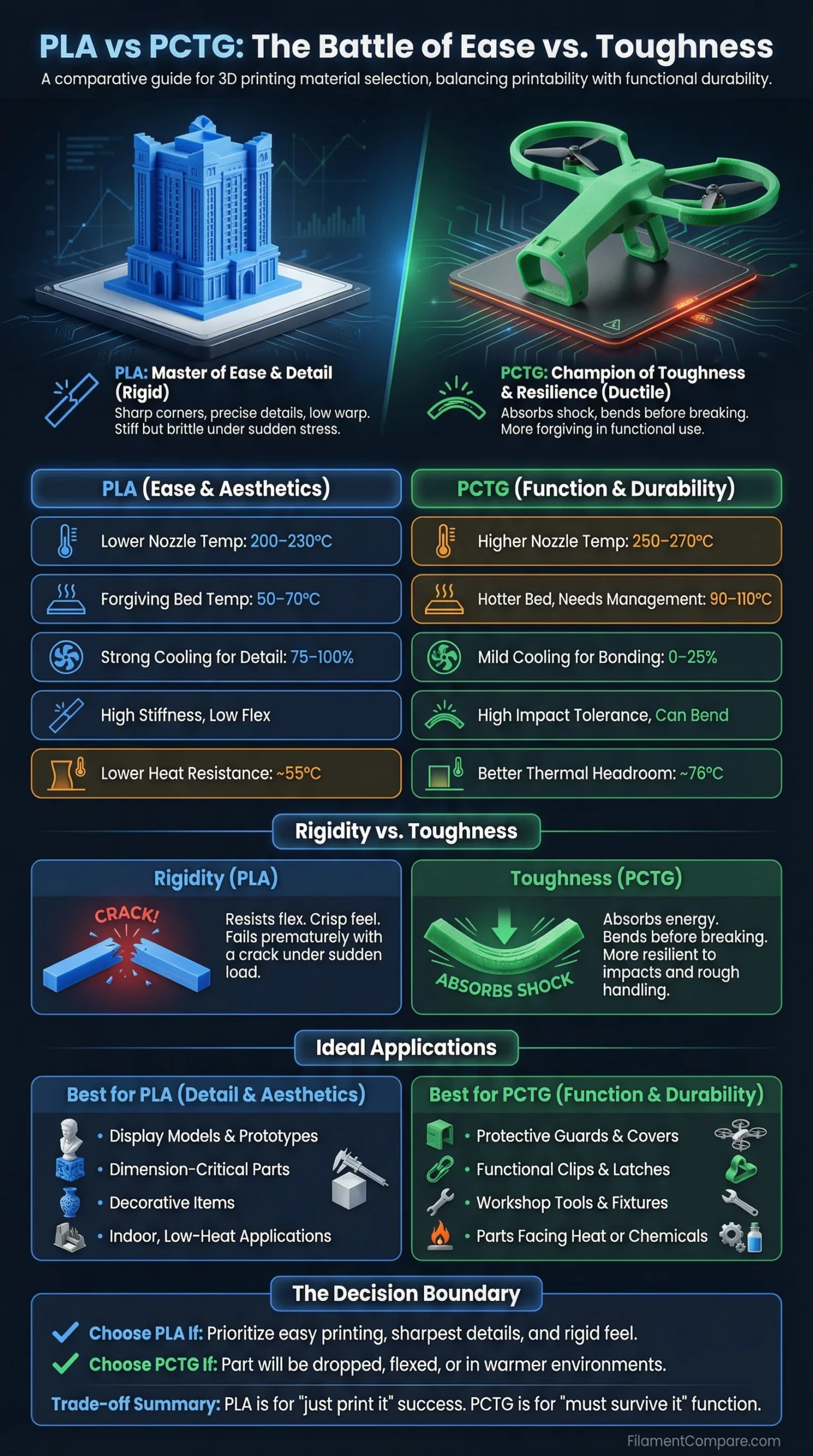
| Comparison Point | PLA | PCTG | What It Usually Means on the Printer or in the Part |
|---|---|---|---|
| Typical Nozzle Temperature | 200–230°C | 250–270°C | PLA asks less from the hotend and usually reaches a stable profile faster. |
| Typical Bed Temperature | 50–70°C | 90–110°C | PCTG tends to need a hotter, better-managed first layer. |
| Drying Conditions | 50°C / 4h | 60°C / 4h | Both benefit from dry storage, but PCTG usually rewards tighter moisture control. |
| Cooling Fan Range | 75–100% | 0–25% | PLA likes stronger cooling for detail; PCTG usually prefers milder cooling for layer bonding. |
| Enclosure Requirement | Not required | Not required | Neither material needs a closed chamber in the cited vendor profiles. |
| Density | 1.24 g/cm³ | 1.23 g/cm³ | Weight per volume is close, so the choice is less about mass and more about behavior. |
| Tensile Strength at Yield | 60 MPa | 43 MPa | PLA often looks stronger in simple tensile figures, especially for rigid parts. |
| Flexural Modulus | 3800 MPa | 1600 MPa | PLA is the more stiff option; PCTG bends more before it gives up. |
| Reported Ductility Marker | 6% elongation at yield | 220% elongation at break | PCTG sits much closer to a tough, ductile feel than a rigid one. |
| Reported Impact Marker | Notched Izod 16 J/m | Notched Izod 92 kJ/m² | Both datasheets point in the same direction: PCTG is the more shock-tolerant material, even though the test standards differ. |
| HDT Under Load | 55°C @ 0.45 MPa | 76°C @ 0.45 MPa | PCTG keeps more thermal headroom for parts that may sit in warmer spaces. |
| General Part Feel | Rigid, crisp, detail-forward | Tough, resilient, more forgiving under impact | The split is simple: ease and stiffness versus toughness and give. |
This PLA vs PCTG comparison uses current official Fiberlogy Easy PLA datasheet values [a] and Fiberlogy PCTG datasheet values [b]; the numbers show material direction under the listed test methods, while real prints still move with nozzle design, moisture, geometry, slicer choices, and part orientation.
PLA and PCTG can look close on a store page. On a printer, and later in the hand, they do not feel close for long. PLA usually wins on setup ease, surface sharpness, and day-one success rate. PCTG usually wins when the part may get knocked, flexed, warmed up, or used beyond display duty.
- Lower nozzle heat: PLA
- Higher rigidity: PLA
- Higher impact tolerance: PCTG
- No chamber required: both
- More thermal room: PCTG
What Ease and Toughness Mean in This Comparison
Toughness is not the same thing as raw strength. A rigid material can post a firm tensile number and still crack when a printed bracket gets dropped. A tougher material may flex, absorb energy, and stay usable. That is why PLA and PCTG often suit different part families even when both can print cleanly.
- Ease of Use
- Lower print temperatures, low warping, forgiving bed behavior, and less fiddling to get repeatable results.
- Toughness
- The part’s ability to absorb shock, bend a bit, and avoid cracking under everyday handling.
- Rigidity
- Resistance to flex. Higher rigidity often helps dimensional feel and crispness, but it does not automatically mean better impact survival.
- Heat Deflection Temperature
- The temperature under load where the part starts to lose shape. It is one of the clearest practical separators between standard PLA and PCTG.
Where PLA Pulls Ahead on Print Ease
Prusa describes PLA as one of the easiest materials to print, notes that it works at lower temperatures, and also points out that it is not prone to major warping. That combination matters. It means fewer setup surprises, cleaner starts, and less printer drama when the goal is simply to get a precise part on the bed and finish the job. [c]
NatureWorks says its 3D-printing PLA grades are known for good build-plate adhesion, less warping or curling, precise detail, and low odor during printing. Put together, those traits explain why PLA still feels like the default “just print it” material in many shops. Long jobs become easier to trust, especially on open-frame machines. [d]
Ease is not only about temperature. It is also about how much the material forgives a less-than-perfect room, a basic printer, or a fast switch from one project to the next.
- Lower nozzle and bed targets usually reduce setup friction.
- Higher cooling support helps bridges, corners, and fine surface detail.
- Lower warp tendency makes large flat parts easier to trust on common build surfaces.
- Rigid behavior often gives prints a cleaner, sharper feel right off the bed.
Official Easy PLA print guidance also stays fairly relaxed: drying at 50°C for 4 hours, no enclosure, and strong part cooling. Those details matter because they fit the everyday desktop workflow rather than a tightly controlled engineering setup. [e]
Where PCTG Gains Ground on Part Survival
Spectrum describes PCTG as a copolyester that keeps easy-printing traits close to PET-G while adding more impact strength, higher elasticity, chemical resistance, and a 76°C heat deflection temperature. That wording lines up with how printed parts usually behave: less crisp than PLA in feel, but far more willing to take a bump, a bend, or a hard landing without failing the same way. [h]
Eastman’s Eastar DN011 page describes this copolyester family as clear material with impact strength, chemical resistance, and low shrinkage. That broader polymer background helps explain why PCTG is often chosen when a printed part needs to do more than simply look right on a shelf. [i]
Fiberlogy’s print notes for PCTG add another practical clue: no enclosure is required, yet drying at 60°C for 4 hours is advised, cooling is kept low, and direct printing on bare glass is discouraged because the material can grip the surface hard enough to damage it. That is not difficult in the ABS sense. Still, it is plainly more demanding than standard PLA. [f]
A Useful Way to Read the Split
PLA usually resists flex better. PCTG usually resists failure better. Those are not the same sentence.
A Real-World Split: Rigidity vs Ductility
The top table tells the story well. PLA sits in the stiffer corner, while PCTG sits in the more ductile one. That means a PLA panel, fixture, or display part may feel cleaner and firmer. A PCTG clip, guard, lid, or bracket may look a little less crisp under the fingers, yet hold up better when life gets rough. Small difference on paper. Bigger difference in use.
Another point many comparison pages miss: the impact numbers on datasheets often use different standards and units, so a direct one-line numerical shootout can mislead. The safer read is directional. Every official source used here places PLA on the more rigid, easier-printing side and PCTG on the tougher, more resilient side.
Directional Material Tendencies
The bars above are not lab constants. They are a visual summary of the vendor settings, thermal values, and material descriptions discussed in this article.
Heat, Chemicals, and Shop Wear
Standard PLA is usually the first material to soften out of these two. Prusa says PLA parts can deform above about 60°C and also notes lower mechanical resistance under impact. Spectrum’s PLA Premium page places its heat distortion temperature at 55°C and highlights its rigid, detail-focused nature rather than warm-environment durability. [g]
PCTG opens more room here. The cited PCTG pages put its HDT around 76°C, and Eastman’s Tritan copolyester technical sheet ties this polymer family to toughness, heat resistance, chemical resistance, hydrolytic stability, and good processing behavior. For parts that may face cleaners, repeated handling, or warmer indoor conditions, that extra room matters. [j]
If the part is mainly decorative, geometric, or dimension-first, PLA often feels natural. If the part is expected to flex a bit, absorb a knock, or live closer to warmth, PCTG usually looks more comfortable.
Surface Finish, Clarity, and Dimensional Behavior
PLA still has a strong case when surface quality is the leading concern. Official PLA pages repeatedly lean on sharp detail, clean surfaces, and low shrink behavior. That is why figurines, display pieces, mockups, and crisp presentation parts still land in PLA so often.
PCTG brings a different finish story. It can produce very nice surfaces too, but its bigger selling points are usually clarity, dimensional stability, and the way the finished part behaves after printing rather than only how it looks at first glance. For transparent or semi-transparent functional parts, it often feels more useful than standard PLA.
Which Parts Tend to Favor Each Material
PLA-Leaning Part Types
- Display models and presentation pieces
- Dimension checks where rigid feel helps
- Decorative parts with small details
- General prototypes that stay indoors and away from heat
- Jigs or holders that do not see repeated impact
PCTG-Leaning Part Types
- Protective covers, guards, and housings
- Clips, lids, and parts that benefit from some flex
- Workshop items that may get bumped or dropped
- Functional prototypes that need chemical or heat margin
- Clear or translucent parts where durability matters too
The Decision Boundary
- Choose PLA when printer forgiveness, sharp detail, and rigid feel matter more than shock survival.
- Choose PCTG when the part may flex, get dropped, or sit in a warmer environment.
- PLA usually asks less from the printer profile; PCTG usually asks more from bed prep and moisture control.
- PCTG often makes more sense for functional pieces that live beyond a desk display role.
- PLA often makes more sense when repeatable success and clean cosmetics are the main target.
- If the design needs both easy printing and better toughness than regular PLA, PCTG is often the cleaner step up than simply pushing PLA beyond the kind of service it likes.
Resources Used
- [a] Fiberlogy EASY PLA Technical Data Sheet
- [b] Fiberlogy PCTG Technical Data Sheet
- [c] Prusa Knowledge Base: PLA
- [d] NatureWorks: 3D Series for 3D Printing
- [e] Fiberlogy Easy PLA Filament Product Page
- [f] Fiberlogy PCTG Filament Product Page
- [g] Spectrum Filaments: PLA Premium
- [h] Spectrum Filaments: PCTG Premium
- [i] Eastman: Eastar DN011 Copolyester
- [j] Eastman Tritan Copolyester TX1000 Technical Data Sheet
