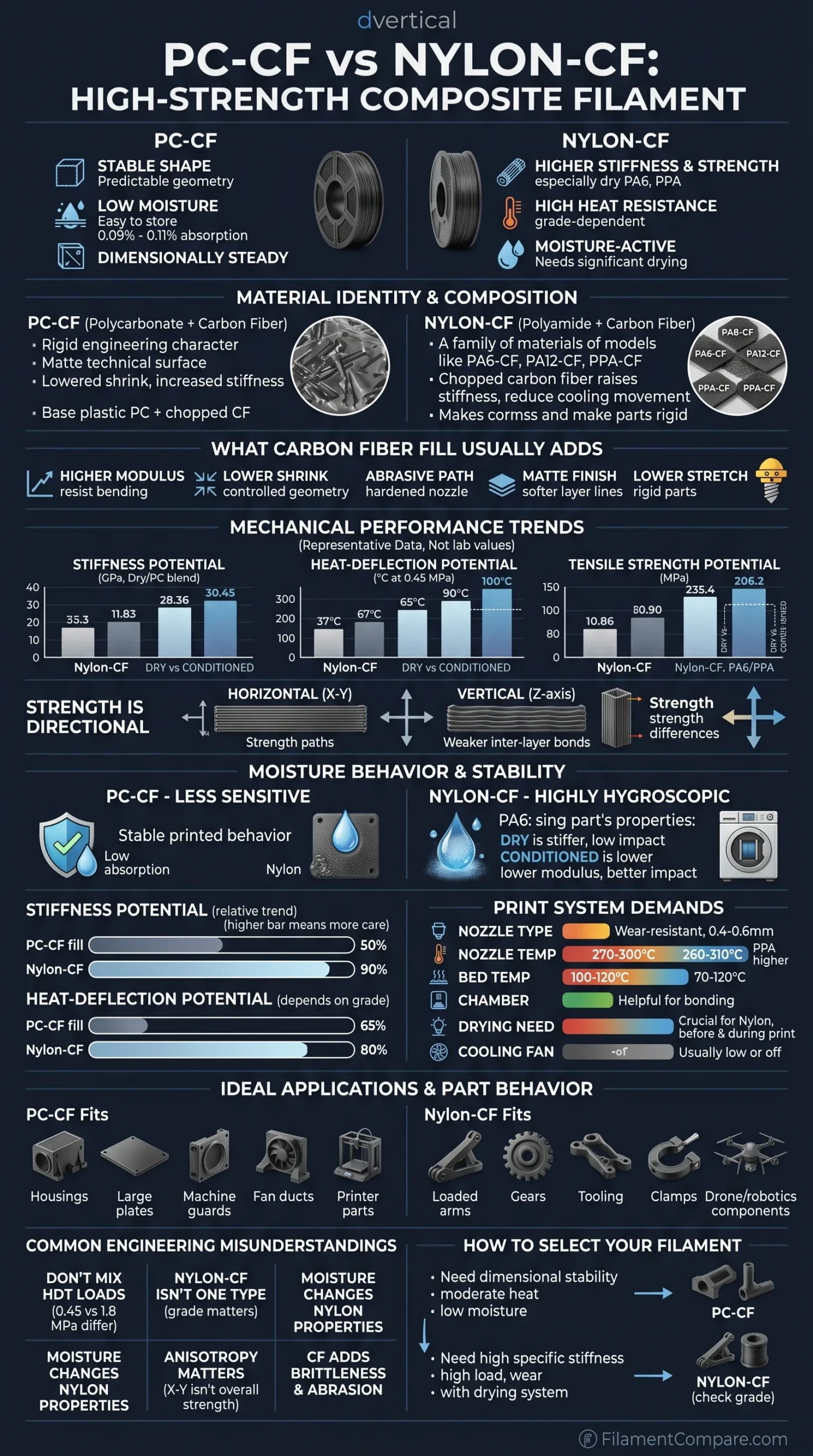
PC-CF and Nylon-CF sit in the same high-strength composite category, but they are not interchangeable. PC-CF usually feels more stable and less moisture-sensitive, while Nylon-CF often reaches higher stiffness and higher heat-deflection numbers when the nylon grade is PA6, PAHT, or PPA based. The real choice depends on load, heat, humidity, printer hardware, and part orientation.
| Comparison Point | PC-CF | Nylon-CF |
|---|---|---|
| Base polymer | Polycarbonate or PC blend filled with chopped carbon fiber. | Polyamide family filled with chopped carbon fiber; common bases include PA6, PA6/12, PA12, PAHT, and PPA. |
| General strength profile | Strong, stiff, and dimensionally steady, with good creep behavior for brackets, fixtures, housings, and heat-exposed machine parts. | Often higher in tensile strength and modulus, especially in dry PA6-CF and PPA-CF grades; moisture state changes the numbers more noticeably. |
| Example tensile modulus | Prusament PC Blend Carbon Fiber printed specimens list 2.6 GPa horizontal and 3.2 GPa vertical xz.[a] | PolyMide PA6-CF lists 7.453 GPa dry X-Y modulus; Bambu PPA-CF lists 11.8 GPa X-Y modulus in its tested condition.[b] |
| Example tensile strength | Prusament PC Blend Carbon Fiber printed specimens list 64 MPa horizontal and 70 MPa vertical xz tensile yield strength. | PolyMide PA6-CF lists 105 MPa dry X-Y tensile strength, while Bambu PPA-CF lists 168 MPa X-Y tensile strength in its datasheet. |
| Heat-deflection behavior | PC-CF commonly gives heat tolerance above standard PLA, PETG, and many ABS-like materials; Prusament PCCF lists 106 °C at 1.8 MPa and 114 °C at 0.45 MPa. | Nylon-CF can reach higher HDT values by grade: PA6-CF examples list 173 °C at 1.8 MPa, and PPA-CF examples list 196 °C at 1.8 MPa. |
| Moisture behavior | Usually easier to keep stable in normal storage; one PC-CF datasheet lists 0.09% moisture absorption in 24 hours and 0.11% in 7 days under the stated test conditions. | More moisture-active as a material family. PA6-CF can absorb enough water to change stiffness, impact behavior, surface finish, and printed-part repeatability. |
| Dimensional stability | Very useful for larger fixtures, flat plates, tool mounts, and parts that need predictable geometry after cooling. | Carbon fiber helps reduce shrink and warping versus many unfilled nylons, but drying condition and chamber control still matter a lot. |
| Printer demand | High nozzle and bed temperatures are common. Many PC-CF grades prefer hot beds, low fan, and a wear-resistant nozzle. | Often asks for high nozzle temperature, dry filament path, wear-resistant nozzle, and in many cases a warm chamber. |
| Surface and feel | Matte, rigid, slightly technical finish; parts often feel hard and crisp. | Matte and fiber-textured, with a more nylon-like engineering feel; impact response depends strongly on moisture and base grade. |
| Most natural fit | Heat-exposed jigs, printer parts, brackets, covers, mounts, and machine components that need stable geometry. | Load-bearing arms, gears, tooling, fixtures, clamps, sliding or wear-related parts, and high-stiffness components where moisture control is planned. |
This PC-CF and Nylon-CF comparison uses manufacturer datasheets and reliable ISO test references; the figures show datasheet trends rather than guaranteed printed results, since fiber loading, dry state, orientation, slicer settings, chamber temperature, and annealing can change the final part.
Material Identity and What the Carbon Fiber Changes
PC-CF is a polycarbonate-based composite. The “PC” part gives the material its heat-resistant, rigid engineering character. The “CF” part means chopped carbon fiber has been added to raise stiffness, lower shrink movement, and give the print a matte technical surface.
Nylon-CF is broader. It is not one single material. A PA6-CF spool, a PA12-CF spool, and a PPA-CF spool can all be sold as Nylon-CF, yet their heat resistance, water absorption, bed adhesion, and strength can feel quite different in real parts. That is the detail many short comparisons miss.
Carbon fiber does not make either filament “metal-like.” It changes the plastic’s behavior. It makes the printed part stiffer, helps edges stay sharper, reduces some cooling movement, and lowers elongation compared with many unfilled versions. The part becomes more rigid. Less bendy.
What the CF Fill Usually Adds
- Higher modulus: parts resist bending more than unfilled versions.
- Lower shrink movement: printed geometry can stay more controlled.
- More abrasive filament path: hardened steel, ruby, tungsten carbide, or similar nozzles are normally used.
- Matte surface texture: layer lines often look softer, but small details can depend on fiber size and nozzle diameter.
- Lower stretch: many CF-filled prints behave more like rigid engineering parts than flexible nylon parts.
Representative Datasheet Values
The table below uses real manufacturer examples to show why generic “PC-CF vs Nylon-CF” claims need context. One Nylon-CF can behave very differently from another Nylon-CF, especially when the base resin moves from PA6 to PPA.
| Property | PC-CF Example: Prusament PC Blend CF | Nylon-CF Example: PolyMide PA6-CF | Nylon-CF Example: Bambu PPA-CF | Nylon-CF Example: UltiMaker Nylon CF Slide |
|---|---|---|---|---|
| Polymer family | PC blend with carbon fiber | PA6 with carbon fiber | PPA with carbon fiber | Nylon 6/12 copolymer with 15% carbon fiber[d] |
| Density | 1.22 g/cm³ | 1.17 g/cm³ | 1.25 g/cm³[c] | 1.03 g/cm³ |
| HDT at higher load | 106 °C at 1.8 MPa | 173 °C at 1.8 MPa | 196 °C at 1.8 MPa | Not listed at 1.8 MPa in the cited sheet |
| HDT at lower load | 114 °C at 0.45 MPa | 215 °C at 0.45 MPa | 227 °C at 0.45 MPa | 135.4 °C at 0.455 MPa non-annealed; 180 °C annealed |
| X-Y tensile modulus | 2.6 GPa printed horizontal | 7.453 GPa dry; 5.666 GPa moisture conditioned | 11.8 GPa | Not listed in the same format in the cited sheet |
| X-Y tensile strength | 64 MPa printed horizontal | 105 MPa dry; 81.7 MPa moisture conditioned | 168 MPa | Not listed in the same format in the cited sheet |
| Water-related value | 0.09% in 24 hours and 0.11% in 7 days under the stated datasheet condition | 3.33% equilibrium water absorption | 1.30% saturated water absorption rate at 25 °C and 55% RH | Nylon 6/12 base chosen partly to balance moisture uptake and printability |
Mechanical Strength: Stiffness, Tensile Load, and Layer Direction
For pure stiffness, Nylon-CF often has the higher ceiling. Dry PA6-CF and PPA-CF datasheets can show much higher X-Y tensile modulus than PC-CF examples. That matters when a part needs to resist flex: long arms, loaded brackets, press-fit tooling, clamps, lever shapes, and structural printer components.
PC-CF still holds a useful place because stiffness is not the only strength signal. A PC-CF part can give controlled geometry, good heat behavior, and a harder feel without the same level of moisture management that many nylon composites need. For housings, plates, holders, and fixtures, that balance is often the reason people choose it.
Layer direction changes the story. Most datasheets separate X-Y values from Z values because FDM parts are anisotropic: strength along the roads of plastic is not the same as strength across layer bonds. Print orientation is part of the material decision, not a later detail.
Data reading note: tensile data from ISO 527-style testing describes behavior under controlled specimen geometry and test conditions, not every printed shape or every nozzle setup.[e]
Dry Nylon-CF and Moisture-Conditioned Nylon-CF Are Different Comparisons
Nylon absorbs moisture because polyamide chains interact with water. In practice, that can lower stiffness while improving impact behavior in some tested conditions. The PolyMide PA6-CF example shows this clearly: the dry X-Y modulus is 7.453 GPa, while the moisture-conditioned X-Y modulus is 5.666 GPa. The material did not become “bad.” It moved to a different state.
This is why dry-state data should not be mixed casually with conditioned data. A part printed from wet Nylon-CF may show surface texture changes, small bubbles, weaker consistency, or softer behavior than the datasheet suggests. PC-CF is usually less demanding here, although it still benefits from correct storage.
Heat Resistance and Load Ratings
Heat resistance is one of the cleanest differences between these materials, but the test load matters. HDT at 0.45 MPa is a lighter-load number. HDT at 1.8 MPa is a heavier-load number. They should not be treated as equal values.
PC-CF can be excellent for warm printer parts, fan shrouds, electronics enclosures, tool mounts, and machine fixtures where stable shape is needed. Nylon-CF, especially PA6-CF, PAHT-CF, and PPA-CF, can show higher heat-deflection temperatures in datasheets. That makes Nylon-CF attractive for parts that carry load near warm motors, enclosed printers, automotive-style mockups, or factory tooling.
HDT is not a melting point. ISO 75 describes deflection under load during heating, so it is better read as a short-term stiffness-under-heat comparison than as a final service temperature for every part shape.[f]
Relative Engineering Profile
The bars below are not lab measurements. They translate the datasheet pattern into a simple visual: PC-CF leans toward stable, lower-moisture engineering prints, while Nylon-CF leans toward higher stiffness and higher heat capability when the chosen nylon grade supports it.
Stiffness Potential relative trend
Heat-Deflection Potential depends on grade
Moisture Management Need higher bar means more care
Moisture Behavior and Dimensional Stability
Moisture is the everyday detail that separates these two families. PC-CF tends to keep its printed behavior more predictable after normal handling. Nylon-CF can be outstanding when dry, yet it asks for better storage, drying, and filament-path control.
For PA6-CF, water absorption can be part of the final material state. Dry specimens may be stiffer. Moisture-conditioned specimens may show lower modulus but higher impact values in some datasheets. That is not a contradiction; it is polyamide behavior.
PPA-CF and PA12-CF grades often reduce this concern compared with PA6-CF, but they do not erase it. A printed Nylon-CF part should be judged with its base polyamide grade in mind. The label “Nylon-CF” alone is too broad.
Print System Demands
Both filaments belong on printers prepared for abrasive, high-temperature materials. A brass nozzle can wear quickly with carbon-fiber-filled filament, so a wear-resistant nozzle is the normal setup. Drive gears, PTFE path limits, hotend rating, and bed surface also matter.
| Printer Area | PC-CF | Nylon-CF |
|---|---|---|
| Nozzle | Wear-resistant nozzle recommended; 0.4 mm works for many blends, though larger nozzles can be more forgiving. | Wear-resistant nozzle recommended; 0.6 mm is often comfortable for fiber-filled nylon grades. |
| Hotend temperature | Often around the high-270s to 300 °C range, depending on the product. | Often around 260–310 °C, with PPA/PAHT grades commonly toward the higher end. |
| Bed temperature | Usually hot; many PC-CF materials use about 100–120 °C bed settings. | Varies by grade; many engineering Nylon-CF materials use warm to hot beds, often around 70–120 °C. |
| Chamber | Helpful for many PC-based materials. Some PC-CF blends are tuned for easier printing than plain PC. | Helpful for many PA6, PAHT, and PPA grades; chamber warmth can support layer bonding and dimensional control. |
| Drying | Less moisture-active than most nylon composites, but proper storage still supports repeatability. | Very relevant. Many Nylon-CF spools should be dried before printing and kept dry during long jobs. |
| Cooling fan | Often low or off for stronger layer bonding; small amounts may help bridges depending on geometry. | Usually controlled carefully; too much cooling can affect layer bonding, while too little can affect overhangs. |
Part Behavior in Real Use
When PC-CF Makes More Sense
PC-CF is a strong candidate when the part needs stable shape, moderate-to-high heat resistance, a rigid feel, and lower sensitivity to ambient moisture. It fits printer components, electronics fixtures, sensor mounts, brackets, light-duty machine guards, fan ducts, and jigs that need to stay flat.
It also suits larger prints better than many plain PC materials because the carbon fiber fill can reduce shrink movement. A big plate, a square housing, or a wide mount may be easier to keep true in PC-CF than in an unfilled high-shrink engineering polymer.
When Nylon-CF Makes More Sense
Nylon-CF becomes very appealing when higher specific stiffness, tensile strength, wear behavior, and heat-deflection performance are the main concerns. PA6-CF and PPA-CF can be very stiff in the X-Y direction. Short sentence: it can be strong.
It fits loaded arms, clamp bodies, gears, tooling nests, end-use fixtures, drone or robotics parts, and functional prototypes that need a fiber-reinforced engineering-polyamide feel. The best results usually come when the material is kept dry and the print orientation matches the load path.
PC-CF and Nylon-CF by Application Type
| Application Type | PC-CF Fit | Nylon-CF Fit | Reason |
|---|---|---|---|
| Printer fan shroud or hotend-adjacent duct | Strong fit | Strong fit with the right grade | Both can handle more heat than common hobby filaments; Nylon-CF grade selection matters. |
| Large flat mounting plate | Very good fit | Good fit if dried and chamber-controlled | PC-CF’s dimensional stability is helpful for wide, flat shapes. |
| High-stiffness lever or arm | Good fit | Very good fit | Dry PA6-CF and PPA-CF can offer higher modulus. |
| Humid workshop fixture | Very good fit | Depends on nylon grade and conditioning | PC-CF is usually less moisture-sensitive; PA12/PPA-based Nylon-CF can help compared with PA6. |
| Wear or sliding-contact component | Possible, grade-dependent | Often a natural fit | Nylon-family materials are often selected for wear-related parts, but fiber fill and surface finish still matter. |
| Cosmetic technical enclosure | Very good fit | Good fit | Both can print matte; PC-CF often gives a rigid, crisp enclosure feel. |
Common Datasheet Misreads
- Comparing 0.45 MPa HDT with 1.8 MPa HDT
- These are different load conditions. A 0.45 MPa number will usually look higher, so it should be compared only with another 0.45 MPa value.
- Using “Nylon-CF” as if it means one resin
- Nylon-CF may mean PA6-CF, PA12-CF, PA6/12-CF, PAHT-CF, or PPA-CF. The base polymer changes the result.
- Ignoring moisture conditioning
- A dry PA6-CF datasheet value and a moisture-conditioned PA6-CF value can describe different part behavior. Both can be valid.
- Reading X-Y strength as whole-part strength
- Layer direction, Z bonding, wall count, infill, annealing, and part geometry all affect the printed component.
- Assuming CF fill always improves every property
- Carbon fiber usually raises stiffness and dimensional control, but it can reduce stretch and can make the filament path abrasive.
Selection Notes for High-Strength Parts
Choose PC-CF when the part should stay dimensionally steady, handle moderate-to-high heat, and avoid heavy moisture-management work. It is especially attractive for rigid fixtures, housings, brackets, covers, and printer-related components.
Choose Nylon-CF when the part needs higher stiffness or higher load-bearing potential and the print setup can keep the filament dry. For the strongest heat and stiffness profile, check whether the spool is PA6-CF, PAHT-CF, or PPA-CF rather than relying on the word “nylon” alone.
The most reliable comparison is not brand name versus brand name; it is base polymer, fiber percentage, dry state, HDT load, tensile method, and print orientation. Once those are aligned, PC-CF and Nylon-CF become much easier to compare fairly.
Resources Used
- [a] Prusament PC Blend Carbon Fiber Technical Datasheet
- [b] PolyMide PA6-CF Technical Data Sheet
- [c] Bambu PPA-CF Technical Data Sheet
- [d] UltiMaker Nylon CF Slide Technical Data Sheet
- [e] ISO 527-1:2019 — Plastics — Determination of Tensile Properties — Part 1: General Principles
- [f] ISO 75-1:2020 — Plastics — Determination of Temperature of Deflection Under Load — Part 1: General Test Method
