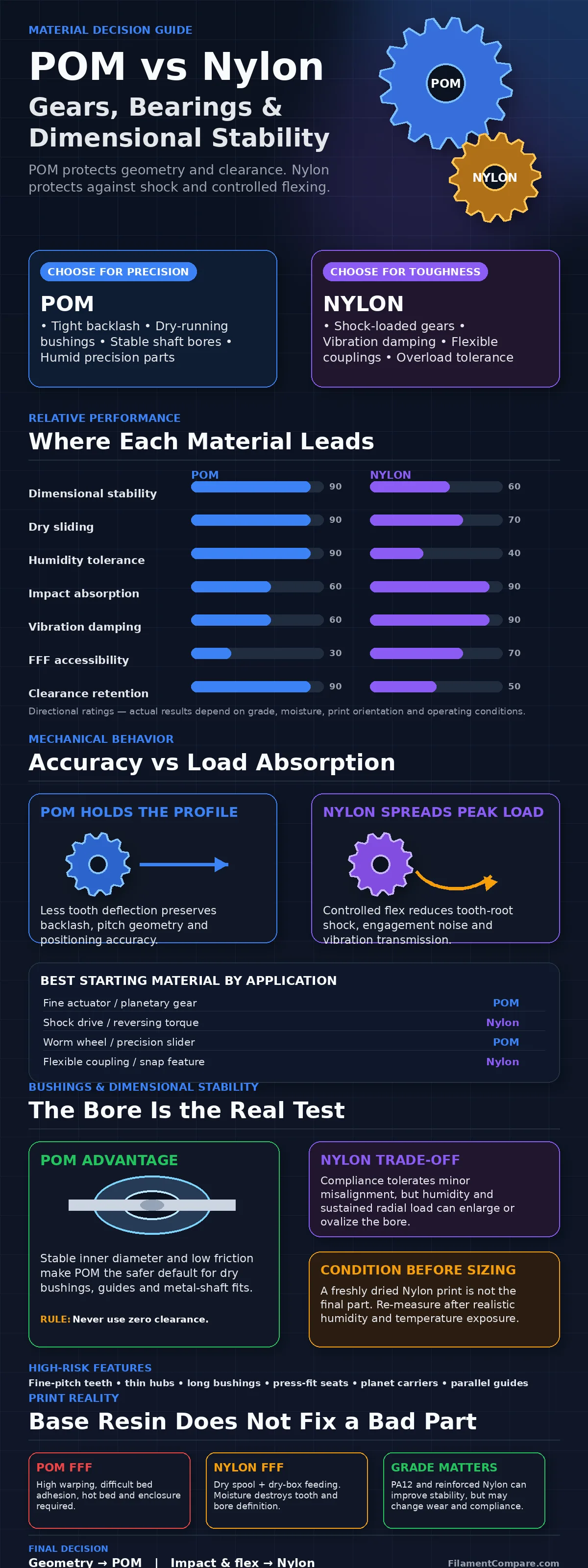
POM keeps gear geometry, bearing clearance, and press-fit dimensions more predictable, while Nylon absorbs shock and tolerates flexing more effectively. POM is usually the stronger candidate for low-friction motion and tight mechanical clearances; Nylon is often better where impact, vibration, and tooth-root toughness matter more than exact dimensional retention. The choice changes with humidity, continuous load, Nylon grade, print orientation, and whether the comparison involves printed, machined, or molded parts.
Direct Material Verdict
Choose POM for precision gears, low-friction bushings, rollers, sliding guides, and mechanisms that must preserve backlash or bore clearance in changing humidity.
Choose Nylon for shock-loaded gears, flexible couplings, vibration-damping components, snap features, and parts that benefit from controlled elastic deformation.
There is no universal winner. For dimensional stability and sliding motion, POM has the clearer advantage. For impact absorption and mechanical compliance, Nylon is usually the better starting point.
Best for Tight Backlash
POM
Lower moisture sensitivity and higher dimensional predictability help preserve tooth spacing and center-distance assumptions.
Best for Shock-Loaded Gears
Nylon
Its tougher, more compliant behavior can spread a sudden load instead of concentrating it at one tooth root.
Best for Dry-Running Bushings
POM
Its sliding behavior, surface hardness, and stable bore dimensions suit many low-to-moderate-load bearing applications.
Best for Vibration Damping
Nylon
Greater elastic response can reduce transmitted vibration and soften gear engagement noise.
Best for Humid Precision Parts
POM
It is less affected by ambient moisture and is more likely to maintain a designed fit over time.
Best for Accessible FFF Printing
Nylon
Nylon still requires drying and tuning, but compatible filament grades and printer profiles are more widely available.
Best for Flexible Tooth Survival
Nylon
When occasional overload is expected, slight tooth deflection may be safer than a harder, less compliant response.
Best for Bore and Shaft Accuracy
POM
It is the more dependable option when an inner diameter, shaft fit, or sliding clearance must remain controlled.
| Decision Area | POM | Nylon | More Suitable Choice |
|---|---|---|---|
| Material family | Semi-crystalline polyoxymethylene, also called acetal | Polyamide family including PA6, PA6/66, PA11, PA12, copolyamides, and reinforced grades | Application-dependent |
| Typical nozzle temperature | A commercial POM filament may specify about 210–220°C[b] | Common unfilled Nylon guidance is often around 230–260°C[c] | Follow the spool specification |
| Typical bed temperature | Often about 100–130°C for commercial POM filament | Often about 40–70°C for common Nylon profiles | Printer and grade dependent |
| Print difficulty | Very tuning-sensitive due to shrinkage and restricted bed-surface compatibility | Moderate to high, mainly due to moisture, warping, stringing, and hot-end requirements | Nylon |
| Enclosure need | Strongly recommended for temperature consistency and draft control | Recommended for many grades, although some modified Nylons are designed for lower-warp printing | Grade-dependent |
| Drying demand | Usually less demanding because POM has low moisture absorption | Frequently requires drying and dry-box feeding | POM |
| Bed adhesion | Difficult; ordinary build surfaces may not hold it reliably | More manageable with a suitable adhesive and stable thermal conditions | Nylon |
| Warping tendency | High, especially on broad or long parts | Moderate to high; PA type, reinforcement, and formulation can change the result | Nylon |
| Sliding behavior | Low friction, good wear behavior, and low moisture uptake are established POM traits[a] | Suitable for sliding parts, but the result depends more heavily on grade, moisture, additives, and mating surface | POM |
| Gear tooth stiffness | Higher shape retention and less elastic tooth movement | More tooth deflection and load spreading | Depends on backlash and shock load |
| Impact absorption | Good for an engineering thermoplastic, but usually less compliant | Usually tougher and better able to absorb sudden loading | Nylon |
| Dimensional stability | High, particularly where humidity varies | Grade-dependent and affected by moisture conditioning | POM |
| Bore clearance retention | More predictable for bushings, guides, and shaft holes | Can change as the part absorbs moisture or remains under radial load | POM |
| Long-term creep risk | Usually lower under equal conditions, although load and temperature still matter | More attention is needed around press fits, screw preload, and continuously loaded walls | POM |
| Noise and vibration control | Smooth engagement can reduce noise when geometry is accurate | Material compliance can absorb tooth engagement and mechanical vibration | Nylon |
| Small precision gears | Well suited when the print process can reproduce the geometry reliably | Usable, but humidity and elastic tooth movement must be included in the clearance design | POM |
| Large shock-loaded gears | Useful for controlled loads and low-friction operation | Often better where impact and occasional overload dominate | Nylon |
| Main limitation | Demanding FFF process, strong warping tendency, difficult bed adhesion, and processing-safety requirements | Moisture sensitivity, conditioning-related dimensional change, and greater long-term deformation risk | Different limitations |
This comparison combines POM and Nylon manufacturer guidance, engineering-plastic documentation, and common FFF behavior; the listed trends are directional because polymer grade, reinforcement, color, moisture level, part geometry, print orientation, and machine settings can alter the result.
Material Profiles for Moving Mechanical Parts
POM Mechanical Profile
- Polymer type: Semi-crystalline polyoxymethylene or acetal
- Print difficulty: High
- Nozzle range: Common product guidance is near 210–220°C, but the spool specification controls
- Bed range: Frequently near 100–130°C
- Enclosure: Strongly recommended
- Drying need: Usually lower than Nylon, though contaminated or poorly stored filament may still need attention
- Typical behavior: Hard, smooth, dimensionally stable, fatigue-resistant, and less affected by humidity
- Better uses: Precision gears, dry bushings, rollers, sliders, cams, guides, and tolerance-sensitive fittings
Nylon Mechanical Profile
- Polymer type: Polyamide family rather than one single resin; common printed types include PA6, PA11, PA12, and copolyamides[d]
- Print difficulty: Moderate to high
- Nozzle range: Common unfilled grades often print around 230–260°C; reinforced grades may require more
- Bed range: Commonly around 40–70°C, with major grade variation
- Enclosure: Recommended for many formulations
- Drying need: High; dry-box feeding is often useful during long prints
- Typical behavior: Tough, fatigue-tolerant, slightly compliant, impact-absorbing, and moisture-responsive
- Better uses: Shock-loaded gears, couplings, clips, flexible hubs, vibration-damping parts, and functional prototypes
Relative Performance for Gears and Bearings
Dimensional Stability
Impact Absorption
Dry Sliding Performance
Humidity Tolerance
FFF Process Accessibility
Vibration Damping
Long-Term Clearance Retention
These meters are relative indicators for printed mechanical use, not fixed laboratory ratings. Results can move considerably with Nylon type, POM formulation, reinforcement, moisture conditioning, layer direction, wall structure, temperature, mating surface, and slicer settings.
What Happens to Gear Teeth Under Load?
POM and Nylon can both produce functional plastic gears, but they manage tooth loading differently. POM resists elastic shape change, while Nylon allows more controlled deflection. One behavior supports geometric accuracy; the other supports impact survival.
Backlash and Tooth-Profile Retention
Backlash is not set only by the CAD model. It is also affected by printing shrinkage, bore accuracy, shaft position, tooth deflection, wear, temperature, and moisture. This makes material stability especially important in small gears, where a small dimensional change represents a larger share of the intended tooth clearance.
POM is usually easier to predict after a part reaches operating conditions. Its low moisture uptake means a gear is less likely to swell enough to alter center-distance clearance or tighten the mesh. The material also resists elastic tooth movement more strongly, which helps preserve the designed involute geometry under moderate loading.
Nylon teeth can bend slightly as they enter contact. That movement may reduce impact at engagement, but it can also increase the effective backlash under load. In a positioning system, encoder drive, compact actuator, or low-backlash reduction stage, this elastic movement may appear as lost motion even when the unloaded gear dimensions look correct.
Why Small Gears Are Less Forgiving
A dimensional change that is unimportant on a large conveyor sprocket may consume much of the designed clearance in a miniature actuator gear. Fine teeth also leave less material at the root, so print resolution, layer placement, and moisture-related size changes have a stronger influence.
Shock Loading and Tooth-Root Survival
Nylon becomes more attractive when a mechanism experiences sudden starts, stalls, impacts, or reversing torque. Its toughness allows a tooth to deflect and spread a peak load across a wider contact region. In some systems, temporary deformation is preferable to a harder response that concentrates stress near the tooth root.
POM still performs well under repeated mechanical cycling and is widely associated with gears and precision moving parts. The difference is that its advantage is strongest when the load remains within the intended range and the gear benefits from a stable profile, smooth surface, and controlled clearance. A stalled motor or jammed mechanism may favor Nylon’s extra compliance.
Spur, Worm, Planetary, and Rack Applications
Spur Gears
POM suits accurate tooth engagement and stable backlash. Nylon suits larger teeth, intermittent shock, and quieter engagement.
Worm Gears
POM’s sliding behavior is useful because worm drives include more sliding contact than ordinary spur meshes. Heat buildup and lubrication still need prototype testing.
Planetary Sets
POM can help preserve the geometry of small planet gears. Nylon may reduce noise, but carrier clearance and moisture-conditioned dimensions need attention.
Rack-and-Pinion Drives
POM supports repeatable travel where tooth position matters. Nylon can suit lower-precision drives that encounter impacts or misalignment.
Motor Pinions
Small POM pinions can retain tooth shape well, although FFF resolution and bore accuracy may become the limiting elements rather than the resin.
Overload-Tolerant Drives
Nylon is often the safer candidate when a gear is expected to act as a compliant or replaceable element during a jam.
Gear material should not be selected from tensile strength alone. Tooth-root fatigue, tooth stiffness, surface wear, contact temperature, print direction, backlash, shaft support, and expected overload all affect service life.
Bushings, Bearings, and Sliding Interfaces
In this comparison, “bearing” mainly refers to plain bearings, bushings, thrust washers, rollers, and sliding guides rather than ball or roller bearings. These parts depend on the interaction between two surfaces. The plastic grade is only one half of that pair.
Starting Friction and Stick-Slip
POM is often selected for smooth sliding because it combines a hard surface, low friction, good wear behavior, and stable dimensions. This is useful in low-speed guides, control levers, printer mechanisms, drawer-like slides, valve components, and dry-running bushings where motion must begin without a large breakaway force.
Nylon can also work as a bearing material, but its behavior is more dependent on the exact polyamide and operating condition. Moisture can soften a Nylon part and alter its bore. That may improve compliance in one assembly while increasing drag or reducing clearance in another.
Bore Stability on a Metal Shaft
A bushing can fail without cracking. Its inner diameter may shrink, expand, become oval, or wear unevenly until the shaft either binds or develops too much play. POM is generally the better starting point when bore clearance must remain narrow and predictable.
Nylon is useful when slight flexibility helps the bushing tolerate edge loading or minor misalignment. The same flexibility becomes a limitation under continuous radial pressure. A thin Nylon wall can slowly ovalize, especially when the assembly is warm or the part has absorbed moisture.
Do not design a dry plastic bushing with zero clearance. Low friction does not remove the need for thermal expansion, print variation, shaft runout, debris allowance, and moisture-related change. A fit that moves freely on the workbench may tighten after the mechanism warms.
The Shaft Surface Can Control Wear
A smooth hardened-steel shaft, rough aluminum rod, printed polymer pin, and polished stainless shaft create different wear pairs. Surface roughness can turn the shaft into a cutting tool. An uneven or scratched counterface may remove material from a POM or Nylon bushing even when the polymer is described as wear-resistant.
- Smooth steel: Usually the most predictable counterface for a printed plastic bushing.
- Rough aluminum: Can transfer material, wear unevenly, or create abrasive oxide debris.
- Plastic-on-plastic: May run quietly but can trap heat because both surfaces conduct heat poorly.
- Reinforced Nylon: Carbon or glass fibers can improve stiffness while making the printed surface more abrasive to a softer shaft.
- Layered bore surface: A horizontally printed hole may present stair-stepped contact rather than a continuously smooth bearing surface.
Celanese’s POM design documentation treats bearing design as a combination of pressure, sliding velocity, temperature, wear, lubrication, and geometry rather than a simple material ranking[g]. A prototype should therefore be tested at the real shaft speed, radial load, operating temperature, and duty cycle.
Lubricated and Unlubricated Motion
POM is often the more natural choice for an unlubricated guide or moderate-duty bushing. Nylon may still be chosen for impact absorption or noise control, but a standard unfilled Nylon grade should not automatically be treated as a dedicated bearing compound.
Lubrication can lower friction, yet it introduces other variables. Grease may collect dust, attack an incompatible polymer or seal, increase drag at low temperature, or migrate away from the contact zone. For clean mechanisms, a tribologically modified POM or Nylon grade may offer better control than adding lubricant to a general-purpose filament.
Dimensional Stability After Printing
Dimensional stability is the main separation between POM and standard unfilled Nylon. It affects more than the outside length of a part. It changes gear backlash, shaft clearance, insert retention, screw preload, bearing alignment, and the contact pressure between moving surfaces.
Dry Nylon and Conditioned Nylon Are Not the Same Part
Drying Nylon before printing is necessary for extrusion quality, but the finished component can absorb moisture again after it leaves the printer. Polymaker notes that completed Nylon parts continue to take up moisture from their surroundings and that the effect varies by Nylon type[e].
This means a bore measured immediately after printing may not represent the bore after several days or weeks in service. The part may become slightly larger, softer, and less stiff as it approaches equilibrium with the environment. The exact amount depends on the polyamide chemistry, additives, wall thickness, humidity, temperature, and exposure time.
POM changes less under the same moisture exposure. For a precision gear train, sliding fit, or bearing housing, that lower sensitivity simplifies tolerance planning. It does not make POM dimensionally motionless; thermal expansion, residual stress, print shrinkage, and creep still remain.
Moisture Does Not Enter the Part Instantly
A thick Nylon component can develop a moisture gradient. The outside region may condition before the center does. As moisture continues moving inward, dimensions and stiffness can keep changing even though the part has already been assembled.
This behavior matters in thick hubs, wide rollers, bearing blocks, and gears with solid centers. A thin test coupon may reach equilibrium much sooner than the real component, so a short material test can underestimate long-term change.
Condition the Test Part Before Freezing the Tolerance
For a Nylon gear or bushing that will operate in ordinary room air, measure more than the fresh print. Check the part after it has spent time in an environment resembling its final use. For humid service, testing only a freshly dried sample can produce an unrealistically tight tolerance.
Temperature and Metal Components
A polymer gear on a steel shaft is a two-material assembly. The plastic and steel do not expand at the same rate. As temperature rises, a printed hub, bore, bearing seat, and housing can change relative to the metal component.
POM’s moisture stability makes the temperature effect easier to isolate. Nylon can experience thermal expansion, moisture expansion, and moisture-related stiffness change at the same time. A press fit that is secure in dry winter air may behave differently after warm, humid exposure.
Geometries Most Sensitive to Dimensional Change
High-Risk Gear Features
- Fine-pitch teeth
- Low-backlash meshes
- Small motor pinions
- Planet gears with narrow carrier clearance
- Long racks that accumulate shrinkage error
- Thin hubs around press-fit bores
High-Risk Bearing Features
- Long narrow bushings
- Thin bearing walls
- Closely fitted shaft holes
- Split bushings under clamp pressure
- Plastic bearing seats for metal bearings
- Guides that must remain parallel
Creep, Press Fits, and Parts That Loosen Later
A part can remain unchanged by humidity and still lose its fit under continuous load. This is creep: gradual deformation while stress remains applied. It is separate from moisture swelling, although the two effects may occur together in Nylon.
Where Creep Appears in Mechanical Assemblies
- A gear hub pressed onto a metal shaft
- A bushing wall carrying constant radial pressure
- A roller compressed by a belt or spring
- A screw clamping a printed housing
- A metal bearing pressed into a plastic seat
- A tensioner arm held in one position
- A keyed or D-shaped bore transmitting continuous torque
POM usually retains these fits more predictably because it is stiffer and less moisture-sensitive. It still needs sensible stress levels. An excessively tight press fit can create a persistent hoop stress that eventually cracks a thin hub or relaxes the interference.
Nylon can survive assembly strain well, but that does not guarantee that the original clamping force will remain. A Nylon hub may stretch over a shaft during installation and then slowly relax. Moisture and heat can accelerate the loss of interference or screw preload.
A Press Fit Should Not Carry Torque Alone
For a gear that must transmit dependable torque, use geometry rather than relying only on friction. A D-flat, spline, key, cross-pin, knurled insert, captured nut, or mechanically locked hub can continue transferring torque even if the polymer relaxes slightly.
POM supports precise bores but has a low-energy surface that is difficult to bond reliably without preparation. Nylon may bond more readily with some systems, yet moisture and surface chemistry still make adhesive-only torque transfer uncertain. Mechanical retention is the safer design route for both materials.
Thin POM Hub
Risk: cracking from excessive interference. Add wall thickness, a relief feature, or a metal insert.
Thin Nylon Hub
Risk: long-term relaxation. Add a spline, pin, flat, or clamping feature.
Metal Bearing Seat
Risk: loss of fit after heat cycling. Include a shoulder, retaining cap, or mechanical stop.
Printed POM and Printed Nylon Are Not Equivalent to Molded Stock
Many material comparisons use properties measured on injection-molded specimens. A printed gear or bushing contains layer interfaces, toolpaths, start-and-stop seams, internal voids, and a surface created by deposited roads. These features can become more important than the difference between the base polymers.
Layer Direction Changes the Failure Mode
A printed gear loaded across strong in-plane roads can behave differently from the same gear loaded in a direction that opens layer interfaces. Tooth-root stress may intersect layer boundaries, while a printed bushing may split along its axis if press-fit stress is oriented poorly.
Nylon often develops useful interlayer bonding when it is dry and printed hot enough, but absorbed moisture can create bubbles, rough extrusion, and weaker interfaces. POM requires stable thermal control and strong bed retention; a warped POM gear may have excellent resin properties but unusable pitch accuracy.
Printed Bores Are Usually Not Bearing-Ready
A nominally round hole can emerge undersized, polygonal, tapered, or stair-stepped. For a working bushing, reaming, boring, drilling, or machining the inner surface may improve alignment and distribute pressure more evenly.
POM is well known for machinability, which supports a print-then-finish workflow if the deposited part has adequate layer strength. Nylon is more compliant and may deflect during cutting, so sharp tools, controlled support, and light finishing cuts are useful.
POM’s FFF Process Is the Larger Obstacle
POM’s semi-crystalline shrinkage and low surface adhesion make it difficult to keep flat. Long racks, broad gears, bearing plates, and large rollers are particularly demanding because the shrinking material can lift from the bed or distort the pitch geometry.
Processing temperature also needs careful control. Celanese warns that excessive POM processing temperature or long residence time can lead to degradation and formaldehyde release, making correct settings and effective ventilation necessary[h]. Do not raise nozzle temperature beyond the filament maker’s range simply to force more flow.
POM should not be treated like an ordinary desktop filament. Use the exact filament documentation, avoid overheating, maintain ventilation or local exhaust, and never mix unknown material residue into the hot end. Material changes should follow the printer and filament manufacturer’s purge instructions.
Nylon’s Main Process Variable Is Moisture
Wet Nylon may hiss or pop at the nozzle, string more heavily, produce a rough surface, lose dimensional definition, and form internal voids. These defects are particularly damaging to small gear teeth and thin bearing walls because there is little extra material available to distribute the load.
Drying the spool improves extrusion consistency, but dry storage must continue during the print. A long print fed from open room air may change quality from the first layers to the last, especially in a humid workshop.
PA6, PA12, and Reinforced Nylon Change the Comparison
“Nylon” is not one fixed material. A soft, moisture-responsive PA6, a lower-moisture PA12, a copolyamide, and a carbon-fiber-reinforced PA blend can behave like different engineering options.
PA6 Versus PA12 for Dimensional Stability
PA6-based materials commonly offer high strength, heat capability, and impact performance, but they are among the more moisture-responsive Nylon options. PA12 generally absorbs less moisture and preserves dimensions more predictably, though its stiffness and heat behavior may differ from PA6.
A PA12 or PA6/12-based filament can therefore narrow the dimensional-stability gap with POM. It does not automatically match POM’s sliding behavior or moisture resistance, but it may offer a more balanced choice for a printed gear that needs both toughness and controlled geometry.
Carbon- and Glass-Fiber-Reinforced Nylon
Short fibers reduce shrinkage, raise stiffness, and limit tooth or wall deflection. These changes can make Nylon-CF or Nylon-GF more suitable for gears, fixtures, bearing blocks, and rigid housings than an unfilled Nylon.
The reinforcement also changes the wear pair. Exposed fibers can make the printed surface more abrasive, which is not always desirable inside a bushing or against a softer mating gear. A reinforced Nylon housing may be useful, while an unfilled or tribologically modified material may be better at the actual sliding surface.
Polymaker describes its PA612-CF as less moisture-sensitive than PA6/66 and PA6-based materials, with carbon reinforcement used to improve printed dimensional stability[f]. This illustrates why the grade name matters: reinforced PA612 should not be judged as if it were ordinary unfilled PA6.
Tribological Grades Deserve Separate Evaluation
Both POM and Nylon are sold in wear-modified versions containing PTFE, silicone, oil, fibers, or other additives. A purpose-made bearing grade may outperform a standard version of the “better” base polymer. For a production mechanism, compare actual grade datasheets rather than only the words POM and Nylon.
A carbon-filled grade is not automatically the better gear or bushing material. Added stiffness can improve accuracy, but reduced tooth compliance, surface abrasiveness, nozzle wear, and weaker performance across some print directions may offset that gain.
Wear Patterns Reveal Different Failure Modes
POM and Nylon do not always fail in the same way. Knowing the likely wear pattern helps diagnose whether the problem comes from material choice, geometry, heat, alignment, or the counterface.
Common POM Wear Signs
- A polished or glossy contact track
- Fine wear debris around a dry sliding interface
- Local tooth-tip or tooth-flank wear
- Cracking near a thin, highly stressed hub
- Uneven contact caused by warped printed geometry
- Surface fatigue under excessive contact pressure
Common Nylon Wear Signs
- Rounded or smeared tooth profiles
- Bore ovalization under sustained radial load
- Surface fuzzing or fiber exposure
- Heat-softened contact regions
- Increased clearance from creep
- Dimensional drift after moisture conditioning
A quiet mechanism can still be wearing. Nylon may damp noise while its teeth slowly deform, and POM may continue moving smoothly while fine abrasive particles enlarge a bushing. Inspection should include backlash, bore diameter, shaft marking, contact temperature, and debris rather than sound alone.
Application-Based Material Recommendations
| Application | Preferred Starting Material | Reason | Design Caution |
|---|---|---|---|
| Fine-pitch actuator gear | POM | Better tooth-profile and backlash retention | FFF warping or poor layer placement may cancel the material advantage |
| Shock-loaded drive gear | Nylon | Greater toughness and tooth compliance | Allow for elastic movement and moisture-conditioned dimensions |
| Small planetary gearbox | POM | Stable planet geometry and carrier clearance | Check layer direction at the bore and tooth roots |
| Low-speed worm wheel | POM | Useful sliding and wear behavior | Validate heat buildup, lubrication, and contact pressure |
| Dry-running shaft bushing | POM | Low friction and stable internal diameter | Finish the bore and provide operating clearance |
| Slightly misaligned low-load bushing | Nylon | Compliance can accommodate minor edge loading | Long-term radial creep may enlarge or ovalize the bore |
| Precision linear slider | POM | Smooth movement and more predictable clearance | Dust and shaft roughness may dominate wear |
| Vibration-damping roller | Nylon | Greater energy absorption | Continuous belt pressure can cause creep |
| Humid-environment gear train | POM | Lower moisture-driven size change | Check chemical exposure and actual operating temperature |
| Flexible coupling insert | Nylon | Better controlled deformation and shock absorption | Do not use an overly stiff reinforced grade without testing |
| Press-fit gear hub | POM | More predictable initial bore and fit | Add a flat, spline, key, or insert instead of relying only on friction |
| Snap-on mechanical retainer | Nylon | Repeated flexing and impact tolerance | Moisture and creep can alter retention force |
| Large flat bearing plate | Modified Nylon or another process | Standard POM is difficult to keep flat in FFF | Consider Nylon-CF, machining, or molding if flatness controls function |
| Rapid functional prototype | Nylon | Wider FFF availability and more established print workflows | Dry the spool and measure the conditioned part |
| Production tolerance-critical gear | POM, preferably machined or molded | The base material suits precision motion | Printed surface and layer variation may remain the limiting issue |
| Abrasive-dust mechanism | Grade-specific testing | Debris can dominate both materials | Use seals, replaceable bushings, and a suitable wear-modified grade |
Where Each Material Fits Better
Choose POM When
- Gear backlash must remain controlled.
- A bushing or guide needs a stable internal dimension.
- The mechanism runs in changing humidity.
- Low sliding friction matters more than impact absorption.
- A hard, smooth contact surface is useful.
- The part will be finish-machined after printing.
- A metal shaft, bearing, or insert needs a predictable fit.
- The load is controlled and alignment is good.
POM Is Less Suitable When
- The printer cannot provide a hot bed, enclosure, or suitable build surface.
- The part is large, broad, and highly sensitive to warping.
- Strong impacts or repeated jamming are expected.
- Ventilation and safe POM-processing controls are unavailable.
- The design relies on repeated large elastic deflection.
Choose Nylon When
- The gear experiences shock, reversal, or intermittent overload.
- Vibration and engagement noise need damping.
- A coupling, clip, or hub benefits from controlled flexing.
- A functional FFF prototype is needed with an established filament workflow.
- Slight misalignment must be tolerated.
- Tooth-root toughness matters more than exact unloaded geometry.
- A lower-moisture PA12 or reinforced grade can be selected for the environment.
- The printer can keep the filament dry during extrusion.
Nylon Is Less Suitable When
- Tight dimensions must remain unchanged across humidity cycles.
- A press fit must preserve high clamping force for a long period.
- The part cannot be conditioned before its final tolerance is set.
- A thin bushing wall carries constant radial pressure.
- The spool cannot be dried or printed from dry storage.
Material Selection Matrix
Best Choice by Mechanical Priority
Choose POM if the mechanism is controlled by geometry. It is the more dependable starting point for fine gears, stable backlash, accurate shaft holes, low-friction sliders, dry bushings, rollers, and parts that must retain dimensions in humid air.
Choose Nylon if the mechanism is controlled by impact and deformation. It is usually better for shock-loaded gears, compliant couplings, snap features, vibration damping, and components that need to bend slightly instead of maintaining a rigid profile.
Choose a lower-moisture or reinforced Nylon grade when ordinary Nylon offers the right toughness but not enough stiffness or dimensional control. PA12, PA612, Nylon-CF, and Nylon-GF should be evaluated as separate materials rather than treated as interchangeable versions of PA6.
Use a different manufacturing process when precision dominates. A machined or molded POM gear may be the right engineering answer even when printed POM is not practical. Base-resin properties cannot correct a warped pitch circle, rough bore, weak layer boundary, or inaccurate tooth profile.
Common POM and Nylon Questions
Is POM always better than Nylon for gears?
No. POM is usually better for stable tooth geometry, low friction, and controlled backlash. Nylon can be better for gears exposed to impact, vibration, reversing torque, or occasional overload.
Which material is better for a printed bushing?
POM is generally the stronger starting point for a dimensionally stable, low-friction bushing. Nylon may suit a lower-load bushing that needs impact absorption or tolerance for minor misalignment, but bore change and creep need closer attention.
Does Nylon keep changing size after printing?
It can. A dry printed Nylon part may absorb moisture until it approaches equilibrium with the surrounding air. The resulting dimensional and stiffness changes depend on the Nylon type, humidity, temperature, wall thickness, and exposure time.
Can POM be printed on a normal desktop printer?
Only some suitably equipped machines are practical candidates. POM normally needs a high bed temperature, controlled enclosure, compatible build surface, accurate temperature control, and effective ventilation. Printer and filament documentation should be checked before use.
Is PA12 closer to POM than PA6?
PA12 is generally less moisture-sensitive than PA6, so it can offer better dimensional predictability. POM still tends to provide lower moisture uptake and stronger sliding behavior, while PA12 retains more of Nylon’s toughness and compliance.
Is carbon-fiber Nylon better for gears?
It can improve stiffness, shrinkage control, and tooth-position accuracy, but it also reduces compliance and may create a more abrasive surface. It is not automatically better for every gear mesh or bearing surface.
Can a printed POM or Nylon gear replace a metal gear?
Only when torque, speed, temperature, duty cycle, shaft support, wear, and expected service life fall within the tested capability of the printed design. Plastic gears are not direct substitutes for metal gears merely because their dimensions match.
Technical References
- [a] POM Plastic – Polyoxymethylene (Ensinger’s engineering-material overview was used for POM’s sliding behavior, wear resistance, rigidity, low moisture absorption, and dimensional-stability characteristics.)
- [b] Acetal 3D Printer Filament (The product guidance was used for a commercial POM filament’s stated nozzle and build-plate temperature ranges. Other POM formulations may specify different settings.)
- [c] How to Print with Nylon Filament (UltiMaker’s printing guidance was used for common Nylon nozzle and build-plate temperature ranges and general process behavior.)
- [d] Types of Nylon Used in FDM 3D Printing (Polymaker’s material overview was used to distinguish PA6, PA11, PA12, copolyamide, and reinforced Nylon families rather than treating Nylon as one fixed polymer.)
- [e] Moisture Conditioning (This source was used for the distinction between drying filament for printing and moisture conditioning of the completed Nylon component.)
- [f] Fiberon PA612-CF15 (The official product page was used as an example of a reinforced PA6/PA12-family filament designed for lower moisture sensitivity and improved dimensional stability.)
- [g] Designing with Celcon POM Acetal Copolymer (Celanese’s engineering design manual was used for the bearing, gear, creep, pressure-velocity, wear, assembly, and long-term dimensional considerations.)
- [h] Celcon Acetal Copolymer Processing and Troubleshooting Guide (Celanese’s processing document was used for the warning that excessive heat or unsuitable processing conditions can cause POM degradation and formaldehyde release.)
