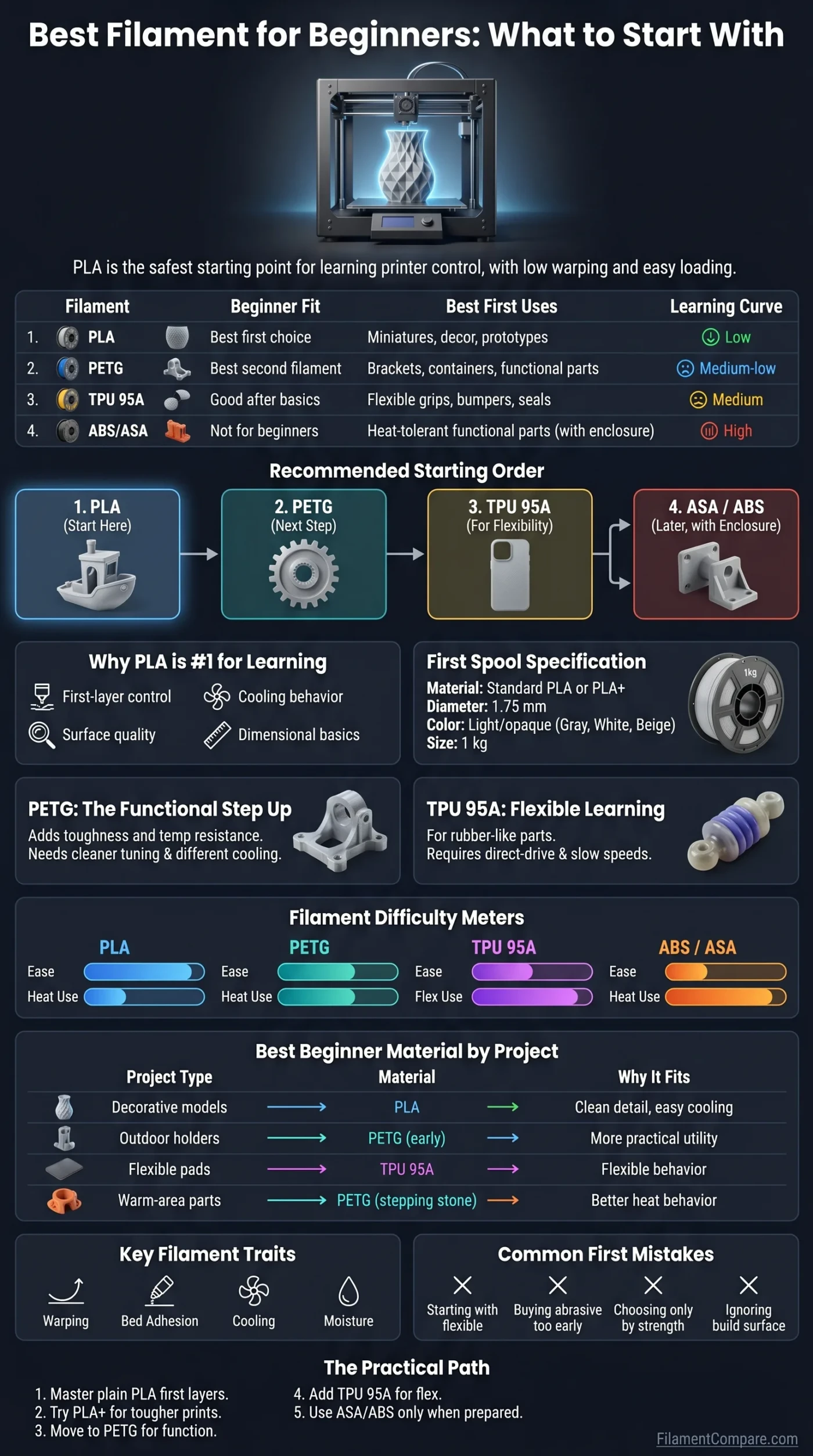
For most new FDM printer owners, the best first filament is PLA. It loads easily, prints at moderate nozzle temperatures, sticks well to common build plates, and has low warping compared with many engineering materials. That makes it the safest starting point for learning slicer settings, bed leveling, first-layer quality, cooling, support removal, and surface finish without fighting the material at the same time.
| Filament | Beginner Fit | Typical Nozzle Range | Typical Bed Range | Printer Needs | Best First Uses | Learning Curve |
|---|---|---|---|---|---|---|
| PLA | Best first choice | About 200–220°C for many PLA blends; Prusament PLA lists 210 ± 10°C [a] | 40–60°C on many heated beds [b] | Open printer is usually fine; strong part cooling helps | Miniatures, desk items, decor, prototypes, calibration models | Low |
| PETG | Best second filament | Prusa lists 230°C first layer and 240°C for later layers [c] | Prusa lists 85°C first layer and 90°C for later layers [d] | Heated bed recommended; moderate cooling; clean bed surface | Practical brackets, containers, printer parts, simple outdoor-adjacent items | Medium-low |
| TPU 95A | Good after PLA/PETG basics | Varies by brand and hardness | Varies by brand and build surface | Direct-drive extruder helps; slow print speed is common | Flexible feet, bumpers, grips, soft protective parts | Medium |
| ABS | Not the easiest first filament | Higher than PLA and PETG | Prusa notes the bed should be at least 100°C for ABS [e] | Enclosure, stable chamber temperature, suitable ventilation | Heat-tolerant functional parts on prepared printers | High |
| ASA | Better kept for later | Prusa lists 260°C | Prusa lists 105°C first layer and 110°C later layers [f] | Enclosure recommended; stable bed adhesion matters | Outdoor functional parts, UV-exposed covers, technical housings | High |
Best starting order: begin with PLA, move to PETG once first layers are consistent, then try TPU 95A if flexibility matters. ABS and ASA make more sense after the printer, slicer, and bed surface are already familiar.
- First spool: PLA
- Second spool: PETG
- Flexible parts: TPU 95A
- Heat and outdoor parts: ASA later
- Enclosure materials: ABS / ASA
Why PLA Is Usually the Best Filament for Beginners
PLA gives a new user the cleanest learning path because it removes many early problems from the equation. It does not demand a hot enclosure, it is less prone to warping than ABS-style materials, and it can produce sharp detail even on basic desktop printers.
That matters. A beginner is already learning nozzle height, bed adhesion, slicer profiles, retraction, cooling, supports, infill, wall count, and print orientation. Using a forgiving material keeps the first learning curve focused on printer control, not material troubleshooting.
What PLA Teaches Well
- First-layer control: PLA shows clearly whether the nozzle is too close, too far, or just right.
- Cooling behavior: small details, overhangs, bridges, and corners respond visibly to fan settings.
- Surface quality: layer lines, seams, top-surface finish, and support marks are easy to inspect.
- Dimensional basics: PLA is useful for learning tolerances before moving into more flexible or heat-resistant materials.
A plain PLA spool is better than a specialty PLA for the first prints. Matte PLA, silk PLA, wood-filled PLA, glow filament, carbon-filled blends, and high-speed blends can all be useful, but a standard, well-made PLA filament gives a cleaner baseline.
What to Buy as a First Spool
Best First Spool Specification
- Material
- Standard PLA or PLA+ from a known filament brand.
- Diameter
- Use the diameter your printer requires. Most current hobby FDM printers use 1.75 mm filament.
- Color
- Light gray, white, beige, or light blue makes layer lines and surface defects easier to see.
- Spool Size
- 1 kg is practical for learning because it gives enough material for tests, small parts, and failed attempts.
- Avoid at First
- Very cheap mystery filament, abrasive blends, flexible filament, transparent PETG, carbon fiber blends, and high-temperature materials.
The color choice is not only aesthetic. Very dark filament can hide small surface defects, while translucent filament may make layer bonding harder to judge. A neutral, opaque PLA makes the learning process easier because the print tells the truth.
PLA, PLA+, and Tough PLA: What a Beginner Should Know
PLA is the normal starting point. PLA+ is a broad label rather than one fixed material formula, so its behavior depends on the brand. It often aims for better toughness or smoother printing, but the exact nozzle temperature, bed temperature, and cooling behavior should come from the spool label or manufacturer profile.
Tough PLA is still PLA-based, but it is tuned for better impact behavior and more practical prototypes. It can be a good first or second spool if the printer has a matching profile. Plain PLA remains the simplest reference material. Start there.
When PLA Is Enough
- Display models and decorative objects
- Miniatures and detailed shapes
- Draft prototypes used indoors
- Simple jigs that do not sit near heat
- Boxes, organizers, labels, holders, and light-use parts
Where PLA Has Natural Limits
PLA is not the first pick for warm car interiors, heat-exposed brackets, outdoor fixtures, or parts that must flex repeatedly. That is not a flaw. It is a material boundary. For heat, weather, or impact-focused parts, a beginner can move toward PETG, ASA, or other technical filaments after building confidence.
PETG as the Second Beginner Filament
PETG is often the best second material because it keeps printing fairly approachable while adding more toughness, better layer bonding, and better temperature resistance than PLA. It is a strong step toward functional prints without jumping straight into enclosure materials.
PETG also teaches different habits. It can string more than PLA, it may prefer less aggressive cooling, and it likes a clean build surface with the right adhesion behavior. The first layer should be close enough to bond, but not so squashed that it grips too hard or builds up around the nozzle.
Good PETG Projects for Early Learning
- Printer accessories and tool holders
- Small brackets with moderate load
- Containers and trays
- Snap-fit tests with gentle geometry
- Parts that need more ductility than PLA
PETG is beginner-friendly, but it is not “PLA with higher numbers.” It rewards cleaner temperature tuning, slightly different cooling, and careful bed-surface selection.
TPU 95A: Flexible, Useful, but Better After the Basics
TPU is the common choice for flexible FDM prints. For beginners, harder TPU around 95A is usually easier than softer flexible grades because it feeds more predictably through the extruder. Softer filament bends more inside the feed path, so the printer setup matters more.
TPU is not a bad beginner material. It is simply less forgiving than PLA. A direct-drive extruder, slower print speed, dry filament, and a clean path from spool to extruder make the experience smoother. Small parts print best at first.
What TPU Is Good For
- Rubber-like feet for electronics or furniture
- Protective bumpers and corner guards
- Flexible grips and sleeves
- Vibration-damping pads
- Soft washers or simple flexible connectors
TPU teaches extrusion consistency in a very direct way. If the filament path has drag, the print shows it. If the speed is too high, the surface tells you. It is a patient material, not a fast one.
Why ABS and ASA Are Usually Later Materials
ABS and ASA are useful technical filaments, especially when heat resistance, impact behavior, post-processing, or outdoor use matters. They also ask more from the printer: higher bed temperatures, stable ambient temperature, an enclosure for many prints, and proper ventilation planning.
For a new printer owner, those requirements add extra variables too early. Warping, corner lift, layer cracking, and chamber stability can distract from basic learning. Once PLA and PETG prints are consistent, ABS and ASA become much easier to understand.
When ASA Makes Sense
ASA filament is often chosen for outdoor parts because of its UV resistance and heat tolerance. It can be a smart material for covers, brackets, mounts, housings, and practical parts exposed to sunlight. It is not normally the first spool because it benefits from a warmer, more controlled print environment.
When ABS Makes Sense
ABS filament remains useful for heat-tolerant technical parts, smoothing workflows, and functional prototypes on printers prepared for enclosure printing. A stable chamber helps the part cool evenly, which supports better dimensional stability and layer bonding.
Beginner Filament Ranking by Print Difficulty
PLA Lowest difficulty
PETG Best next step
TPU 95A Flexible learning material
ABS / ASA Prepared-printer materials
Beginner Filament Choice by Project Type
| Project Type | Best Beginner Material | Why It Fits | Move Up Later To |
|---|---|---|---|
| Decorative models | PLA | Clean detail, easy cooling, low warp tendency | Silk PLA or matte PLA after plain PLA |
| Miniatures and small display parts | PLA | Sharp edges and fine features are easier to keep clean | High-detail PLA blends |
| Printer accessories | PLA first, PETG later | PLA is easier for test pieces; PETG adds more ductility | PETG or ASA depending on heat and location |
| Outdoor holders or covers | PETG for early learning | More practical than PLA for many utility parts | ASA when enclosure printing is ready |
| Flexible pads or grips | TPU 95A | Flexible behavior is the point of the part | Softer TPU after 95A experience |
| Warm-area functional parts | PETG as a stepping stone | Better heat behavior than PLA while staying approachable | ASA, ABS, PC blends on suitable printers |
Filament Traits Beginners Should Understand First
Warping
Warping happens when plastic cools unevenly and pulls upward from the build plate. PLA has a low tendency to warp, which is one reason it is so friendly for first prints. PETG can also behave well, but it needs a more deliberate first layer. ABS and ASA need more environmental control.
Bed Adhesion
Good bed adhesion is not just “stickier is better.” Too little adhesion causes lifting. Too much adhesion can damage a print surface or make removal stressful. The right surface, temperature, and first-layer height depend on the material.
Cooling
PLA usually likes strong cooling, especially for overhangs and small details. PETG often prefers more controlled cooling. ABS and ASA commonly use lower cooling so layers stay warm enough to bond well. Cooling changes the look, strength, and accuracy of a print.
Moisture
Filament can absorb moisture from the air. Wet filament may pop, string, foam, or leave rough surfaces. PLA is fairly manageable, PETG can become stringy when damp, and TPU often benefits from careful storage. A resealable bag with desiccant is a simple habit that helps every material.
Diameter Consistency
A consistent filament diameter supports stable extrusion. For beginners, this matters more than exotic additives. A clean spool of ordinary PLA from a reliable brand is often more useful than a specialty filament with unpredictable flow.
Common First-Filament Mistakes
- Starting with flexible filament: TPU is useful, but it adds feed-path variables before the basics are learned.
- Buying abrasive filament too early: carbon fiber, glow, metal-filled, and some wood-filled filaments may require a hardened nozzle.
- Choosing only by strength: the easiest material to print is often the best material for learning.
- Using random slicer settings: manufacturer profiles and spool labels are safer than copied settings from unrelated printers.
- Ignoring the build surface: PLA, PETG, TPU, ABS, and ASA do not all behave the same on the same plate.
Best Filament Path for a New 3D Printer Owner
- Start with plain PLA. Learn first layers, cooling, supports, seams, infill, and surface quality.
- Try PLA+ or Tough PLA. Keep the same easy printing style while exploring stronger practical parts.
- Move to PETG. Learn stringing control, bed release, and more functional part behavior.
- Add TPU 95A. Use it when the part actually needs flexibility.
- Use ASA or ABS later. Choose them when the printer setup supports enclosure printing and the part needs their properties.
This order keeps each new material useful. It also keeps each step small enough to understand. One change at a time works better than changing the filament, nozzle, bed surface, speed, and enclosure conditions all on the same weekend.
Recommended First Print Settings Mindset
There is no single perfect PLA temperature for every printer and every spool. The better rule is to begin with the manufacturer profile, then adjust only when the print gives a clear reason. If a spool label says one range and the slicer profile says another, use the printer/material profile as the baseline, then tune in small steps.
What to Watch on the First PLA Prints
- First layer: smooth lines with no gaps and no heavy scraping.
- Corners: no lifting from the plate.
- Top surface: even lines without deep grooves.
- Overhangs: clean enough to show that cooling is working.
- Stringing: light wisps are normal during learning; heavy webs point to temperature, retraction, or moisture.
Which Filament Should a Beginner Avoid at First?
A beginner does not need to avoid advanced materials forever. It is better to delay them until the printer is already producing repeatable PLA and PETG parts. The materials below can be excellent in the right setup, but they add more variables than a first spool should.
| Filament Type | Why It Adds Difficulty | Use Later When |
|---|---|---|
| Carbon fiber filled PLA/PETG | Abrasive filler can wear standard brass nozzles | A hardened nozzle is installed and flow is tuned |
| Soft TPU | Very flexible filament can buckle or feed unevenly | The extruder path and print speed are already understood |
| ABS | Needs high bed temperature and stable warm environment | An enclosure and suitable ventilation are available |
| ASA | Benefits from enclosure printing and careful adhesion control | Outdoor or heat-resistant parts are needed |
| Nylon | Moisture control and higher print temperatures matter more | Drying, storage, and printer temperature limits are clear |
| Polycarbonate blends | Higher heat and printer capability requirements | The printer is rated for the material’s temperature needs |
The Practical Answer
Buy one spool of standard PLA first. Use it until the printer can produce reliable first layers, clean walls, and predictable supports. Then add PETG for more practical parts. TPU, ASA, ABS, nylon, and filled composites can wait until the printer is no longer the mystery.
The first filament is not supposed to be the strongest material on the shelf. It should be the material that helps the printer, slicer, and user speak the same language. For most beginners, that material is PLA.
