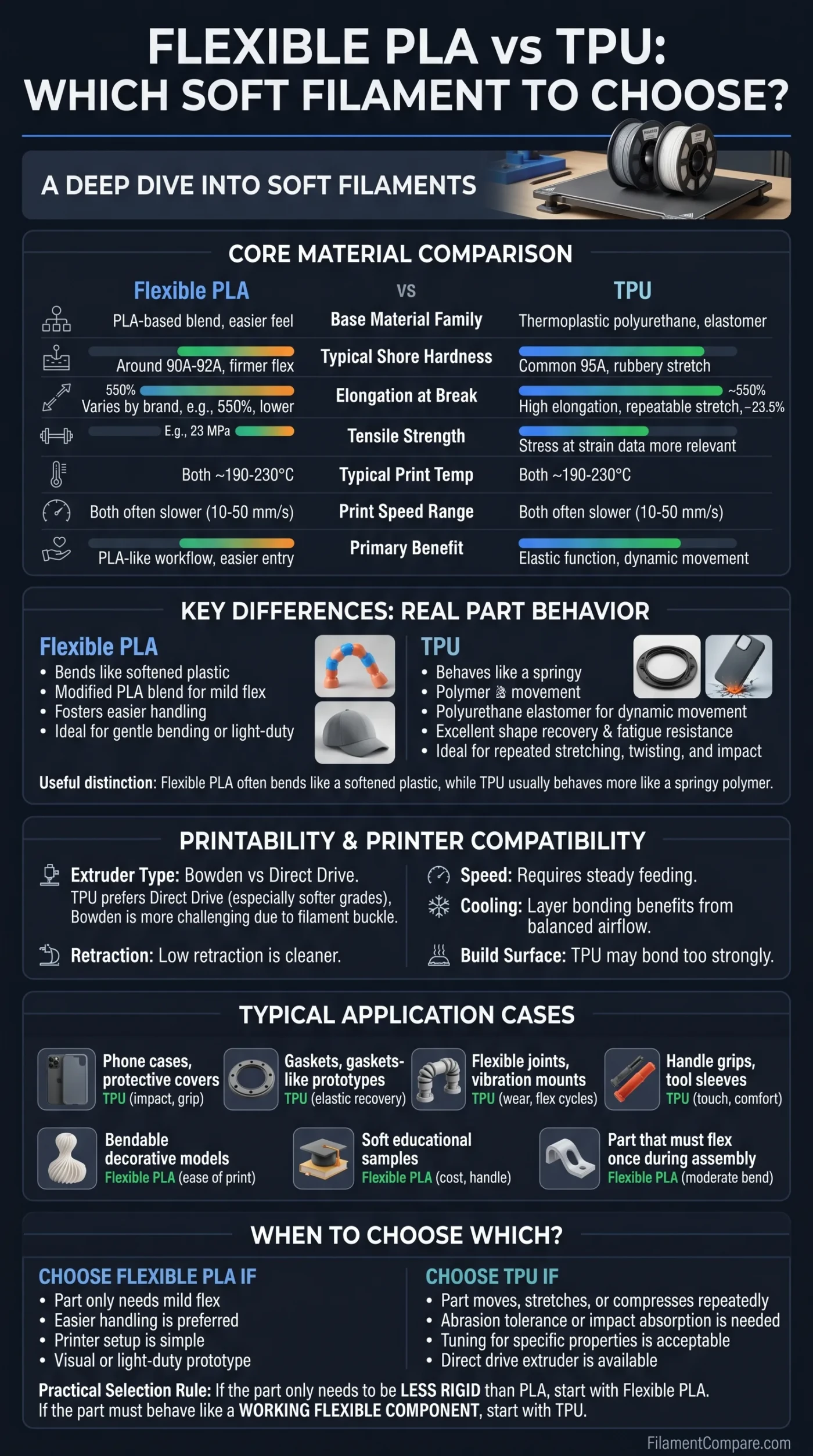
| Comparison Point | Flexible PLA | TPU | What It Means for a Printed Part |
|---|---|---|---|
| Base Material Family | Modified PLA-based flexible blend, often sold as Soft PLA or Flexible PLA | Thermoplastic polyurethane, usually sold by Shore hardness grade such as 95A | Flexible PLA keeps more of a PLA-like printing feel; TPU behaves more like an elastomer. |
| Typical Shore Hardness | About 90A in one Flexible PLA datasheet; some Soft PLA listings sit near 92A [a] | 95A for a common desktop TPU grade [b] | Both are flexible, but the feel depends on geometry. Thin walls bend more than thick, solid parts. |
| Elongation at Break | 550% in one Flexible PLA datasheet; another Soft PLA listing reports lower values, showing brand variation [c] | 551.2% ± 23.5% for the cited TPU95 specimen data | TPU is generally chosen when stretch and repeated flexing matter; Flexible PLA varies more by formulation. |
| Tensile Strength | 23 MPa in the cited Flexible PLA data | TPU95 values are often read through stress-at-strain and modulus data rather than a single rigid-plastic style strength number | Do not compare strength alone. For soft parts, strain, recovery, tear behavior, and layer bonding matter too. |
| Density | 1.22 g/cm³ in the cited Flexible PLA data | 1.20–1.24 g/cm³ for PolyFlex TPU95 | Weight difference is usually small; wall count and infill change the part feel more. |
| Printing Temperature | 190–230°C in the cited Flexible PLA data | 210–230°C for PolyFlex TPU95 | The ranges overlap. TPU usually asks for more attention to feed path, speed, and retraction. |
| Print Speed Range | Often slower than standard PLA; one Soft PLA listing gives 10–30 mm/s | 30–50 mm/s for PolyFlex TPU95 under the cited conditions | Flexible filaments reward steady feeding. Speed claims are only useful when matched to the printer and extruder. |
| Best Fit | Gentle flex, bendable PLA-like parts, soft covers, light-duty flexible prototypes | Grips, gaskets, bumpers, hinges, sleeves, vibration pads, protective cases | Choose Flexible PLA for easier entry into soft prints; choose TPU for elastic function and repeated movement. |
The figures below combine representative Flexible PLA and TPU datasheets with standards references, so they show material trends rather than guaranteed results for every brand, color, printer, nozzle, or part geometry.
Flexible PLA and TPU both belong in the soft filament category, but they do not solve the same problem. Flexible PLA is the calmer choice when a print only needs to bend, compress a little, or feel less rigid than standard PLA. TPU is the stronger match when the part must stretch, rebound, absorb impact, or survive repeated movement. Same shelf. Different behavior.
For most desktop 3D printing users, the decision is less about which filament is “better” and more about the part’s job. A soft decorative cover, light hinge, or bendable classroom model can make sense in Flexible PLA. A gasket, protective case, wheel tread, grip sleeve, vibration foot, or flexible connector usually points toward TPU.
Flexible PLA vs TPU in Plain Terms
Flexible PLA is usually a modified polylactic acid blend made to bend more than normal PLA. It often prints closer to PLA than to rubber-like materials, so it can be attractive for users who want a softer result without changing every printer habit.
TPU is a polyurethane elastomer. It is made for elastic behavior, not just mild bending. A common grade such as 95A can still feel firm in the hand, yet it can stretch far more than standard rigid plastics when the part design allows it.
- Flexible PLA favors easier handling, PLA-like workflow, and moderate softness.
- TPU favors shape recovery, abrasion resistance, impact absorption, and long flex cycles.
- Part geometry changes both materials: thin walls, low infill, and lattice structures can make even firmer grades feel much softer.
Material Chemistry and Real Part Feel
The name Flexible PLA can be a little misleading because it is not simply regular PLA made thinner. It is normally a PLA-based blend adjusted with other ingredients so it can bend without cracking as easily as standard PLA. The exact recipe changes by manufacturer, which is why two Flexible PLA spools can feel noticeably different.
TPU is more consistent as a category because it is built around polyurethane elastomer behavior. Even then, TPU is not one material. A 95A TPU, an 85A TPU, and a foaming TPU will not feel the same. Shore hardness is the starting point, not the full story.
Useful distinction: Flexible PLA often bends like a softened plastic, while TPU usually behaves more like a springy polymer. The difference becomes clearer in parts that are stretched, twisted, compressed, or flexed many times.
Shore Hardness, Stretch, and Recovery
Shore hardness measures indentation resistance with a durometer. ASTM D2240 describes durometer hardness as a penetration-based test where the result depends on the material’s elastic and viscoelastic response [d]. In simpler words: a lower Shore A number usually feels softer, but the printed shape still matters.
A 90A Flexible PLA and a 95A TPU may sound close on paper. In a real print, TPU can still feel more elastic because it tends to recover after stretching and compression. Flexible PLA can feel pleasantly rubbery, yet many blends are better treated as bendable plastics rather than true elastic engineering materials.
Relative Bendability in Typical Desktop Prints
Relative Ease of Feeding on Basic Printers
Printability and Printer Compatibility
Printability is where Flexible PLA earns attention. Many Flexible PLA products are marketed toward users who want a soft filament but do not want the feeding challenges of very elastic materials. The filament is still flexible, so slow speed helps, but it often feels less demanding than very soft TPU.
TPU asks for a cleaner filament path. A direct-drive extruder is usually the easier setup because the filament travels a shorter distance between drive gears and hot end. Bowden setups can still print firmer TPU grades, especially around 95A, but the long tube gives soft filament more room to compress and buckle. Tiny detail. Big effect.
| Printing Area | Flexible PLA Behavior | TPU Behavior |
|---|---|---|
| Extruder Type | Often more forgiving on Bowden-style printers than softer elastomers | Direct drive is usually preferred, especially below 95A hardness |
| Retraction | Moderate retraction may work, but lower values often reduce feed stress | Low retraction is often cleaner because elastic filament stores pressure |
| Speed | Usually slower than standard PLA for clean surfaces and stable extrusion | Usually slower than rigid filaments; firmer TPU grades can print faster than ultra-soft grades |
| Cooling | Cooling can help small features, but too much cooling may affect bonding | Cooling depends on grade and geometry; layer bonding often benefits from balanced airflow |
| Build Surface | Painter’s tape, PEI, or suitable adhesive can work depending on brand | TPU can bond strongly to some surfaces, so a release layer may protect the bed |
Mechanical Properties: Why Numbers Need Context
Soft filament datasheets can be tricky because the same number may not mean the same thing in a printed part. Tensile data is affected by specimen preparation, strain rate, temperature, and testing conditions; ASTM D638 notes that tensile properties vary with specimen preparation, testing speed, and environment [e]. Layer direction adds another variable in FFF printing.
Flexible PLA can show high elongation in one datasheet and more moderate elongation in another. That is not automatically a contradiction. It often reflects a different blend, test method, specimen shape, or print condition. Brand-specific datasheets matter more with Flexible PLA than with many rigid PLA products.
TPU data often includes stress at 100%, 200%, 300%, or 400% strain. That is useful because elastomers do not behave like rigid plastics. Instead of asking only “What is the tensile strength?”, it is better to ask: How much force does the part resist while stretching? and Does it recover after deformation?
Durability, Abrasion, and Flex Cycles
TPU is usually the safer choice for parts that rub, flex, or take small impacts over and over. Think of phone cases, bumpers, tool grips, feet, sleeves, cable strain reliefs, flexible joints, and protective covers. These parts need more than softness. They need elastic memory.
Flexible PLA can still be useful for bendable models, covers, low-load grips, and soft decorative pieces. It also works well when the desired feel is not extremely rubbery. If the part only needs to flex during installation and then sit in place, Flexible PLA can be a clean fit.
Design note: a TPU part with thick walls can feel firm, while a Flexible PLA part with thin walls can feel surprisingly soft. Material choice and geometry should be considered together.
Heat, Moisture, and Storage Behavior
Flexible PLA keeps some PLA-like thermal limits. It is not the first pick for parts that sit near heat sources, inside warm enclosed spaces, or under load at elevated temperatures. Some Flexible PLA listings show softening values around the mid-to-upper double digits Celsius, but the usable part temperature depends on load and shape.
TPU also benefits from dry storage. Moisture can show up as bubbles, rough texture, stringing, or inconsistent extrusion. The cited PolyFlex TPU95 data recommends drying at 70°C for 8 hours, which reflects a common reality for flexible filaments: dry filament prints cleaner.
Flexible materials can absorb handling problems as much as moisture. A spool that is mounted with too much drag, a tight filament guide, or a rough Bowden path can turn a normal profile into an inconsistent print. The filament is soft. It notices everything.
Surface Feel and Detail Quality
Flexible PLA often gives a smoother transition from standard PLA workflows. It can hold simple details well when printed slowly, and it may suit parts where the surface should look tidy rather than extremely rubbery. It can feel soft, but not always lively.
TPU can produce a slightly grippy, elastic surface. It is useful when touch matters: pads, sleeves, flexible buttons, anti-slip bases, and covers. Stringing can appear more often, especially with wet filament or aggressive retraction. Cleaner drying and a tuned path help more than chasing a perfect number in the slicer.
Typical Applications by Part Type
The easiest way to choose is to start with the job of the part. A soft filament should be selected by motion, load, contact, and expected life, not only by name.
| Part Type | Better Starting Choice | Reason |
|---|---|---|
| Bendable decorative model | Flexible PLA | It gives a softer feel while staying closer to PLA-style printing. |
| Phone case or protective cover | TPU | TPU usually handles impact, flexing, and grip better over repeated use. |
| Simple soft cap or plug | Flexible PLA or TPU | Flexible PLA may work for light use; TPU suits repeated compression. |
| Gasket or seal-like prototype | TPU | Elastic recovery and compression behavior matter more than PLA-like printability. |
| Wearable band or strap prototype | TPU | Repeated bending and skin-contact use need careful material selection and post-processing. |
| Soft educational sample | Flexible PLA | It is easy to explain as a flexible PLA blend and often easier to print in basic setups. |
| Vibration foot or damping pad | TPU | TPU is usually better for compressive movement and repeated vibration. |
| Part that must flex once during assembly | Flexible PLA | Moderate bendability may be enough when the part is not cycling constantly. |
When Flexible PLA Makes More Sense
Flexible PLA makes sense when the print needs to be softer than regular PLA but does not need true rubber-like performance. It is also attractive when the printer setup is simple, the user wants less tuning, or the part is mainly a visual or light-duty functional prototype.
- Choose Flexible PLA for mild bend, easier handling, and PLA-like workflow.
- Use it for soft covers, light-duty caps, flexible visual models, and parts that bend during installation.
- Check the exact datasheet, because Flexible PLA formulas vary widely.
- Treat it as a bendable thermoplastic unless the manufacturer clearly supports heavier elastic use.
When TPU Makes More Sense
TPU makes more sense when the part is expected to move. Repeated flexing, twisting, squeezing, gripping, sliding contact, and impact absorption all point toward TPU. It may take more tuning, but the final part has a wider functional range.
- Choose TPU for stretch, compression, repeated bending, and impact-friendly parts.
- Use 95A TPU as a practical entry point before moving to softer grades.
- Prefer a direct-drive extruder when the filament path is soft, long, or friction-heavy.
- Dry the spool when surface quality, stringing, or extrusion consistency starts to drift.
Specification Terms Worth Reading Before Buying
Soft filament shopping becomes easier when the datasheet is read as a set of clues. The material name is only one clue. The better clues are Shore hardness, elongation at break, modulus, recommended speed, drying instructions, and whether the test specimen was printed or molded.
- Shore A Hardness
- A lower number usually feels softer. A 95A TPU is firm-flexible; an 85A TPU feels softer and is usually harder to feed cleanly.
- Elongation at Break
- The stretch before failure under test conditions. High elongation does not automatically mean the printed part will survive every hinge design.
- Young’s Modulus or Tensile Modulus
- A stiffness indicator. Lower modulus generally means the part deforms more easily.
- Stress at 100%, 200%, or 300% Strain
- Common in elastomer data. It shows how much stress the material carries while stretched to a defined length.
- Drying Setting
- A practical clue for storage needs. TPU often benefits from active drying before clean printing.
Flexible PLA vs TPU for Bowden Printers
Bowden printers can be friendly to rigid PLA because the filament acts like a solid push rod. Soft filament behaves differently. It compresses, bends, and stores pressure in the tube. This is why very soft TPU can feel stubborn in a Bowden path.
Flexible PLA and firmer TPU grades are more realistic starting points for Bowden machines than ultra-soft elastomers. MatterHackers’ Soft PLA page specifically presents Soft PLA as the firmest option among NinjaFlex, TPE, and Soft PLA, with a noted 92A hardness and Bowden suitability comment [f]. Still, slicer speed, retraction, spool drag, and extruder grip remain part of the result.
Flexible PLA vs TPU for Direct-Drive Printers
Direct-drive printers open the door to more TPU grades because the filament path is shorter. That shorter path means less compression before the hot end and more predictable extrusion. For users comparing both materials on a direct-drive machine, TPU becomes more attractive because its main feeding obstacle is reduced.
Flexible PLA is still useful on direct drive. It can offer a softer PLA-like material for simple flexible projects while avoiding some of the tuning work that comes with elastic TPU. The difference is not about printer status. It is about the part’s movement and expected life.
Wall Thickness and Infill Change the Choice
A common mistake is choosing a soft filament and then printing it like a brick. Thick walls, high infill, and short spans make flexible materials feel much firmer. A 95A TPU part with four walls and high infill can feel more rigid than expected; a 90A Flexible PLA part with thin walls can bend quite easily.
For soft parts, geometry is part of the material. Thin shells, rounded corners, ribs, lattice infill, and controlled wall count can change the feel more than a small Shore hardness difference. This is why datasheet numbers are useful, but the final print is decided by material plus design.
Which Soft Filament Should You Choose?
Choose Flexible PLA when the part needs gentle flex, easier printing, and a PLA-like workflow. It is a good match for soft models, light-duty covers, bendable prototypes, caps, and parts that flex occasionally rather than continuously.
Choose TPU when the part needs stretch, grip, abrasion tolerance, compression, impact absorption, or repeated bending. It is the more natural choice for functional soft parts. It asks more from the printer, but it gives more back in elastic behavior.
Practical Selection Rule
If the part only needs to be less rigid than PLA, start with Flexible PLA. If the part must behave like a working flexible component, start with TPU. That single distinction prevents most material mismatches.
Resources Used
- [a] Spool3D Flexible PLA product and technical data table: Spool3D Flexible PLA – 1.75mm 3D Printer Filament
- [b] Polymaker TPU95 technical data: Polymaker PolyFlex TPU95 Technical Data Sheet
- [c] Filament2Print Soft PLA specifications: Filament2Print SOFT PLA-Flexible Specifications
- [d] ASTM durometer hardness standard page: ASTM D2240-15(2021) Standard Test Method for Rubber Property—Durometer Hardness
- [e] ASTM tensile properties standard page: ASTM D638-22 Standard Test Method for Tensile Properties of Plastics
- [f] MatterHackers Soft PLA product notes: MatterHackers Silver Soft PLA – 1.75mm
