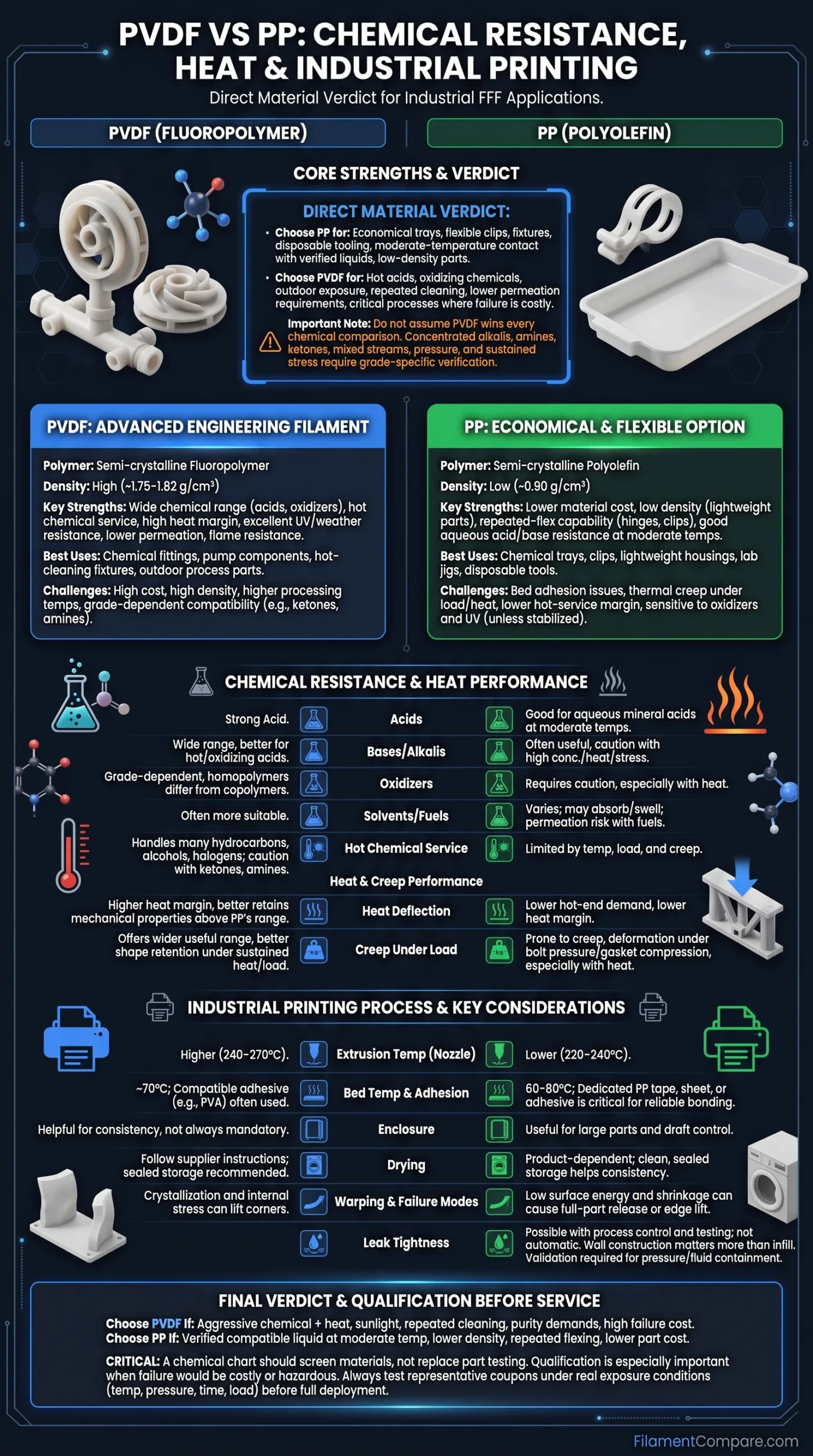
PVDF offers the wider operating window for hot, corrosive, outdoor, and purity-sensitive service, while PP provides lower material cost, lower density, repeated-flex capability, and useful resistance to many chemicals at moderate temperatures. Neither polymer should be selected from a generic resistance label alone. Chemical type, concentration, temperature, contact time, mechanical stress, filament grade, and the porosity of the printed part can change the result.
Direct Material Verdict
Choose PP for economical chemical trays, flexible clips, laboratory fixtures, disposable tooling, and moderate-temperature contact with a verified compatible liquid.
Choose PVDF when the part faces hot acids, oxidizing chemicals, outdoor exposure, repeated chemical cleaning, lower permeation requirements, or a process where failure costs more than the filament.
Do not assume PVDF wins every chemical comparison. Concentrated alkalis, amines, ketones, mixed process streams, pressure, and sustained stress require grade-specific verification.
Lower Material Cost
PP
Better suited to larger parts, replaceable fixtures, and applications where the verified service conditions do not justify a fluoropolymer.
Hot Acid Service
PVDF
Usually offers a wider operating range when corrosive acids and elevated temperature occur together.
Repeated Flexing
PP
Well suited to clips, hinges, snap features, and parts that must bend repeatedly without remaining rigid.
Outdoor Chemical Equipment
PVDF
A stronger starting point when sunlight, weather, cleaning chemicals, and heat act on the same part.
Lower-Density Parts
PP
Produces much lighter parts for the same printed volume, which can matter for covers, trays, floats, and handling tools.
High-Purity Processing
Qualified PVDF Grade
Often selected for wet-process and fluid-handling equipment, but the exact filament composition still needs confirmation.
Lower Hot-End Demand
PP
Typical PP filament profiles use lower nozzle temperatures, although bed adhesion can require more tuning.
Higher Heat Margin
PVDF
Better suited to parts that must retain useful mechanical properties above the comfort range of typical unfilled PP filament.
| Decision Area | PVDF | PP | Material Direction |
|---|---|---|---|
| Polymer family | Fluoropolymer | Polyolefin | Different service roles |
| Typical filament density | High, commonly around 1.75–1.82 g/cm³ depending on grade | Low, commonly around 0.90 g/cm³ | PP for lightweight parts |
| Broad chemical resistance | Very wide, with grade-specific limits for bases, amines, and selected solvents | Wide in many aqueous acids and bases, with more caution around oxidizers and elevated heat | PVDF for harsher mixed demands |
| Hot chemical service | Usually the stronger starting point | More limited by temperature, load, and creep | PVDF |
| Strong alkalis | Grade-dependent; copolymers may differ from homopolymers | Often useful, subject to concentration, heat, and stress | Chemical-specific decision |
| Oxidizing environments | Often more suitable, subject to the exact chemical | Requires more caution, especially with heat and mechanical strain | Usually PVDF |
| Typical nozzle range | About 240–270°C for many formulations | About 220–240°C for the referenced industrial filament | PP for lower hot-end demand |
| Typical bed range | Around 70°C is a useful starting point for many formulations | About 60–80°C for the referenced industrial filament | Filament-specific |
| Build surface | Glass with a compatible PVA adhesive is one documented approach | PP tape, PP sheet, or PP-specific adhesive is commonly needed | Both need surface control |
| Enclosure | Not always required, but a regulated environment can improve consistency | Useful for larger parts and draft control; some products can print without active chamber heat | Part-size dependent |
| Warping pattern | Crystallization and internal stress can lift corners | Low surface energy and shrinkage can cause full-part release or edge lift | Different failure modes |
| Repeated bending | Depends strongly on homopolymer or copolymer selection | Often well suited to living hinges and flexible clips | PP |
| UV and weather exposure | Usually a stronger fit for sustained outdoor service | Use UV-stabilized grades where long exposure is expected | PVDF |
| Creep under heat | Generally offers a wider useful range, depending on grade and load | Needs careful design around bolts, seals, pressure, and sustained loading | PVDF |
| Printed leak tightness | Possible with process control and testing; not automatic | Possible with process control and testing; not automatic | Validation required |
| Typical industrial roles | Hot-chemical fixtures, fittings, pump parts, outdoor housings, purity-sensitive equipment | Chemical trays, clips, lightweight housings, disposable fixtures, moderate-temperature containers | Use-case based |
| Main limitation | High price, high density, higher processing temperature, and grade-dependent compatibility gaps | Bed adhesion, thermal creep, lower hot-service margin, and oxidizer sensitivity | Different trade-offs |
PVDF Industrial Profile
- Polymer type: Semi-crystalline fluoropolymer
- Print difficulty: Advanced engineering filament
- Nozzle range: Commonly 240–270°C, formulation-dependent
- Bed: Often near 70°C with a compatible adhesive system
- Enclosure: Helpful for process consistency; active chamber heat is not always required
- Drying: Follow the filament supplier’s instructions rather than a generic fluoropolymer rule
- Typical behavior: High density, good self-adhesion when tuned, useful heat margin, strong weathering performance
- Best uses: Chemical fittings, pump components, hot-cleaning fixtures, outdoor process parts, low-volume industrial replacements
PP Industrial Profile
- Polymer type: Semi-crystalline polyolefin
- Print difficulty: Moderate to advanced due mainly to build-surface behavior
- Nozzle range: Commonly around 220–240°C for standard industrial PP filament
- Bed: Often 60–80°C with PP tape, PP sheet, or dedicated adhesive
- Enclosure: Useful for large parts, although requirements vary by formulation
- Drying: Product-dependent; clean, sealed storage still helps process consistency
- Typical behavior: Low density, fatigue resistance, chemical resistance, flexibility, and thermal creep under sustained heat
- Best uses: Trays, flexible clips, lightweight housings, laboratory jigs, fluid-contact prototypes, replaceable tooling
PVDF Relative Industrial-Use Indicators
PP Relative Industrial-Use Indicators
Chemical Resistance Changes with Temperature, Stress, and Time
A material can remain visually unchanged while losing stiffness, swelling, absorbing a solvent, allowing permeation, or developing stress cracks around a thread or fastener. For that reason, “chemical resistant” should not be treated as one permanent material property.
The selection should include the exact chemical name, concentration, liquid temperature, contact duration, pressure, and applied load. A room-temperature splash tray and a pressurized fitting carrying the same liquid at 90°C are not equivalent applications.
Arkema’s Kynar chemical chart places general long-term ambient guidance for PVDF homopolymer at up to about pH 12 and for selected Kynar Flex copolymers at up to about pH 13.5. The same document warns that listed temperatures do not account for pressure, vacuum, chemical mixtures, or close dimensional tolerances[a].
Acids and Oxidizing Chemicals
PP can perform well in many aqueous mineral acids, especially at moderate temperature and without high mechanical stress. This makes it useful for acid trays, sampling tools, laboratory supports, and replaceable fixtures. Its low cost can also make planned replacement practical.
The decision moves toward PVDF as acid temperature rises, exposure becomes continuous, or oxidizing action is added. Hot-acid manifolds, plating fixtures, dosing-system components, sensor housings, and cleaning-system parts often need more heat margin than unfilled PP filament can provide.
Oxidizing acids deserve their own compatibility check. A PP rating for a non-oxidizing acid cannot be transferred to nitric acid, concentrated peroxide, liquid halogens, or another oxidizing stream. Mechanical strain can lower the usable limit further.
Bases and High-pH Cleaning
PVDF should not be presented as universally better in alkaline service. Homopolymer and copolymer PVDF grades can have different pH limits, flexibility, crystallinity, and stress response. A flexible copolymer may cover an alkaline condition that is outside the preferred range of another PVDF formulation.
PP is often a sensible candidate for aqueous bases at moderate temperatures. The concern rises when high concentration, elevated heat, bolt load, residual print stress, or a long cleaning cycle is added. In those cases, short-term visual compatibility is not enough.
Solvents, Fuels, Amines, and Mixed Streams
Alcohol resistance does not prove compatibility with ketones, esters, ethers, aromatic solvents, or amines. PVDF handles many hydrocarbons, fuels, alcohols, halogens, and chemical mixtures well, yet its charts also contain chemicals marked with low temperature limits or no recommended long-term rating.
PP’s resistance to an organic liquid depends partly on absorption and permeation. Even when the polymer recovers after the liquid evaporates, dimensional swelling during service can disturb a seal, press fit, sensor position, or calibrated flow path.
HMC Polymers bases its PP guide on immersion testing of unstressed resin specimens and notes that laboratory ratings are indicators rather than exact replicas of field service. The guide describes resistance to many mineral acids and bases but calls out stronger attack from oxidizing agents and several high-temperature chemical conditions[d].
| Environment | PVDF Direction | PP Direction | Verification Point |
|---|---|---|---|
| Dilute mineral acid at room temperature | Usually compatible within grade limits | Often a practical lower-cost candidate | Concentration and contact duration |
| Hot concentrated acid | Often the preferred starting material | Usable range narrows as temperature rises | Grade chart plus hot immersion test |
| Oxidizing acid | Often has the wider range | Requires added caution | Temperature, strain, and concentration |
| Moderate-temperature caustic solution | Grade-dependent | Can be an efficient choice | pH, heat, and sustained load |
| Hot concentrated alkali | Homopolymer and copolymer limits must be separated | Creep and stress cracking require attention | Long exposure under mechanical load |
| Alcohol cleaning | Often suitable | Often suitable | Temperature and repeated cycles |
| Ketone or strong polar solvent | Do not assume blanket compatibility | May absorb, swell, or lose dimensions | Exact solvent and printed coupon test |
| Fuel or hydrocarbon | Often a strong candidate | Compatibility varies with absorption and heat | Permeation, swelling, and seal geometry |
| Amine-containing process liquid | Special caution is needed | Exact formulation must be checked | Manufacturer confirmation |
| Unknown chemical mixture | Single-chemical charts are not enough | Single-chemical charts are not enough | Actual mixed-stream exposure test |
Heat, Creep, and Shape Retention in Service
Melting temperature is not the temperature at which a printed part can safely carry load. A semi-crystalline polymer can have a relatively high melting range while a thin bracket, threaded cap, or gasket seat begins to deform much earlier under constant force.
A referenced Ultrafuse PP profile uses a 220–240°C nozzle, a 60–80°C bed, and a PP-compatible surface. The same product page reports an HDT of 54°C at 0.45 MPa for its printed test material (a product-specific result, not a value for every PP filament)[c].
Arkema’s PVDF resin tables show homopolymer melting ranges commonly around 155–172°C and list heat-deflection ranges that are higher than those reported for the referenced PP filament. These values belong to tested resin families and molded specimens; a printed wall with seams and internal voids cannot inherit the numbers automatically[e].
Creep Around Fasteners and Seals
PP can deform gradually under bolt pressure, gasket compression, internal fluid pressure, or the weight of a supported component. The risk rises with temperature. A joint may pass its first leak test and begin to loosen after days or weeks.
PVDF usually offers more room for sustained heat and load, but it is not dimensionally fixed. Printed threads, sharp internal corners, insert pockets, and thin flange faces can still concentrate stress. Copolymer grades that gain flexibility may not have the same stiffness or HDT behavior as a homopolymer.
Thermal Cycling
Repeated heating and cooling affects the polymer, the layer boundaries, and the connected hardware. A metal insert and a polymer body expand at different rates. This can loosen threads, overload a seal, open a layer seam, or create a crack near a rigid attachment.
Design Responses for Hot Chemical Parts
- Use generous radii instead of sharp internal corners.
- Increase wall thickness around threads, ports, and inserts.
- Limit unsupported flat walls that can bow under pressure.
- Use controlled gasket compression rather than excessive bolt torque.
- Orient layer lines so the main pressure load does not pull the part apart in Z.
- Test after repeated hot-and-cold cycles, not only after the first fill.
Industrial FFF Printing: Different Failure Modes
PP and PVDF can both warp, but they often fail for different reasons. PP is strongly affected by surface compatibility and low surface energy. PVDF needs a hotter extrusion system and control of crystallization, cooling, adhesion, and thermal history.
PP Bed Adhesion and Part Release
PP often bonds most reliably to a PP-based surface. Common PEI, glass, or general-purpose adhesive combinations may provide inconsistent grip. The part can look stable for several layers and then lift as a large section, especially when a long flat edge begins to shrink.
PP tape, a dedicated PP sheet, or a PP-specific adhesive gives the polymer a more compatible surface. A wide brim, uniform bed temperature, low drafts, calibrated first-layer flow, and moderate early-layer speed can help. Large parts may still benefit from being divided into smaller sections and joined afterward.
PVDF Extrusion and Build Environment
Arkema documents nozzle temperatures of about 240–270°C for PVDF formulations and identifies roughly 70°C as a useful build-plate point for adhesion and reduced warping. It also notes that an actively heated chamber is not mandatory for all formulations, although an enclosure or regulated environment can improve repeatability[b].
A high-temperature-capable all-metal hot end is the safer equipment direction. The filament should not remain stationary in an overheated nozzle for long periods. Excessive residence time or temperature can degrade the polymer, so purge routines and the product’s processing limits matter.
PVDF homopolymer, flexible copolymer, carbon-filled, glass-filled, conductive, and blended grades can require different speed, cooling, drive, and nozzle choices. A setting copied from one PVDF spool may not suit another.
Cooling, Layer Bonding, and Internal Stress
Too much cooling can weaken interlayer fusion. Too little cooling can soften fine details, distort bridges, and extend the time before a layer becomes stable. The useful balance also changes with nozzle size, wall count, part mass, room temperature, and whether the grade is a stiff homopolymer or flexible copolymer.
For both materials, a visually smooth print can still contain weak seams. Process qualification should include Z-direction test bars, sealed-wall coupons, and parts printed with the same orientation as the intended component.
Storage, Drying, and Cross-Contamination
Neither material should be given a universal drying schedule. Filament formulations, packaging, pigments, fillers, storage history, and supplier instructions differ. A sealed dry box is still useful because surface moisture and contamination can create bubbles, rough extrusion, voids, or unstable flow.
High-purity parts need more than a low-moisture spool. Residue from an earlier polymer, brass wear, oil from handling, build-plate adhesive, support material, pigment, recycled content, or a filled nozzle can affect the final component. A dedicated material path may be justified for sensitive work.
Leak-Tight Parts, Permeation, and Layer Interfaces
Bulk resin resistance and printed-part resistance are not identical. Injection-molded or machined material is usually denser and more uniform than an FFF wall. Printed parts contain start-stop seams, interlayer boundaries, possible under-extrusion, and internal paths that can carry liquid through the structure.
A part that does not crack may still fail by slow permeation. A fuel, solvent, gas, or concentrated chemical can pass through a polymer or through connected print voids without producing immediate visual damage.
Wall Construction Matters More Than Infill Percentage
For a vessel or manifold, continuous outer walls normally control leakage more directly than a high infill percentage. Increasing perimeters, using a calibrated extrusion width, reducing gaps around line starts, and avoiding thin sections can improve the chance of a sealed structure.
One hundred percent infill does not guarantee a void-free part. Internal lines can touch without fully fusing, and a seam may connect several layers into one leak path.
Threads, Seams, and Fittings
Printed pipe threads concentrate stress at the roots and expose layer boundaries to the fluid. A mechanically retained O-ring, face seal, flange, welded joint, or replaceable insert may offer a more controllable sealing method than relying on tapered printed threads alone.
Seam placement should be kept away from the highest-pressure wall where possible. A seam hidden for appearance can become a straight vertical leakage path.
Visual Inspection
Look for bubbles, whitening, swelling, soft areas, delamination, surface tack, and cracks around threads.
Dimensional Check
Measure mass, wall thickness, port diameter, flatness, and seal-gland dimensions before and after exposure.
Functional Test
Repeat the pressure, vacuum, load, or leak test after chemical exposure and thermal cycling.
Grade Selection, Purity, and Outdoor Exposure
“PVDF” and “PP” identify polymer families, not one fixed set of properties. The grade can change flexibility, impact response, stiffness, chemical range, print shrinkage, flame behavior, electrical behavior, and service temperature.
PP Homopolymer and Copolymer Grades
PP homopolymer is generally associated with higher stiffness, while copolymer and impact-modified grades can offer more ductility. A flexible PP filament designed for hinges should not be assigned the same creep, stiffness, or HDT expectation as a stiffer industrial formulation.
Glass-filled PP can improve stiffness and reduce dimensional movement, but it also changes nozzle wear, surface finish, weld-line behavior, and sometimes chemical exposure at the fiber interface. A carbon-filled grade may be chosen for stiffness or electrical behavior rather than for repeated bending.
PVDF Homopolymer and Copolymer Grades
PVDF homopolymer grades are commonly selected when stiffness, chemical service, and heat performance are the main goals. Copolymers can be softer and more ductile because of lower crystallinity. This can improve impact behavior and printability, but it also changes modulus, HDT, pH range, and dimensional response.
Filled PVDF can reduce warping or raise stiffness. Conductive and ESD grades introduce additives that alter electrical behavior and may affect purity, abrasion, nozzle selection, and chemical qualification.
Outdoor Equipment
PVDF is usually the safer starting point for long-term combinations of sunlight, weather, heat, and chemical exposure. PP can still be used outdoors when the selected grade contains a suitable UV stabilization package and the expected life has been verified.
Color alone is not proof of UV stability. A black filament may contain carbon black, another pigment, or a cosmetic additive package with no declared weathering performance.
Purity and Regulated Contact
A polymer family used in semiconductor, pharmaceutical, food, or laboratory equipment does not make every retail filament suitable for those uses. Pigments, processing aids, fillers, recycled resin, spool handling, printer contamination, layer texture, and cleaning method all affect suitability.
Use a documented grade when purity, biocompatibility, potable-water contact, food contact, or another regulated use is involved. Certification for bulk resin does not automatically transfer to a printed component made on an uncontrolled machine.
Industrial Part Recommendations
| Application | Starting Material | Why It Fits | Required Check |
|---|---|---|---|
| Room-temperature chemical drip tray | PP | Low density, lower cost, and useful resistance to many aqueous chemicals | Exact liquid and cleaning agent |
| Hot-acid sensor housing | PVDF | Wider heat and corrosive-service range | Acid concentration, temperature, and seal design |
| Caustic-cleaning fixture | PP or suitable PVDF copolymer | Selection changes with pH, temperature, and grade | Loaded immersion test |
| Flexible bottle clip | PP | Low density and repeated-flex behavior | Minimum bend radius and chemical splash |
| Outdoor dosing-system cover | PVDF | Better combined fit for UV, weather, and chemical exposure | Mounting stress and thermal cycling |
| Replaceable laboratory jig | PP | Lower cost and easy replacement | Solvent and sterilization compatibility |
| High-purity wet-process fixture | Qualified PVDF | Common industrial fit for aggressive fluids and purity-sensitive equipment | Full filament composition and cleaning method |
| Low-pressure manifold prototype | Depends on chemical and temperature | Either material may work in a controlled trial | Leak, burst, creep, and exposure testing |
| Production pressure vessel | Neither without engineering qualification | FFF seams, creep, and defects need formal validation | Applicable code, safety factor, and destructive testing |
| Hot washdown component | PVDF | Better temperature margin and chemical-cleaning fit | Cleaner concentration and cycle count |
| Large lightweight splash guard | PP | Low mass and economical volume | Warp control and UV exposure |
| Fuel-contact fitting prototype | Usually PVDF | Often offers the more useful resistance and temperature range | Permeation, swelling, and seal compatibility |
Qualification Before Chemical Service
A chemical chart should screen materials, not replace part testing. Qualification is especially important when the printed component can release a hazardous fluid, stop production, contaminate a process, or damage nearby equipment.
1. Print Representative Coupons
Use the intended filament lot, nozzle, layer height, wall count, orientation, temperature, cooling, and build surface. Include a flat specimen, a Z-loaded specimen, and a sealed-wall sample.
2. Record the Starting Condition
Measure mass, dimensions, surface appearance, stiffness, and leak rate. Photograph seams, threads, corners, and gasket areas.
3. Reproduce the Real Exposure
Match the chemical concentration, temperature, contact duration, flow, pressure, cleaning cycle, and mechanical load. Testing a cold liquid does not qualify a hot process.
4. Measure More Than Appearance
Check swelling, mass change, softening, stiffness loss, cracking, color change, surface tack, delamination, permeation, and dimensional movement.
5. Retest the Function
After exposure, repeat the pressure, torque, bending, leak, or load test. A coupon that looks unchanged may have lost useful mechanical performance.
6. Add Time and Safety Margin
A short immersion test does not establish multi-year service life. Extend the test, use elevated but representative conditions where appropriate, and include a replacement or inspection interval.
Where Each Material Fits Better
Choose PVDF When
- The liquid is hot, corrosive, oxidizing, or difficult to contain.
- Outdoor UV and chemical exposure occur together.
- The part must tolerate repeated hot cleaning.
- Lower permeation is more important than low weight.
- Failure would cause costly downtime or contamination.
- A documented high-purity or industrial PVDF grade is available.
- The printer can maintain the supplier’s higher processing range.
PVDF Has More Limits When
- Material price controls the project.
- The part is large and weight-sensitive.
- The printer cannot reliably process engineering temperatures.
- The chemical is an amine, ketone, strong base, or mixture without verified compatibility.
- The application needs repeated flexible hinging rather than stiffness and heat margin.
- The filament’s pigment, filler, or purity package is undocumented.
Choose PP When
- The chemical is verified at moderate temperature.
- The part should be lightweight and economical.
- Repeated bending, snap action, or hinge movement is needed.
- The component is replaceable or intended for limited service.
- A PP-compatible build surface and tuned profile are available.
- The design can accommodate creep and thermal expansion.
- A large-volume part would be costly in PVDF.
PP Has More Limits When
- The part carries sustained load at elevated temperature.
- The liquid is a strong oxidizer or hot aggressive chemical.
- Long-term outdoor exposure is expected without a verified UV-stabilized grade.
- A flange, seal, or threaded joint cannot tolerate gradual deformation.
- The build surface cannot provide reliable PP-to-PP adhesion.
- The part needs a wide hot-cleaning or fire-performance range.
Material Selection Matrix
Best Choice by Priority
Choose PVDF if the job combines chemical aggression with heat, sunlight, repeated cleaning, purity demands, or expensive failure consequences. Its higher filament price can be justified when the process conditions sit outside PP’s comfortable range.
Choose PP if the liquid is verified as compatible at the real service temperature and the design benefits from lower density, repeated flexing, or lower part cost. Account for creep, bed adhesion, oxidizers, and outdoor grade selection.
Choose neither without further engineering work if the component is pressure-rated, safety-related, used with an unknown mixture, or expected to contain a hazardous fluid for long periods. The polymer name does not qualify the FFF process, layer structure, seal, or final part.
Common PVDF and PP Questions
Is PVDF always more chemically resistant than PP?
No. PVDF covers many harsher chemical and temperature combinations, but strong bases, amines, ketones, and certain mixtures can expose grade-specific limits. PP may be the more practical material for a verified moderate-temperature alkali or aqueous chemical.
Which filament is easier to print?
PP needs lower extrusion temperatures, but its bed adhesion can be difficult without a compatible surface. PVDF requires a higher-temperature hot end and tighter process control, yet a suitable adhesive and enclosed environment can produce consistent parts. Difficulty depends on the exact formulation and printer.
Can a printed PP or PVDF part hold liquid?
It can, but leak tightness is not guaranteed by the material. Wall construction, seams, flow calibration, orientation, pressure, chemical permeation, and thermal cycling must be tested on a representative part.
Does PVDF require an actively heated chamber?
Not for every formulation. Published Arkema guidance states that a heated chamber is not mandatory for PVDF, while an enclosure or regulated build environment can improve part-to-part consistency. Follow the filament supplier’s profile.
Is PP suitable for hot water or steam?
Suitability depends on the PP grade, load, duration, pressure, and required dimensional stability. A high melting point does not prevent creep or seal deformation. Steam service needs product-specific engineering data and testing.
Can resin chemical charts be used directly for FFF parts?
They are useful for screening, but not as direct part certification. Resin charts commonly use controlled, unstressed specimens. Printed parts introduce layer boundaries, residual stress, seams, surface roughness, and possible porosity.
Technical Resources Used
- [a] Kynar PVDF Chemical Resistance Chart (Used for PVDF homopolymer and copolymer pH guidance, chemical-specific limits, and the warning that pressure, mixtures, vacuum, and close tolerances alter material selection.)
- [b] PVDF for 3D Printing (Used for documented PVDF nozzle and bed guidance, enclosure notes, build-plate adhesion, formulation differences, and industrial FFF applications.)
- [c] Ultrafuse PP (Used for product-specific PP nozzle, bed, surface, density-related positioning, printed mechanical values, and HDT data.)
- [d] Polypropylene Chemical Resistance Guide (Used for PP immersion-test context, mineral acid and base behavior, oxidizer cautions, water absorption data, and the limits of unstressed laboratory specimens.)
- [e] Kynar PVDF Performance Characteristics and Data (Used for PVDF grade density, melting range, HDT, creep, thermal expansion, weathering, chemical resistance, and the distinction between grades.)
