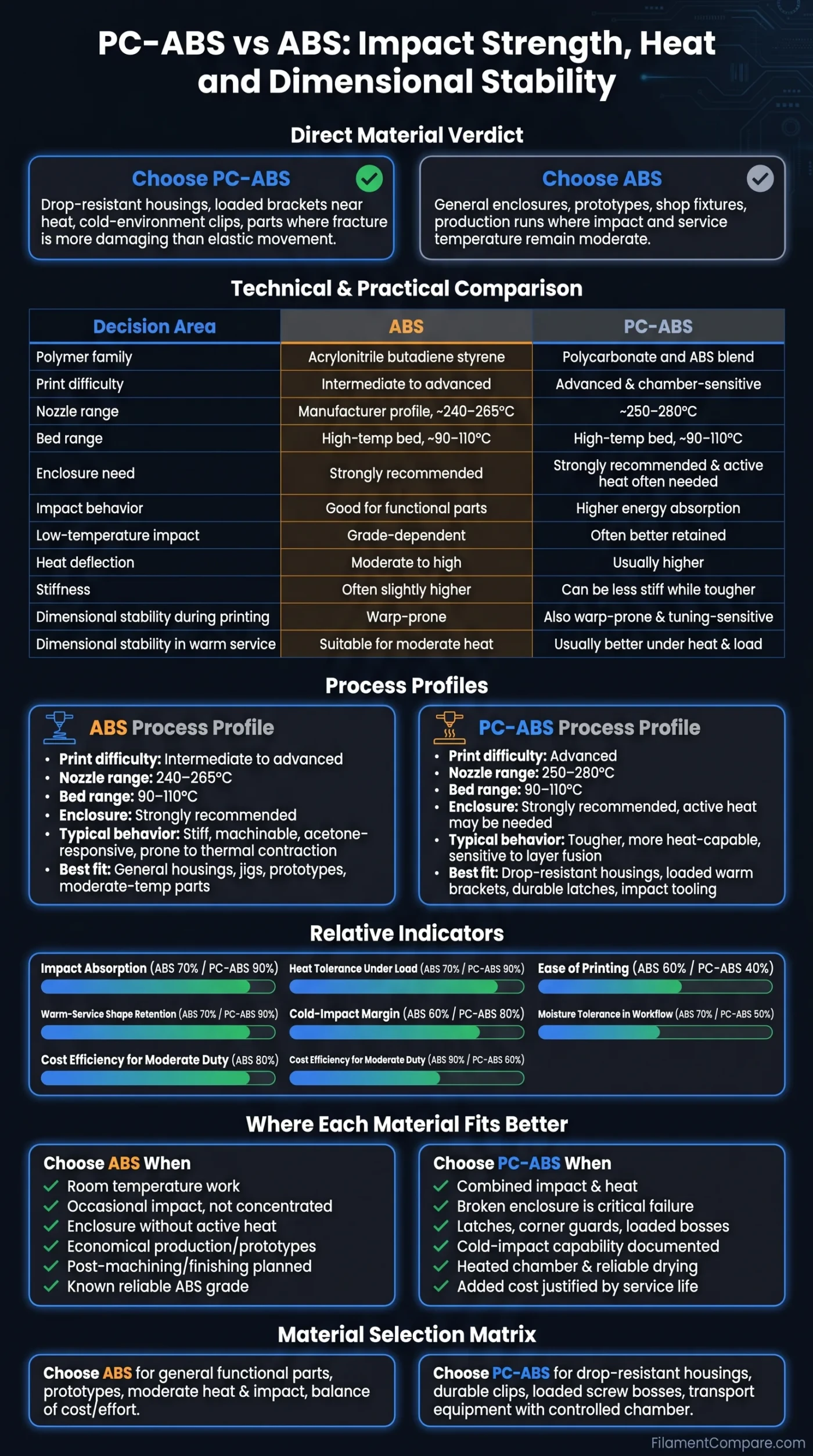
PC-ABS usually provides higher impact tolerance and better shape retention under heat, while standard ABS is easier to source, less demanding to process, and often accurate enough for general functional parts. The blend becomes worthwhile when a printed component must absorb a hit and remain useful in a warm, loaded environment. For room-temperature housings, prototypes, and moderate-duty fixtures, ABS can remain the more efficient engineering choice.
Direct Material Verdict
Choose PC-ABS for drop-resistant housings, loaded brackets near heat, cold-environment clips, and parts where fracture would be more damaging than a small amount of elastic movement. Choose ABS for general enclosures, prototypes, shop fixtures, and production runs where impact and service temperature remain moderate. PC-ABS is not an automatic upgrade: it asks for tighter moisture control, higher extrusion temperature, and better chamber management.
Better for Sudden Impact
PC-ABS
The blend usually absorbs more impact energy before cracking, especially when the print has strong layer bonding.
Better for Warm Loaded Parts
PC-ABS
Its higher heat-deflection performance makes it the stronger candidate for brackets and housings that carry load while warm.
Better for General Functional Prints
ABS
Standard ABS offers a useful balance of stiffness, heat tolerance, machinability, and material cost.
Better for Cold-Impact Risk
PC-ABS
Selected PC-ABS grades retain more impact capability at low temperature than many general-purpose ABS grades.
Lower Processing Demand
ABS
Both materials benefit from an enclosure, but ABS is generally less dependent on a high, even chamber temperature.
Better for Drop-Resistant Enclosures
PC-ABS
Corner impacts, screw bosses, and snap features benefit from the blend’s higher toughness when geometry is well designed.
Better for Tight Budgets
ABS
It is usually more widely available and easier to justify when the added impact and heat margin would not be used.
Better for Heat Plus Impact
PC-ABS
This combined load case is where the blend separates itself most clearly from ordinary ABS.
| Decision Area | ABS | PC-ABS | Practical Meaning |
|---|---|---|---|
| Polymer family | Acrylonitrile butadiene styrene | Polycarbonate and ABS blend | PC-ABS changes the balance of toughness, heat response, flow, and processing demand. |
| Print difficulty | Intermediate to advanced | Advanced and more chamber-sensitive | A weak PC-ABS print can perform below a well-tuned ABS print. |
| Typical nozzle range | Manufacturer profile required; usually below or near PC-ABS settings | Manufacturer profile required; commonly at the upper end of ABS-family processing | The spool maker’s profile takes priority over a generic range. |
| Typical bed range | High-temperature bed usually required | High-temperature bed usually required | First-layer control matters, but chamber temperature governs the rest of a large part. |
| Enclosure need | Strongly recommended | Strongly recommended; active heat may be needed | An enclosure reduces uneven cooling and corner lift. |
| Impact behavior | Good for many functional parts | Usually higher energy absorption | The difference is most useful in dropped, struck, or flexed components. |
| Low-temperature impact | Grade-dependent | Often better retained in impact-focused grades | Useful for cold workshops, transport equipment, and outdoor handling. |
| Heat deflection | Moderate to high, grade-dependent | Usually higher | PC-ABS is more suitable when the part is warm and mechanically loaded. |
| Stiffness | Often slightly higher in comparable unfilled examples | Can be a little less stiff while remaining tougher | A part may resist fracture yet allow more deflection. |
| Dimensional stability during printing | Warp-prone without thermal control | Also warp-prone and often more tuning-sensitive | Material capability does not remove shrinkage or residual stress. |
| Dimensional stability in warm service | Suitable for moderate heat | Usually better under heat and load | Hole position, flatness, and clamp force are more likely to be retained. |
| Moisture management | Drying may be needed | Drying discipline is more important | Moisture can reduce surface quality and layer strength. |
| Surface finish | Smooth, familiar ABS finish | Usually smooth, with formulation-dependent gloss | Both can produce clean housings when cooling is controlled. |
| Outdoor use | Limited without UV stabilization or coating | Also formulation-dependent | Neither should be treated as a direct replacement for ASA in long UV exposure. |
| Typical uses | General housings, fixtures, prototypes, covers | Impact housings, interior vehicle parts, warm fixtures, durable clips | Select by failure mode rather than by material name alone. |
| Main limitation | Lower impact and heat margin than many PC-ABS grades | Higher process demand and often higher cost | The printer must be able to convert the blend’s raw properties into a sound part. |
The ABS and PC-ABS comparisons below combine official printed-part datasheets and manufacturer material guidance; they describe common trends rather than fixed outcomes because formulation, color, moisture, orientation, geometry, and print settings can change the result.
ABS Process Profile
- Polymer type: Amorphous ABS thermoplastic
- Print difficulty: Intermediate to advanced
- Nozzle range: Commonly around 240–265°C, grade-dependent
- Bed range: Commonly around 90–110°C
- Enclosure: Strongly recommended for functional accuracy
- Drying: Useful after open storage or when extrusion becomes inconsistent
- Typical behavior: Stiff, machinable, acetone-responsive, and prone to thermal contraction
- Best fit: General housings, jigs, prototypes, covers, and moderate-temperature parts
One current PolyLite ABS profile lists a 245–265°C nozzle range, a 90–100°C build plate, an enclosed chamber, 70°C drying for six hours, 18.0 kJ/m² notched Charpy impact strength, and HDT values of 98–100°C under the stated ISO loads[a].
PC-ABS Process Profile
- Polymer type: Amorphous PC and ABS blend
- Print difficulty: Advanced
- Nozzle range: Commonly around 250–280°C, formulation-dependent
- Bed range: Commonly around 90–110°C
- Enclosure: Strongly recommended; active chamber heat may be needed for large parts
- Drying: More important before mechanical testing or long prints
- Typical behavior: Tougher, more heat-capable, and more sensitive to incomplete layer fusion
- Best fit: Drop-resistant housings, loaded warm brackets, durable latches, and impact tooling
A current Polymaker PC-ABS profile specifies 250–270°C at the nozzle, 90–105°C on the bed, fan off, and 75°C drying for six hours after moisture exposure; the same grade reports 25.8 kJ/m² XY notched Charpy impact, 13 kJ/m² at −30°C, and HDT values above 106°C under its stated ISO loads[b].
Relative Printing-Use Indicators
These meters are relative indicators for printed-part selection, not laboratory ratings. A different resin blend, pigment, additive package, moisture level, build direction, wall layout, or slicer profile can move either material up or down.
What Polycarbonate Changes Inside ABS
PC-ABS is a polymer blend, not ABS reinforced with fibers or mineral particles. The polycarbonate phase is used to shift the material toward higher toughness and heat capability, while the ABS portion helps preserve processability and the familiar finish associated with ABS-family parts. Blend ratio, compatibilizers, impact modifiers, flow agents, and flame-retardant packages vary, so two spools marked PC-ABS can behave quite differently.
Toughness Is Not the Same as Tensile Strength
A filament can resist a sharp hit without having the highest tensile-strength number. Tensile strength describes response to a steadily applied pulling load, while impact strength describes how much energy a notched or unnotched specimen absorbs during a fast strike. Stiffness is another separate property: a stiff part bends less under load, but that does not guarantee that it will survive a corner impact.
This distinction explains why PC-ABS may be the better enclosure material even when an ABS datasheet lists a similar or higher tensile value. UltiMaker’s Method material listing, for example, shows 43 MPa tensile strength and 84°C heat deflection for its ABS, while its PC-ABS listing shows 37 MPa tensile strength and 108°C heat deflection[c]. Those numbers apply to the stated material system, but they illustrate why “stronger” needs a property name attached to it.
A Tougher Part Can Still Move More
PC-ABS often fails less suddenly. Instead of splitting immediately, it may whiten, bend, dent, or remain connected around a crack. That behavior is useful when containment matters, yet it can be undesirable in a calibration bracket or alignment fixture. A component that survives a drop but leaves a shaft, sensor, or optical mount out of position has not fully met its job.
Property Translation for Real Parts
- Higher impact strength: More resistance to sudden fracture at corners, bosses, and latch roots.
- Higher heat deflection: Better shape retention while a warm part carries a defined load.
- Lower stiffness: More deflection can occur before fracture, depending on the grade.
- Better toughness: More energy may be absorbed through elastic and plastic deformation.
- Good dimensional stability: The part can retain shape in service, but only after it has been printed with low residual stress.
Impact Strength Depends on the Crack Path
Impact failure rarely begins in the middle of a smooth wall. It usually starts where geometry concentrates stress: a sharp internal corner, the edge of a screw boss, a thin latch root, a seam beside a cutout, or a layer boundary that was not fully fused. PC-ABS provides more impact margin, but it cannot remove these local stress raisers.
Notched and Unnotched Results Answer Different Questions
A notched impact test deliberately gives the crack a place to begin. It is relevant to parts with holes, corners, threads, embossed text, or abrupt thickness changes. An unnotched test measures a specimen without that pre-made stress point and often produces a much larger value. Comparing an unnotched PC-ABS number with a notched ABS number would create a false material advantage.
Test method also matters. Izod and Charpy fixtures strike and support the sample differently, while molded and printed specimens do not share the same internal structure. Units must match as well. The safest comparison uses the same standard, specimen geometry, conditioning, orientation, and printer process.
Build Direction Can Reduce the Advantage
Fused-filament parts are anisotropic. A strike that loads continuous roads in the XZ plane can be absorbed differently from a strike that opens the layer stack in the ZX direction. In Stratasys F900 data, PC-ABS shows 241 J/m notched impact in XZ and 34 J/m in ZX, while the same sheet reports HDT values of 107.5°C and 112.0°C at 264 psi for the listed orientations[d]. The gap shows that the printed structure can dominate a material with high bulk toughness.
ABS shows the same orientation problem. Stratasys ABS-M30 data lists 101 J/m notched impact in XZ and 32.2 J/m in ZX, with HDT at 264 psi reported as 99.9°C for the stated test setup[e]. PC-ABS creates more impact headroom in the favorable orientation, but the upright result remains close to the interlayer limit of the process.
Cold Impact Needs Its Own Check
Some ABS-family parts become less tolerant of sudden loading as temperature drops. A latch that works on a desk can crack when opened in an unheated vehicle, cold storage room, or winter workshop. A PC-ABS grade with published low-temperature impact data is easier to assess for this condition than a spool that provides only room-temperature tensile data.
Do not treat a hand drop test as a material standard. Drop height, floor type, part angle, internal mass, wall layout, print orientation, and previous damage all change the outcome. A useful workshop test keeps these variables fixed and compares several specimens, not one successful print.
Heat Resistance Must Include Load and Time
Heat resistance is often reduced to one temperature, yet a printed bracket does not experience temperature alone. It may also hold a motor, clamp a tube, support a panel, carry screw preload, or remain bent by a cable. The correct material question is not “Which one melts later?” but “Which one keeps the required geometry for the required time under the actual load?”
HDT, Glass Transition, and Vicat Are Not Interchangeable
Heat-deflection temperature measures bending under a stated load and test method. Glass-transition temperature marks a change in molecular mobility for an amorphous polymer. Vicat softening measures penetration under a defined force. These values may sit near one another, but they do not describe the same event and should not be mixed into a single “maximum temperature.”
The applied HDT stress changes the published result. A value at 0.45 MPa cannot be compared directly with one at 1.8 MPa without stating the difference. UltiMaker lists 86.6°C HDT at 0.455 MPa for its ABS and also shows a strong orientation effect in tensile stress at break, from 33.9 MPa in XY to 19.0 MPa in Z[f]. Both points matter when a warm part is loaded across layers.
Short Heat Exposure Is Not Continuous Warm Service
A housing may tolerate a short temperature spike and still deform during weeks of service at a lower temperature. This time-dependent movement is creep. It becomes more noticeable around screw bosses, snap fits held in deflection, press fits, cable clamps, and long brackets carrying a constant mass. PC-ABS generally offers more room before this behavior becomes unacceptable, but no unfilled blend is dimensionally inert.
Heat Cycling Can Release Print Stress
A part that looks flat immediately after printing may move during its first warm cycle. Uneven bead cooling leaves residual stress, and reheating allows some of that stress to relax. Long panels can bow, hole spacing can change, and mating surfaces can lose parallelism. PC-ABS may retain shape better during later service, yet its higher processing demand can create more residual stress when the chamber is too cool.
Heat Without Load
Useful for checking whether a cover softens, sags under its own weight, or shows surface distortion.
Heat With Static Load
Relevant to brackets, bosses, clamps, mounts, and any part carrying preload or external weight.
Repeated Heat Cycling
Reveals stress relaxation, accumulated movement, fit changes, and loss of clamp force over time.
Dimensional Stability Starts During the Print
Dimensional stability has two stages. The first is whether the printer can produce the intended geometry without corner lift, layer splitting, or internal stress. The second is whether that geometry remains acceptable after assembly, loading, and temperature exposure. A PC-ABS part can be better in the second stage and worse in the first when printed without enough thermal control.
Shrinkage, Warping, and Warm-Service Movement Are Different
- Shrinkage is the dimensional reduction that occurs as deposited polymer cools.
- Warping is uneven movement caused by nonuniform shrinkage and restraint from the build plate or adjacent layers.
- Residual stress remains locked into the part after cooling and may relax later.
- Thermal expansion changes dimensions reversibly as temperature changes.
- Creep is time-dependent deformation under a sustained load, often accelerated by heat.
A Good ABS Print Can Outperform a Weak PC-ABS Print
Material selection cannot repair incomplete fusion. If PC-ABS is extruded too cold, fed while wet, or allowed to cool sharply between layers, the part may split through the layer stack before the blend’s impact capability is engaged. A well-conditioned ABS print made in a stable chamber can therefore be more dependable than a PC-ABS print produced outside its process window.
The Most Tolerance-Sensitive Features
Holes, Seats, and Inserts
- Horizontal holes can print undersized or uneven.
- Bearing seats can become oval after stress release.
- Heat-set inserts can move nearby walls if the boss is too thin.
- Screw preload can relax during warm service.
Panels, Latches, and Mating Faces
- Long panels can bow even when corner lift is small.
- Snap-fit roots can retain impact damage as permanent set.
- Cover gaps can change after thermal cycling.
- Wide mating faces can lose flatness when wall thickness varies.
Where tolerances are tight, leave machining allowance for bores and bearing seats, use metal inserts only in bosses designed for the insertion heat, and place critical dimensions away from large thickness transitions. Printed accuracy and in-service stability should be measured separately (a caliper check at room temperature does not replace a warm loaded test).
Geometry and Printer Control Decide the Real Winner
Sharp Corners Waste Impact Capability
An internal radius spreads stress over a wider area. This matters at the base of a clip, around the inside of a rectangular opening, where a boss meets a wall, and where a rib ends. PC-ABS can slow crack growth, but a very sharp corner may still start a crack before the surrounding material has a chance to absorb much energy.
Walls Often Matter More Than Infill
Impacts enter through the outer shell. More well-fused perimeters usually help a housing more than raising infill alone, especially around corners and screw features. Very thick solid regions can create their own problem by cooling unevenly. A balanced wall-and-rib design can be tougher and more dimensionally stable than a heavy block with abrupt section changes.
Passive Enclosure and Heated Chamber Are Not the Same
A passive enclosure traps some heat and blocks drafts. An actively heated chamber controls the air around the part and can keep tall layers closer to a stable temperature. Large PC-ABS parts benefit more from that control because each new layer must bond to material that has not cooled too far below its useful fusion window. Chamber temperature should remain within the printer manufacturer’s limits; enclosing electronics and motors without thermal planning can create a separate reliability issue.
Moisture Can Look Like a Material Defect
Moisture may produce popping, foamy extrusion, fine surface pits, stringing, and variable line width. The mechanical effect can be less visible: small voids and irregular bead contact reduce the area available for layer bonding. When a wet PC-ABS specimen fails early in Z, the result may say more about filament condition than about the polymer blend.
Failure-First Design Checks
- Orient the part so the expected impact does not peel layers apart.
- Add radii at latch roots and boss-to-wall transitions.
- Use several perimeters around holes and loaded edges.
- Keep wall thickness changes gradual where possible.
- Test warm parts while loaded, not only after cooling.
- Dry the spool when extrusion or mechanical repeatability changes.
- Measure hole spacing, flatness, and latch force after thermal cycling.
Material Choice by Part Failure Mode
| Use Case or Failure Risk | More Suitable Starting Point | Reason |
|---|---|---|
| Handheld enclosure dropped onto a hard floor | PC-ABS | Higher impact absorption provides more margin at corners, bosses, and cover clips. |
| Indoor electronics cover with little impact exposure | ABS | The extra processing demand of PC-ABS may not produce a useful service benefit. |
| Bracket supporting weight near a warm motor | PC-ABS | Heat and sustained load make shape retention more important than room-temperature stiffness alone. |
| Short-life assembly or fit prototype | ABS | Lower cost and easier process tuning usually matter more than maximum impact margin. |
| Clip opened in an unheated workshop | PC-ABS | A grade with low-temperature impact data is a better starting point for cold handling. |
| Large flat machine cover | Depends on chamber control | PC-ABS may perform better in service, but ABS may print flatter on a less capable machine. |
| Screw boss exposed to repeated assembly | PC-ABS | Higher toughness can reduce sudden radial cracking when boss geometry and torque are controlled. |
| Precision gauge kept at room temperature | ABS or another stiffer material | Impact toughness may be less important than stiffness, calibration, and controlled post-machining. |
| Vehicle interior trim away from extreme hot zones | PC-ABS | The combination of impact tolerance and higher warm-service capability suits clips and interior housings. |
| Long-term exterior UV exposure | Neither by default | ASA or a verified UV-stabilized grade is usually a better starting point. |
| Workshop jig that may be struck or dropped | PC-ABS | The blend is useful when damage comes from impact rather than steady loading alone. |
| High-volume moderate-duty covers | ABS | Material price, availability, cycle time, and process repeatability can outweigh unused PC-ABS capability. |
Where Each Material Fits Better
Choose ABS When
- The part works mainly at room temperature.
- Impact is occasional and not concentrated at thin features.
- The printer has an enclosure but limited active chamber heat.
- Many prototypes or production pieces must be made economically.
- Post-machining, sanding, bonding, or acetone finishing is planned.
- The design has already performed reliably in a known ABS grade.
ABS Is Less Suitable When
- A drop or strike can break a safety-related housing or mount.
- The part stays loaded near the upper end of the grade’s heat range.
- Cold handling increases brittle-fracture risk.
- Thin snap fits and bosses must survive repeated mechanical abuse.
- Warm-service movement would disrupt alignment or sealing.
Choose PC-ABS When
- Impact and heat occur in the same duty cycle.
- A broken enclosure would expose or release internal components.
- The part contains latches, corner guards, or loaded screw bosses.
- Cold-impact capability is documented for the selected grade.
- A heated chamber and reliable drying workflow are available.
- The added material and tuning cost is justified by service life.
PC-ABS Is Less Suitable When
- The printer cannot maintain stable enclosure or chamber conditions.
- The spool cannot be dried and kept dry during long prints.
- The job is a low-load visual prototype with no warm-service demand.
- Very large flat geometry must be printed on an open machine.
- Higher stiffness is more useful than higher impact absorption.
- The application requires verified outdoor UV durability, flame rating, or chemical resistance not stated for the grade.
Material Selection Matrix
Best Choice by Priority
Choose ABS when the required part is a general functional housing, jig, prototype, or cover that sees moderate heat and manageable impact. It usually offers the better balance of material cost, availability, stiffness, and process effort.
Choose PC-ABS when the same component must survive both mechanical shock and warm loaded service. The added capability is most useful in drop-resistant housings, durable clips, screw-boss structures, transport equipment, and interior vehicle components printed on a machine with controlled chamber conditions.
Redesign before changing material when failure starts at sharp corners, thin boss walls, layer-peel orientation, abrupt thickness changes, or unsupported long panels. Neither polymer can compensate for a crack path built into the geometry.
There is no general winner. PC-ABS is the more specialized choice for combined impact and heat, while ABS remains the efficient choice when those extra margins are not part of the duty cycle.
Common PC-ABS and ABS Questions
Is PC-ABS always stronger than ABS?
No. PC-ABS is usually tougher and more heat-capable, but an ABS grade can have similar or higher stiffness, tensile strength, or elongation in a particular test. The print direction and process quality can reverse a simple datasheet ranking.
Does PC-ABS warp less because it is dimensionally stable?
Not necessarily. Dimensional stability in service and warping during printing are separate issues. PC-ABS may retain shape better while warm, yet it can be more demanding to print because high processing temperatures and uneven cooling create residual stress.
Can PC-ABS be printed in a passive enclosure?
Small parts may print successfully, depending on the grade and printer. Large, tall, or tolerance-sensitive parts are more likely to need stable active chamber heat. The filament and printer manufacturers’ limits should control the setup.
Is PC-ABS better for snap-fit parts?
Often, especially when the snap may be hit, opened in cold conditions, or used near warmth. The latch still needs a generous root radius, suitable strain level, strong layer orientation, and enough time to recover between cycles.
Which material holds tight tolerances better?
During printing, the answer depends heavily on chamber quality, geometry, and calibration. During warm loaded service, PC-ABS usually has the advantage. A stable ABS process can still produce a more accurate first article than poorly controlled PC-ABS.
Can either material be used outdoors?
Short or sheltered outdoor use may be possible with a suitable grade, coating, and design. Long UV exposure should not be assumed from the base polymer name. ASA or a documented UV-stabilized formulation is usually easier to justify.
Technical References
- [a] PolyLite™ ABS | Polymaker Wiki (Used for the cited ABS processing profile, drying setting, notched Charpy result, and ISO heat-deflection data.)
- [b] Polymaker PC-ABS – Polymaker (Used for the cited print settings, drying guidance, notched impact data, low-temperature impact result, and HDT values for one commercial PC-ABS formulation.)
- [c] Method Series PC-ABS – UltiMaker (Used for the cited same-platform ABS and PC-ABS tensile-strength and heat-deflection comparison.)
- [d] PC-ABS Data Sheet (Used for printed PC-ABS impact, heat-deflection, orientation, and anisotropy data from the stated Stratasys process.)
- [e] ABS-M30 Data Sheet (Used for printed ABS-M30 impact, HDT, and build-direction values from the listed Stratasys setup.)
- [f] ABS 3D Printing Material – UltiMaker (Used for the cited HDT load condition and tensile stress at break by print orientation.)
