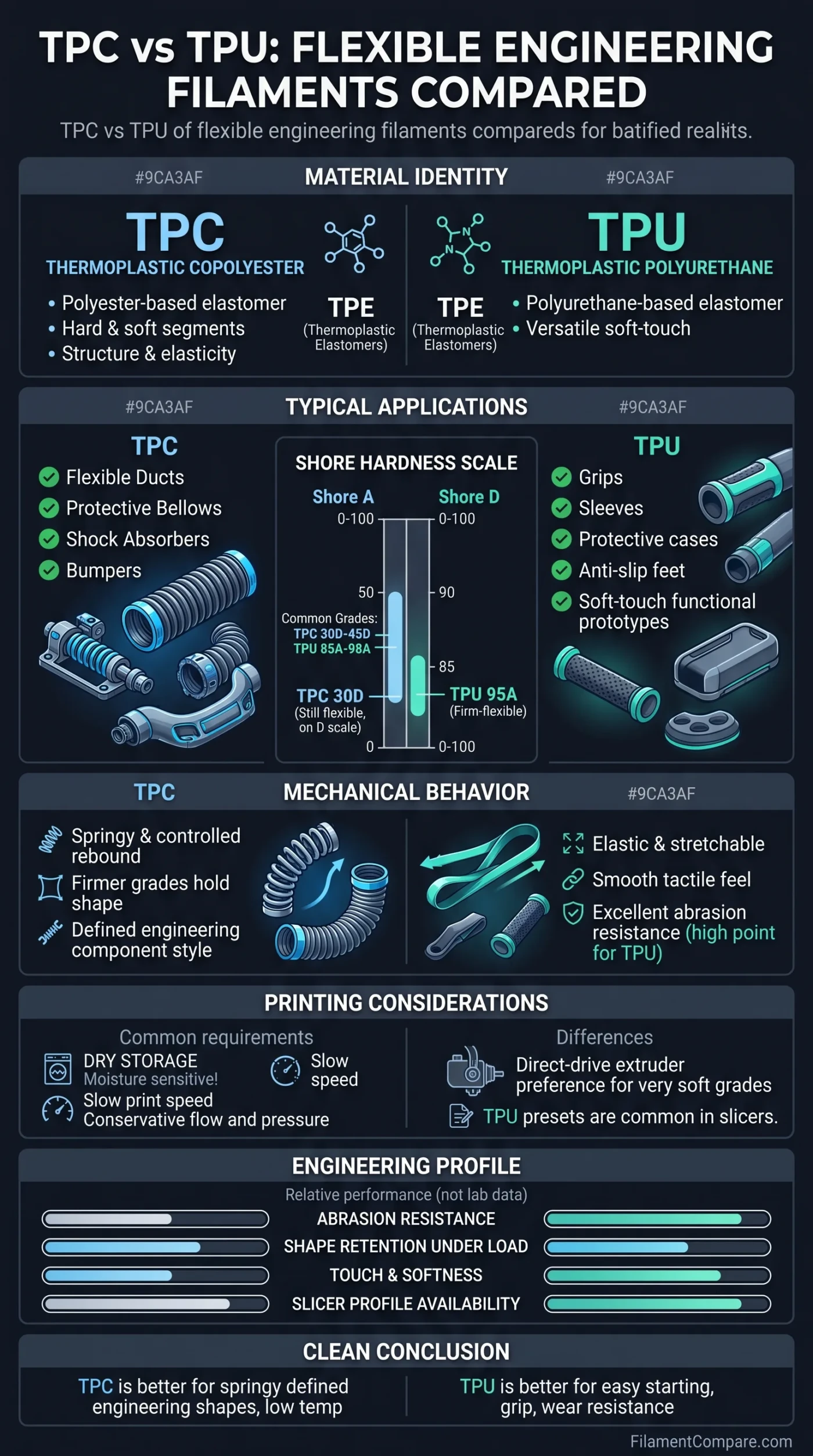
| Comparison Area | TPC Flexible Filament | TPU Flexible Filament | Practical Reading |
|---|---|---|---|
| Full material name | Thermoplastic copolyester, also called TPE-C or TPC-ET in many polymer references. | Thermoplastic polyurethane, usually shortened to TPU in FFF/FDM filament listings. | Both are thermoplastic elastomers, yet they come from different polymer families. |
| Typical flexible filament hardness | Common printed grades may sit around Shore 30D to 45D; FormFutura lists FlexiFil TPC 30D at Shore D 30.[a] | Many print-friendly grades are sold around 85A to 98A, while harder TPU grades may also be listed on the Shore D scale. | Shore A and Shore D are not cleanly interchangeable. A 95A TPU and a 45D TPC can both feel “flexible,” but not in the same way. |
| Stretch and rebound | Often springy and resilient, especially in parts that flex repeatedly. Some TPC data sheets list elongation above 400%. | Usually elastic, soft-touch, and well suited to bendy parts. BASF’s Ultrafuse TPU 95A lists 661% elongation at break in XY test specimens.[b] | TPU is usually easier to recognize as “rubber-like.” TPC can feel more like a flexible engineering plastic. |
| Tensile and layer-direction behavior | Can show strong layer adhesion in certain grades, with useful toughness for boots, covers, and protective parts. | Printed orientation matters. Ultimaker’s TPU 95A data shows high XY and YZ elongation, with lower Z-up elongation in the tested samples.[c] | For both materials, a data sheet value from one print orientation should not be read as a universal part value. |
| Abrasion and wear | Good impact absorption and flex-fatigue behavior are common reasons to use TPC in moving or shock-loaded parts. | Abrasion resistance is one of TPU’s main strengths, especially in grips, sleeves, protective cases, and contact surfaces. | TPU often suits rubbing contact. TPC often suits springy, impact-absorbing shapes where the grade also supports the environment. |
| Heat behavior | Grade dependent. TPC 30D data can show HDT around 50°C, while some harder TPC 45D product data lists higher heat deflection values. | Grade dependent as well. TPU data sheets may list useful melting, Vicat, and service-temperature notes rather than one universal heat limit. | Do not treat “TPC” or “TPU” as a single heat rating. The grade and test method matter. |
| Chemical, moisture, and UV notes | Several TPC filament grades emphasize chemical resistance, UV resistance, and low moisture absorption. | TPU grades often emphasize resistance to oils, industrial chemicals, wear, and impact. | Environmental fit is formulation-specific. Read the actual spool data sheet, not only the material name. |
| Density examples | FlexiFil TPC 30D is listed at 1.15 g/cm³. | Ultrafuse TPU 95A filament density is listed at 1149 kg/m³, very close to 1.15 g/cm³. | Weight differences between these two flexible families are usually small compared with infill, wall count, and part size. |
| Printing window | Typical nozzle ranges often sit around the low-to-mid 200°C range. A TPC 45D product sheet from RS PRO lists 220°C to 260°C and Shore D 45.[h] | TPU 95A grades commonly print around 210°C to 240°C, with slow-to-moderate print speeds depending on the extruder path. | Both materials reward dry storage, a controlled filament path, and conservative speed. Very soft grades need more care than firmer ones. |
| Common part types | Flexible ducts, boots, bumpers, seals, shock absorbers, weather-facing covers, and springy protective parts. | Grips, phone-style cases, protective sleeves, flexible hinges, anti-slip pads, wear surfaces, and soft-touch functional prototypes. | The difference is less “which one is better” and more “which elastic behavior matches the part.” |
This TPC vs TPU comparison uses published datasheets from TPC and TPU filament suppliers plus recognized standards sources; the numbers show grade-level trends, while real printed results can change with drying, toolpath, print orientation, wall thickness, and machine setup.
TPC and TPU are both used when a printed part needs flexibility without losing shape, but they do not behave like two names for the same material. TPC is a polyester-based elastomer with a more engineering-plastic feel in many grades. TPU is a polyurethane-based elastomer that many printers know for soft-touch parts, stretch, and wear resistance. Same category. Different personality.
For 3D printing, the useful comparison is not only “which one bends more?” A better reading looks at Shore hardness, elongation, tear behavior, abrasion, layer direction, heat response, moisture behavior, and how the filament moves through the extruder. Flexible filament is honest: the printed part reveals every choice in geometry and processing.
- TPC: thermoplastic copolyester
- TPU: thermoplastic polyurethane
- Both: flexible TPE family
- Main tests: Shore, tensile, HDT
- Process: FFF/FDM printing
What TPC Means in Flexible Filament
TPC stands for thermoplastic copolyester. In polymer language it is often grouped as TPE-C or TPC-ET, meaning a copolyester elastomer with hard and soft segments. The hard segments help the material keep structure. The soft segments let it bend, compress, and recover.
In 3D printing, TPC is less common than TPU on hobby shelves, but it has a clear place in flexible engineering filament. It is often chosen for parts that need elastic movement, impact absorption, chemical exposure tolerance, or low-temperature flexibility. Celanese’s TPC-ET technical manual describes a broad Shore D range and notes that harder TPC-ET grades tend to gain heat and chemical resistance, while softer grades keep low-temperature mechanical behavior.[g]
That grade spread matters. A soft TPC 30D filament and a firmer TPC 45D filament can feel very different even though both sit under the same TPC label. One may suit an insole-like part; another may suit a duct, boot, bumper, or flexing cover.
What TPU Means in Flexible Filament
TPU stands for thermoplastic polyurethane. In filament form, it is probably the most familiar flexible material for desktop and professional FFF printers. It can stretch, compress, absorb impact, and return to shape while still melting and solidifying like a thermoplastic.
TPU’s appeal comes from a balanced mix of elasticity, abrasion resistance, impact behavior, and print availability. A 95A TPU is firm enough to feed through many printers more reliably than very soft elastomers, yet it still produces parts that flex in the hand. Softer TPU grades can feel more rubber-like, but they ask more from the extruder path.
There is one naming trap. A filament sold as “TPU 95A” may not test at exactly 95A in every data sheet, because hardness readings depend on the standard, dwell time, specimen, and measurement conditions. The product name is a grade label, not a universal law.
Shore Hardness: The Number That Needs Context
Shore hardness is a durometer reading. It measures indentation, not “strength” by itself. ASTM D2240 describes durometer hardness as an empirical test based on the penetration of an indenter under defined conditions, and it also notes that there is no simple relationship between measurements from different durometer types.[d]
Why Shore A and Shore D Can Mislead
Soft elastomers usually use Shore A. Harder elastomers and softer plastics often use Shore D. The scales overlap in daily conversation, but they should not be treated as a clean conversion chart.
- TPU 95A often feels firm-flexible, not floppy.
- TPC 30D can still feel flexible even though it uses the D scale.
- A higher number does not always mean a more durable printed part.
- Part geometry can overpower the material feel: thin walls bend, thick walls resist.
For a real part, hardness is only one piece. A 2 mm wall in TPU may flex more than a 5 mm wall in TPC, even when the datasheet makes TPC look “more flexible” on paper. Geometry speaks loudly.
Mechanical Behavior: Stretch, Tear, Rebound, and Direction
TPC and TPU both stretch far beyond rigid filaments like PLA, PETG, or ABS. The more useful question is what kind of stretch the part needs. Does it need to elongate once? Bend thousands of times? Rub against another surface? Seal around a joint? Snap back after compression?
TPC Mechanical Feel
TPC often feels springy and controlled. It can work well where the part behaves like a flexible engineering component rather than a soft pad. In published filament data, TPC examples can show high elongation, no-break impact behavior, and useful tensile modulus values. This is why TPC appears in part categories such as boots, ducts, bumpers, seals, and protective covers.
A firmer TPC grade can keep its shape better under load than a very soft elastomer. That does not make it universally stronger; it means its stiffness and rebound may fit parts that need a defined shape during movement.
TPU Mechanical Feel
TPU is often the smoother choice for tactile flexible parts: grips, sleeves, soft hinges, gaskets, and wear surfaces. Its abrasion resistance is a major reason it is used for contact areas. In many FFF setups, firm TPU grades also feed more predictably than softer TPE-style filaments.
TPU can stretch a lot, but printed orientation matters. Flat, side, and upright specimens can show very different break behavior because FFF parts are layered. A tall upright specimen asks the layer bonds to do more work. That is not a flaw. It is the process.
Useful reading: ASTM D638 tensile data is made to compare tensile behavior under defined testing conditions, but ASTM also notes that tensile properties vary with specimen preparation, test speed, and environment.[e] For flexible prints, that warning is not a footnote detail; it shapes the part.
Heat, Softening, and Environmental Exposure
Heat resistance is one of the areas where short comparisons often become too simple. Some TPC grades show higher heat capability than some TPU grades, but the material name alone does not prove it. A soft TPC grade and a firmer TPC grade can have very different HDT values. TPU grades also vary by chemistry, hardness, additives, and test method.
HDT, or heat deflection temperature, is not the same as melting point. ASTM D648 describes it as the temperature where a specimen reaches a defined deformation under load, and the standard warns against using that test alone to predict long-term elevated-temperature behavior outside similar loading conditions.[f]
This is why a part near a warm motor, a sunlit enclosure, or a moving joint should be read through the exact grade’s data sheet. A TPC 45D with a higher HDT is not the same material experience as a soft TPC 30D. A TPU 95A with a published service note is not the same as a harder TPU 64D. The label gets you close. The grade decides the rest.
Moisture and Dry Storage
Flexible filaments benefit from dry handling. TPU and TPC can absorb moisture, and wet filament often prints with bubbles, surface texture changes, stringing, or weaker-looking walls. TPC grades may be described as low moisture absorption in some data sheets, while TPU suppliers often still recommend drying before mechanical parts. Keep it dry. Simple rule, real payoff.
UV, Oils, and Chemicals
Environmental resistance should be tied to the actual formulation. Some TPC filaments state good UV resistance and chemical resistance. TPU data sheets often highlight resistance to oils, common industrial chemicals, impact, and wear. For outdoor or chemical-exposed parts, the safest reading is grade first, family second.
Print Behavior in FFF and FDM Machines
Flexible filament printing is less about raw nozzle temperature and more about filament control. A stiff PLA strand can be pushed through a long path with little complaint. A soft elastomer can compress, buckle, curl, or drag if the feed path leaves room for it. That is why extruder design, retraction, speed, and spool drag matter so much.
- Direct-drive extruder
- Usually gives better control over soft filament because the distance between drive gear and hot end is short.
- Bowden extruder
- Can work with firmer TPU grades, yet very soft materials are less forgiving because the filament must travel through a longer tube.
- Print speed
- Flexible materials often prefer slower speeds than rigid filaments; firmer TPU grades and some TPC grades can print faster than softer elastomers.
- Flow and pressure
- Elastic filament can store pressure in the path, so over-aggressive retraction may create inconsistent extrusion.
TPU has the advantage of availability. Many slicers and printer profiles already include TPU presets, especially for 95A-type grades. TPC may require more manual tuning because fewer printers ship with TPC-specific profiles. This is not a quality issue; it is a profile and market issue.
Processing Data Table for Common Published Grades
| Published Grade Example | Material Family | Hardness | Elongation or Strain Data | Thermal / Print Notes |
|---|---|---|---|---|
| FormFutura FlexiFil TPC 30D | TPC | Shore D 30 | Elongation at break above 400% | HDT listed at 50°C under the stated ASTM D648 condition |
| RS PRO FLEX45 | TPC | Shore D 45 | Strain at break listed at 530% | Printing temperature listed at 220°C–260°C; melting point listed at 180°C |
| BASF Ultrafuse TPU 95A | TPU | Shore A 92 and Shore D 45 in the listed ISO 7619-1 readings | XY elongation at break listed at 661%; ZX upright listed at 192% | Nozzle range listed at 210°C–230°C; drying listed at 70°C for at least 5 hours |
| Ultimaker TPU 95A | TPU | Shore A 96 and Shore D 48 | XY elongation above 560%; YZ above 700%; Z-up 82.3% ± 18.4% | Data sheet notes orientation effects in printed parts |
Relative Engineering Profile
The bars below are not lab results. They are a relative reading of common published grade behavior and day-to-day print use, meant to show where each material family often feels strongest in FFF parts.
Abrasion and Wear Surface Use
Shape-Holding Flex in Firmer Grades
Profile Availability on Desktop Printers
Grade-Specific Outdoor and Chemical Fit
Where TPC Usually Fits Better
TPC often fits parts that need a flexible but defined engineering feel. It is useful when a part should bend, absorb impact, and return to shape without feeling as soft as many TPU prints. This can make TPC attractive for parts that need spring, toughness, and environmental tolerance in the same design.
- Flexible ducts and air-flow parts that must hold a formed shape.
- Protective boots, bellows, covers, and bumpers.
- Seals and gaskets where the exact grade supports the fluid or environment.
- Low-temperature flex parts, depending on the data sheet.
- Shock-absorbing parts that need rebound rather than a soft skin feel.
TPC also deserves attention when the part will see outdoor exposure or chemical contact, but only when the selected grade states those properties. The family name is a starting point, not a certificate.
Where TPU Usually Fits Better
TPU often fits parts where touch, grip, abrasion, and easy sourcing matter. It is the flexible filament many users try first because it is widely available, and 95A-type grades are firm enough to print on more machines than very soft elastomers.
- Protective sleeves, cases, and bumper-style shells.
- Grips, handles, pads, anti-slip feet, and contact surfaces.
- Flexible hinges and parts that bend repeatedly within a controlled range.
- Wear-facing parts where abrasion resistance is part of the design need.
- Functional prototypes that need a rubber-like feel without custom molding.
TPU is also easier to research before buying because there are more brands, more hardness levels, and more shared print profiles. A firmer TPU may be less dramatic in stretch than a very soft elastomer, but it can be much easier to turn into a clean functional print.
Part-Type Comparison Table
| Part Type | TPC Reading | TPU Reading | Material Detail That Matters |
|---|---|---|---|
| Gaskets and seals | Useful when chemical exposure or shape retention is a major part of the design. | Useful when soft compression, grip, and easy printing are more important. | Check compression set, hardness, and the specific chemical environment. |
| Protective cases | Good for firmer protective shells and bumpers that need spring. | Good for soft-touch cases, sleeves, and impact-friendly covers. | Wall thickness changes the feel as much as the material family. |
| Flexible ducts and boots | Often a strong match, especially for parts that need a defined folded shape. | Works well for softer ducting or flexible protective sleeves. | Heat exposure and layer direction should be checked before final use. |
| Wear pads and contact strips | Can work when the grade supports abrasion and impact needs. | Often a strong match due to TPU’s common wear and tear profile. | Surface texture, infill, and print direction affect rubbing behavior. |
| Soft grips | Works when the grip should feel firmer and more springy. | Often fits hand-contact parts because of soft touch and friction. | Shore hardness and wall thickness decide the hand feel. |
| Outdoor covers | Can be a good match when the TPC grade states UV and weather-facing properties. | Can work when the TPU grade supports the exposure profile. | Outdoor use should be tied to the actual data sheet, not the broad material name. |
Terms That Shape the Comparison
Elongation at Break
This is the strain level where the test specimen breaks. A higher number usually means more stretch, but it does not automatically mean a better working part. A thin strap, a thick bumper, and a vertical printed wall all load the material differently.
Tensile Modulus
Modulus describes stiffness in tension. A higher modulus usually means a firmer part. TPC 45D examples can show a more shape-holding feel than softer elastomers, while TPU grades vary widely across Shore values.
Compression Set
Compression set describes how much a material stays deformed after being compressed for a defined time and temperature. For seals, feet, gaskets, and dampers, this can matter more than headline elongation.
Glass Transition and Melting Temperature
Glass transition relates to changes in polymer mobility; melting temperature relates to crystalline melting behavior. Flexible engineering filaments can remain bendable far below room temperature, yet still soften under load well below their melt point.
Common Misreadings in TPC vs TPU Comparisons
- “TPC is always more heat resistant.” Some grades are; some soft TPC filaments list modest HDT values. Grade comes first.
- “TPU 95A always measures exactly 95A.” Published readings can differ by brand, specimen, and standard condition.
- “More elongation always means a better flexible part.” A seal, hinge, bumper, and wear pad do not use stretch in the same way.
- “Flexible filament data transfers cleanly across print directions.” FFF layer direction changes tensile, tear, and elongation behavior.
- “Drying is only for nylon.” Flexible filaments also benefit from dry storage and dry printing when surface quality and mechanical behavior matter.
Part Behavior Decides the Better Fit
For many printed parts, TPU is the easier starting material because it is common, well documented, and available in many hardness grades. It suits soft-touch parts, wear surfaces, grips, cases, and general flexible prototypes.
TPC becomes more interesting when the part needs a firmer springy feel, grade-specific chemical or UV resistance, low-temperature flex, or a more engineering-plastic style of elasticity. It is less common on desktop shelves, but the right TPC grade can make sense for boots, ducts, covers, bumpers, and parts that must flex while keeping a more defined shape.
The cleanest choice comes from matching the part to the datasheet: Shore scale, elongation, compression behavior, heat deflection, print direction, storage notes, and the real environment around the part. TPC and TPU can both make excellent flexible prints. They simply answer different mechanical questions.
Resources Used
- [a] FormFutura FlexiFil TPC 30D Technical Data Sheet
- [b] BASF Forward AM Ultrafuse TPU 95A Technical Data Sheet
- [c] Ultimaker TPU 95A Technical Data Sheet
- [d] ASTM D2240 Standard Test Method for Rubber Property—Durometer Hardness
- [e] ASTM D638 Standard Test Method for Tensile Properties of Plastics
- [f] ASTM D648 Standard Test Method for Deflection Temperature of Plastics Under Flexural Load
- [g] Celanese Riteflex TPC-ET Technical Manual
- [h] RS PRO FLEX45 Technical Document
