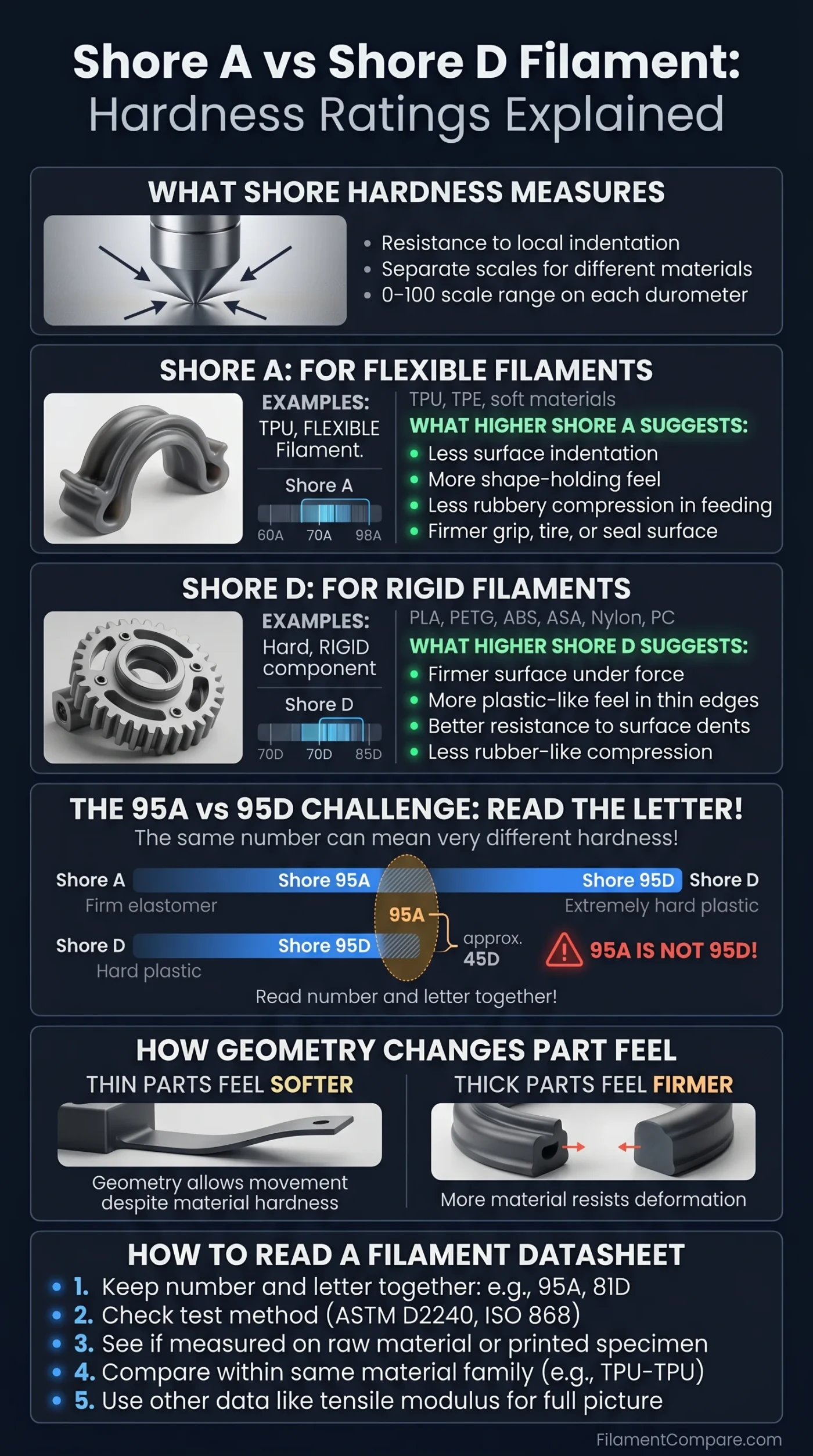
Shore A and Shore D are two hardness scales used to describe how much a material resists local indentation. In filament terms, Shore A appears most often on flexible materials such as TPU and TPE, while Shore D is common on rigid plastics such as PLA, PETG, ABS, ASA, nylon, and PC. Very firm TPU can also sit on the Shore D scale, with 68D TPU now providing a useful 3D-printing example. The number matters, but the letter matters just as much.
| Comparison Point | Shore A | Shore D |
|---|---|---|
| Main filament use | Flexible and semi-flexible filament families such as TPU, TPE, soft copolyesters, and rubber-like materials. | Rigid and semi-rigid plastics such as PLA, PETG, ABS, ASA, nylon, and PC, plus very firm elastomers such as 68D TPU. |
| Scale style | 0–100 on the A scale. A higher number means the indenter enters the material less. | 0–100 on the D scale. A higher number also means less indentation, but the durometer is different. |
| Typical feel in printing | More elastic, grippy, bendable, and compressible as the number moves downward. | Usually firmer and more shape-holding. A Shore D material can still flex when its polymer chemistry is elastomeric. |
| Common example range | Flexible filaments often appear around 60A–98A, depending on formulation and brand. | Rigid filaments often appear around 70D–85D, while firm TPU grades can also use Shore D values such as 68D. |
| Overlap zone | High Shore A values can overlap with lower Shore D readings. | Lower Shore D readings can describe materials that retain more flex than ordinary hard plastics. |
| Best use of the value | Comparing flexible filament grades with similar chemistry. | Comparing harder materials or very firm elastomers under similar test conditions. |
| Main reading mistake | Thinking 95A is nearly the same as 95D. | Assuming a Shore D label automatically means the material is a rigid plastic. |
This Shore A and Shore D comparison uses filament datasheets, current manufacturer product information, and standards references. The values describe indentation hardness; printed-part flexibility can still change with formulation, wall thickness, infill, orientation, and geometry.
- Indentation hardness
- Separate durometers
- 85A / 90A / 95A
- 68D TPU
- Flexible to firm TPU
- Rigid plastics
What the Shore Number Measures
A Shore reading measures how far a standardized indenter pushes into a material under a defined force. Harder materials allow less penetration. Softer materials allow more. The test measures indentation hardness rather than tensile strength, impact resistance, heat resistance, or overall part stiffness.
ASTM D2240 describes durometer hardness as a penetration-based test and notes that different durometer types do not have a simple direct relationship with one another. For filament, this means Shore A and Shore D are not two labels for the same ruler.[a]
ISO 868 also treats Shore hardness as an indentation method for plastics and ebonite, using type A durometers for softer materials and type D durometers for harder materials. The reading may be taken immediately or after a stated time interval, so the test method and sample conditions belong beside the hardness number.[b]
Hardness Is Not the Same as Strength
A high Shore D number can indicate a firm surface, yet it does not automatically tell you tensile strength, impact behavior, heat resistance, or layer adhesion. A soft TPU can stretch far before breaking. A rigid PLA can feel hard while tolerating far less bending. These properties need their own measurements.
- Hardness
- Resistance to a small indenter pressing into the surface.
- Flexibility
- How easily a printed shape bends under load.
- Tensile modulus
- How stiff a material behaves in a tensile test.
- Elongation at break
- How far the material can stretch before it breaks.
- Layer adhesion
- How well printed roads bond across the layer structure.
How Shore A Reads Flexible Filament
Shore A is the scale most people see when comparing flexible filament. TPU marked 95A is usually easier to feed and better at holding its shape than a very soft 60A or 70A grade, while still behaving more elastically than PLA or PETG.
The differences inside the common TPU range are useful in actual part selection. 85A, 90A, and 95A are all flexible grades, but they do not feed, compress, bend, or recover in exactly the same way.
| TPU Grade | Relative Feel | Typical Part Direction | Printing Behavior |
|---|---|---|---|
| 85A | Soft and highly flexible | Cushions, soft grips, padding, flexible protection, shock-absorbing parts | More compressible in the feed path and more demanding to push through long filament paths. |
| 90A | Soft but firmer than 85A | Shoe components, RC tires, flexible covers, wear-resistant parts | Still soft enough to need careful feeding, but holds its shape more readily than 85A. |
| 95A | Firm flexible TPU | Bumpers, seals, protective cases, brackets with flex, general-purpose flexible parts | Easier to feed than softer TPU and widely supported by direct-drive printers. |
Bambu Lab’s current TPU range includes TPU 85A and TPU 90A, positioning 85A toward softer shock-absorbing applications and 90A toward firmer parts such as shoe soles and RC tires.[g] Both remain softer and more compressible than the firm’s 95A and 68D options.
What a Higher Shore A Value Usually Suggests
- Less surface indentation under the same durometer test.
- More shape-holding feel compared with lower-A flexible grades.
- Less rubbery compression in the filament path.
- A firmer grip surface, tire, bumper, sleeve, seal-like shape, or wearable part.
This does not mean high-A TPU becomes rigid. A 95A TPU still belongs to a flexible material family, and printed geometry can make the finished part feel much softer or firmer than the hardness number alone suggests.
How Shore D Reads Harder Materials
Shore D is common for harder plastics. PLA, PETG, ABS, ASA, nylon, PC, and many fiber-filled blends are normally discussed on the D scale because a Shore A durometer reaches the upper end of its useful range on materials this firm.
Shore D is not restricted to rigid plastics. A hard elastomer can also be measured on this scale. Bambu Lab’s TPU for AMS is rated at 68D, giving current filament users a direct example of TPU that sits on the Shore D side while retaining TPU flexibility and durability.[i]
A 68D TPU therefore should not be grouped with PLA merely because both use Shore D measurements. Polymer chemistry still determines how the material stretches, recovers, bonds, and handles repeated deformation. The Shore value tells you how resistant its surface is to the specified indentation test.
What a Higher Shore D Value Usually Suggests
- A firmer surface under indentation.
- Greater resistance to local compression than softer grades in the same material family.
- More shape-holding behavior in the filament path.
- Less rubber-like compression than ordinary Shore A flexible grades.
A rigid filament with a Shore D value around the high 70s or low 80s is not automatically better than a material with a lower value. A 68D TPU and an 81D PLA serve very different jobs even though both hardness values are reported on the same scale.
Why 95A Is Not the Same as 95D
The numbers can mislead. A material marked 95A is near the hard end of the Shore A scale, while 95D would sit far up the hard-material side of the Shore D scale. The identical number does not make the materials equally hard.
Some reference charts place Shore 95A near Shore 45D as an approximate overlap point, which is useful for orientation but not a true conversion formula.[c] A value should therefore be kept together with its scale letter.
Scale Feel Without Treating It as a Conversion
High Shore A Flexible Grade firm elastomer feel
Shore D Material harder indentation range
The bars are a relative visual only. They show scale position, not a laboratory conversion between Shore A and Shore D.
The 2026 TPU Range: 85A, 90A, 95A HF, and 68D
Current TPU product lines make hardness more useful than a simple “soft versus rigid” split. Bambu Lab now sells TPU across 85A, 90A, 95A HF, and 68D TPU for AMS. These grades differ not only in indentation hardness but also in feed-path behavior, supported material systems, print speed, and the kinds of parts they suit.[g][h][i]
| Material | Hardness | Feed / AMS Position | Main Difference |
|---|---|---|---|
| Bambu TPU 85A | 85A | AMS HT supported; AMS, AMS Lite, and AMS 2 Pro are not listed for normal automatic feeding. | The softest option in this group, aimed at high-flex and shock-absorbing parts.[g] |
| Bambu TPU 90A | 90A | AMS HT supported; AMS, AMS Lite, and AMS 2 Pro are not listed for normal automatic feeding. | Firmer than 85A while retaining substantial flexibility.[g] |
| Bambu TPU 95A HF | 95A | Ordinary AMS and AMS Lite feeding is not the reason for this grade; its main change is higher print throughput. | High-flow formulation with a listed maximum volumetric speed of 12 mm³/s.[h] |
| Bambu TPU for AMS | 68D | Designed for AMS use and listed for AMS and AMS Lite integration, with current product information extending compatibility across the AMS series. | Much firmer TPU intended to feed reliably through automated material systems and support multicolor TPU printing.[i] |
The 68D product is especially useful for understanding the scales. It is still TPU, but it is firm enough that Shore D is the more suitable durometer range. Its higher hardness also makes the filament strand less prone to buckling and compression inside an automated feed system than softer 85A, 90A, or 95A TPU.
Bambu’s current TPU printing information separates softer TPU from TPU for AMS for this reason. TPU 85A and 90A need a feed path suited to very flexible filament, while the 68D formulation is specifically designed around automated material handling.[j]
68D Does Not Mean TPU Has Become Rigid
TPU for AMS feels far firmer than ordinary 85A, 90A, or 95A flexible filament, but its Shore D rating does not change the polymer family into PLA or PETG. It retains elastomeric behavior while resisting indentation and feed-path compression much more strongly than softer TPU.
That combination explains why 68D can suit parts such as durable tags, protective elements, flexible fixtures, multicolor parts, and other prints where some deflection and recovery are useful but a soft rubber-like feel is not required.
High-Flow TPU Changes Print Speed Without Changing the Shore Scale
Hardness and flow rate are separate properties. Two filaments can both be called 95A TPU while behaving very differently when pushed through the hotend at high volumetric flow. This is where high-flow TPU differs from a hardness comparison alone.
Bambu Lab lists TPU 95A HF with a 12 mm³/s maximum volumetric speed and describes it as printing up to three times faster than its regular TPU 95A reference.[h] The manufacturer comparison lists 3.6 mm³/s for the regular 95A reference, so the HF formulation is intended to sustain much greater material throughput while remaining in the same 95A hardness class.
95A describes hardness, not speed. TPU 95A HF and ordinary TPU 95A can share the same nominal Shore hardness while using different formulations and very different volumetric-flow limits.
The 12 mm³/s figure is a manufacturer rating rather than a guarantee that every model should be printed at that limit. TPU remains sensitive to moisture, feed resistance, hotend conditions, retraction, geometry, and sustained extruder pressure. A small detailed model may also spend little time near maximum flow even when the filament can support it.
This follows the same material-flow principle covered in High-Speed Filament vs Standard Filament: linear speed in mm/s is only part of the picture. Layer height, line width, nozzle size, and speed together determine how many cubic millimeters of polymer the hotend must melt each second.
Material Examples from Filament Datasheets
Published material data shows why the scale letter cannot be ignored and why TPU should no longer be treated as a Shore A-only filament family. Flexible TPU can report both A and D hardness, rigid filaments usually sit on Shore D, and current hard TPU products can use Shore D while remaining elastomeric.
| Filament Example | Hardness Data Shown | Other Product or Datasheet Data | What It Shows |
|---|---|---|---|
| Bambu TPU 85A | 85 Shore A | Soft TPU positioned for shock absorption and soft support applications. | Lower Shore A values give a softer and more compressible TPU strand.[g] |
| Bambu TPU 90A | 90 Shore A | Firmer flexible TPU positioned for uses including shoe soles and RC tires. | A five-point Shore A change can move the material toward greater shape retention without leaving the flexible TPU family.[g] |
| Bambu TPU 95A HF | 95 Shore A | Maximum volumetric speed listed at 12 mm³/s and marketed for up to 3× faster printing than regular TPU 95A. | Hardness alone does not predict extrusion throughput.[h] |
| Bambu TPU for AMS | 68 Shore D | Designed for automated material feeding and multicolor flexible printing. | A TPU can move onto the Shore D scale while remaining an elastomer.[i] |
| UltiMaker TPU 95A | 96 Shore A and 48 Shore D | XY tensile modulus 67 MPa; XY elongation at break greater than 560%. | A flexible filament can sit near the hard end of Shore A while also having a lower Shore D reading.[d] |
| Prusament PLA | 81 Shore D | Density 1.24 g/cm³; heat deflection temperature 55 °C at 0.45 MPa and 1.80 MPa. | PLA is a rigid filament, so Shore D is the natural scale for its indentation hardness.[e] |
| Prusament PETG V0 | 79 Shore D | Density 1.27 g/cm³; heat deflection temperature 74 °C at 1.80 MPa. | PETG can have a Shore D value close to PLA while behaving differently in toughness and thermal response.[f] |
Hardness, Flexibility, and Printed Geometry
Printed geometry can change the feel of a part more than the hardness number suggests. A 95A TPU sheet with thick walls and high infill may feel firm in the hand, while a thin lattice made from a harder material may flex under finger pressure because the geometry allows it. Material hardness provides one property; geometry controls how that material is arranged.
Shore hardness is therefore most useful as surface indentation resistance. It is not a full prediction of part softness. Wall count, infill pattern, part thickness, print orientation, and temperature exposure all affect the final feel.
Thin Parts Can Feel Softer Than Their Rating
A thin PLA tab can bend even though PLA carries a high Shore D rating. The surface remains hard under the indenter, but the slender geometry lowers bending resistance. Small hinges, clips, and tabs show this clearly.
Thick Flexible Parts Can Feel Firmer Than Expected
A thick TPU bumper can feel firm even when the material is elastomeric. More material under the load increases resistance to deformation. The Shore rating can remain unchanged while the finished part feels very different.
How the Rating Connects to Filament Feeding
Hardness affects more than touch. It also relates to how the filament behaves as a strand before reaching the nozzle. Lower Shore A materials are more compressible in the feed path, while firmer materials resist buckling and retain a rounder shape under drive gears.
Filament Behavior by Scale Area
- Lower Shore A: more rubber-like compression, more bend, softer contact feel, and greater feed-path sensitivity.
- Higher Shore A: firmer flexible behavior and less squash under local load.
- Lower to mid Shore D elastomer: firm TPU behavior with better resistance to feed-path compression.
- Higher Shore D rigid plastic: firm surface and strong shape retention, with flexibility determined mainly by the polymer and part geometry.
This feed-path effect is one reason Bambu’s 68D TPU for AMS can be handled through AMS and AMS Lite while the softer 85A and 90A grades are not listed for those normal automatic feed paths.[g][i] The distinction comes from filament handling as well as finished-part feel.
Where Each Scale Makes More Sense
| Use Case | More Useful Scale | Reason |
|---|---|---|
| Soft TPU grip, bumper, cushion, flexible foot, or spacer | Shore A | The material behaves like a soft elastomer, so the A scale separates the flexible grades well. |
| 85A vs 90A vs 95A TPU | Shore A | All three values sit naturally inside the common flexible TPU hardness range. |
| Very firm TPU such as Bambu TPU for AMS | Shore D | The material is firm enough for a D-scale reading even though it remains TPU. |
| PLA display part, fixture, jig body, bracket shell, or dimensionally firm model | Shore D | The material behaves like a hard plastic, so the D scale gives a more suitable indentation range. |
| Semi-flexible copolyester or firm TPU near the scale overlap | Shore A and Shore D may both appear | Some materials can be measured meaningfully on both scales, as shown by TPU datasheets reporting A and D values together. |
| Filled PLA, carbon fiber blends, glass fiber blends, and stiff engineering filaments | Shore D | Their surface behavior generally sits closer to hard plastics than soft elastomers. |
Common Misreadings of Shore A and Shore D
Reading the Number Without the Letter
“95” alone tells you almost nothing. It might mean a firm TPU if the label says 95A, or an extremely hard material if it says 95D. The letter is part of the value.
Assuming Every Shore D Filament Is Rigid
Bambu TPU for AMS is a useful counterexample. Its 68D rating sits on the Shore D scale, yet the material remains TPU and retains flexibility. Shore D tells you the indentation test range, not the polymer family.
Assuming a Higher Hardness Rating Prints Faster
A harder TPU strand may feed more easily, but Shore hardness does not specify melt flow. Bambu TPU 95A HF demonstrates the difference: its speed claim comes from a high-flow formulation, not from changing the nominal hardness above 95A.[h]
Treating Hardness as Heat Resistance
Shore hardness does not replace HDT, Vicat softening temperature, glass transition data, or long-term temperature information. A material can feel hard at room temperature and still soften earlier than another material with a similar Shore value.
Comparing Different Brands Too Literally
Two filaments with the same Shore rating can print and feel different because polymer grade, additives, pigments, moisture history, and test preparation can shift material behavior. A 95A label does not guarantee the same flow limit, elongation, rebound, or surface feel from every manufacturer.
Ignoring the Test Conditions
Some datasheets measure raw material. Some measure molded specimens or printed samples. Some state orientation, infill, nozzle, layer height, and conditioning; others provide less detail. Hardness values are most useful when the test method and specimen conditions are also available.
Reading a Filament Datasheet Hardness Line
- Keep the number and letter together: 85A, 95A, 48D, 68D, 81D.
- Check whether the method says ASTM D2240, ISO 868, ISO 7619, or another related hardness method.
- Look for whether the sample is raw material, molded material, or a printed specimen.
- Compare materials from the same family first, such as 85A TPU with 90A TPU or one 95A TPU with another.
- Do not use hardness to infer maximum print speed; check volumetric-flow or speed data separately.
- Use tensile modulus, elongation, HDT, impact data, and feed-system compatibility beside hardness when they matter to the part.
A useful comparison keeps the scale, sample method, mechanical data, and printer requirements separate. This avoids treating a 68D TPU like an ordinary rigid plastic or assuming that two 95A TPU products must print at the same speed.
Shore A vs Shore D in Filament Terms
Shore A remains the normal scale for soft and medium-firm flexible filament. It separates materials such as 85A, 90A, and 95A TPU according to indentation hardness. Shore D is the more suitable scale once materials become much firmer, including rigid plastics and hard elastomers such as 68D TPU.
For 3D printing, Shore A is useful for comparing flexible TPU firmness, while Shore D covers harder plastics and very firm TPU grades. The 2026 TPU market also shows why hardness should be kept separate from print throughput: 95A HF can flow much faster than standard 95A, while 68D TPU can solve feed-system problems by being much firmer without becoming an ordinary rigid thermoplastic.
Resources Used
- [a] ASTM D2240 — Standard Test Method for Rubber Property—Durometer Hardness
- [b] ISO 868:2003 — Plastics and ebonite — Determination of indentation hardness by means of a durometer (Shore hardness)
- [c] Smooth-On — Durometer Shore Hardness Scale
- [d] UltiMaker TPU 95A — Technical Data Sheet
- [e] Prusament PLA by Prusa Polymers — Technical Datasheet
- [f] Prusament PETG V0 by Prusa Polymers — Technical Datasheet
- [g] Bambu Lab — TPU 85A / TPU 90A
- [h] Bambu Lab — TPU 95A HF
- [i] Bambu Lab — TPU for AMS, 68D
- [j] Bambu Lab Wiki — TPU Printing Guide
