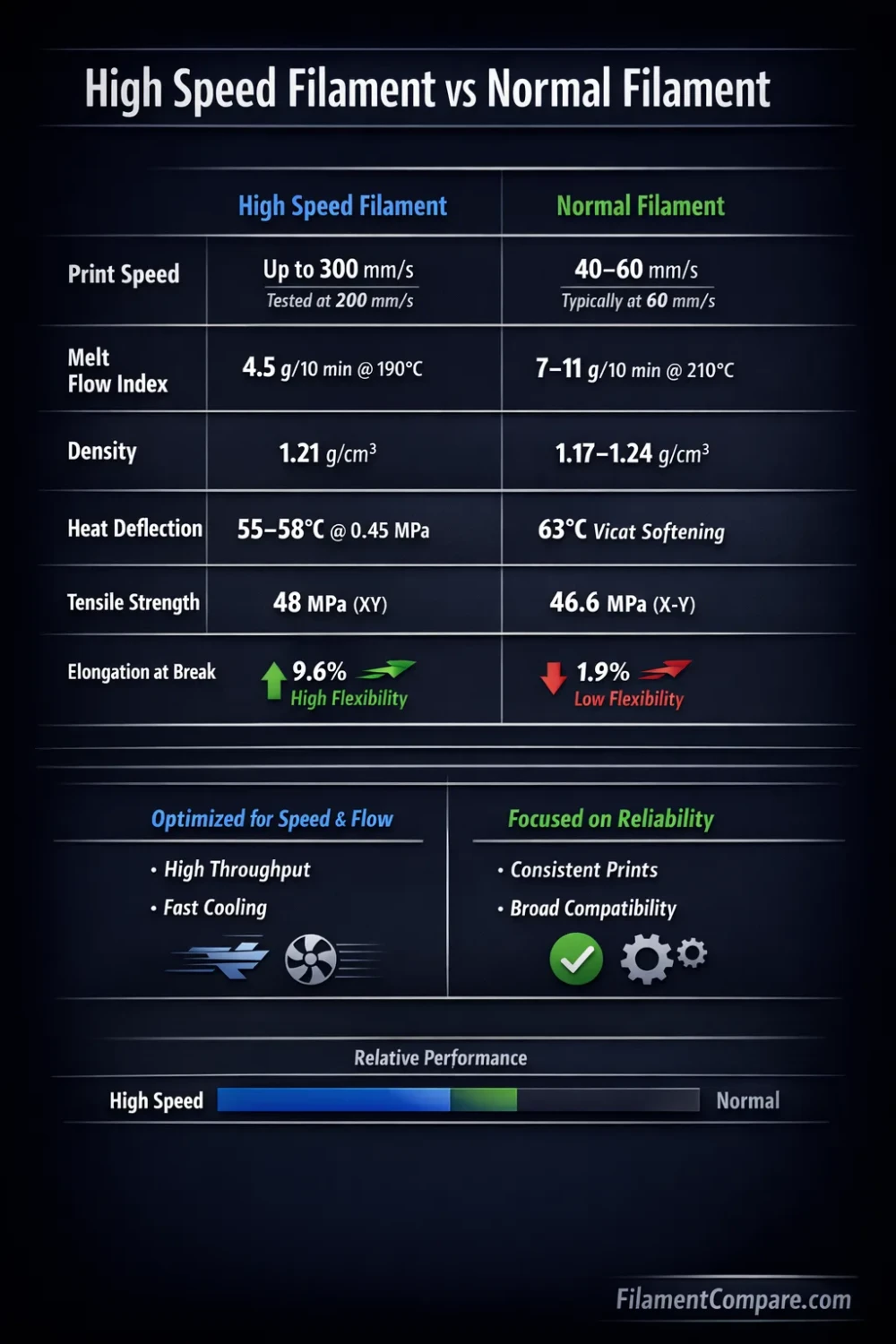
High-speed filament is formulated to maintain steadier melt flow and faster shape retention under increased extrusion demand, while normal filament is designed for moderate print speeds and broader everyday use. The speed label does not create a new polymer family: high-speed PLA is still PLA, and high-speed PETG is still PETG. Choose the optimized grade when a fast printer is limited by material flow; choose the normal grade when moderate output, broad profile support, and lower cost matter more.
The Practical Choice
Choose high-speed filament for a modern CoreXY or other fast printer when large models, batch production, or high-flow toolpaths repeatedly approach the material’s extrusion limit.
Choose normal filament for standard-speed printers, detail-focused models, occasional printing, wider color selection, or projects where a familiar manufacturer profile already gives consistent results.
There is no universal material winner. The useful comparison is between equivalent polymer families, such as high-speed PLA versus normal PLA, on the same printer and nozzle.
Fast CoreXY Printing
High-speed filament gives more flow headroom when acceleration, cooling, and the hotend can use it.
Standard Bed-Slinger
Normal filament is usually sufficient when actual extrusion demand remains moderate.
Large Prototypes
High-speed filament can reduce under-extrusion risk during long, fast infill and perimeter moves.
Fine Display Models
Normal filament offers broad profiles and predictable results when speed is intentionally limited.
Batch Production
High-speed filament fits repeated jobs where saved minutes accumulate across many parts.
Lowest Material Cost
Normal filament often has more brand, color, finish, and price options.
Large Nozzle Output
High-speed filament may help, but only when the hotend can melt the required volume.
Known Engineering Profile
Normal filament may be easier to qualify when an established datasheet and tested slicer profile already exist.
| Decision Area | High-Speed Filament | Normal Filament | Practical Reading |
|---|---|---|---|
| Material family | PLA, PETG, ABS, ASA, TPU, or another polymer with a speed-focused formulation | The conventional formulation of the same polymer family | Compare PLA with PLA or PETG with PETG, not the label alone |
| Primary formulation goal | Higher usable melt flow, rapid shaping, and steadier extrusion at elevated demand | Balanced behavior across common temperatures and print speeds | High-speed grade for sustained fast extrusion |
| Print difficulty | Usually easy when a matching profile is available; more sensitive to flow and cooling calibration at the upper limit | Usually easier to tune on standard printers because default profiles are common | Printer and profile support matter |
| Typical nozzle temperature | Often uses the upper part of the base polymer’s normal range at fast output | Uses the standard range listed for the grade | Brand-dependent; follow the spool or datasheet |
| Typical bed temperature | Usually similar to the matching base polymer | Standard range for the base polymer | The speed label rarely changes the bed requirement by itself |
| Enclosure need | Determined mainly by the base polymer | Determined mainly by the base polymer | High-speed ABS may need an enclosure; high-speed PLA usually does not |
| Maximum volumetric flow | Designed for higher material throughput, but no cross-brand minimum is guaranteed | May work quickly until the material or hotend reaches its flow ceiling | Measure in mm³/s rather than relying only on mm/s |
| Cooling demand | Higher at fast PLA-style printing because each layer has less time to set | More forgiving at moderate speed | Part cooling can become the limit before the filament does |
| Layer adhesion | Can remain consistent at higher flow when temperature and cooling are tuned | Usually reliable within the manufacturer’s normal speed window | Too little heat or too much cooling can weaken either grade |
| Mechanical behavior | Not automatically stronger; properties can shift with formulation and print speed | Not automatically weaker; may match or exceed a fast print when deposited more slowly | Judge stiffness, toughness, impact resistance, and Z strength separately |
| Heat resistance | Usually follows the base polymer unless the grade also includes a heat-focused modification | Usually follows the base polymer and grade | High speed does not mean high heat tolerance |
| Moisture behavior | Still depends on polymer family, storage, and additives | Still depends on polymer family, storage, and additives | A speed label does not remove drying needs |
| Surface finish | Can preserve clean walls at fast output when flow, pressure advance, and cooling are calibrated | Often gives clean surfaces at moderate output with less tuning | Both can look excellent inside their stable process window |
| Dimensional stability | Good when extrusion dynamics are calibrated; overshoot and corner bulging can appear at aggressive settings | Often easier to control at moderate acceleration and flow | Motion tuning and pressure control are part of the result |
| Availability | Growing selection, but fewer colors and specialty finishes in some markets | Usually the broadest selection across brands and finishes | Normal grade for choice and local availability |
| Main limitation | Its value may be small on a printer that cannot deliver high acceleration, cooling, or hotend flow | May under-extrude or lose layer quality when pushed beyond its tested throughput | The weaker link sets the real speed |
| Better choice | Fast machines, high-output profiles, large parts, repeated production | Conventional printers, moderate speeds, detail work, broad material choice | Use-case based |
This High-Speed Filament vs Normal Filament comparison combines manufacturer datasheets with established technical guidance; the patterns are general, while brand, color, additives, moisture, printer hardware, and slicer settings can change the measured result.
Material and Workflow Profiles
High-Speed Filament Workflow Profile
- Polymer type: A modified grade of an existing polymer, not a separate family
- Print difficulty: Easy to moderate with a tested high-flow profile
- Nozzle range: Product-specific; fast profiles often use a warmer setting
- Bed range: Usually follows the base polymer
- Enclosure: Based on PLA, PETG, ABS, ASA, nylon, or the actual polymer
- Drying need: Still polymer-dependent; dry material improves flow consistency
- Typical behavior: Lower flow resistance and faster shaping at high output
- Best uses: Large prototypes, print farms, fast infill, production fixtures, repeated parts
Normal Filament Workflow Profile
- Polymer type: Conventional PLA, PETG, ABS, ASA, TPU, nylon, or another grade
- Print difficulty: Often supported by mature default profiles
- Nozzle range: Standard product range
- Bed range: Standard product range
- Enclosure: Based on the actual polymer
- Drying need: Polymer-dependent and unchanged by the absence of a speed label
- Typical behavior: Predictable extrusion at common desktop-printer speeds
- Best uses: Daily prints, visual models, moderate-speed functional parts, color-sensitive projects
Relative Printing-Use Scores
High-Speed Filament
Normal Filament
The meters show relative workflow tendencies rather than fixed laboratory ratings. Brand chemistry, pigments, additives, moisture, nozzle geometry, print orientation, acceleration, and slicer calibration can move the result in either direction.
Flow Rate Matters More Than the Advertised mm/s
A printer does not consume the same amount of plastic at every 250 mm/s move. A thin 0.12 mm layer with a narrow line requires far less material than a 0.30 mm layer with a wide extrusion. The more useful limit is maximum volumetric speed, measured in cubic millimeters per second.
Approximate volumetric flow = layer height × extrusion width × print speed. Prusa describes maximum volumetric speed as the amount of plastic a hotend can reliably melt and notes that the effective ceiling is set by the weaker link between the material and the hotend[a].
Why the Same mm/s Can Produce Different Results
- A 0.4 mm nozzle printing fine layers may stay below the flow limit even at a high travel number.
- A 0.6 or 0.8 mm nozzle with thick layers can reach the hotend limit at a much lower linear speed.
- Outer walls, bridges, overhangs, and small layers are often slowed for finish or cooling.
- Acceleration determines whether a short feature ever reaches the requested speed.
This is why a spool marked “600 mm/s” cannot guarantee 600 mm/s on every model. Creality states that its Hyper PLA supports up to 600 mm/s through a high-fluidity and fast-cooling formulation[e], but that figure remains a product-specific maximum under suitable printer and profile conditions.
What the High-Speed Formulation Changes
High-speed grades are generally adjusted so the polymer reaches a usable melt state within a shorter residence time in the hotend. Manufacturers may tune resin selection, molecular-weight distribution, modifiers, nucleating behavior, lubricity, or other additives. Exact recipes are proprietary, so the label alone does not reveal the chemistry.
One useful indicator is melt mass-flow rate (often called melt index), but values are comparable only when the test temperature and load match. Polymaker lists a melt index of 15.4 g/10 min at 210°C and 2.16 kg for PolySonic PLA[b]. Its conventional PolyLite PLA lists 7–11 g/10 min under the same stated test conditions[c]. That brand-specific example shows the direction of the design change without creating a universal threshold for all high-speed filament.
eSUN describes its ePLA-HS approach as balancing melt index and flow temperature so the material flows smoothly when molten and cools quickly during printing[d]. The practical goal is not simply “more liquid.” The filament must also stop flowing where intended, hold corners, bridge acceptably, and form the next layer without excessive sagging.
Do not compare melt index values measured under different conditions. A number tested at another temperature or load cannot be treated as a direct speed ranking.
The Printer Still Sets the Upper Limit
High-speed filament does not turn a conventional printer into a high-output machine. It can remove or delay one bottleneck, but the motion system, heater power, melt-zone length, extruder grip, nozzle geometry, part cooling, firmware tuning, and slicer profile still have to support the requested throughput.
Hotend Capacity
A longer or more efficient melt zone can process more polymer per second. A standard hotend may reach its limit before a high-speed spool shows a clear benefit.
Acceleration
Small models may spend most of the print accelerating and slowing down. A high top-speed setting can therefore save less time than expected.
Part Cooling
PLA-style materials need enough airflow to set overhangs and short layers. More flow without enough cooling may soften corners or reduce detail.
Pressure advance or linear advance also matters. Faster extrusion changes increase pressure inside the melt path. Without calibration, the printer can leave swollen corners, thin line starts, inconsistent seams, or dimension changes even when the filament itself flows well.
Part Strength Can Shift as Throughput Rises
High-speed filament is not automatically stronger than normal filament, and normal filament is not automatically stronger than a high-speed grade. Strength must be separated into tensile strength, stiffness, elongation, impact behavior, and interlayer performance. Print orientation and thermal history can change each one.
Polymaker’s PolySonic PLA data illustrates why print speed should be treated as a test variable. The same product sheet reports shifts in tensile, elongation, bending, and impact results between its classic-speed and high-speed specimens. That does not make faster printing unsuitable; it shows why a material claim must be read together with the specimen settings and print orientation.
For load-bearing parts, qualify the actual spool, color, orientation, layer height, nozzle temperature, cooling level, and speed. A fast visual test print is not a substitute for application-specific mechanical testing.
Cooling, Detail, and Dimensional Control
A high-speed formulation can improve extrusion consistency, but surface quality still depends on how the printer handles motion and heat. Fast straight infill is easier than a small embossed label, a sharp corner, a bridge, or a thin tower. Slicers often use different speeds for each feature for this reason.
Conditions That Favor High-Speed Filament
- Long toolpaths that let the printer reach target speed
- Large parts with repeated walls and infill
- A calibrated maximum volumetric speed
- Strong part cooling for the chosen polymer
- Pressure advance and flow ratio already tuned
Conditions That Reduce the Difference
- Small models dominated by acceleration limits
- Outer walls intentionally printed slowly
- A standard-flow hotend
- Thick layers already capped by heater capacity
- Materials whose base polymer needs slow cooling or chamber heat
Moisture remains relevant. Water in the filament can create bubbles, rough surfaces, inconsistent extrusion, stringing, or weaker bonding. A speed-focused formulation does not cancel the storage behavior of PETG, nylon, TPU, or other moisture-sensitive polymers (and even PLA can print less consistently after unsuitable storage).
Use-Case Recommendations
| Use Case | More Suitable Choice | Reason |
|---|---|---|
| Beginner prints on a standard printer | Normal filament | Default profiles, moderate flow, and broad troubleshooting knowledge make setup simpler. |
| Fast CoreXY printer with a high-flow hotend | High-speed filament | The machine is more likely to use the extra flow capability. |
| Large draft prototypes | High-speed filament | Long infill and wall paths can convert higher flow into shorter print time. |
| Miniatures and fine lettering | Normal filament or either at a slow profile | Detail speed, cooling, and motion control matter more than maximum throughput. |
| Print farm producing repeated PLA parts | High-speed filament | Small time savings per part can add up across a production queue. |
| Occasional household models | Normal filament | The added flow headroom may not justify a higher price or a new profile. |
| Large nozzle with thick layers | High-speed filament, conditionally | Higher-flow material can help, but the hotend must still supply enough heat. |
| Dimension-sensitive jigs | Either after calibration | Flow ratio, pressure advance, shrinkage, and speed transitions affect accuracy more than the label alone. |
| Outdoor parts | Choose by polymer family | ASA, UV-stabilized grades, and part design matter more than high-speed branding. |
| Warm functional environment | Choose by heat resistance | A high-speed PLA remains PLA-like unless the datasheet states a separate heat modification. |
| Carbon-fiber or glass-fiber parts | Choose by reinforced grade | Abrasive additives and mechanical targets determine nozzle and profile needs; the speed label is secondary. |
| Wide color and finish selection | Normal filament | Standard product lines usually include more silk, matte, translucent, recycled, and specialty options. |
Where Each Option Fits Better
Choose High-Speed Filament When
- Your printer regularly approaches the filament’s tested volumetric-flow limit.
- You print large parts, repeated batches, or long high-speed toolpaths.
- The manufacturer supplies a profile for your printer or slicer.
- Your hotend, extruder, and cooling system support sustained output.
- You are willing to calibrate flow ratio, temperature, pressure advance, and MVS.
High-Speed Filament Is Less Suitable When
- Your printer cannot reach or sustain high material throughput.
- Most models are small, highly detailed, or intentionally slow.
- The selected high-speed line lacks the color, finish, or certified grade needed.
- You expect the speed label to add heat, UV, chemical, or impact resistance by itself.
Choose Normal Filament When
- You use a conventional printer or moderate-speed profile.
- A tested default profile already meets the required finish and strength.
- Material price, color range, and local availability are priorities.
- You need a specific specialty grade rather than maximum flow.
- Your parts are limited by cooling, acceleration, or geometry rather than extrusion.
Normal Filament Is Less Suitable When
- High-speed moves cause repeatable under-extrusion or weak bonding.
- The extruder clicks or skips after the hotend reaches its flow ceiling.
- Production time matters and the printer has unused high-flow capacity.
- You must reduce speed far below the machine’s stable motion range to maintain extrusion.
Material Selection Matrix
Final Material Decision
Choose high-speed filament if the same-polymer normal grade is limiting your calibrated volumetric flow, your printer has enough hotend and cooling capacity, and shorter production time has measurable value.
Choose normal filament if you print at moderate output, need the widest selection, already have a stable profile, or your print time is controlled mainly by acceleration, detail speeds, and cooling.
Keep the base polymer decision first. Select PLA, PETG, ABS, ASA, TPU, nylon, PC, or another material for the required heat, toughness, flexibility, UV exposure, chemical contact, and dimensional behavior. Then decide whether a high-speed grade of that polymer improves the workflow.
Neither option replaces the other. High-speed filament is a process optimization; normal filament remains the practical choice when the machine or part does not demand extra flow.
High-Speed and Normal Filament Questions
Can normal filament print on a high-speed printer?
Yes. Start with the manufacturer’s normal temperature range and a conservative volumetric-flow limit, then raise flow gradually while checking extrusion, layer bonding, corners, and surface consistency.
Can high-speed filament print slowly?
Usually yes. Many high-speed grades include conventional-speed settings. Retraction, temperature, and cooling may still need adjustment because the formulation can flow differently from a normal grade.
Does high-speed filament require a hardened nozzle?
Not because of the speed label alone. Plain high-speed PLA or PETG is not automatically abrasive. Carbon fiber, glass fiber, glow pigments, metal powders, and other filled variants may require a wear-resistant nozzle.
Is high-speed filament stronger?
Not as a general rule. A high-speed grade may preserve bonding better at elevated throughput, while a normal grade printed more slowly may deliver equal or better values in another test. Compare the relevant tensile, impact, stiffness, elongation, and Z-direction data.
Does a faster spool reduce every print time?
No. Small parts, bridges, overhangs, outer walls, minimum-layer-time limits, acceleration, and travel moves can dominate the schedule. The largest gains usually appear on models with long extrusion paths and a printer able to sustain high flow.
Should temperature always be raised for high-speed printing?
No fixed increase works for every filament. A warmer nozzle can improve melting at higher flow, but excess heat may increase stringing, soften detail, or alter dimensions. Use the product range and calibrate at the intended volumetric speed.
Technical References and Product Data
- [a] Max volumetric speed | Prusa Knowledge Base (Used for the definition of maximum volumetric speed, slicer limiting behavior, and the interaction between material and hotend capacity.)
- [b] PolySonic™ PLA | Polymaker Wiki (Used for melt index, classic and high-speed printing ranges, drying guidance, and the manufacturer’s mechanical test values at two print speeds.)
- [c] PolyLite™ PLA | Polymaker Wiki (Used as a conventional PLA reference under matching melt-index test conditions and for the normal-grade printing window.)
- [d] ePLA-HS High Speed Printing PLA 3D Printer Filament (Used for the manufacturer’s explanation of balancing melt flow and flow temperature for smooth extrusion and rapid cooling.)
- [e] Hyper PLA 1.75 mm 3D Printing Filament 1 kg (Used for the product-specific high-fluidity, fast-cooling, and maximum-speed claim; the article treats that number as conditional rather than universal.)
