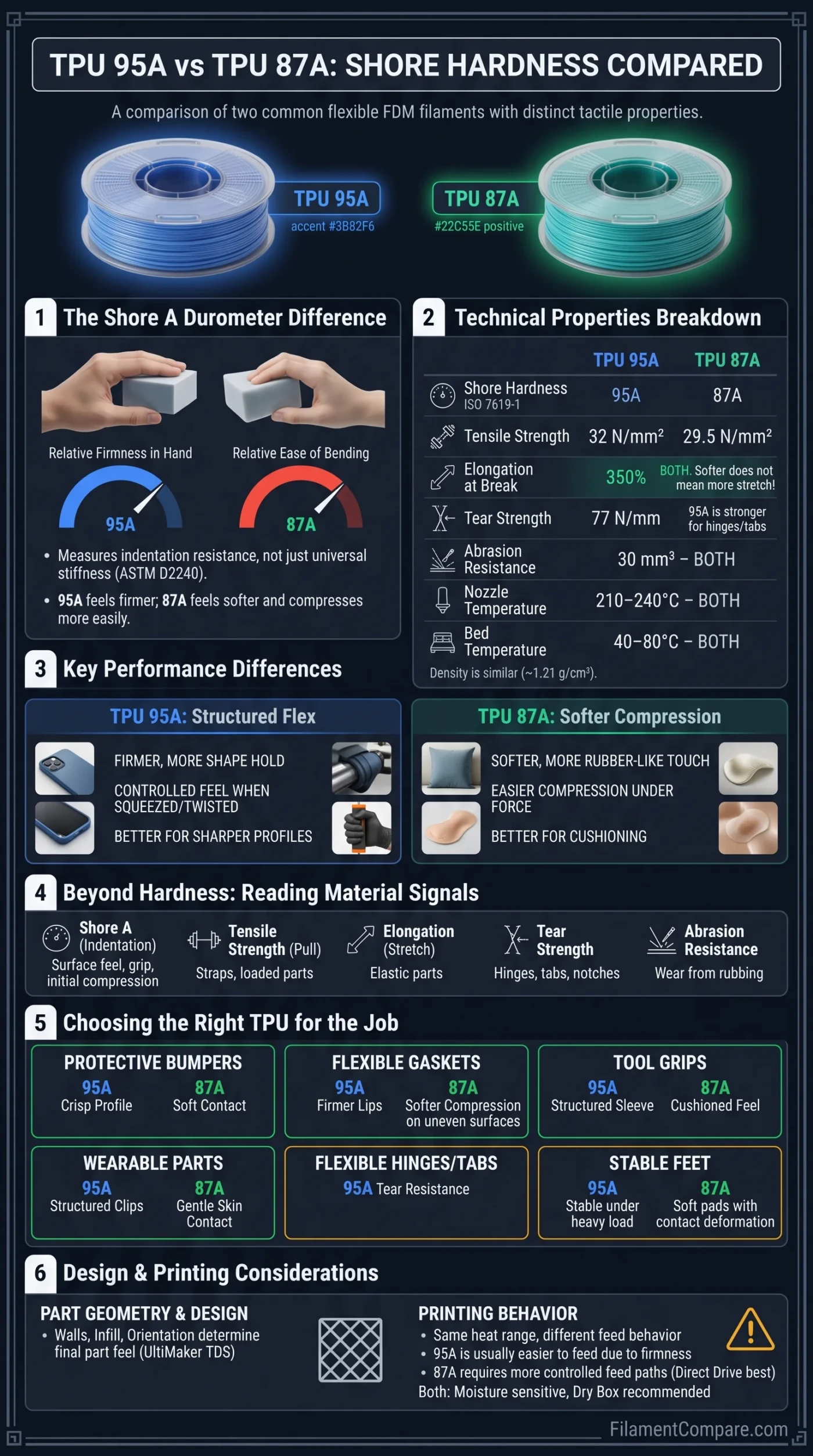
TPU 95A and TPU 87A are both flexible thermoplastic polyurethane filaments, but the 8-point Shore A gap changes the feel of a printed part in a very real way. TPU 95A sits on the firmer side of flexible FDM materials, while TPU 87A bends and compresses more easily under finger pressure. The number is not a universal stiffness rating; it is an indentation reading, so wall count, infill, print orientation, and the exact filament grade still matter.
| Property | TPU 95A | TPU 87A | What the Difference Means |
|---|---|---|---|
| Shore A hardness | 95A, measured by ISO 7619-1 | 87A, measured by ISO 7619-1 | TPU 95A feels firmer; TPU 87A feels softer and compresses with less force. |
| Specific gravity | 1.21 g/cm³ | 1.21 g/cm³ | Density is nearly the same in these compared grades, so the feel difference comes mainly from hardness and formulation. |
| Tensile strength | 32 N/mm² | 29.5 N/mm² | Both sit in a useful range for flexible functional prints; TPU 95A has the higher listed value in this paired datasheet set. |
| Elongation at break | 350% | 350% | The same listed elongation shows that softer does not always mean more stretch in every datasheet. |
| Tear strength | 77 N/mm | 52 N/mm | TPU 95A has the higher listed tear value, useful when thin tabs, hinges, or edges are pulled repeatedly. |
| Abrasion resistance | 30 mm³ | 30 mm³ | In this datasheet pair, both grades show the same listed abrasion figure. |
| Nozzle temperature | 210–240°C | 210–240°C | Temperature range is not the main divider here; feed control and part geometry matter more. |
| Bed temperature | 40–80°C | 40–80°C | Both grades use the same listed bed range in the compared datasheets. |
| Dry box recommended | Yes | Yes | Both should be treated as moisture-sensitive printing materials. |
| Closed chamber | Not necessary | Not necessary | Neither grade is presented as requiring an enclosure in this datasheet pair. |
This TPU 95A vs TPU 87A comparison uses named material datasheets plus recognized durometer references; the values show normal comparison trends, while real printed results can change with printer type, filament storage, part geometry, and testing conditions.
What the Shore A Difference Means
Shore A hardness measures how far a standardized indenter presses into a soft material under controlled conditions. ASTM D2240 describes durometer hardness as an empirical indentation test, not a direct measurement of one single material property such as tensile modulus or strength [a]. That matters here. A jump from 87A to 95A is not a simple percentage increase in stiffness.
Still, the difference is easy to feel. TPU 87A deforms sooner under light pressure. TPU 95A pushes back sooner and keeps more shape in a thin wall. Small number gap. Big tactile change.
Relative Firmness in Hand
Relative Ease of Bending
Why TPU 95A Feels More Structured
TPU 95A keeps a more defined edge on parts such as protective corners, cable grommets, mounts, buttons, bumpers, and soft-touch tool grips. It still flexes. It is not rigid like PLA, PETG, ABS, or nylon. The difference is that 95A resists indentation earlier, so a printed part can feel more controlled when squeezed or twisted.
This is helpful when the design uses thin walls, snap areas, sleeves, or feet that should bend without feeling loose. A TPU 95A phone corner, for example, can cushion contact while still holding a sharper shape around the edge of the device.
Why TPU 87A Feels Softer
TPU 87A gives more under the same hand force. That makes it better suited to parts where the main goal is soft compression, grip, cushioning, flexible contact, or a rubber-like surface feel. It can be more noticeable in small items, because a thin TPU 87A wall may flex where TPU 95A mainly springs back.
The softer grade can also make a part feel less “plastic-like” in contact areas. That is often the reason a designer moves from 95A to the high-80s Shore A range: not for more maximum stretch on paper, but for a softer first touch.
Hardness Is Not the Same as Strength
A common mistake is to read Shore A as the whole material story. It is only one property. In the compared datasheets, both grades list 350% elongation at break, yet their Shore hardness and tear strength differ. That tells us something useful: hardness, stretch, tear behavior, and abrasion need to be read together.
| Material Signal | What It Describes | Why It Matters in Printed TPU Parts |
|---|---|---|
| Shore A hardness | Resistance to indentation under a durometer | Controls the first feeling of softness, grip, and compression. |
| Tensile strength | Stress a sample carries during a pull test | Relevant for straps, tabs, and parts loaded in tension. |
| Elongation at break | How much the sample stretches before it breaks | Useful for elastic parts, but it does not alone predict surface feel. |
| Tear strength | Resistance to tear propagation | Important for notches, holes, hooks, thin lips, and flexible hinges. |
| Abrasion resistance | Material loss under rubbing wear | Useful for feet, rollers, contact pads, and protective surfaces. |
Printing Behavior: Same Heat Range, Different Feed Feel
The selected TPU 95A and TPU 87A datasheets list the same 210–240°C nozzle range, the same 40–80°C bed range, and the same dry-box recommendation. So the printing difference is not mainly about melting temperature. It is about how the filament behaves while being pushed.
TPU 95A is usually more forgiving in the filament path because it is firmer. TPU 87A can compress more between the drive gears and the hot end. On a well-constrained direct-drive extruder, that difference can be modest; on a long or loose feed path, the softer grade may show more sensitivity to speed and retraction. Keep the wording precise: this is a feed behavior trend, not a fixed rule for every printer.
Print Behavior Notes
- TPU 95A usually suits parts that need a cleaner edge, more shape hold, and easier filament feeding.
- TPU 87A usually suits parts that need a softer squeeze, more rubber-like touch, and easier compression.
- Both grades benefit from dry storage because moisture can affect surface finish and extrusion consistency.
- Both can produce functional flexible parts, but the softer grade asks more from the extruder path.
Part Design Changes the Hardness You Feel
A printed TPU part is not just raw polymer. It is also walls, air gaps, infill lines, seam placement, layer bonding, and print orientation. UltiMaker’s TPU 95A data sheet notes that FFF printed parts vary by print orientation because the process creates a layered structure [e]. That is why two parts made from the same TPU spool can feel different in the hand.
Walls, Infill, and Compression
A solid TPU 87A block can feel firmer than a thin TPU 95A lattice. Geometry wins often. A part with fewer walls and lower infill has more empty space to collapse into, so it may feel soft even when the filament’s Shore A number is higher.
This is also why comparing sample strips can be misleading if the samples are not printed the same way. Layer height, wall count, infill pattern, and print direction can change the bending response before the material itself reaches its limit.
Surface Grip and Contact Area
TPU 87A often feels more compliant at the surface, especially in pads, bumpers, wearable contact parts, soft feet, and protective covers. TPU 95A can still offer grip, but it normally feels more structured. For a hand-held part, that can be pleasant. For a cushion, the softer grade may feel more natural.
Application Fit by Shore Hardness
The better choice depends on the job. A flexible part that should hold its shape under light load often points toward TPU 95A. A part that should compress, flex, and absorb small impacts with a softer touch often points toward TPU 87A.
| Application Area | TPU 95A Fit | TPU 87A Fit | Material Logic |
|---|---|---|---|
| Protective corners and bumpers | Good when the part should keep a crisp profile. | Good when soft contact is the main goal. | 95A favors shape hold; 87A favors cushion feel. |
| Gaskets and seals | Useful for firmer sealing lips or spacers. | Useful for softer compression against uneven surfaces. | Seal design matters as much as hardness. |
| Wearable contact parts | Better for more structured clips or mounts. | Better for softer skin-contact surfaces. | 87A can feel gentler where pressure is spread over a small area. |
| Tool grips | Good for grip sleeves that should not collapse easily. | Good for more cushioned hand contact. | Hand feel depends on wall thickness and surface texture. |
| Flexible hinges and tabs | Useful where tear resistance and edge support matter. | Useful where easy bending is preferred. | The listed tear strength favors 95A in this datasheet pair. |
| Feet and anti-slip pads | Good for stable feet under heavier objects. | Good for softer pads with more contact deformation. | Load level and pad thickness decide the final feel. |
TPU 95A vs TPU 87A for Shore Hardness
For pure Shore hardness, the answer is direct: TPU 95A is harder than TPU 87A. It resists indentation more and normally feels firmer in a printed part. TPU 87A is softer, more compressible, and more likely to give a rubber-like hand feel.
The more useful reading is not “hard versus soft” alone. TPU 95A can be the better match for flexible parts that need a cleaner shape, stronger edge support, and a more controlled bend. TPU 87A can be the better match for parts that should compress with less force, feel softer against contact surfaces, or absorb small movements with less stiffness.
Short material reading: choose TPU 95A when firmer flexible behavior is desired; choose TPU 87A when softer compression is the more important property. The Shore number starts the comparison, but geometry finishes it.
Questions About the Hardness Gap
Is TPU 95A Twice as Hard as TPU 87A?
No. Shore A is an empirical durometer scale, not a linear stiffness scale. A move from 87A to 95A is clearly noticeable, but it should not be read as a simple multiplication of strength, stiffness, or durability.
Does TPU 87A Stretch More Than TPU 95A?
Not always. In the compared The Filament datasheets, both grades list 350% elongation at break. TPU 87A is softer by Shore A hardness, but maximum elongation depends on the formulation and test method, not hardness alone.
Which One Is Easier to Print?
TPU 95A is usually easier to feed because it is firmer. TPU 87A can print well, but its softer filament body may need a more controlled path through the extruder. Both listed grades share the same datasheet temperature range, so the practical difference is mostly mechanical feeding behavior.
Can Infill Make TPU 95A Feel Like TPU 87A?
It can move the feel in that direction. Lower infill, thinner walls, and flexible patterns can make a TPU 95A part bend more easily. It will not change the polymer’s Shore A value, but it can change the part’s hand feel.
Resources Used
- [a] ASTM International, durometer hardness standard page: ASTM D2240
- [b] Spectrum Filaments / The Filament, TPU 95A technical data sheet: TPU 95A TDS
- [c] Spectrum Filaments / The Filament, TPU 87A technical data sheet: TPU 87A TDS
- [e] UltiMaker, TPU 95A technical data sheet: UltiMaker TPU 95A TDS
