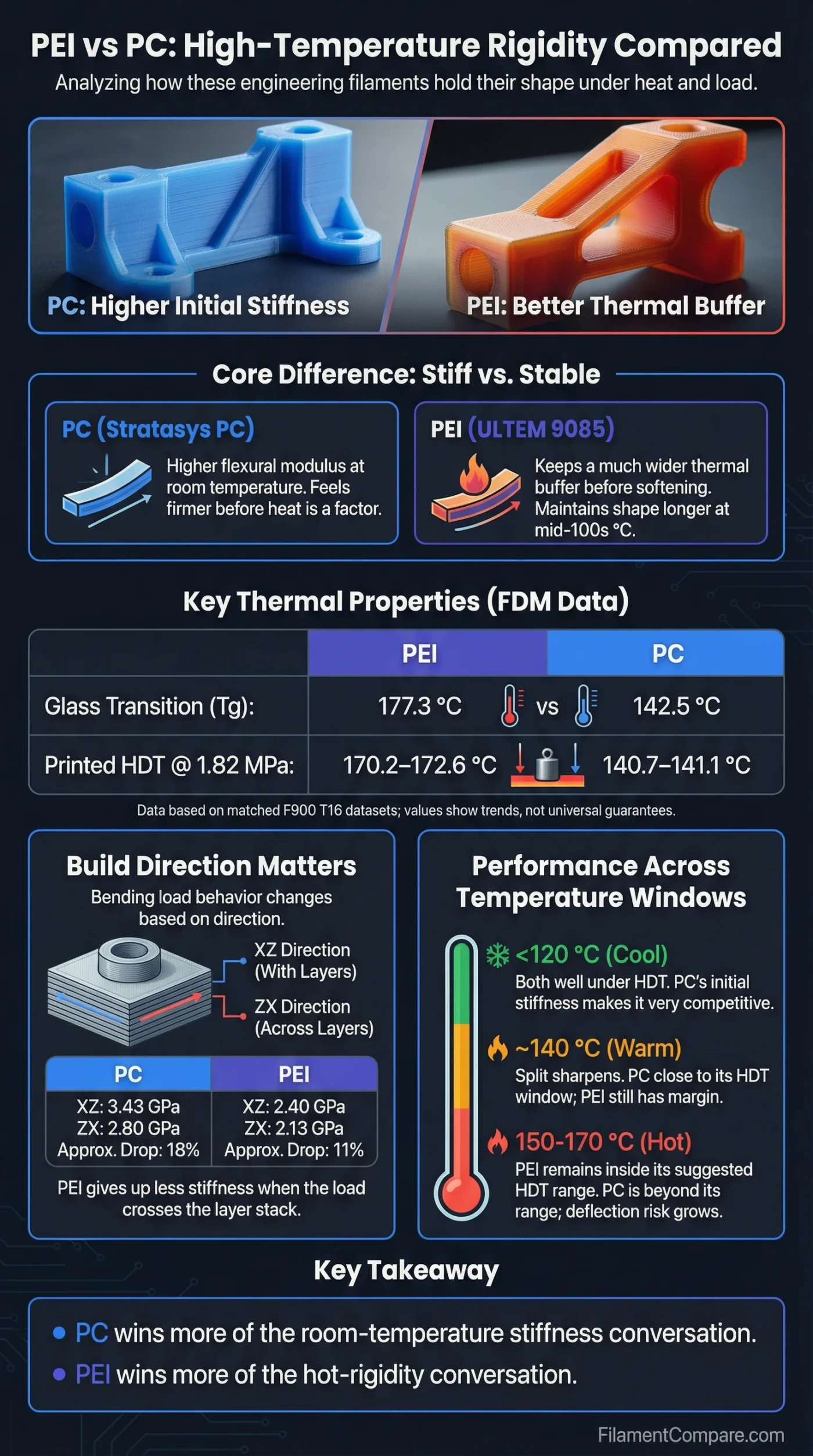
| Property | PEI ULTEM 9085[a] | PC Stratasys PC[b] |
|---|---|---|
| Representative print condition | F900, T16, 0.254 mm layer height | F900, T16, 0.25 mm layer height |
| Glass transition, Tg | 177.3 °C | 142.5 °C |
| Printed HDT @ 264 psi / 1.82 MPa | 170.2 to 172.6 °C | 140.7 to 141.1 °C |
| Tensile modulus, XZ | 2.52 GPa | 2.94 GPa |
| Flexural modulus, XZ | 2.40 GPa | 3.43 GPa |
| Unnotched Izod impact, XZ | 647 J/m | 1,930 J/m |
| Specific gravity | 1.278 | 1.208 |
PEI vs PC here is based on matched Stratasys FDM datasets, while ASTM and ISO pages are used only to define the tests, so the numbers show material trends under named lab conditions rather than a promise for every printer, color, or build.
PEI and PC belong to the same engineering tier of filament, but they do not hold their shape the same way once a loaded part gets hot. PC begins with the higher bending stiffness in the matched printed dataset above, while PEI keeps a much wider thermal buffer before the polymer starts to relax. That split is the whole point of this comparison.
- Matched FDM datasets
- PC starts stiffer
- PEI keeps more heat margin
- Build direction still matters
What High-Temperature Rigidity Really Means
Rigidity is mostly about how hard a part is to bend, so flexural modulus deserves more attention than room-temperature marketing language.[d] HDT is also useful, but that number comes from a fixed loaded test rather than a lifetime service promise.[c]
- Flexural Modulus
- The bending stiffness of a specimen in a three-point flex test. For brackets, covers, plates, and fixtures, this often tells more than simple tensile strength.[d]
- HDT
- The temperature where a loaded specimen reaches a specified deflection under a standard method. It is a screening metric, not a blanket approval for continuous service at that temperature.[c]
- Tg
- The glass transition point from DSC testing, where an amorphous polymer starts leaving its glassy state and stiffness begins to fall off more quickly.[e]
- ISO Language
- European datasheets often express deflection-under-load under ISO 75-2.[f] Flexural properties are commonly listed under ISO 178.[g]
Where PEI Pulls Ahead
PEI opens its lead when temperature becomes part of the load case, not just the background environment. The printed HDT gap is roughly 30 °C, and the Tg gap points the same way. Those two numbers are why PEI keeps its shape longer once a part moves into the mid-100s °C.
That margin matters. A component living around 140 °C places the matched PC dataset almost on top of its printed HDT range, while PEI still has room left. Heat changes the ranking.
PEI is not automatically the stiffer filament at room temperature. It is the material that stays more resistant to deflection once elevated temperature becomes a real mechanical condition rather than a brief spike.
Useful caution: ASTM says D648 data should not be treated as a universal predictor of part behavior at elevated temperature unless time, load, and test conditions are similar to the test itself.[c]
Where PC Still Has More Initial Stiffness
PC deserves credit for how stiff it starts. In the matched F900 T16 dataset, PC shows a higher XZ tensile modulus and a much higher XZ flexural modulus than PEI. So a cool or only moderately warm part can feel firmer in PC before temperature becomes the deciding factor.
PC also carries more impact headroom in the unnotched XZ data above, which helps explain why it remains popular for hard-use engineering parts that do not need PEI’s extra thermal runway.
A small detail that changes many web comparisons: the PC XZ flexural value in the Stratasys sheet is reported as strength at 5% strain because the specimen does not break in the same way.[b] The PEI natural T16 sheet, by contrast, lists XZ flexural strength at break.[a]
Build Direction Changes the Story
Printed parts are anisotropic. That sounds technical, but the idea is simple: the same material behaves differently depending on whether the bending load runs with the bead structure or across the layer stack. This is one of the easiest points to miss when people compare only one headline number.
| Directional Flexural Readout | PEI ULTEM 9085 | PC Stratasys PC |
|---|---|---|
| Flexural modulus, XZ | 2.40 GPa | 3.43 GPa |
| Flexural modulus, ZX | 2.13 GPa | 2.80 GPa |
| Approx. drop from XZ to ZX | About 11% | About 18% |
PC still keeps the higher absolute bending stiffness in both directions. PEI, though, gives up less of that stiffness when the load crosses the layer stack. For parts that bend through Z, that narrower drop is worth noticing.
Where the Temperature Window Changes the Result
- Below 120 °C: both materials stay well under their representative printed HDT values, so initial stiffness and impact behavior tend to matter more. This keeps PC very competitive.
- Around 140 °C: the split sharpens. PC is already close to its printed HDT window, while PEI still holds extra margin.
- From 150 °C to 170 °C: PEI remains inside the range suggested by its representative printed HDT result, while the matched PC dataset is already beyond its own HDT range, so deflection risk grows much faster for PC.
Same geometry, different heat window. That is why PEI can lose the room-temperature stiffness contest yet still win the hot-rigidity contest once service temperature rises enough.
Small Details That Change the Verdict
- HDT is a screening tool. ASTM is explicit that D648 should not be treated as a universal service-life guarantee for hot parts.[c]
- Flexural data usually tell the cleaner stiffness story. Bending is where heat-softening tends to show up early in real printed parts.[d]
- Density shifts the stiffness-per-mass picture. PC is slightly lighter in the matched data, while PEI trades that extra mass for more thermal margin.
- Do not mix unlike datasheets. ISO 178 covers flexural properties under one standards family.[g] ASTM D790 covers the same broad idea under another.[d] One-to-one comparisons work best when the datasets come from the same testing ecosystem.
Many PEI vs PC pages sound inconsistent because they compare one brand’s raw-resin numbers with another brand’s printed coupons. The table here avoids that as much as possible by keeping the two headline datasets inside one Stratasys test environment.
Plain-language read: PC wins more of the room-temperature stiffness conversation. PEI wins more of the hot-rigidity conversation.
Resources Used
- [a] Stratasys, ULTEM™ 9085 Resin Material Data Sheet. Open source
- [b] Stratasys, PC (Polycarbonate) FDM Material Data Sheet. Open source
- [c] ASTM International, ASTM D648-18 Standard Test Method for Deflection Temperature of Plastics Under Flexural Load in the Edgewise Position. Open source
- [d] ASTM International, ASTM D790-17 Standard Test Methods for Flexural Properties of Unreinforced and Reinforced Plastics and Electrical Insulating Materials. Open source
- [e] ASTM International, ASTM D7426-24 Standard Test Method for Assignment of the DSC Procedure for Determining Tg of a Polymer or an Elastomeric Compound. Open source
- [f] ISO, ISO 75-2:2013 Plastics — Determination of Temperature of Deflection Under Load — Part 2: Plastics and Ebonite. Open source
- [g] ISO, ISO 178:2019 Plastics — Determination of Flexural Properties. Open source
