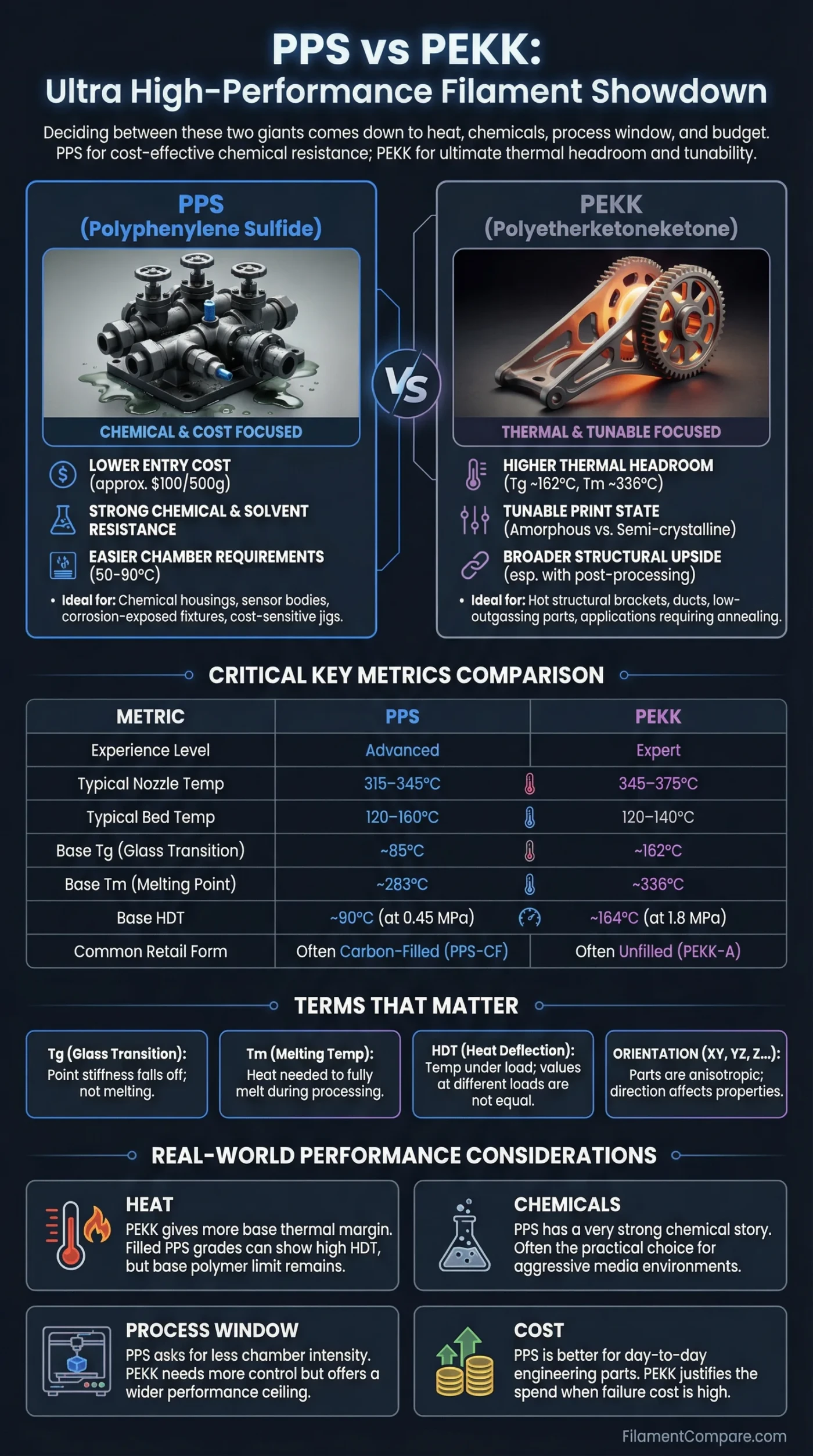
| Decision Point | PPS | PEKK |
|---|---|---|
| Common retail format | Unfilled PPS exists, but many visible FFF offerings are PPS-CF or other reinforced PPS grades. | Often sold as unfilled PEKK-A or PEKK-C, with carbon-filled and ESD-oriented variants above that. |
| 3DXTech experience class [a] | Advanced | Expert |
| Current 500 g shelf price and usual print envelope | $100 for a 500 g spool; nozzle 315–345°C, bed 120–160°C, chamber 50–90°C recommended [c] | $295 for a 500 g spool; nozzle 345–375°C, bed 120–140°C, chamber 70–150°C recommended [d] |
| Base thermal markers from cited datasheets | Tg 85°C, Tm 283°C, HDT 90°C at 0.45 MPa [b] | Tg 162°C, Tm 336°C, HDT 164°C at 1.8 MPa [f] |
| What usually tips the choice | Lower cost of entry, very strong chemical stability, and a chamber requirement that is usually easier to satisfy. | Higher thermal headroom, broader structural upside, and more value when print-state tuning and post-processing are part of the workflow. |
This PPS vs PEKK comparison blends datasheet and official material-page figures from ThermaX PPS, THERMAX PEKK A, and Arkema Kepstan PEKK; it shows normal material tendencies rather than fixed part outcomes, so reinforcement, annealing, orientation, and machine setup can shift the final result.
If your shortlist has narrowed to PPS and PEKK, the choice is less about prestige and more about where the part will actually live. Heat. Solvents. Dimensional drift. Budget. Printer envelope. Those are the real filters. In many shops, PPS wins because it gets you into the high-performance class with less money and less chamber demand. PEKK usually earns the extra spend when the part also needs a hotter thermal ceiling, more room for process tuning, or a cleaner fit for tightly documented industrial work.
- PPS: lower entry cost
- PPS: strong solvent resistance
- PEKK: higher Tg
- PEKK: more tunable print state
- Both: high-end industrial polymers
The awkward part is simple: many PPS filament listings lean toward carbon-fiber-filled grades, while many PEKK filament listings begin with unfilled PEKK-A. So a single tensile number can mislead you. Compare unfilled PPS to filled PEKK and PEKK looks far stiffer. Compare PPS-CF to unfilled PEKK and PPS can look dominant on modulus. That is why the cleaner read is to separate polymer-family behavior from grade-specific datasheet values.
Terms That Matter First
- Tg
- The glass transition temperature. This is the point where stiffness starts to fall off sharply. It is not the same thing as melting.
- Tm
- The melting temperature for a semi-crystalline polymer. It tells you how much heat is needed to fully melt the material during processing.
- HDT
- Heat deflection temperature under load. Useful, but easy to misuse. Two HDT values measured at different loads should not be treated as direct equals.
- CUT
- Continuous use temperature. Vendor pages may list it, but the test basis can differ from HDT or Tg.
- XY, YZ, Z, XZ, ZX
- Print orientation labels. FFF parts are anisotropic, so the same filament can look very different depending on raster and layer direction.
Where PPS Pulls Ahead
PPS makes sense when the part lives around chemicals, cleaning fluids, or humid storage and you want a material that stays stable without forcing the whole production chain upward in cost. That matters more than many comparison pages admit. A polymer can have a hotter thermal profile on paper and still be the less sensible filament once the printer, scrap rate, and build consistency enter the picture.
There is also a clear money angle. The current 3DXTech retail spread shown in the table above is not a tiny gap. It changes how freely you can test wall thickness, supports, annealing, and geometry changes before locking a part down. For R&D loops, jigs, housings, and fluid-contact components, PPS often lowers the barrier to serious material performance without dragging the whole job into an ultra-hot process window.
PPS also tends to be friendlier to the chamber side of the equation. Not easy in an absolute sense. Still, a printer that can hold a steady mid-range hot chamber is easier to source and easier to run than one that needs to stay far hotter for long builds. That difference can decide whether a material is merely attractive on paper or actually usable on your floor.
Why PPS Data Can Look Stiffer Than Expected
Many PPS numbers that catch attention come from PPS-CF rather than neat PPS. Fiber does what fiber usually does: it drives stiffness up, improves dimensional control, and pulls elongation down. So when a PPS-CF datasheet looks more rigid than an unfilled PEKK datasheet, that does not mean the base PPS chemistry suddenly outruns PEKK in every direction. It means reinforcement is part of the story.
PPS Usually Feels Right When
- Solvent or corrosion exposure matters as much as heat.
- You want a lower material cost during prototyping and early production.
- The printer can manage a hot bed and enclosure, but not the hottest chamber class.
- Dimensional steadiness and stiffness matter more than ductility.
Where PEKK Moves Ahead
The strongest case for PEKK is not “it is hotter, so it wins.” That is too shallow. The better case is that PEKK combines a higher thermal ceiling with a print state you can tune. In plain English, it gives a skilled shop more room to decide whether it wants easier processing and better layer fusion, or a more crystalline part with higher heat and chemical resistance.
Arkema describes this split directly for FFF: amorphous PEKK favors low warp, stronger layer adhesion, and easier processing, while semi-crystalline PEKK adds higher use temperature and stronger chemical resistance but asks for post-processing or a hotter build environment [e]. That is one of the most useful ideas in this whole matchup, and many side-by-side articles skip it.
That tunability is why PEKK often lands in applications where a part is not just exposed to heat, but exposed to heat while also needing structural confidence, cleaner documentation, or tighter control over how the finished part will behave after print and post-print treatment. It costs more. It asks more. Yet it can return more when the part cost of failure is far above the filament cost.
Why PEKK Often Justifies the Extra Spend
- A much higher base Tg than neat PPS changes how much stiffness remains as temperature climbs.
- Amorphous versus semi-crystalline behavior gives PEKK more process-side tuning room.
- Industrial PEKK systems often come with stronger published data around chemical exposure, outgassing, or thermal conditioning.
- When a part will be annealed or thermally conditioned anyway, PEKK has more upside to unlock.
A comparison based on one row alone is risky. A higher Tg does not cancel chemical exposure, and a higher modulus from a carbon-filled grade does not automatically mean better layer-to-layer toughness. PPS and PEKK are both serious materials. They simply win under different constraints.
Representative Datasheet Numbers
The next table is there to show what current commercial references actually look like. It is not a pure apples-to-apples shootout. That is intentional. Two rows use PPS-CF because that is how PPS often appears in today’s filament market, while the PEKK row uses a well-documented PEKK-based industrial FDM material with printed-part data.
| Material Example | Form | Print Window | Thermal Markers | Mechanical Markers | What It Tells You | Source |
|---|---|---|---|---|---|---|
| Bambu PPS-CF | Carbon-fiber-filled PPS filament | Nozzle 310–340°C; chamber 60–90°C | Tg 100°C; Tm 284°C; HDT 264°C at 0.45 MPa | Tensile strength 87 MPa (XY); Young’s modulus 8230 MPa (XY); saturated water absorption 0.05% | Very stiff PPS option with strong heat resistance, but the low elongation tells you fiber is shaping the behavior. | [h] |
| UltiMaker PPS CF | Carbon-fiber-filled PPS filament | High-temperature platform material for HT print cores | Temperature resistant above 230°C; insoluble in all solvents below 200°C | Tensile stress at break 47.3 MPa (XY) and 72.6 MPa (YZ); tensile modulus 4376 MPa (XY) and 7766 MPa (YZ) | Orientation changes the result a lot, which is a reminder that PPS-CF data must be read with raster direction in mind. | [i] |
| Stratasys Antero 800NA | PEKK-based industrial FDM filament | Industrial Fortus/F900 system material | Printed HDT 157°C at 264 psi; annealed printed HDT 159°C; Tg 156°C in printed data | Yield strength 86.7 MPa (XZ); elastic modulus 2.64 GPa (XZ); outgassing TML 0.347% and CVCM 0.004% | PEKK becomes especially attractive when low outgassing, heat, and documented industrial test data matter together. | [g] |
Read that table slowly. The PPS rows are not “better” just because the stiffness numbers jump. Those are carbon-filled products. The PEKK row is not “weaker” just because one modulus value lands lower. It is a different grade, a different system, and a different use target. That is exactly why material selection at this level stops being a simple spec-sheet race.
What the Numbers Mean in Real Parts
Heat
If the whole printer setup already supports very hot processing, PEKK usually gives more thermal margin in the base polymer. If you are leaning on filled PPS grades, though, the part-level HDT can look very impressive. That is why Tg, Tm, HDT, and vendor use-temperature language should never be mixed as if they were one metric.
Chemicals
PPS has a very strong chemical story. For many readers, that alone makes it the more practical answer. PEKK is also highly resistant, especially when pushed toward a more crystalline state, but PPS often reaches the shortlist sooner when the part is fundamentally a housing, duct, manifold, or fixture living around aggressive media.
Process Window
PPS usually asks for less chamber intensity. PEKK usually asks for more thermal control, then pays you back with a wider performance ceiling. Very short sentence. That trade is often the whole decision.
Cost
The material price spread in current retail listings is large enough that it should not be treated as background noise. For day-to-day engineering parts, PPS can be the better economic material. For parts where downtime, qualification effort, or thermal failure would cost far more than the spool, PEKK often makes more sense.
Which Material Usually Fits Each Job Better
- Chemical-contact housings, sensor bodies, and corrosion-exposed fixtures: PPS usually gets the first serious look.
- Hot structural brackets, ducts, and parts that need more thermal reserve: PEKK usually moves ahead.
- Cost-sensitive industrial jigs near heat: PPS or PPS-CF often lands in the sweet spot.
- Applications that care about low outgassing and published industrial testing: PEKK-based systems become much more attractive.
- Parts that will be heat-treated, annealed, or tuned after printing: PEKK has more room to reward that extra process effort.
So the clean read is this: PPS is often the smarter buy when chemical resistance, stiffness, and budget dominate. PEKK is often the smarter bet when the whole application can justify hotter processing, more post-print control, and a higher material ceiling. Same family of decisions. Different winner.
Resources Used
- [a] 3DXTech Technical and Safety Data Sheets ↩
- [b] Technical Data Sheet: ThermaX PPS 3D Printing Filament ↩
- [c] ThermaX PPS ↩
- [d] THERMAX PEKK A ↩
- [e] 3D Printing Using Kepstan PEKK ↩
- [f] KEPSTAN 7002 Technical Data Sheet ↩
- [g] Antero 800NA Material Data Sheet ↩
- [h] Bambu PPS-CF Technical Data Sheet V1.0 ↩
- [i] UltiMaker PPS CF Technical Data Sheet ↩
