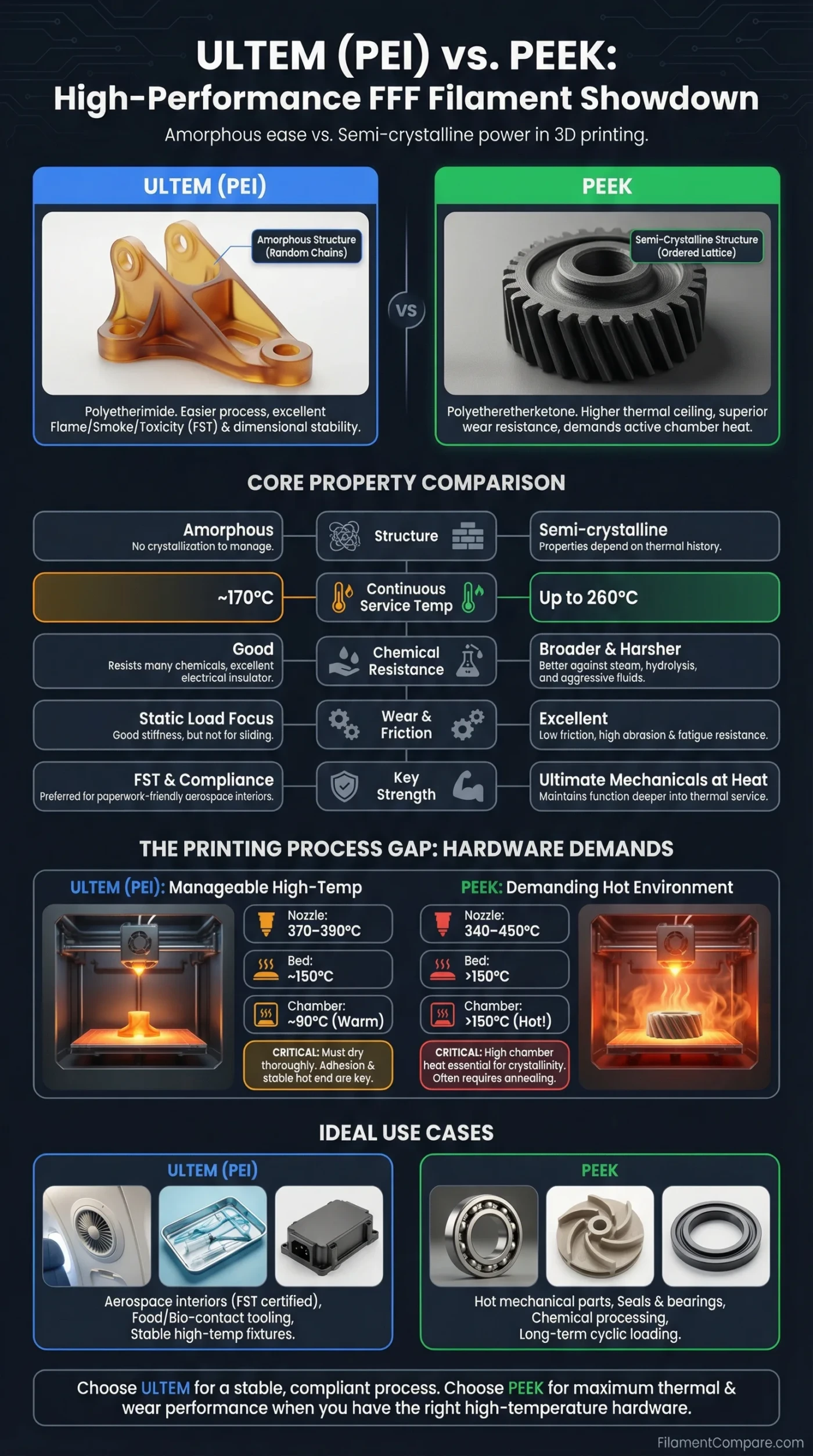
When people compare ULTEM (PEI) and PEEK as filament, they are really comparing two different thermal personalities. ULTEM is SABIC’s brand family for PEI materials, and in FFF talk that usually points to grades such as ULTEM 1010 or ULTEM 9085. PEEK sits in the semi-crystalline PAEK family, so it keeps a higher operating ceiling, stronger wear behavior, and broader chemical endurance, but it also asks more from the printer and from the process window.[a]
| Comparison Point | ULTEM (PEI) | PEEK |
|---|---|---|
| Material family | Amorphous polyetherimide; in filament markets, “ULTEM” usually means PEI grades from the SABIC ULTEM family.[b] | Semi-crystalline polyetheretherketone; part of the wider PAEK family.[c] |
| Representative filament references | ULTEM AM1010F made from ULTEM 1010 resin; ULTEM 9085 is also widely used in industrial FDM.[d] | VICTREX AM 450 FIL for FFF, based on VICTREX 450G polymer.[e] |
| Density | About 1.27 g/cm³ in ULTEM 1010 references.[f] | About 1.30 g/cm³ for crystalline 450G / AM 450 FIL references.[g] |
| Glass transition temperature | About 217°C in ULTEM 1010 resin data; printed FDM references sit around 209°C depending on test route.[h] | About 143–150°C, depending on onset or midpoint method.[i] |
| Melting point | No true crystalline melt point in the usual PEI sense; vendor filament sheets may list a processing melt window instead of a classic polymer Tm.[j] | 343°C melting point for VICTREX 450G / AM 450 FIL.[k] |
| Heat resistance in common datasheets | ULTEM 1010 FDM references show HDT around 212°C at 264 psi; ULTEM 9085 is lower and often chosen for FST balance rather than top-end heat alone.[l] | VICTREX 450G / AM 450 FIL lists 152°C deflection under load at 1.8 MPa, yet the polymer family also carries much higher long-term use ratings.[m] |
| Long-term temperature position | Representative PEI filament references place continuous service around 170°C.[n] | Victrex lists up to 260°C continuous use for PEEK polymers, with UL RTI strength values up to 240°C in 450G / AM 450 FIL references.[o] |
| Tensile strength | Representative ULTEM 1010 filament datasheets show about 110 MPa at yield for the raw material; printed FDM coupon values are lower and orientation-sensitive.[p] | VICTREX 450G shows about 98 MPa at yield injection molded; AM 450 FIL printed XY values are listed at 60–80 MPa and vary with process control.[q] |
| Tensile modulus | Roughly 3.2–3.35 GPa in ULTEM 1010 material references.[r] | About 4.0 GPa injection molded in 450G, with AM 450 FIL printed XY ranges of 3.0–4.0 GPa.[s] |
| Moisture behavior | Needs drying and dry handling; PEI still absorbs moisture fast enough to affect extrusion quality.[t] | Also needs drying, but its process notes are tied more tightly to chamber heat and crystallinity control.[u] |
| Flame and smoke position | Strong point. ULTEM 1010 carries UL94 V0 / 5VA in official resin data, and ULTEM 9085 is widely used where FST documentation matters.[v] | Victrex also lists V-0 flammability and low smoke / low toxic gas behavior for PEEK polymers, but PEI grades are more commonly the default route for cabin-interior style FDM workflows.[w] |
| Chemical and wear profile | Very good chemical resistance for an amorphous polymer and a solid electrical insulator.[x] | Broader chemical range, low friction, strong abrasion resistance, and better long-run fatigue / creep behavior.[y] |
| Printer demand | Still a high-temperature filament, yet it is usually the easier of the two because it does not need crystallinity management in the same way.[z] | Needs a hotter and more stable process envelope; build-space temperature, crystallinity, and often annealing change the final result in a very direct way.[aa] |
| Cost position | Premium industrial filament, but usually the more accessible route between the two.[ab] | Usually the more expensive route in both material spend and machine/process overhead.[ac] |
This comparison reads ULTEM/PEI and PEEK through official resin and filament datasheets, then checks those numbers against manufacturer process notes, so the table shows normal material trends rather than pretending every printer will deliver the same coupon values.
- PEI / ULTEM: Amorphous
- PEEK: Semi-Crystalline
- PEI: Lower Process Burden
- PEEK: Higher Thermal Ceiling
- PEI: FST-Friendly Route
- PEEK: Better Wear Profile
What “ULTEM” Means in Filament Talk
ULTEM is not a separate polymer family from PEI. It is SABIC’s trade name for a PEI material family. That matters because many comparison pages blur generic PEI, ULTEM 1010, and ULTEM 9085 into one bucket, even though those grades do not serve the exact same role. ULTEM 1010 usually enters the conversation when the target is maximum PEI heat resistance, food-contact or biocompatible certified routes, or tooling. ULTEM 9085 appears more often when the design brief leans toward high strength-to-weight plus flame, smoke, and toxicity documentation for transportation and aerospace-adjacent parts.[ad]
- PEI
- Polyetherimide, an amorphous high-temperature polymer with strong dimensional stability and flame performance.
- ULTEM
- SABIC’s PEI family name, often seen in industrial filament discussions as ULTEM 1010 or ULTEM 9085.
- PEEK
- Polyetheretherketone, a semi-crystalline polymer known for higher thermal ceiling, wear behavior, and chemical endurance.
- PAEK
- The wider polymer family that includes PEEK and related materials such as low-melt additive grades like Victrex AM 200.
Direct Property Differences That Matter in FFF
Thermal Behavior: Why Structure Changes the Result
The biggest split is not the headline temperature number. It is the polymer structure. PEI is amorphous, so it does not go through the same crystallization game that PEEK does. PEEK is semi-crystalline, which is why its data sheets can show a lower Tg than PEI while still keeping a higher real-world operating ceiling. Once heat moves above Tg, the crystalline fraction still carries load. That is why PEEK can live in hotter service even though PEI posts a higher glass transition number.[ae]
This is also why PEEK printing quality is tied to thermal management more tightly. If the build chamber stays too cool, the printed part may come out with reduced crystallinity, and then a chunk of the material’s usual advantage in heat resistance, chemical endurance, stiffness, and dimensional behavior does not fully show up in the final part. Same polymer. Different part state.[af]
Stiffness, Strength, and Wear
PEI is not a weak option. ULTEM 1010 material references sit around 110 MPa tensile strength at yield and around 3.35 GPa modulus, which is already far beyond mainstream desktop filaments. It prints into parts that hold shape well at heat, stay electrically stable, and feel very “engineering-grade” rather than “prototype-grade.”[ag]
PEEK usually pulls ahead once the part sees sliding contact, repeated cyclic loading, or hotter long-term service. Victrex frames PEEK around excellent strength, stiffness, creep, fatigue, and wear resistance, and that lines up with the way the material is used for tribological parts, seals, bearings, and hardware that keeps moving rather than only sitting under static load.[ah]
Flame, Smoke, and Regulated Environments
This is where ULTEM/PEI often becomes the cleaner choice. ULTEM 1010 resin carries UL94 V0 and 5VA in official material data, and Stratasys positions ULTEM 9085 around certified-grade traceability plus aerospace and rail FST use cases. That does not make PEEK unsuitable for every regulated environment, but it does explain why PEI shows up so often in cabin-interior style FDM workflows and transport hardware programs.[ai]
PEEK still brings a very strong fire profile. Victrex lists V-0 flammability, low smoke and low toxic gas emission, so this is not a simple “one is safe, one is not” story. The more precise reading is this: PEI usually wins the paperwork-friendly FST path in FDM, while PEEK wins the hotter and harsher service path.[aj]
Chemicals, Moisture, and Sterilization
Both families are strong here, but they are not equal. ULTEM 1010 is described by SABIC and Stratasys as having very good chemical resistance, and certified ULTEM 1010 routes are used where food-contact or biocompatibility requirements matter. That makes it attractive for jigs, fixtures, trays, and tooling that need temperature resistance plus a clean certification path.[ak]
PEEK goes further when the environment stays harsh for a long time. Victrex describes resistance to a very wide range of chemicals, low moisture uptake, steam / hydrolysis resistance, and steady mechanical behavior across aggressive operating conditions. For parts that see fluids, abrasion, and sustained heat at the same time, that wider margin is often the deciding detail. Small sentence. Big effect.[al]
The Datasheet Trap Most Comparison Pages Miss
Resin data, filament data, and printed-coupon data answer different questions. A resin sheet tells you the polymer ceiling. A filament sheet tells you the printable feedstock and its process window. A printed FDM sheet tells you what the machine, orientation, and deposition path actually delivered. Mixing those three without saying so usually leads to sloppy material conclusions.[am]
You can see that directly in the official documents. ULTEM 1010 raw-material values sit near 110 MPa tensile strength, while Stratasys FDM coupon data for printed ULTEM 1010 is lower and clearly orientation-dependent. Victrex does the same on the PEEK side, separating injection-molded values from filament-extruded values and explicitly warning that part geometry, equipment, and process strategy change the final numbers.[an]
Printing Conditions: Where the Gap Widens
On paper, both materials belong in the high-temperature filament class. On the printer, they do not feel the same. PEI still needs serious hardware, dry material handling, and a stable hot end. PEEK goes a step further because chamber heat and crystallinity control are part of the property package, not just part of convenience.[ao]
| Process Point | ULTEM (PEI) Filament | PEEK Filament |
|---|---|---|
| Structure during printing | Amorphous, so no crystallinity target needs to be managed during the build. | Semi-crystalline, so part state depends strongly on build-space temperature and post-print thermal treatment.[ap] |
| Nozzle / melt window | Representative official ULTEM AM1010F filament sheet: 370–390°C nozzle.[aq] | VICTREX AM 450 FIL: 340–450°C melt temperature range.[ar] |
| Bed temperature | Representative ULTEM AM1010F sheet: 150°C plate.[as] | VICTREX AM 450 FIL: >150°C bed.[at] |
| Build chamber temperature | Representative ULTEM AM1010F sheet: about 90°C chamber.[au] | VICTREX AM 450 FIL: not less than 150°C build space; AON3D notes that in-situ crystallization of PEEK needs about 133°C or higher chamber and bed temperatures.[av] |
| Drying | Representative ULTEM AM1010F sheet: 120°C for 8 hours predrying.[aw] | VICTREX AM 450 FIL: 120°C for 5 hours, with max moisture below 0.020%.[ax] |
| Annealing | Usually not the central lever for property development in the way it is for PEEK. | VICTREX AM 200 notes that annealing may be required, with a 170–180°C range suggested when the build state does not reach the needed crystallinity.[ay] |
| Warp and shrink pressure | Still real, but usually more manageable because the polymer is not transitioning into a crystalline part state. | Higher process sensitivity; lower-temperature printing can leave the part more amorphous and less stable, while hotter printing or annealing can raise properties but also raise distortion risk.[az] |
| What usually makes the print fail first | Moisture, poor adhesion strategy, or insufficient hot-end / chamber capability. | Thermal non-uniformity, incomplete crystallization, delamination, or geometry movement during annealing.[ba] |
Plain version: if the machine is only barely “high-temp,” PEI/ULTEM is often the more realistic production filament. PEEK starts to justify itself when the printer can hold a truly hot chamber and the part needs the extra thermal, chemical, or tribological margin after printing.
Questions That Usually Decide the Choice
- Does the part need sustained service around 240–260°C? That points toward PEEK, because this is where its long-run thermal margin becomes hard to replace with PEI.[bb]
- Is the part more about cabin-interior style compliance, traceability, and FST documentation? That usually points toward ULTEM 9085 or a related PEI route.[bc]
- Will the part slide, rub, seal, or cycle under load for a long time? PEEK tends to pull ahead because its wear, fatigue, and low-friction behavior are a better fit for moving hardware.[bd]
- Is the printer hot enough to develop PEEK properly? If not, a well-chosen PEI/ULTEM filament often delivers a more predictable part, even when PEEK looks better on a generic property chart.[be]
Where Each Material Usually Lands
ULTEM (PEI) Usually Fits Best When
- The part needs high heat resistance, but the printer or production line benefits from a less demanding process than PEEK.
- FST-related documentation, flame behavior, traceability, or transportation-oriented compliance matters.
- The part is a fixture, bracket, cover, duct, tooling component, electrical part, or enclosure that must stay dimensionally stable under heat.
- Food-contact or biocompatible certified PEI routes matter more than maximum tribology performance.[bf]
PEEK Usually Fits Best When
- The part lives in a hotter service band and the goal is not just to survive heat spikes, but to keep mechanical function there.
- Chemical exposure, steam, wear, and long cyclic loading all matter at the same time.
- The geometry behaves like a seal, bearing, cage, wear strip, insulator, pump or valve part, or lightweight metal-replacement detail.
- The printer can support a real high-temperature process window, including hot chamber control and, where needed, annealing or in-situ crystallization.[bg]
So the cleanest reading is this: PEI/ULTEM is often the smarter industrial filament when the target is stable high-temperature FFF with compliance-friendly behavior and a more manageable print route. PEEK is the higher-ceiling filament when the part has to keep working deeper into heat, chemicals, friction, and long-run mechanical duty. The better material is not the one with the louder reputation. It is the one whose printed state matches the machine and the job.
Resources Used
- [a] Stratasys — ULTEM 9085 Material Page
- [b] Weerg — ULTEM vs. PEEK
- [c] Victrex — PEEK Polymers
- [d] FIL-A-GEHR — ULTEM AM1010F Filament (PEI) PDF
- [e] Victrex — AM 450 FIL Datasheet PDF
- [f] SABIC — ULTEM 1010 Resin Datasheet PDF
- [g] Victrex — PEEK 450G Datasheet PDF
- [h] Stratasys — ULTEM 1010 FDM Material Datasheet PDF
- [i] Victrex — PEEK Material Properties
- [j] Victrex — Polymer Crystallinity Explained
- [k] Victrex — AM 200 FIL Datasheet PDF
- [l] AON3D — PEEK 3D Printing Temperatures
- [m] Stratasys Support — ULTEM 1010 Resin
