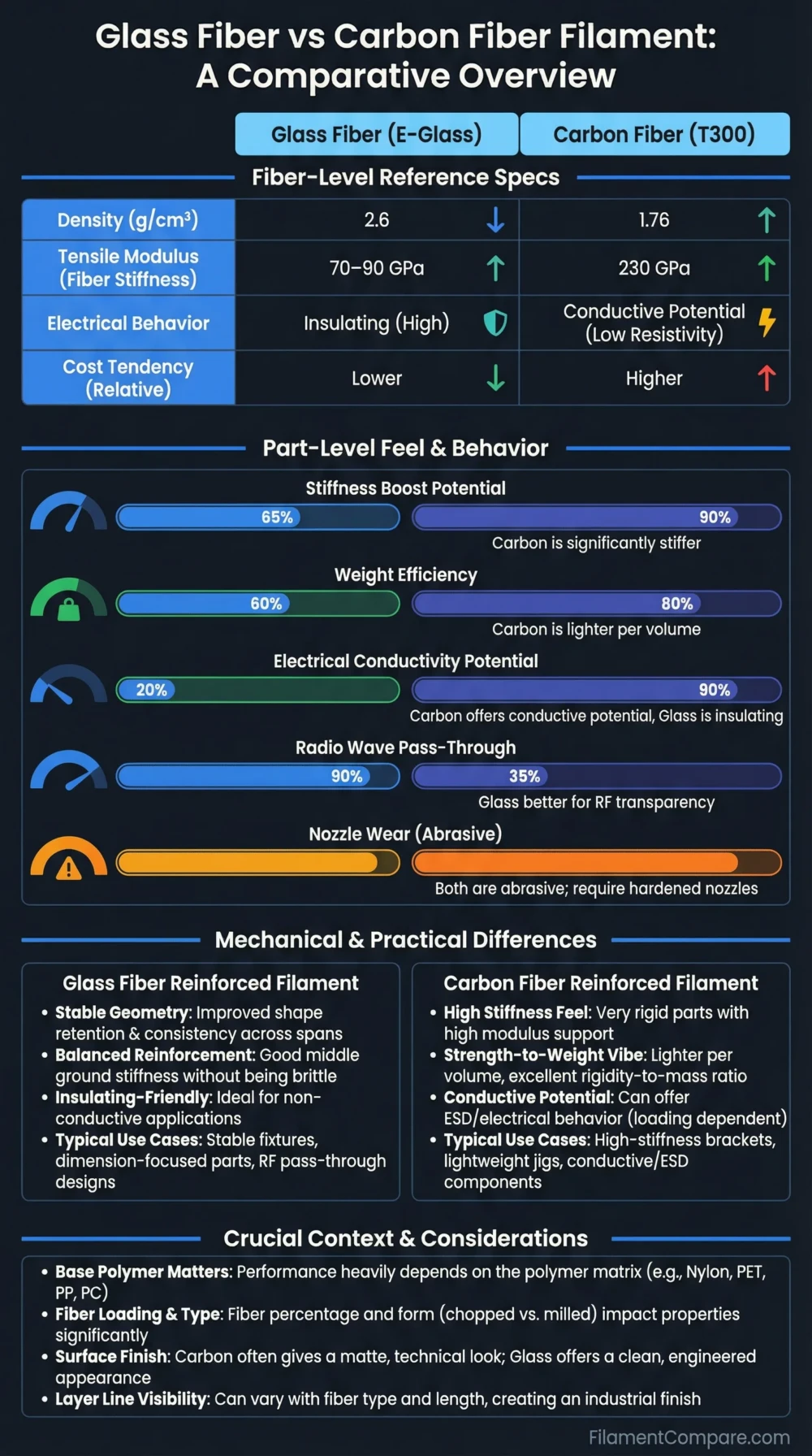
Glass fiber reinforcement is usually the budget-friendly way to add stiffness and heat stability to a base polymer, while carbon fiber reinforcement is typically chosen for maximum stiffness-to-weight and a more rigid, “engineering” feel. Both are abrasive (nozzle wear is part of the deal), and the base polymer (PA, PETG, ABS, PC, etc.) still sets many real-world limits.
Choose Glass Fiber (GF) when you want a practical stiffness/warp-control boost at a lower material cost, you prefer a bit more “give” than CF in many blends, and you’re printing larger functional parts where dimensional stability matters more than ultra-high rigidity.
Choose Carbon Fiber (CF) when your priority is the highest stiffness-to-weight feel, cleaner-looking matte surfaces in many blends, and parts where bending must be minimized (fixtures, brackets, lightweight frames). Expect a stricter setup: hardened nozzle, dry filament, and tuned flow.
| Decision Factor | Glass Fiber (GF) | Carbon Fiber (CF) | Better Choice |
|---|---|---|---|
| What You’re Comparing | Fiber reinforcement added to a base polymer (often short/chopped fibers in FFF filaments) | Fiber reinforcement added to a base polymer (often short/chopped fibers in FFF filaments; continuous CF exists in special systems) | Depends on system |
| Typical Fiber Density | About 2.55–2.60 g/cm³ (E-glass typical)[a] | Roughly 1.6–2.0 g/cm³ (grade/precursor dependent)[b] | Carbon Fiber |
| Typical Fiber Stiffness (Young’s Modulus) | About 72–85 GPa (E-glass typical range)[c] | Common structural CF grades around ~230 GPa (standard modulus example)[d] | Carbon Fiber |
| Rigidity Gain in Printed Parts | Usually improves stiffness and reduces warping; effect is formulation- and print-orientation dependent | Usually the bigger stiffness jump vs the same base polymer; orientation and fiber content strongly matter | Carbon Fiber |
| Impact/Toughness Feel (in many blends) | Often keeps parts from feeling “overly brittle” versus aggressive CF loadings (still base-polymer dependent) | Can feel more rigid and less forgiving; some CF blends trade impact toughness for stiffness | Grade-dependent |
| Heat Behavior | Reinforcement can improve shape retention; the base polymer still sets the softening/creep envelope | Similar rule: reinforcement helps, but base polymer + print structure dominate real heat limits | Depends on base polymer |
| Nozzle Wear / Abrasiveness | Abrasive; brass nozzles wear quickly without hardened options[e] | Abrasive; carbon-filled and other filled materials can cause rapid nozzle wear on soft nozzles[f] | Tie (both) |
| Electrical Behavior | Typically insulating (useful when conductivity is undesirable) | CF itself is conductive; many CF-filled plastics can be more static-prone or conductive (but not always “ESD-safe” without a designed formulation) | Glass Fiber (for insulation) |
| Surface Finish | Often more “technical” than unfilled, but can show fibers/speckle; varies by brand | Commonly matte and hides layer gloss; can look very uniform in many CF blends | Carbon Fiber |
| Cost (Typical Market Behavior) | Usually lower cost per kg at similar base polymer and fiber loading | Usually higher cost per kg (fiber + positioning) | Glass Fiber |
| Typical Uses | Stiffer housings, large functional parts, warp-controlled brackets, dimensionally stable components | Rigid fixtures, lightweight structural brackets, drone/robot parts, parts where bending must be minimized | Use-case based |
| Main Limitation | Abrasive + can reduce layer bonding vs unfilled versions (depends on formulation and settings) | Abrasive + can demand tighter tuning; may sacrifice toughness at high stiffness targets | Tie |
| Better Choice | When stability and cost matter most | When stiffness-to-weight is the priority | Depends on priority |
This comparison reflects typical GF- and CF-reinforced printing materials using manufacturer property ranges and established fiber data; real results shift with fiber loading, base polymer, moisture level, and print orientation.
Glass Fiber Reinforcement Profile
- Fiber type: E-glass is common; S-glass exists for higher performance
- Typical goal: better dimensional stability, stiffness, and warp control
- Printer fit: hardened nozzle strongly recommended; dry storage helps most base polymers (especially PA)
- Behavior to expect: stiffer feel than unfilled; less glossy surfaces; some blends print “cleaner” on large parts
- Best use cases: large brackets, housings, dimensionally sensitive functional parts
Carbon Fiber Reinforcement Profile
- Fiber type: often chopped CF in common FFF filaments; continuous CF in specialized systems
- Typical goal: maximum stiffness-to-weight and minimal bending
- Printer fit: hardened nozzle is the default; keep filament dry and tune extrusion/flow carefully
- Behavior to expect: more rigid feel; often very matte surfaces; can reveal under-extrusion faster if flow is off
- Best use cases: fixtures, rigid brackets, lightweight structural components
These meters are practical, relative indicators for 3D printing use (not fixed lab ratings). Results vary with brand, fiber loading, base polymer, moisture level, print orientation, extrusion multiplier, and slicer choices.
Stiffness, Weight, and “Feel” in Real Prints
If your main complaint is “my part flexes too much,” CF reinforcement is usually the more direct answer. Carbon fiber’s intrinsic stiffness can be far higher than typical glass fibers, and its lower density helps when you’re chasing rigidity without a weight penalty (common in brackets, frames, and jigs). Standard-modulus carbon fibers around ~230 GPa are a familiar reference point for structural grades[d].
GF reinforcement often hits a very practical middle ground: noticeable stiffness and improved shape retention, with a price profile that’s easier to justify for larger parts. E-glass property ranges like 72–85 GPa for Young’s modulus are typical references for glass fibers[c]. In many consumer-grade “GF” filaments, chopped fibers + a tougher base polymer can produce parts that feel stiff but not as “board-like” as some high-stiffness CF blends (formulation-dependent).
Dimensional Stability and Warp Control
Both reinforcements can reduce shrink-driven distortion compared to the same unfilled base polymer, especially on long spans and flat sections. In practice, GF materials are frequently chosen for large functional parts where you want improved stability but still want a bit of tolerance to assembly stress. CF can also be stable, but it’s commonly selected for rigidity first (and then stability comes along for free if the base polymer is suitable).
(A useful mental model: reinforcement helps, but the base polymer still governs most thermal softening, layer bonding behavior, and moisture sensitivity.)
Nozzle Wear, Hardware, and Settings Reality
GF and CF filled filaments are abrasive enough that a standard brass nozzle can lose diameter and shape quickly, which then shows up as messy extrusion and unpredictable line width. Independent nozzle-wear testing has shown filled composites can chew through softer nozzles rapidly[e], and nozzle manufacturers explicitly warn that carbon-filled (and other abrasive) filaments can cause rapid, measurable wear on standard nozzles[f].
Practical setup notes that usually matter more than people expect:
- Nozzle: hardened steel / coated abrasion-resistant nozzle is the default assumption for either fiber.
- Filament dryness: moisture-sensitive base polymers (notably many nylons) lose strength/finish fast when wet; dry storage and pre-drying often pay back immediately.
- Flow calibration: filled filaments can respond strongly to small flow and temperature changes; tune for consistent walls before judging strength.
- Layer adhesion: fibers don’t “glue layers together”; poor temperature control or cooling choices can reduce Z-strength more than expected.
Electrical and Functional Side Effects
If your part sits near sensors, wiring, or you care about insulation, GF is often the safer default because glass fibers are typically insulating. Carbon fiber is conductive as a fiber, so CF-filled plastics can behave differently with static and conductivity (but don’t assume ESD performance unless the material is sold and specified that way). For printed jigs that touch electronics, this single factor can outweigh stiffness advantages.
| Use Case | More Suitable | Why (Practical Reason) |
|---|---|---|
| Large housings and panels | Glass Fiber | Often selected for stability and cost control on bigger prints |
| Rigid brackets that must not flex | Carbon Fiber | Higher stiffness-to-weight feel is usually the point |
| Jigs and fixtures (shop use) | Carbon Fiber | Stiffer parts can hold alignment better (when Z-load is managed) |
| Functional parts with slight impact loads | Glass Fiber | Many GF blends keep a bit more “forgiveness” than ultra-rigid CF blends |
| Weight-sensitive structural parts | Carbon Fiber | Lower fiber density + high stiffness potential favors CF |
| Parts near electronics (insulation preferred) | Glass Fiber | Typically insulating reinforcement (safer default) |
| Dimensionally stable brackets (value-focused) | Glass Fiber | Good stability per cost for many “daily driver” functional prints |
| Matte cosmetic + rigid feel | Carbon Fiber | CF blends often produce matte surfaces and rigid “technical” feel |
| If you can’t upgrade the nozzle hardware | Neither (or reconsider) | Both are abrasive; soft nozzles wear quickly and cause print drift |
Choose Glass Fiber When
- You want stiffer, more stable functional parts without paying the CF premium
- Large part stability and warp control are the main drivers
- Electrical insulation is preferred (typical)
- You want an “everyday engineering” reinforcement for brackets and housings
Glass Fiber Is Less Suitable When
- You need the highest stiffness-to-weight feel available in common filled materials
- You’re trying to minimize bending on thin, weight-sensitive structures
- You can’t run a hardened nozzle (abrasion will become the limiting factor)
Choose Carbon Fiber When
- Rigidity is the priority (fixtures, stiff brackets, lightweight frames)
- You want strong stiffness-to-weight potential (base polymer permitting)
- Matte surface finish and reduced gloss are desirable
- You’re comfortable tuning flow and keeping filament dry
Carbon Fiber Is Less Suitable When
- Your design needs high impact forgiveness (some CF blends skew rigid over tough)
- You must avoid conductivity-related side effects near electronics
- You’re printing on hardware that can’t handle abrasive materials (nozzle/extruder path)
Choose Glass Fiber if your priority is stable functional parts at sensible cost, especially on larger prints where warp control and predictable dimensions matter.
Choose Carbon Fiber if your priority is maximum rigidity and stiffness-to-weight, and you’re willing to treat abrasive hardware + dryness + tuning as non-negotiable.
If you’re unsure, pick the base polymer first (PA vs PETG vs PC, etc.), then decide GF vs CF as the reinforcement “flavor” for stiffness, stability, and behavior trade-offs.
Glass Fiber vs Carbon Fiber Questions
Is carbon fiber always “stronger” than glass fiber in 3D prints?
Not reliably. CF usually brings higher stiffness, but printed strength depends heavily on the base polymer, fiber content, layer bonding, and print orientation. A tougher GF blend can outperform a poorly tuned CF blend in real assemblies.
Will GF or CF automatically increase heat resistance?
Reinforcement often improves shape retention (less creep/deflection), but the base polymer still determines the softening window. A GF-PETG part won’t behave like a high-temp polymer just because it has fibers.
Do I need a hardened nozzle for both?
In most cases, yes. Both are abrasive, and soft nozzles can wear quickly, which changes extrusion behavior and print quality over time[e].
Which one is better for dimensional accuracy?
Either can help versus the same unfilled base polymer, but GF is commonly chosen for large, stable functional parts, while CF is commonly chosen for rigidity. Accuracy still depends on calibration, shrink behavior of the base polymer, and print cooling strategy.
Is CF-filled filament “ESD-safe” by default?
No. Carbon fiber is conductive as a material, but ESD-safe behavior depends on a formulation designed and tested for that purpose. If you need controlled conductivity, look for an explicitly specified ESD material grade.
Resources Used
- [a] Properties: E-Glass Fibre (AZoM) (Used for typical E-glass density and modulus ranges in the comparison table.)
- [b] Carbon Fiber Properties (ScienceDirect Topics) (Used for typical carbon fiber density range as a general reference.)
- [c] Properties: E-Glass Fibre (AZoM) (Used for typical E-glass Young’s modulus range; cited once in-table per page rules.)
- [d] STANDARD MODULUS CARBON FIBER (T300 baseline datasheet PDF) (Used as a concrete example of standard-modulus CF around ~230 GPa and ~1.76 g/cm³.)
- [e] How Much Abrasive Filaments Damage Your Nozzle! (CNC Kitchen) (Used to support the practical claim that CF/GF filled materials can wear nozzles quickly.)
- [f] Are Abrasives Killing Your Nozzle? (E3D) (Used for manufacturer-level warning that carbon-filled/abrasive filaments cause rapid nozzle wear on standard nozzles.)
