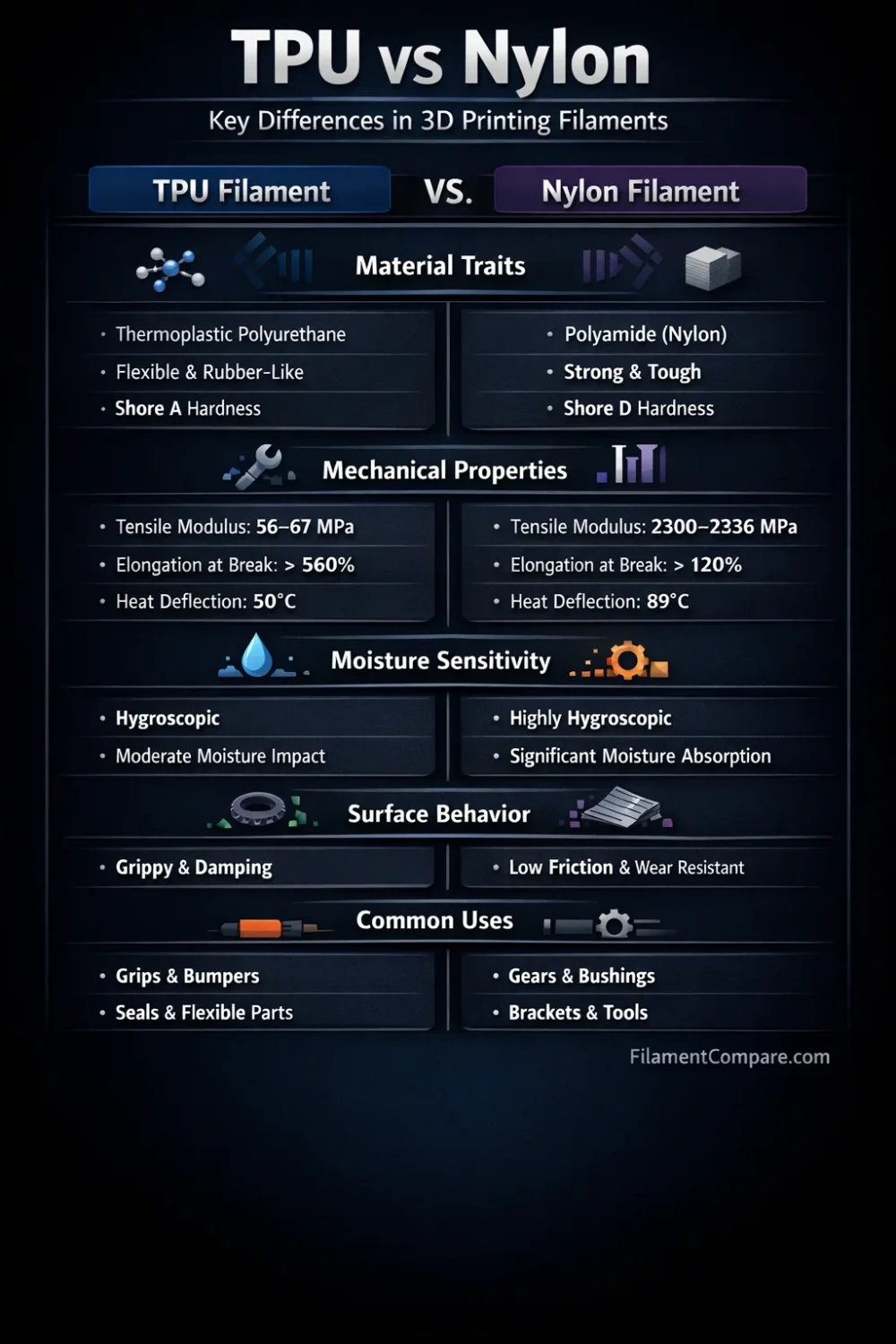
TPU is an elastomer that bends and rebounds, while Nylon is a tough polyamide that holds shape and carries structural load. Choose TPU for parts that must compress, flex, grip, or absorb shock; choose Nylon for gears, hinges, brackets, and wear parts that need controlled stiffness. Both demand dry filament, but their main printing problems are different.
The Practical Choice
Choose TPU when elastic recovery, vibration damping, soft contact, or repeated bending defines the part. Choose Nylon when the design needs a load-bearing engineering plastic with low friction, abrasion resistance, fatigue tolerance, and better shape retention under moderate heat.
There is no useful overall winner: TPU behaves more like printable rubber, while Nylon behaves more like a tough, slightly yielding structural plastic.
Flexible Seals and Bumpers
TPU deforms around contact surfaces and returns toward its original shape.
Gears and Bushings
Nylon offers a firmer tooth profile, low friction, and good wear behavior.
Impact Cushioning
TPU absorbs energy through controlled elastic deformation.
Structural Brackets
Nylon holds geometry and fastener loads better than common soft TPU grades.
Low-Warp Printing
TPU usually shrinks less, although feeding and stringing still require tuning.
Moderate Heat Exposure
Nylon is usually the better fit, with grade and test method still deciding the limit.
Repeated Snap Motion
Nylon suits firm clips and living hinges; TPU suits softer latches that can stretch farther.
Soft Grips and Wearables
TPU provides a compliant surface (skin-contact suitability still depends on the exact grade and manufacturing process).
| Decision Area | TPU | Nylon | More Suitable Choice |
|---|---|---|---|
| Material Family | Thermoplastic polyurethane; part of the thermoplastic elastomer family | Polyamide family, including PA6, PA12, PA11, copolyamides, and filled variants | Different material roles |
| Typical Part Behavior | Rubber-like, elastic, compressible, and highly bendable | Tough, fatigue-resistant, slightly yielding, and structurally firmer | Depends on required motion |
| Print Difficulty | Moderate to advanced; soft filament can buckle, ooze, and string | Advanced; moisture, warping, high temperature, and bed adhesion require control | Different difficulties |
| Typical Nozzle Temperature | About 220–245 °C for many 95A-class grades | Often about 250–290 °C; grade profiles vary widely | Printer-dependent |
| Typical Bed Temperature | About 55–75 °C for many printable TPU grades[a] | Often about 70–110 °C; one unfilled-polyamide guide specifies 110 °C[b] | Grade-dependent |
| Enclosure | Usually not required; excess chamber heat can soften the feed path | Recommended for many unfilled grades, especially large parts | TPU for open printers |
| Flexibility | Very high; Shore hardness strongly changes feel | Low to moderate in normal sections; thin Nylon features can flex | TPU |
| Load-Bearing Stiffness | Low for common 85A–98A grades; harder TPU grades are a separate case | Much higher than soft TPU, though still less rigid than many filled engineering materials | Nylon |
| Elastic Recovery | High when strain stays within the grade and geometry limits | Some spring and fatigue tolerance, but not rubber-like recovery | TPU |
| Abrasion and Wear | Very good for rubbing, protective, and traction surfaces | Very good for gears, sliders, bushings, and moving mechanisms | Contact type decides |
| Layer Adhesion | Usually strong, which can make supports hard to remove | Usually strong when dry and printed at the correct thermal conditions | Both can perform well |
| Moisture Sensitivity | Hygroscopic; wet material can foam, pop, string, and lose surface quality | Highly moisture-sensitive in many grades; moisture can alter printing and finished-part behavior | TPU is often easier to manage |
| Warping | Usually low | Often high in unfilled grades, especially on broad or thick parts | TPU |
| Dimensional Precision | Limited by elastic walls, extrusion pressure, and measurement force | Better for rigid dimensions after moisture and warping are controlled | Nylon |
| Heat Fit | Grade-dependent; softening under load may begin well below a quoted Vicat value | Usually better for warm functional service, with PA family and conditioning affecting results | Nylon |
| Typical Uses | Gaskets, feet, grips, bumpers, flexible couplings, sleeves, tires, and protective cases | Gears, hinges, jigs, clips, bushings, brackets, tools, and replacement parts | Use-case based |
| Main Limitation | Low stiffness, slow printing, stringing, support removal, and sustained-load deformation | Drying needs, warping, high printer temperatures, and dimensional change with moisture | Match the limitation to the part |
This TPU and Nylon comparison combines official manufacturer datasheets and material guides; the patterns are general, while brand, color, hardness, polyamide grade, additives, moisture, orientation, and print settings can move the actual result.
Material Profiles
TPU Material Profile
- Polymer type: Thermoplastic polyurethane elastomer
- Print difficulty: Moderate to advanced
- Nozzle range: Commonly low-to-mid 200s °C, grade-dependent
- Bed range: Usually moderate heat
- Enclosure: Normally unnecessary
- Drying need: Recommended when storage humidity or print symptoms indicate moisture
- Typical behavior: Elastic, impact-absorbing, abrasion-resistant, and low in stiffness
- Best uses: Bumpers, feet, grips, protective covers, flexible joints, and soft wheels
Nylon Material Profile
- Polymer type: Polyamide family rather than one single formulation
- Print difficulty: Advanced
- Nozzle range: Commonly mid-to-high 200s °C, depending on PA grade
- Bed range: Moderate to high heat
- Enclosure: Often recommended for unfilled Nylon
- Drying need: Usually essential before and during long prints
- Typical behavior: Tough, wear-resistant, low-friction, fatigue-tolerant, and moderately flexible in thin sections
- Best uses: Gears, hinges, clips, bushings, fixtures, and mechanical replacements
Relative Printing-Use Scores
TPU
Nylon
These meters are relative indicators for printed-part selection, not laboratory ratings. Hardness, PA type, additives, color, absorbed moisture, wall layout, orientation, and slicer settings can change the order for a specific design.
Elastic Response Is Not the Same as Structural Flexibility
TPU and Nylon are both described as “flexible,” but that word refers to two different responses. TPU can stretch, compress, and bend through large movement, then recover much of its original geometry. Nylon normally moves through a smaller range and resists that movement with far more force.
A soft TPU bracket may survive a collision because it folds away from the load, yet it may not keep two shafts aligned. A Nylon bracket is far more suitable for alignment and fastener pressure, but it will not behave like a soft bumper. For mechanisms, the useful question is not simply which material bends; it is how far it should bend and how firmly it must return.
Hardness and Grade Names Matter
TPU 85A, TPU 95A, and harder D-scale TPU do not feel like the same material. A harder TPU can hold detail and feed more reliably, while a softer grade produces greater compliance but magnifies extrusion problems. “Nylon” is equally broad: PA6, PA12, PA11, copolyamides, and filled grades differ in moisture uptake, stiffness, warping, temperature behavior, and surface finish.
Generic TPU vs Nylon advice should therefore be treated as a family-level decision. The final profile must come from the spool manufacturer.
Drying Changes the Print Before It Changes the Part
Both materials absorb moisture. Wet TPU often shows extra stringing, popping, bubbles, rough walls, or inconsistent extrusion. Nylon can show the same symptoms more strongly, and moisture can also change the stiffness and dimensions of the completed part after printing.
For Nylon, a dry box is not merely storage convenience. Feeding directly from a controlled container helps long jobs remain consistent. The official Prusa Nylon guide advises drying for at least four hours below 90 °C for its referenced polyamide workflow, but the spool maker’s own limit should take priority because low-temperature spools and additives can be damaged by an unsuitable dryer setting.
Do not use one drying recipe for every spool. TPU can deform on a hot reel, while Nylon grades may need different time and temperature combinations. Check the packaging, technical page, and spool material before heating.
Feed Control and Warping Need Opposite Solutions
TPU usually stays flat on the build plate, but it can compress between the drive gears and hotend. A short, constrained filament path is helpful. Retraction should be restrained, idler pressure should not crush the filament, and speed often needs to be lower than for rigid materials. Prusa’s general flexible-material guidance describes about 20 mm/s as typical and 30–40 mm/s as a practical upper range for many flexible workflows[e].
Nylon feeds like a rigid filament, but the printed object wants to contract. A warm, stable chamber, a suitable Nylon surface or adhesive system, a brim, rounded corners, and restrained cooling can reduce edge lift. Large flat Nylon parts remain more demanding than small gears or compact clips.
Typical TPU Failure Pattern
- Filament buckles before the melt zone
- Excess idler pressure distorts feeding
- Retraction creates jams or inconsistent restart
- Stringing and oozing mark open travel paths
- Supports bond too firmly to the model
Typical Nylon Failure Pattern
- Moisture produces bubbles and rough extrusion
- Corners lift as the part contracts
- Weak bed preparation releases the first layer
- Cold air causes layer stress on larger parts
- Printed dimensions shift as the part conditions
Heat Ratings Must Be Read with the Test Method
A single temperature number can mislead material selection. Vicat softening, heat-deflection temperature, melting temperature, and a maker’s recommended service limit describe different events. A part carrying load can deform well before the polymer approaches its melting point.
UltiMaker’s TPU 95A datasheet is a useful example: the printed grade is listed at about 50.3 °C HDT under 0.455 MPa, while its Vicat value is about 115.7 °C. The same sheet reports about 96 Shore A hardness and very high elongation in flat test orientations[c]. Those figures do not mean a loaded TPU bracket will remain dimensionally firm near the higher number.
For one UltiMaker PA6/66 Nylon grade, the published HDT at 0.455 MPa is about 89.2 °C, with a tensile modulus around 2.3 GPa in the listed print orientations[d]. That grade illustrates why Nylon is normally chosen over soft TPU for a warm fixture, gear, or bracket, but another Nylon formulation may produce a different limit.
Part Geometry Can Reverse a Simple Material Rule
Wall count, infill, thickness, ribs, and print direction may matter as much as the material label. A TPU part with thick walls and dense infill can feel unexpectedly firm. The same grade printed as a thin lattice can compress easily. Nylon can form a rigid housing in a thick section and a durable flexure in a thin one.
TPU is usually preferred when the whole part must deform. Nylon is usually preferred when movement should occur only at a designed hinge, spring arm, or snap feature while the surrounding body stays aligned. Under constant load, TPU is also more likely to relax or take a set, so bolted joints, belt tensioners, and dimension-critical spacers need careful validation.
Use-Case Recommendations
| Use Case | More Suitable Material | Reason |
|---|---|---|
| Protective phone or device case | TPU | Soft impact absorption, grip, and elastic edge retention |
| Machine gear | Nylon | Firmer tooth geometry, wear resistance, and low-friction behavior |
| Vibration-isolating foot | TPU | Compression and damping reduce transmitted vibration |
| Bushing or sliding guide | Nylon | Better dimensional support for a moving shaft or rail |
| Soft gasket for a prototype | TPU | Conforms to uneven contact surfaces (pressure, fluid, and chemical compatibility require testing) |
| Living hinge with a firm body | Nylon | Thin Nylon sections can flex repeatedly while thicker walls retain structure |
| RC tire or compliant wheel | TPU | Traction, impact absorption, and tunable softness |
| Structural equipment bracket | Nylon | Higher stiffness and better fastener-load support |
| Cable strain relief | TPU | Gradual bending and soft contact protect the cable |
| Snap-fit enclosure clip | Nylon | Firm spring action and fatigue tolerance when the geometry is tuned |
| Protective impact bumper | TPU | Large reversible deformation spreads the impact |
| Warm assembly fixture | Nylon | Usually better shape retention under moderate heat, subject to the selected PA grade |
| Large flat open-frame print | TPU | Lower shrinkage reduces warping, provided the flexible part still meets the design need |
| Dimensioned mechanical spacer | Nylon | Better stiffness, although moisture conditioning must be considered |
Where Each Material Fits Better
Choose TPU When
- The part must bend, stretch, compress, or rebound.
- Impact absorption matters more than rigid alignment.
- A soft grip, non-scratch contact, or vibration-damping surface is needed.
- The printer is open-frame and the design cannot tolerate Nylon warping.
- Thin flexible features would be too stiff in a normal Nylon grade.
TPU Is Less Suitable When
- The part must hold a precise bearing, shaft, or gear position.
- A fastener must remain tightly clamped for long periods.
- Supports, bridges, and crisp overhangs dominate the geometry.
- High-speed printing is required without a tested flexible-material system.
- Service heat acts together with structural load.
Choose Nylon When
- The part carries load but still benefits from toughness and some yield.
- Wear, sliding contact, or repeated mechanical cycling is expected.
- Gears, hinges, clips, jigs, and functional replacements need firm geometry.
- Moderate heat resistance is more important than rubber-like movement.
- The printer can maintain a dry feed path, suitable bed adhesion, and stable ambient temperature.
Nylon Is Less Suitable When
- The printer cannot reach the grade’s nozzle or bed temperature.
- The part is broad and flat but no enclosure or adhesion system is available.
- The required motion is soft, compressible, or highly elastic.
- Humidity-driven dimensional change cannot be accepted.
- The filament cannot be dried and kept dry during the print.
Carbon-Fiber Nylon Is a Separate Decision
Chopped carbon fiber changes Nylon’s print behavior and part feel. It commonly increases stiffness and dimensional stability while reducing the ductile, hinge-like behavior associated with unfilled Nylon. Many filled grades warp less, but they also require an abrasion-resistant nozzle and should not be treated as a direct substitute for soft TPU.
A comparison between TPU and PA-CF is therefore more extreme: TPU supplies elastic movement, while PA-CF supplies a stiff engineering structure. For a rigid frame with a soft contact surface, printing separate Nylon or PA-CF and TPU components is often more sensible than forcing one material to perform both roles.
Material Selection Matrix
Best Choice by Priority
Choose TPU if the part must act as a bumper, gasket, foot, tire, grip, flexible sleeve, strain relief, or soft coupling. Start with a firmer grade such as 95A when feed reliability and detail matter more than maximum softness.
Choose Nylon if the part must act as a gear, bushing, hinge, snap fit, tool, bracket, jig, or wear-resistant mechanical replacement. Select the exact PA grade around moisture exposure, chamber capability, heat, stiffness, and dimensional tolerance.
Use both materials as separate parts if the assembly needs a rigid load path and a compliant contact surface. TPU does not replace Nylon for structural alignment, and Nylon does not replace TPU for rubber-like recovery.
Common TPU and Nylon Questions
Is Nylon flexible like TPU?
No. Nylon can bend and survive repeated flexing, especially in thin sections, but normal Nylon filament does not compress or stretch like an elastomeric TPU.
Which material is stronger?
Nylon is usually stronger for structural stiffness, fastener loads, gears, and dimensioned mechanisms. TPU is usually stronger at surviving large elastic deformation, blunt impact, and repeated compression without brittle fracture.
Which filament handles heat better?
Nylon generally retains useful structural shape at higher temperatures than common soft TPU grades. The answer still depends on the exact grade, load, test method, moisture state, and time at temperature.
Does TPU need drying?
Yes, many TPU grades benefit from drying when they have absorbed moisture. Popping, foamy extrusion, extra stringing, and a rough surface are common warning signs.
Can TPU be used for gears?
TPU can work for low-load compliant gears, quiet drives, or mechanisms designed around tooth deformation. Nylon is normally the better choice when tooth accuracy, torque transfer, and shaft alignment matter.
Can Nylon be printed without an enclosure?
Small parts and some modified or filled grades may print successfully without one. Large unfilled Nylon parts are more likely to warp, so an enclosure and a suitable build surface usually improve consistency.
Technical Resources Used
- [a] Prusament TPU 95A material guide | Prusa Knowledge Base (Used for the published TPU 95A nozzle and bed ranges and printer-preparation context.)
- [b] Polyamide (Nylon) | Prusa Knowledge Base (Used for the referenced unfilled Nylon temperatures, drying guidance, warping behavior, enclosure advice, and low-friction use context.)
- [c] Ultimaker TPU 95A Technical data sheet (Used for grade-specific Shore hardness, elongation, HDT, Vicat, orientation, and test-method distinctions.)
- [d] Nylon 3D printing material – UltiMaker (Used for the PA6/66 grade description, low-friction and wear applications, tensile modulus, and heat-deflection data.)
- [e] Flexible materials | Prusa Knowledge Base (Used for flexible-filament feed behavior, slow-speed guidance, layer adhesion, moisture sensitivity, bed separation, and common print problems.)
