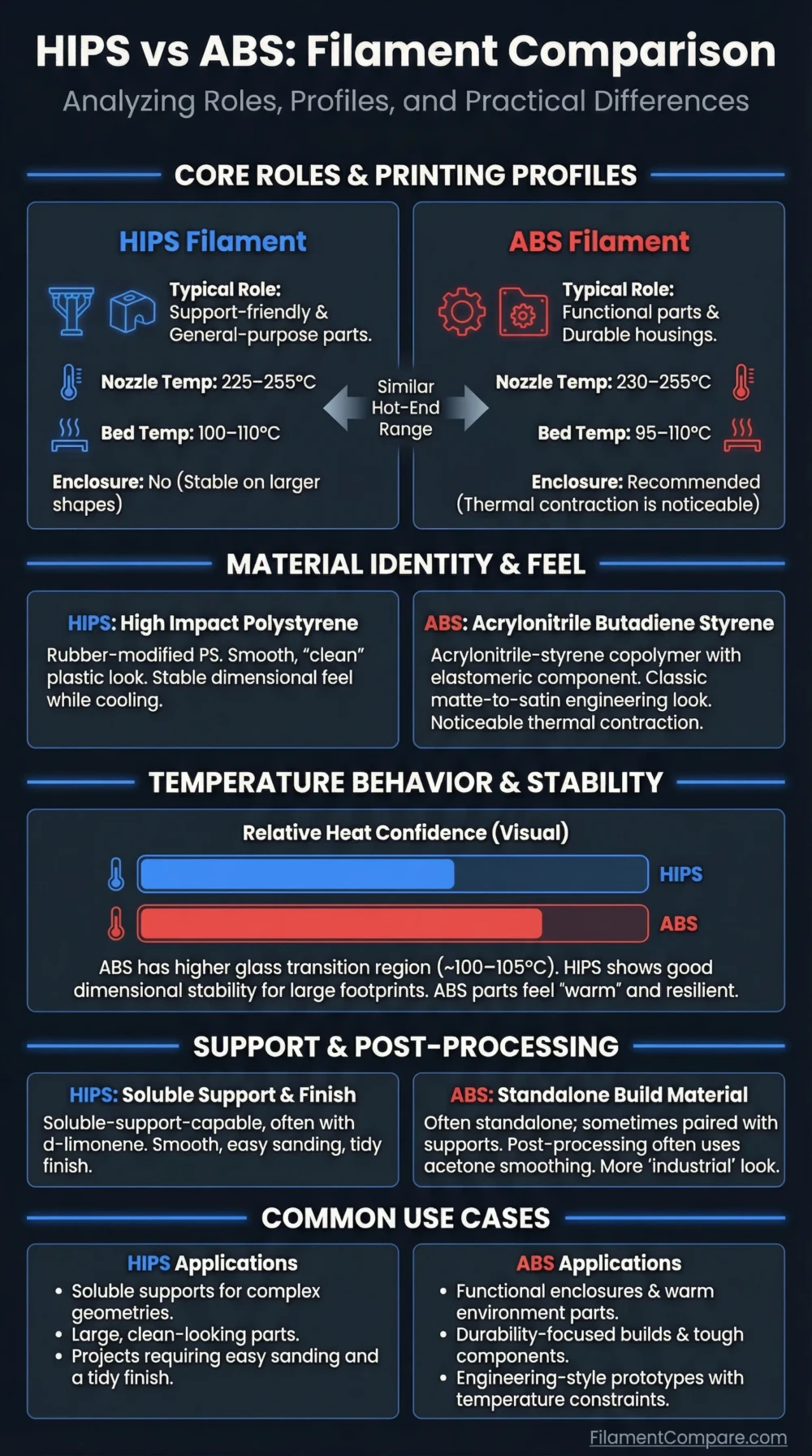
HIPS is easier to treat as a removable support material, while ABS is the stronger choice for standalone functional parts that need more heat tolerance and post-processing options. Both materials print in the same high-temperature family, so an enclosed printer, stable bed adhesion, and controlled cooling matter more than they do with PLA or PETG. Choose HIPS when soluble support behavior or clean breakaway support strategy is the priority; choose ABS when the printed part itself must carry load, tolerate moderate warmth, and accept sanding or acetone vapor smoothing.
Choose HIPS if you need a support material for ABS, want easier post-print support removal with limonene-compatible workflows, or are printing lightweight visual parts with moderate mechanical demands.
Choose ABS if the part itself needs better structural use, higher stiffness, better heat shape retention, and more established finishing methods.
No single winner fits every job. HIPS and ABS overlap in printer requirements, but they solve different problems: HIPS is support-oriented and easier to sacrifice; ABS is usually the better end-use material.
Best for Soluble Supports
HIPS. It can dissolve in limonene, which makes it useful as a support material for ABS prints when the printer has dual extrusion.
Better for Functional Parts
ABS. It is usually a better fit for brackets, housings, covers, and workshop parts that need more stiffness and impact resistance.
Better Heat Tolerance
ABS. Typical ABS grades hold shape better in warm service conditions, though hot enclosed spaces can still exceed its comfort range.
Better Support Removal
HIPS. It is designed for removable support use, especially where complex internal geometry makes manual support cleanup difficult.
Better Surface Finishing
ABS. ABS can be sanded, machined, glued, welded, and acetone-smoothed with proper safety controls.
Better for Low-Warp Printing
Neither is ideal. Both prefer a warm enclosed environment. HIPS can be manageable, but ABS grades vary widely by brand and formulation.
Better for Dual Extrusion
HIPS with ABS. HIPS is most valuable when paired with ABS as a support material rather than used as a direct ABS replacement.
Better General Availability
ABS. ABS is more common in printer profiles, slicer presets, and commercial filament lines.
| Category | HIPS | ABS | Better Choice |
|---|---|---|---|
| Material Family | High-impact polystyrene | Acrylonitrile butadiene styrene | Different polymer families |
| Main Role | Soluble support for ABS, lightweight models, low-stress parts | Functional parts, enclosures, fixtures, post-processed models | Use-case based |
| Print Difficulty | Medium to high; enclosure helps | Medium to high; enclosure strongly recommended | Similar |
| Typical Nozzle Temperature | Usually about 220–260 °C depending on grade[a] | Usually about 230–260 °C depending on grade and printer profile[b] | Similar range |
| Typical Bed Temperature | Usually 90–120 °C | Usually 80–110 °C | Printer-dependent |
| Enclosure Requirement | Recommended for larger parts | Recommended, often needed for stable large prints | HIPS, slightly easier in some setups |
| Heat Resistance | Moderate; many grades sit near ABS-like service ranges | Moderate to good for FDM plastics; ABS TDS values often show HDT around the mid-80 °C range under test load[c] | ABS |
| Toughness | Good impact-modified behavior, but less proven as a structural print material | Good impact resistance and practical toughness when printed well | ABS |
| Stiffness | Moderate; grade-dependent | Moderate to good; often better for housings and fixtures | ABS |
| Layer Adhesion | Can be good with heat and enclosure control | Can be strong, but cooling drafts and low chamber temperature reduce results | Settings-dependent |
| Moisture Sensitivity | Lower than nylon, but dry storage is still recommended | Lower than nylon, but wet filament can worsen surface quality and bubbles | Similar |
| Solvent Behavior | Dissolves in limonene, useful for support removal | Can be smoothed, bonded, or welded with acetone-based methods under controlled conditions[d] | Different solvents |
| Surface Finish | Matte to satin, easy to sand in many cases | Satin to glossy depending on brand; strong finishing ecosystem | ABS |
| Outdoor Suitability | Limited for long-term sun exposure unless grade is stabilized | Better than HIPS for some outdoor parts, but ASA is usually preferred for UV exposure | ABS, with limits |
| Main Limitation | Less suitable as a primary structural material | Warping, odor, ventilation need, and enclosure sensitivity | Different limits |
This HIPS vs ABS comparison uses manufacturer datasheets and material guidance as a baseline, but the trends should be read as practical FDM ranges because brand, pigment, additives, moisture, part geometry, chamber temperature, and slicer settings can change real print behavior.
HIPS Material Profile
- Polymer type: High-impact polystyrene.
- Print difficulty: Medium; easier on enclosed printers with a warm bed.
- Nozzle range: Commonly 220–260 °C, with brand variation.
- Bed range: Commonly 90–120 °C.
- Enclosure: Recommended for large or flat parts.
- Drying need: Usually moderate; keep sealed for more consistent extrusion.
- Typical behavior: Lightweight, sandable, limonene-soluble, support-friendly.
- Best use cases: ABS supports, prototypes, low-load models, sacrificial structures.
ABS Material Profile
- Polymer type: Acrylonitrile butadiene styrene.
- Print difficulty: Medium to high; warping control is the main challenge.
- Nozzle range: Commonly 230–260 °C.
- Bed range: Commonly 80–110 °C.
- Enclosure: Strongly recommended, especially for larger parts.
- Drying need: Helpful when surface defects, bubbles, or weak extrusion appear.
- Typical behavior: Tough, machinable, acetone-smoothable, shrinkage-prone.
- Best use cases: Housings, tool parts, brackets, covers, fixtures, post-processed models.
The meter scores are relative shop-floor indicators, not fixed lab ratings. Real results change with brand, additives, color, drying state, chamber temperature, print orientation, wall count, infill, and slicer cooling strategy.
Printability and Tuning Behavior
HIPS and ABS both print hotter than PLA, and both dislike drafts. A fully open-frame printer can handle small test pieces, but large flat parts are more likely to curl at corners unless the bed surface, first layer, chamber temperature, and cooling are controlled.
HIPS is often slightly more forgiving when used as a support or smaller standalone print because it does not always demand the same structural consistency as the final part. That does not make it a beginner filament. It still benefits from a warm bed, slow cooling, clean build surface, and a brim on geometry with sharp corners.
ABS is more tuning-sensitive because users usually expect the finished part to survive real use. Weak layer bonding, corner lift, or internal stress can turn into cracks around screw holes and loaded corners. For ABS, the enclosure is not only about bed adhesion; it also helps reduce uneven shrinkage through the height of the part.
Practical Setup Notes
- Use an enclosure for medium and large parts (even a passive enclosure can help).
- Use low fan or no fan unless overhangs need controlled cooling.
- Add a brim for flat ABS parts and wide HIPS support bases.
- Let parts cool gradually before removal to reduce stress and corner cracking.
- Vent the printing area properly; both materials can produce noticeable emissions during hot extrusion.
Support Material Role and Solvent Workflow
The biggest reason to choose HIPS is not raw part strength. It is support removal. HIPS is compatible with ABS printing temperatures and can be dissolved in limonene, which makes it useful for dual-extrusion prints with internal channels, undercuts, and support areas that tools cannot reach. Flashforge describes HIPS as completely soluble in limonene and usable as a support material[e].
This workflow is useful, but it is slower than snapping away normal supports. Limonene handling needs ventilation, sealed containers, and enough time for the support to soften. HIPS support material also needs purge tuning because ABS and HIPS can contaminate each other at tool changes if prime towers, wipe volumes, or standby temperatures are not tuned.
ABS, by contrast, is usually the main model material in this pairing. It can print support interfaces from the same material, but support scars and manual cleanup are more common on complex shapes. If the print has simple overhangs, ABS-only supports may be enough. If the print has hidden cavities or fragile detail, HIPS support can save cleanup time.
Mechanical Behavior in Finished Parts
ABS is usually the safer choice for finished functional parts. It has a strong record in housings, covers, brackets, tool organizers, jigs, and snap-fit-like parts where toughness matters. It is not the stiffest FDM material, but it balances impact resistance, machinability, and moderate heat tolerance better than HIPS in most end-use prints.
HIPS can still be printed as a standalone material. It is lightweight, has a clean visual finish, and can be useful for prototypes, display models, cosplay forms, low-load covers, and parts that will be sanded or painted. Its limitation is that it is less commonly chosen when screw retention, repeated flexing, heat exposure, or loaded mounting points matter.
Strength comparisons need context. A thick HIPS part with good layer bonding may outperform a poorly printed ABS part. Print orientation, perimeter count, chamber temperature, nozzle temperature, moisture, infill pattern, and annealing attempts can change the result more than the material name alone.
Heat, Shrinkage, and Dimensional Stability
ABS normally has the advantage when shape retention under warmth matters. That makes it better for parts near electronics, printer accessories, light-duty mechanical housings, and workshop fixtures. It is still not a high-temperature engineering polymer. A closed vehicle interior, heated machine bay, or sun-exposed black part can reach temperatures where standard ABS may soften or deform.
HIPS sits in a similar printing temperature zone, but its strongest identity is not thermal performance. Some HIPS datasheets show heat deflection values near ABS-like ranges, while others vary by grade. For decision-making, treat HIPS as a moderate-heat material and ABS as the better general pick when the printed object must stay usable under warmer conditions.
Both materials shrink as they cool. ABS is especially known for corner lift, layer splitting, and internal stress on large geometry. HIPS can also warp, but when used as support material, small distortions in the support are often less damaging than distortion in the final ABS model.
Surface Finish, Sanding, and Post-Processing
HIPS often gives a pleasant matte or low-gloss finish and is easy to sand. This makes it useful for painted models, props, temporary tooling, and sacrificial structures. Because it is commonly used as support, surface quality is usually judged by how cleanly it separates or dissolves rather than how polished the HIPS itself looks.
ABS offers a wider finishing toolkit. It can be sanded, drilled, tapped with care, glued, welded, and acetone-smoothed. Acetone vapor smoothing can reduce visible layer lines, but it also changes surface dimensions and can soften fine edges. Use it as a finishing method, not as a way to repair weak print settings.
Printer Requirements and Build Plate Needs
A printer that can print ABS can often print HIPS, but the reverse is not always useful. For HIPS as a support material, the printer needs dual extrusion or a tool-changing system. For ABS as a final part material, the printer needs stable thermal control, enough hotend temperature, a heated bed, and preferably an enclosure.
Build plate choice matters. PEI, ABS slurry, dedicated adhesion films, glue-stick layers, and textured plates can all work depending on printer design. The safest approach is to follow the printer manufacturer’s plate guidance first, then tune bed temperature, first-layer speed, brim size, and part orientation.
Do not overuse cooling. Too much fan can improve small overhangs while weakening interlayer bonding and increasing warp. For both materials, part cooling should be treated as a tuning tool, not a default setting.
| Use Case | Better Material | Reason |
|---|---|---|
| Dual-extrusion ABS supports | HIPS | HIPS can be dissolved in limonene, making it useful for complex support removal. |
| Functional brackets | ABS | ABS is usually better for load-bearing use when printed in an enclosure. |
| Visual prototypes | HIPS | HIPS sands well and can produce clean low-gloss prototype surfaces. |
| Machine covers and housings | ABS | ABS has better general fit for impact, moderate warmth, and finishing. |
| Complex internal channels | HIPS with ABS | Soluble support can reach areas that pliers and cutters cannot access. |
| Large flat prints | Neither is easy | Both need enclosure control, brim strategy, and gradual cooling to reduce warping. |
| Acetone-smoothed display parts | ABS | ABS has a well-known acetone finishing workflow when handled safely. |
| Low-load painted models | HIPS | HIPS is easy to sand and finish, provided heat and load demands are low. |
| Parts near moderate heat | ABS | ABS is normally the better pick, though grade and service temperature still matter. |
| Beginner open-frame printing | Neither | PLA, PETG, or ASA-specific easy-print blends may be less tuning-sensitive. |
Choose HIPS When
- You need removable support material for ABS.
- The model has internal cavities or support zones that are hard to reach.
- The HIPS part is mostly visual, sacrificial, or lightly loaded.
- You want a sandable material for painted prototypes.
- You have a dual-extrusion printer and can tune purge behavior.
HIPS Is Less Suitable When
- The printed part must carry repeated mechanical load.
- The part will be used outdoors for long periods without coating or stabilization.
- You do not want to handle limonene or solvent cleanup.
- You are using a single-extruder printer and do not need soluble supports.
Choose ABS When
- You need a stronger finished part rather than a support structure.
- The print must tolerate more warmth than PLA or many easy-print materials.
- You want sanding, machining, bonding, or acetone smoothing options.
- You are making housings, covers, fixtures, brackets, or workshop parts.
- Your printer has an enclosure and good bed adhesion control.
ABS Is Less Suitable When
- You print on an open-frame machine in a drafty room.
- The part is very large, flat, and sharp-cornered without warp mitigation.
- You need long-term UV exposure performance; ASA is usually a better candidate.
- You need clean support removal from complex hidden geometry without dual extrusion.
Choose HIPS if the job is mainly about support removal, low-load prototype work, or a sandable model material that pairs well with ABS in dual extrusion.
Choose ABS if the printed part is the final object and needs better strength, practical toughness, heat tolerance, and finishing flexibility.
The most practical pairing is often ABS for the model and HIPS for the supports. For single-material printing, ABS is usually the more useful engineering choice; HIPS is more specialized.
Common HIPS and ABS Questions
Can HIPS replace ABS for functional parts?
Sometimes, but not as a direct replacement. HIPS can work for low-load covers, prototypes, and display parts, but ABS is usually a better choice for brackets, housings, and parts that need stronger mechanical behavior.
Is HIPS only used as support material?
No. HIPS can be printed as a standalone filament, but its strongest advantage in FDM printing is soluble support use with ABS. That is where it solves a problem ABS cannot solve by itself.
Do HIPS and ABS need an enclosure?
For small parts, both may print without a full enclosure on some machines. For larger parts, flat parts, or prints with sharp corners, an enclosure is strongly recommended to reduce warping and layer splitting.
Which one smells more during printing?
Both can produce noticeable odor during extrusion. ABS is well known for this, and HIPS can also smell during hot printing. Use ventilation and avoid printing either material in an unventilated living area.
Can ABS use HIPS supports on any printer?
No. You need a dual-extrusion, independent dual-extrusion, tool-changing, or multi-material system that can print the model material and support material separately. A standard single-nozzle printer cannot print true HIPS support interfaces unless it has a material-switching setup.
Is ABS better than HIPS for outdoor use?
ABS is usually more suitable than HIPS for some mild outdoor parts, but neither should be treated as the default choice for long sun exposure. ASA or UV-stabilized grades are better candidates when outdoor durability is the main requirement.
Resources Used
- [a] Technical Data Sheet for Innofil3D HiPS Version No. 2.0 (Used for HIPS nozzle range, bed range, drying guidance, glass transition value, and HDT behavior in the comparison and profile sections.)
- [b] Technical Data Sheet ABS Premium 3D Printer Filament (Used for ABS print temperature and bed temperature ranges, storage guidance, and acetone-related post-processing context.)
- [c] Bambu Filament Technical Data Sheet V3.0 ABS (Used for ABS HDT, Vicat softening, density, and mechanical-property context where ABS heat behavior is discussed.)
- [d] Download – Material – Polymaker (Used as a current manufacturer material-download reference for ABS-family documentation availability and grade variation.)
- [e] Technical Data Sheet HIPS Filament (Used for HIPS support-material role, limonene solubility, density range, water absorption, and HIPS mechanical-property context.)
