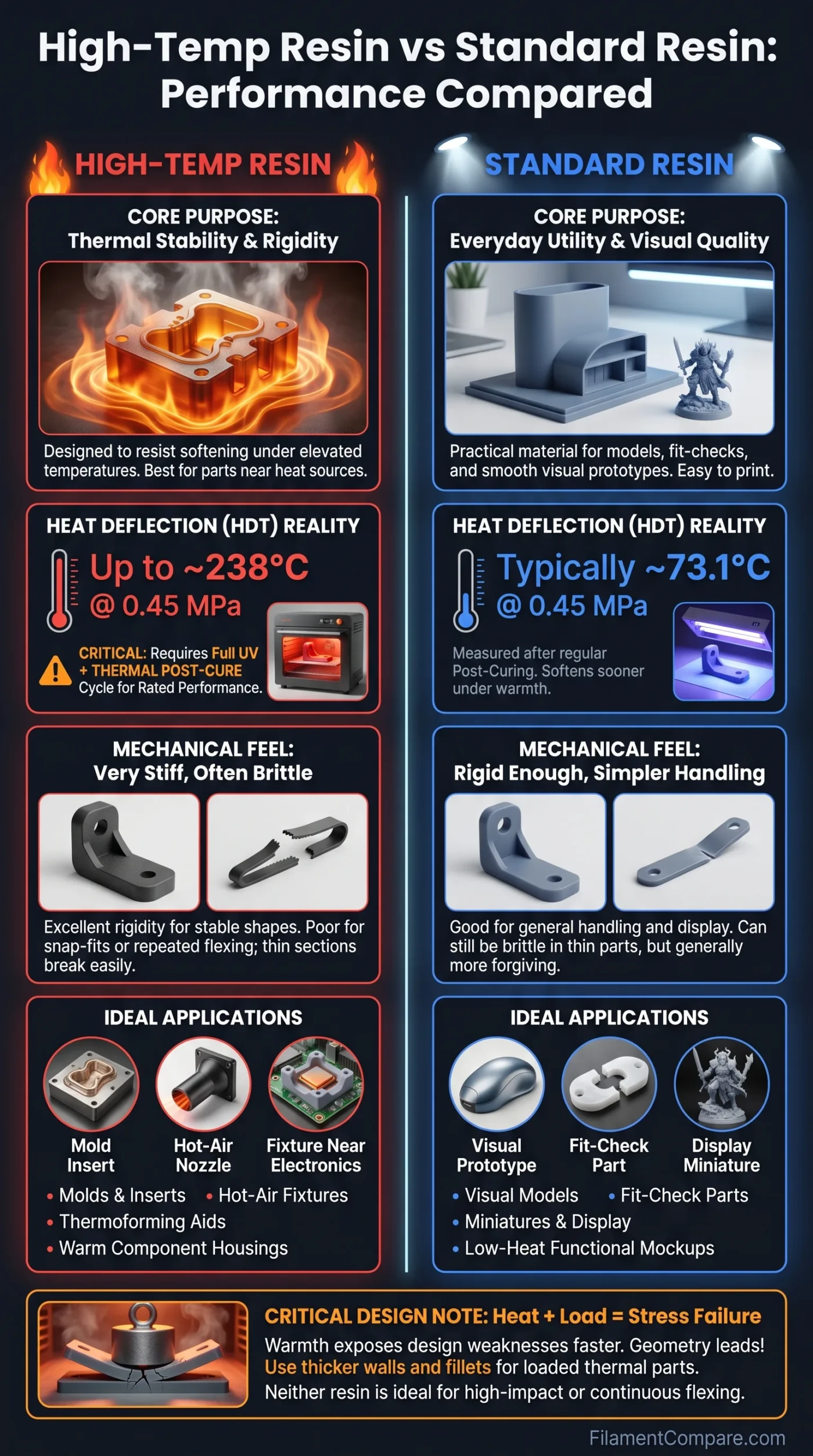
| Comparison Point | High-Temp Resin | Standard Resin |
|---|---|---|
| Main purpose | Heat-resistant prototypes, molds, inserts, hot-air fixtures, flow-contact parts, housings near warm components | Visual models, fit-check parts, miniatures, display pieces, general prototypes, low-heat functional mockups |
| Heat deflection behavior | Designed for high HDT; some engineering grades reach around 238°C at 0.45 MPa after the correct cure cycle [a] | Usually much lower HDT; one common standard resin datasheet lists about 73.1°C at 0.45 MPa after post-curing [b] |
| Stiffness | Often very rigid; good for stable shapes under warmth, but less friendly for snap-fit flex | Rigid enough for everyday models, easier to handle for non-thermal prototypes |
| Toughness feel | Usually firm and glassy; thin clips and living-hinge shapes should be designed with care | Can be brittle in thin sections, yet still practical for display models and shape checks |
| Surface detail | Excellent fine detail when exposure and post-cure are tuned correctly | Excellent fine detail with easier default printing behavior on many desktop resin printers |
| Dimensional stability | Better suited to warm environments after full cure, but cure shrinkage and thermal post-cure can affect final dimensions | Good for room-temperature display and fit checks; warmth can soften the part sooner |
| Post-processing demand | More demanding. Full UV cure, and sometimes thermal post-cure, matters for rated heat performance | Simpler. Wash and UV cure are still needed, but the workflow is usually more forgiving |
| Best use match | Parts exposed to heat for short-term testing, thermoforming aids, hot-fluid visualization, fixtures near warm air | General resin printing, low-cost prototypes, visual parts, models that do not need elevated-temperature strength |
| Cost profile | Usually higher per liter because of engineering formulation | Usually lower per liter and easier to keep in regular stock |
| Beginner friendliness | Moderate. It rewards controlled washing, curing, support design, and temperature management | High. It is the common starting point for SLA, LCD, and MSLA printing |
This comparison treats high-temp resin and standard resin as material categories, using manufacturer datasheets and recognized test methods as reference points; real printer results can shift with resin brand, layer height, exposure, orientation, wall thickness, wash time, UV cure, and thermal post-cure.
High-temp resin and standard resin can both create clean, detailed SLA or MSLA prints, but they are made for different jobs. Standard resin is the practical everyday material for models, fit checks, and smooth visual prototypes. High-temp resin is the better match when a printed part must keep its shape near heat, warm airflow, molds, or short thermal testing.
The simple difference is this: standard resin focuses on easy printing and good surface quality, while high-temp resin focuses on thermal stability. Same printer family. Different material target.
What High-Temp Resin Means
High-temp resin is a photopolymer resin formulated to resist softening under elevated temperature better than general-purpose resin. In datasheets, the most useful thermal number is usually HDT, short for heat deflection temperature. HDT is not the temperature where the part melts. Resin prints are thermoset-like cured polymers, so they do not melt like PLA filament. HDT is the temperature where a test bar bends by a set amount under a defined load.
That load matters. A resin rated at a high HDT under 0.45 MPa may show a lower number under 1.8 MPa. So when two resins are compared, the load level and test method need to match. Otherwise, the numbers look cleaner than the real comparison.
- HDT
- Heat deflection temperature; a short-term stiffness-under-heat test, commonly reported with ASTM D648 or ISO 75.
- Post-cure
- Extra UV curing after printing and washing. It can raise stiffness, strength, and temperature resistance.
- Thermal post-cure
- A controlled heat treatment after UV cure. Some high-temp resins need it to reach their best HDT value.
- Green part
- A printed and washed part before full post-curing. It usually has lower final properties than a fully cured part.
What Standard Resin Means
Standard resin is the general-purpose material most resin printer users start with. It is made for smooth surfaces, sharp detail, simple settings, and accessible cost. It works well for miniatures, display models, enclosure mockups, dental-style visual models where certified dental resin is not required, product shells, assembly checks, and geometry testing.
Standard resin can feel hard and crisp after curing. It can also be less tolerant of heat than engineering resins. A part that looks perfect at room temperature may soften, creep, or lose shape when placed near warm equipment, direct sunlight behind glass, hot water, or a heat gun. That does not make it a poor material. It means the use case is different.
Heat Resistance: The Main Performance Split
Heat resistance is where the two materials separate most clearly. High-temp resin is built around shape retention under heat. Standard resin is built around accessible printing and general model quality.
A manufacturer datasheet for Formlabs High Temp Resin lists an HDT of 238°C at 0.45 MPa after the required post-cure and thermal post-cure cycle [a]. A Formlabs standard resin datasheet lists a much lower post-cured HDT value, about 73.1°C at 0.45 MPa for Clear Resin under its stated test condition [b]. Those figures should be read as controlled test values, not universal promises for every resin bottle or printer.
Relative Heat-Holding Ability Category trend
For a warm decorative model, standard resin may be enough. For a fixture sitting close to a heated chamber, a thermoforming tool, or a prototype exposed to hot air, high-temp resin gives more thermal headroom. It holds geometry longer. That is the point.
Strength, Stiffness, and Brittleness
High-temp resin is not automatically stronger in every direction. Many high-temperature photopolymers are stiff rather than flexible. They resist deformation well, but they may not be the best choice for clips, hinges, impact-loaded brackets, or parts that need repeated bending.
Standard resin is also usually rigid. It prints cleanly and looks sharp, but thin arms, pins, and delicate tabs can break if the geometry is too small or the cure is too aggressive. For impact resistance, “tough,” “durable,” “ABS-like,” or elastomeric engineering resins are often a better category than either standard resin or high-temp resin.
| Property | High-Temp Resin Tendency | Standard Resin Tendency | What It Means in Printed Parts |
|---|---|---|---|
| Tensile strength | Can be similar to or higher than some standard resins, depending on brand | Good for non-load-bearing models and prototypes | Do not choose by tensile strength alone; check elongation and modulus too |
| Tensile modulus | Often high, giving a firm and stable feel | Moderate to high, depending on resin color and formula | Higher modulus means less bending, not always better durability |
| Elongation at break | Often lower than tough or flexible resins | Often low to moderate | Low elongation parts need generous radii and thicker small features |
| Impact behavior | Stable under heat, but not always impact-focused | Fine for display and handling, limited for repeated impact | Impact-loaded parts need a resin made for toughness |
| Creep resistance near heat | Usually better when fully cured | More likely to deform under warmth and load | Heat plus load is harder on resin than heat alone |
For technical comparison, tensile values are commonly measured with ASTM D638, a plastics test method used to generate tensile property data for material control and specification [c]. If a datasheet uses a different standard, specimen shape, or cure cycle, the numbers should not be treated as equal.
Accuracy and Detail Quality
Both resin types can produce sharp detail because SLA, LCD, and MSLA printing cure liquid resin in thin layers. Surface quality depends on pixel size, laser spot size, layer height, anti-aliasing, exposure settings, resin viscosity, supports, and post-processing. Material type matters, but it is not the only factor.
Standard resin is often easier to tune. It has broad slicer profiles, predictable exposure windows, and wide printer support. High-temp resin can be more sensitive to post-cure accuracy, support marks, shrinkage, and heat treatment. A part can print beautifully and still miss its target dimension after thermal post-cure if the design does not allow for the material workflow.
Fine Details
For miniatures, embossed labels, smooth display pieces, and cosmetic prototypes, standard resin gives excellent detail with less setup effort. High-temp resin can also show fine features, but it is usually chosen for heat behavior first, not for lower cost or easier finishing.
Dimensional Fit
If the part is a room-temperature enclosure mockup, standard resin is usually enough. If the part is a warm-air duct test piece or a jig close to a hot surface, high-temp resin makes more sense even if it needs tighter process control.
Post-Curing Changes the Result
Resin printing does not end when the build plate rises. Washing removes uncured resin. UV curing finishes polymerization. For some high-temp resins, thermal post-cure is the step that unlocks the top heat rating. Skip or shorten that step, and the printed part may act like a different material.
Standard resin also changes after curing. It can become stiffer, cleaner to handle, and more dimensionally stable. Over-curing can make delicate parts feel more brittle. Under-curing can leave surfaces tacky or mechanically weak. Cure discipline matters for both categories.
Practical material reading: when a datasheet lists green, post-cured, and thermally post-cured properties, use the row that matches the process actually used on the part. A high HDT value tied to thermal post-cure should not be applied to a part that only received a short UV cure.
Temperature Numbers Need Context
HDT is a useful comparison point, but it is not a universal service-temperature rating. The ASTM D648 deflection test measures the temperature at which a plastic specimen deflects under flexural load in a controlled test setup [d]. ISO 75 also covers temperature of deflection under load using defined specimens and loading conditions [e].
That means a high-temp resin part may survive a brief warm-air test better than standard resin, yet still need real validation for long-term load, contact pressure, chemical exposure, and repeated heating cycles. Resin parts are not just “hot or not.” They age, absorb stress, and respond to geometry.
Where High-Temp Resin Makes More Sense
High-temp resin is useful when the printed part must stay rigid during thermal exposure. It is often selected for engineering prototypes where a standard resin part would lose shape too early.
- Thermoforming masters and short-run forming tools
- Hot-air ducts, vents, and airflow visualization parts
- Fixtures near motors, lamps, heaters, or warm electronics
- Mold inserts for short process trials, depending on resin rating and process temperature
- Housings and brackets that need better shape stability under warmth
- Fluid-flow test pieces where temperature is part of the test plan
The part still needs sensible geometry. Thin walls, sharp internal corners, unsupported overhangs, and tiny loaded tabs can fail even when the resin category is correct. Heat resistance helps the material; it does not rescue every design.
Where Standard Resin Makes More Sense
Standard resin is the better fit when heat is not the main requirement. It is usually easier to print, easier to source, and cheaper to use for everyday SLA/MSLA work. For many users, it gives the best balance between detail, cost, and workflow.
- Display models and presentation prototypes
- Miniatures, figurines, and decorative prints
- Fit-check models used at room temperature
- Product shape studies and visual housings
- Low-load brackets or covers for indoor use
- Painted parts where surface finish matters more than heat rating
Standard resin is also easier for testing new printers because slicer profiles are widely available. Exposure tuning is simpler. Failed prints cost less. That matters during calibration.
Printing Behavior and Workflow
High-temp resin may have a different viscosity, pigment behavior, exposure requirement, and cure response than standard resin. Some formulas need slower lift speeds, stronger supports, warmer room temperature, or longer exposure. Printer compatibility should always be checked from the resin maker’s profile list.
| Workflow Step | High-Temp Resin | Standard Resin |
|---|---|---|
| Printer setup | Use a resin-specific profile; exposure tuning may need more care | Usually supported by many default slicer profiles |
| Support design | Use firm supports for heavy or rigid geometry; avoid small unsupported thermal features | Standard medium supports often work well for general models |
| Washing | Follow resin maker timing; trapped resin in channels needs extra attention | Usually straightforward for open models and simple parts |
| UV post-cure | Needed for final mechanical and thermal properties | Needed for safe handling and final hardness |
| Thermal post-cure | May be required for the best HDT rating | Usually not part of the normal workflow |
| Dimensional check | Check after all curing steps, not before | Check after UV cure for realistic final size |
Cost and Material Waste
High-temp resin usually costs more per liter than standard resin. The higher cost comes from the engineering formulation and narrower use case. It can still be the lower-cost choice when it avoids machining a heat-resistant prototype from metal or thermoset stock.
Standard resin is more economical for general prints. It is a smart choice when the model is large, visual, or disposable after a fit check. Using high-temp resin for every prototype is not automatically better. It is often just more expensive.
Design Rules That Matter More With Heat
Warm conditions expose weak design choices faster. A standard resin part may deform under moderate heat, while a high-temp resin part may hold its shape longer but concentrate stress around thin corners. Geometry still leads.
- Use thicker walls for loaded thermal parts rather than relying only on resin rating.
- Add fillets to internal corners to reduce stress concentration.
- Avoid thin snap tabs when using very stiff high-temp resin.
- Place drain holes in hollow parts so uncured resin cannot remain trapped.
- Measure dimensions after the final UV and thermal cure cycle.
- For warm fixtures, test the printed part under the same load direction it will see in use.
A small warm bracket under load can be harder on resin than a larger part exposed to the same temperature without load. Heat plus stress is the real test.
Surface Finish, Painting, and Sanding
Standard resin is usually pleasant to sand and paint after full curing. It can produce crisp edges and smooth surfaces, which is why it is popular for visual parts. High-temp resin can also be finished well, but its value is usually functional rather than cosmetic.
For painted display models, standard resin is often the more efficient choice. For a heat-test fixture that will never be painted, high-temp resin earns its place through thermal behavior, not visual finish.
Chemical and Moisture Considerations
Neither category should be treated as universally chemical-resistant. Resin performance can change with water, solvents, oils, cleaners, and temperature. Some high-temp resins are selected for hot-air or mold-related work, but that does not automatically make them suitable for every fluid-contact job.
For fluid exposure, check the resin maker’s chemical compatibility notes when available. If the part touches skin, food, or medical workflows, use a resin certified for that specific use rather than standard resin or general high-temp resin.
Standard Resin vs High-Temp Resin by Application
| Application | Better Match | Reason |
|---|---|---|
| Miniatures and display models | Standard resin | Good detail, lower cost, simple finishing |
| Room-temperature fit checks | Standard resin | Easy printing and enough stiffness for most geometry tests |
| Warm-air duct prototype | High-temp resin | Better shape retention during thermal exposure |
| Thermoforming aid | High-temp resin | Higher HDT helps the tool hold form under heat |
| Painted product shell | Standard resin | Surface finish and cost matter more than heat rating |
| Snap-fit clip | Neither is automatically ideal | A tough or durable resin may suit repeated flex better |
| Fixture near warm electronics | High-temp resin | More thermal margin than general-purpose resin |
| Large calibration model | Standard resin | Lower material cost during printer tuning |
When the Datasheet Looks Confusing
Resin datasheets can list many values: tensile strength, tensile modulus, elongation, flexural modulus, impact resistance, Shore hardness, HDT, glass transition temperature, shrinkage, viscosity, and recommended cure settings. The mistake is reading one number as the full story.
For this comparison, the most useful reading order is simple: HDT for heat, modulus for stiffness, elongation for flexibility, impact value for handling shocks, and cure notes for whether the listed properties are realistic in the planned workflow. Small detail. Big difference.
Material Selection Logic
Choose standard resin when the part needs visual quality, low cost, easy printing, and room-temperature performance. Choose high-temp resin when the part must hold geometry around heat and the workflow can include controlled curing. For repeated bending, impact, or long outdoor exposure, check a resin family made for that exact demand.
Print Safety and Handling
Liquid photopolymer resin should be handled with care before curing. Gloves, ventilation, eye protection, clean tools, and proper disposal are part of normal resin printing. High-temp resin and standard resin both need safe handling because uncured resin can irritate skin and contaminate surfaces.
After printing, washing solvent and uncured resin residue should be managed according to the resin maker’s safety data sheet. Fully cured scraps are easier to handle, but local disposal rules still matter. Keep it clean. Keep it labeled.
Which Resin Performs Better?
High-temp resin performs better for heat exposure, dimensional stability near warmth, and thermal testing. Standard resin performs better for cost, daily printing, surface-focused models, and simple prototypes. The stronger choice depends on the stress the part will actually see.
For a clean model on a shelf, standard resin is the sensible pick. For a printed insert, hot-air prototype, or fixture that needs to stay straight under warmth, high-temp resin is the material category to check first. Use the datasheet cure cycle. Then test the real part.
Resources Used
- [a] Formlabs High Temp Resin technical datasheet: Formlabs High Temp Technical PDF
- [b] Formlabs Standard Resin datasheet: Formlabs Standard Resin Datasheet PDF
- [c] ASTM D638 tensile properties standard page: ASTM D638 Standard Test Method for Tensile Properties of Plastics
- [d] ASTM D648 deflection temperature standard page: ASTM D648 Standard Test Method for Deflection Temperature
- [e] ISO 75-1 temperature of deflection under load page: ISO 75-1:2020 Plastics — Determination of Temperature of Deflection Under Load
