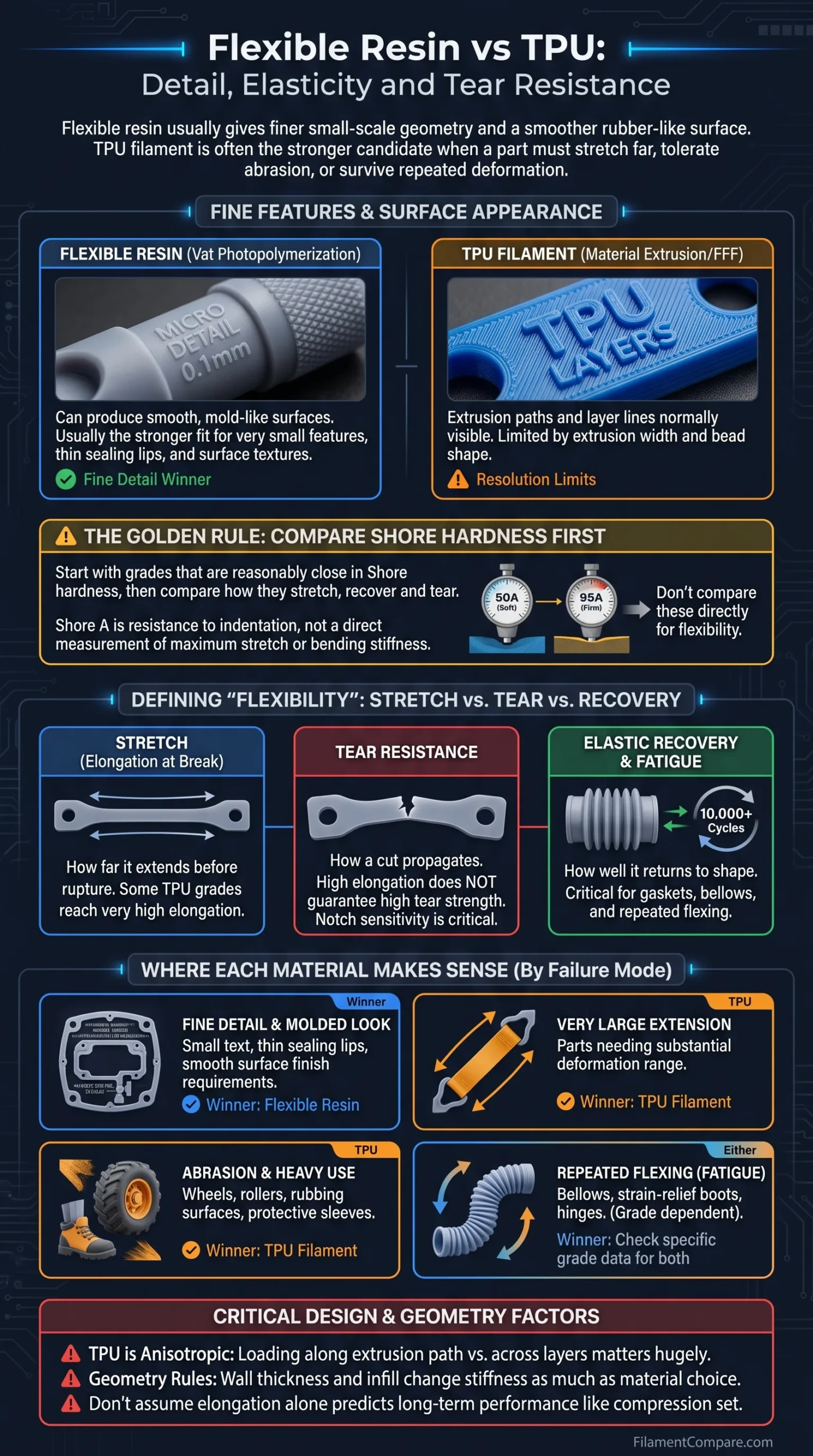
Flexible resin usually gives finer small-scale geometry and a smoother rubber-like surface, while TPU filament is often the stronger candidate when a part must stretch far, tolerate abrasion, or survive repeated deformation. The harder question is tear resistance: modern engineering flexible resins have moved far beyond the older assumption that resin is only useful for visual prototypes, so the better material depends on hardness, crack behavior, elastic recovery, part geometry and the way the part will actually be loaded.
Choose flexible resin when small text, fine grooves, thin sealing lips, surface texture or a smooth molded appearance matters as much as flexibility. Choose TPU when the part needs very large extension, abrasion resistance, repeated flexing or the geometric freedom to tune stiffness with walls and infill. For gaskets, bellows, straps and other parts that can fail from a growing cut, do not choose from the material name alone: compare a similar Shore hardness and then examine tear, elongation, recovery and fatigue data for the actual grade.
| Decision Point | Flexible Resin | TPU Filament |
|---|---|---|
| Printing process | Vat photopolymerization such as SLA, DLP or masked resin printing, depending on the material and machine | Material extrusion through an FFF/FDM printer |
| Fine embossed or recessed detail | Usually the stronger fit for very small features and surface textures | Limited more directly by extrusion width, bead shape and layer structure |
| Surface appearance | Can produce smooth, mold-like flexible surfaces | Extrusion paths and layer lines are normally more visible |
| Very high elongation | Available, but strongly formulation-dependent | Some printable TPU grades reach very high elongation before break |
| Tear resistance | Modern engineering grades can perform well; verify the actual tear test and grade | Often well suited to functional parts, but a high elongation number alone does not prove high tear resistance |
| Elastic recovery | Ranges from soft and compliant to high-rebound formulations | Generally elastic, with recovery dependent on formulation, hardness and printed geometry |
| Repeated flexing | Grade-dependent; newer formulations can be designed for repeated cycling | Often a strong candidate, but raster direction and layer bonding affect the printed result |
| Abrasion-heavy use | Depends heavily on the resin formulation | Commonly favored for wheels, protective feet, sleeves and other rubbing surfaces |
| Post-processing | Wash, dry and specified post-cure steps may be part of reaching final properties | No resin wash or UV cure; filament condition and print settings remain important |
| Part-level flexibility tuning | Wall thickness and geometry remain important | Wall count, wall thickness, infill and internal geometry provide additional tuning options |
| Main selection risk | Assuming every flexible resin is fragile because of older formulations | Assuming every TPU part inherits the bulk or datasheet properties regardless of print direction |
Compare Shore Hardness Before Comparing Flexibility
A flexible resin and a TPU filament can both feel rubber-like while occupying very different parts of the hardness range. Comparing a soft 50A-class resin with a 95A TPU and declaring one material category “more flexible” mixes material chemistry with hardness. Start with grades that are reasonably close in Shore hardness, then compare how they stretch, recover and tear.
Shore A hardness describes resistance to indentation; it is not a direct measurement of maximum stretch, bending stiffness or tear strength. A higher Shore A value normally feels firmer under the same test conditions, but a thin 95A wall can still bend more easily than a thick component printed from a softer formulation. Geometry remains part of the mechanical system.
Current flexible-resin data shows why the distinction matters. Formlabs lists its Flexible 50A Resin at 55 Shore A after the specified workflow, with 160% elongation at break, 12.3 kN/m tear strength and a 3.1% compression-set result under its stated 70°C/22-hour condition. The manufacturer also states that the published properties come from printed, post-processed specimens and that final behavior can vary with geometry, orientation, settings and temperature.[a]
A much firmer flexible resin can behave differently. Flexible 80A Resin V2 is listed at 83 Shore A, 230% elongation at break, 28 kN/m tear strength and 56% pendulum rebound. Formlabs also reports 12,800 Ross Flex fatigue cycles under its internal test conditions, compared with 556 cycles for the preceding formulation. These numbers make an older blanket rule such as “flexible resin is for appearance and TPU is for durability” too broad for current material selection.[b]
TPU still has a clear reason to remain on the shortlist when very large deformation is required. As one current example, NinjaTek specifies its 85A NinjaFlex TPU at 660% elongation. That does not mean an 85A TPU is automatically almost three times “better” than an 83A resin listed at 230% elongation; the values come from different products and test contexts. It does show why maximum stretch can favor TPU even when the two grades have similar Shore hardness.[c]
Fine Features Favor Resin, but Printer Resolution Is Only Part of the Story
The detail difference begins with how the part is formed. FFF TPU is deposited as adjacent extrusion roads. A tiny letter, narrow groove or sharp ridge must be represented with physical beads whose width, cornering behavior and layer placement set a practical geometric limit. Resin printing forms each layer from selectively cured photopolymer, allowing small contours and surface textures to be represented without tracing every feature with a round filament strand.
That difference becomes visible on small embossed text, recessed lettering, knurling, miniature tread, narrow gasket lips, bellows corrugations and shallow textures. A TPU part can be mechanically successful without reproducing those elements as sharply. If the same component also needs a molded-looking exterior, flexible resin often gains another advantage because there are no FFF extrusion roads crossing the visible surface.
Small Text and Markings
Flexible resin is usually easier to justify when part numbers, icons or shallow lettering have to remain legible on a small flexible component.
Thin Sealing Lips
Resin can preserve a narrow lip or small-radius profile well, although the feature still needs enough thickness to survive support removal and use.
Large Functional Shapes
Once the geometry is large enough that extrusion width no longer limits the design, TPU’s detail disadvantage may stop affecting the decision.
Textured Flexible Surfaces
Fine grain, grip patterns and soft-touch cosmetic surfaces often make better use of resin’s surface-resolution advantage.
Resin resolution should not be confused with usable feature strength. A very thin fin can be reproduced accurately and still tear during support removal. A small flexible opening may distort during washing or handling. Supports can also leave marks exactly where surface quality matters. The smallest printable feature is not necessarily the smallest durable flexible feature.
TPU has a different limitation. Narrow walls and small openings can be altered by extrusion width, pressure control, stringing or an imperfectly tuned flow rate, but a slightly coarser feature may tolerate handling better after printing. For a protective boot, bumper or wheel, losing a fraction of surface detail may have almost no functional cost.
Stretch, Springback and Tear Resistance Describe Different Failure Modes
Elongation at break answers one narrow question: how far an intact tensile specimen can extend before it breaks under the stated test. If a 100 mm gauge section reaches 300 mm before rupture, its increase in length is about 200% of the starting gauge length. It does not tell you how easily the material can be indented, how quickly it returns to shape, or how a cut propagates through it.
Softness
How readily the surface resists indentation. Shore hardness is useful here, but part thickness still changes how soft a finished object feels.
Stretch
How much tensile deformation the material can tolerate before rupture. Elongation at break is the common datasheet measure.
Recovery
How well the part returns toward its original shape after load removal. Rebound and compression-set data can reveal behavior that elongation alone misses.
A Long Stretch Does Not Guarantee Strong Tear Resistance
Tearing starts from a defect or edge condition. A notch, cut, sharp internal corner, perforation or damaged screw hole concentrates stress into a much smaller region than an unnotched tensile specimen. Once that crack begins to grow, the material is facing a different problem from simple extension.
This is why a strap can survive being stretched repeatedly and then fail rapidly after a small cut appears beside a buckle hole. The same distinction applies to bellows valleys, cable boots, thin gasket tabs and flexible clips. High elongation is useful evidence for stretchability; it should not be substituted for tear-strength data.
Rebound Changes How a Flexible Part Feels in Use
Two materials can deform by a similar amount yet feel very different when released. A high-recovery elastomer returns energy and snaps back quickly; another formulation may recover more slowly or retain more temporary deformation. That difference matters for bumpers, compliant buttons, impact pads, spring-like connectors and footwear prototypes.
Compression adds another failure mode. For a seal or pad that spends hours squeezed between two surfaces, maximum tensile elongation may be less useful than how much permanent deformation remains after the load is removed. A material that stretches impressively in a pull test is not automatically the better long-duration seal.
Repeated Flexing Is Not the Same Test as Pulling Until Break
Bellows, strain-relief boots and compliant hinges can fail from thousands of smaller strain cycles rather than one large pull. Fatigue performance therefore deserves separate attention whenever the same area bends repeatedly. Newer engineering resins with published flex-fatigue data make this comparison more useful than it was when many flexible photopolymers were primarily treated as short-life prototypes.
Print Orientation and Part Geometry Can Change the Material Verdict
TPU filament enters the printer as a continuous material, but the finished FFF part is an assembly of deposited roads and layers. Loading along an extrusion path is not mechanically identical to pulling across interfaces between roads. A datasheet value therefore cannot describe every possible TPU print orientation.
A 2025 study of material-extrusion TPU found roughly 250–300% elongation for specimens printed with the raster parallel to the specimen length, while a 90° raster produced elongation around 140% under that study’s conditions. The exact values should not be transferred to unrelated printers or TPU grades, but the experiment demonstrates how strongly deposition direction can alter the measured behavior of a printed flexible part.[d]
Wall Thickness Can Matter More Than a Small Hardness Difference
A 0.8 mm wall and a 3 mm wall made from the same elastomer do not feel equally flexible. Increasing thickness raises the force needed to bend many geometries, while ribs, curves, slots and corrugations can change stiffness without changing material at all. This is especially important when a prototype is intended to imitate a molded rubber component.
FFF adds another design layer because perimeter count, infill percentage and internal topology can change the effective compliance of the part. A 95A TPU component that feels too firm may need a thinner wall or different internal structure rather than an immediate move to a softer filament. Conversely, reducing walls simply to gain flexibility may leave a tear-prone region around holes or sharp transitions.
Thin Features and Thick Bumpers Reward Different Materials
A narrow gasket lip benefits from accurate edge geometry and a smooth surface, which can favor flexible resin. A thick impact bumper may gain little from microscopic detail, making TPU’s extrusion texture irrelevant. A thin strap puts more emphasis on tear initiation and cyclic stretching, while a flexible display model may place surface finish above long-term mechanical cycling.
This is also why matching only Shore hardness can never finish the decision. Shore hardness makes the comparison fairer; geometry and failure mode decide whether that comparison describes the actual part.
Choose by How the Part Is Expected to Fail
A useful flexible-material comparison starts with the damage the component is likely to experience. A tiny cosmetic texture can fail by losing definition. A strap can fail from a notch. A wheel can wear away. A gasket can remain permanently compressed. A bellows can crack after repeated cycling. Those are different design problems even though every part may be described as “flexible.”
| Part or Requirement | Better Starting Point | Why | What Still Needs Checking |
|---|---|---|---|
| Miniature flexible model with fine texture | Flexible resin | Small surface geometry and smooth finish carry more value than extreme elongation | Support marks and durability of very thin features |
| Small gasket with a narrow sealing lip | Flexible resin or matched engineering TPU | Resin can favor fine edge geometry; TPU can favor repeated handling | Compression set, surface finish, tear around holes and actual sealing pressure |
| Highly stretchable strap | TPU | High-elongation TPU grades provide substantial deformation range | Notch geometry, print direction and permanent set |
| Bellows or flexible boot | Grade-dependent | Thin fold definition favors resin while repeated cycling can favor suitable TPU or fatigue-rated resin | Stress at fold valleys, wall uniformity and cycle life |
| Wheel, roller or protective foot | TPU | Abrasion and repeated deformation usually matter more than microscopic surface detail | Hardness, traction, temperature and wear conditions |
| Soft-touch presentation prototype | Flexible resin | Surface texture, small details and molded appearance can dominate the requirement | Whether the prototype also needs long cyclic life |
| Cable strain relief | Often TPU | Repeated flexing and geometry-based stiffness tuning are useful | Raster direction and stress concentration where the flexible section meets the rigid body |
| Compressed pad or seal | Test the specific grades | Elongation alone does not predict long-duration recovery after compression | Compression set under the expected temperature, strain and time |
A Five-Zone Test Part Reveals More Than One Stretch Number
When both processes are available, a small comparison coupon designed around the actual failure modes can be more useful than trying to combine unrelated datasheet values. The same test piece can contain several geometries that expose where each material begins to lose its advantage.
Geometry Zones
- Detail zone: small raised text, recessed text and narrow grooves.
- Thin-feature zone: fins, sealing lips and small through-holes.
- Stretch zone: an unnotched flexible strip with a defined gauge length.
- Tear zone: a duplicate strip with a controlled starter notch.
- Cycle zone: a thin flexing hinge or corrugated section.
Conditions to Record
- Actual Shore grade and exact material name.
- Finished wall thickness and test geometry.
- TPU raster and build orientation.
- Resin wash, dry and final cure condition.
- Temperature and conditioning before testing.
- Where the first crack, permanent set or detail loss appears.
The detail zone may give resin an immediate visual lead while the unnotched stretch strip favors TPU. The more revealing result can appear later: the notched strip may rank the materials differently from the unnotched strip, and the cycle feature may fail in a different location again. This separates detail retention, maximum extension, crack propagation and flex fatigue instead of collapsing them into one informal bend test.
- Do not compare a 50A resin with a 95A TPU and attribute every difference to resin versus filament.
- Do not use elongation at break as a substitute for tear strength.
- Do not judge final resin behavior from an incompletely processed part.
- Do not ignore TPU raster and build orientation in a mechanically loaded component.
- Do not assume a datasheet specimen and a thin printed feature will fail in the same way.
Choose flexible resin when the part depends on fine embossed or recessed features, narrow flexible geometry, smooth surfaces or a molded rubber-like appearance.
Choose TPU when very large stretch, abrasion, repeated deformation or FFF geometry tuning carries more weight than microscopic detail.
Either can work when the part is a bumper, seal, grip, enclosure or other moderate-flex component and suitable grades exist at similar hardness. In that case, tear behavior, rebound, compression set, cycle life and workflow can matter more than the process name.
Neither should be selected from elongation alone when a notch, sealing load, long-term compression, repeated flex cycle or safety-related failure mode controls the design. Test the printed geometry under representative loading.
The useful question is not which material bends more. It is which material preserves the required geometry and survives the way this particular part is expected to deform and fail.
Technical Sources and Documentation
- [a] Formlabs — Flexible 50A Resin (Used for current Shore hardness, elongation, tear strength, compression-set and post-processing context.)
- [b] Formlabs — Flexible 80A Resin V2 (Form 4) (Used for current hardness, elongation, tear strength, rebound and Ross Flex fatigue figures.)
- [c] NinjaTek — NinjaFlex 3D Printer Filament (85A) (Used for the representative current 85A TPU elongation figure.)
- [d] Jakab and Lendvai — Effect of Printing Parameters on the Tensile Mechanical Properties of 3D-Printed Thermoplastic Polyurethane (Used for the TPU raster-orientation and elongation comparison.)
