Skip to content

Flexible Filament Comparisons

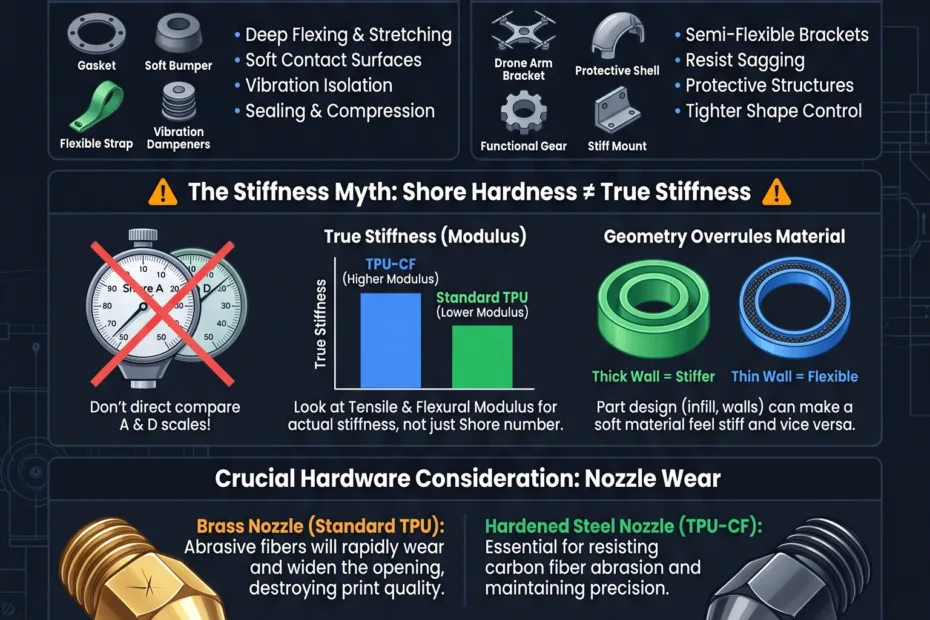
Comparison between TPU-CF and standard TPU highlighting differences in stiffness, flexibility, and nozzle wear for 3D printing.

TPU-CF vs Standard TPU: Stiffness, Flexibility and Nozzle Wear

Standard TPU is built around large, recoverable deformation, while TPU-CF trades some of that soft elastomer behavior for higher stiffness, better shape control, and a more structural response. That makes standard TPU the better starting… 
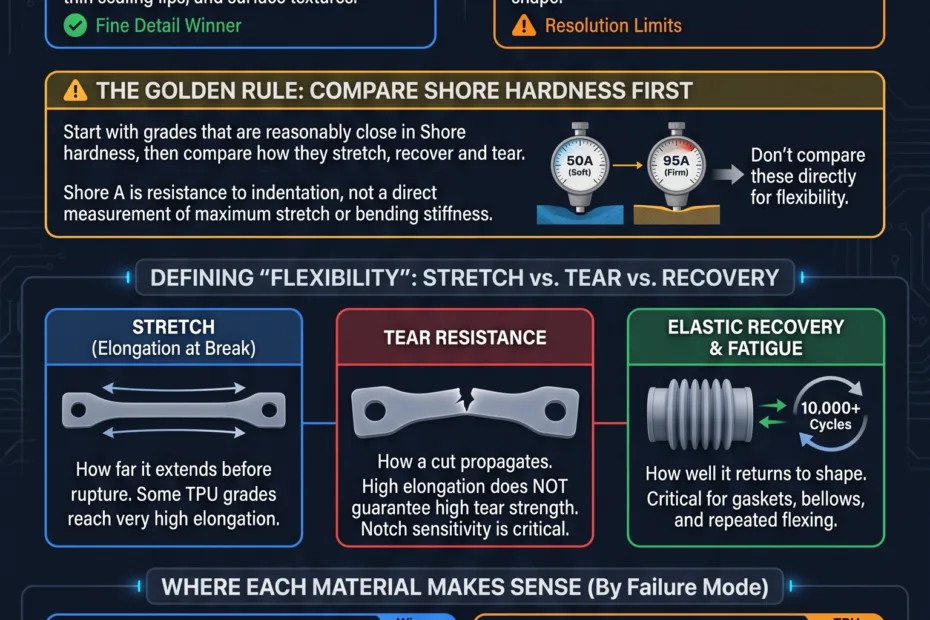
Flexible resin and TPU show different levels of detail, elasticity, and tear resistance in 3D printing applications.

Flexible Resin vs TPU: Detail, Elasticity and Tear Resistance

Flexible resin usually gives finer small-scale geometry and a smoother rubber-like surface, while TPU filament is often the stronger candidate when a part must stretch far, tolerate abrasion, or survive repeated deformation. The harder question… 

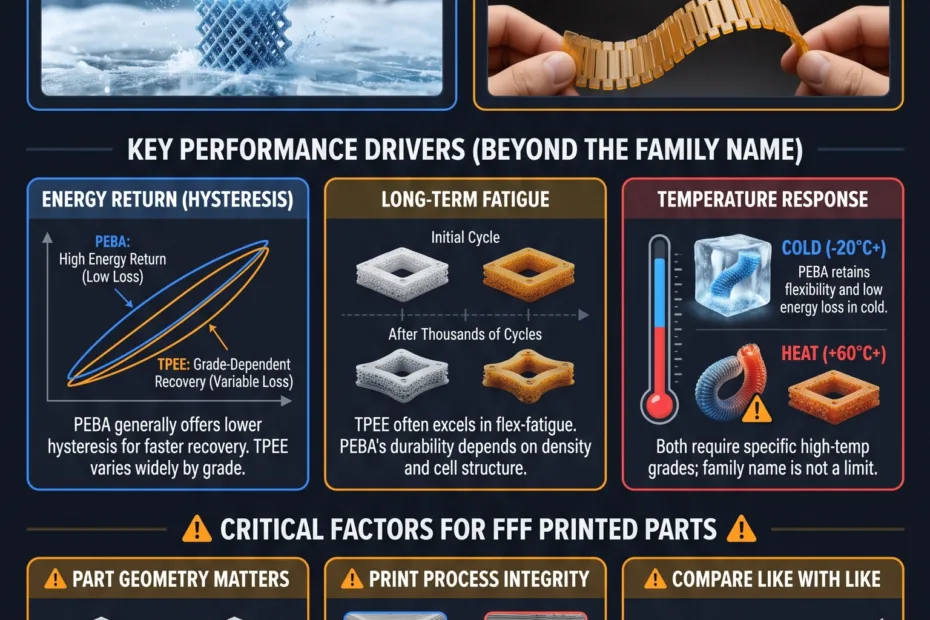
PeBA vs TPEE rubber comparison showing differences in rebound, fatigue resistance, and temperature performance.

PEBA vs TPEE: Rebound, Fatigue and Temperature Performance

PEBA and TPEE can both produce elastic parts with fast recovery, but they reach that behavior through different block-copolymer structures. PEBA is usually the stronger candidate when low hysteresis, low mass and cold-temperature elasticity dominate… 

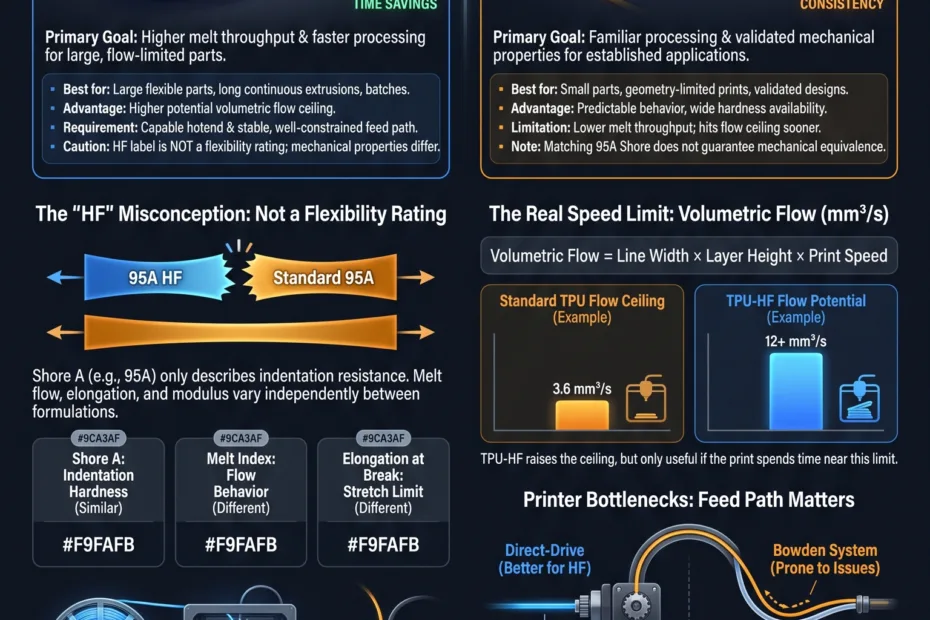
Comparison of TPU-HF and standard TPU shows differences in speed, flow, and flexibility for 3D printing applications.

TPU-HF vs Standard TPU: Speed, Flow and Flexibility

TPU-HF is formulated to move molten material through the hotend at a higher rate than conventional TPU, while standard TPU prioritizes the familiar processing and mechanical behavior of its particular grade. The practical choice is…