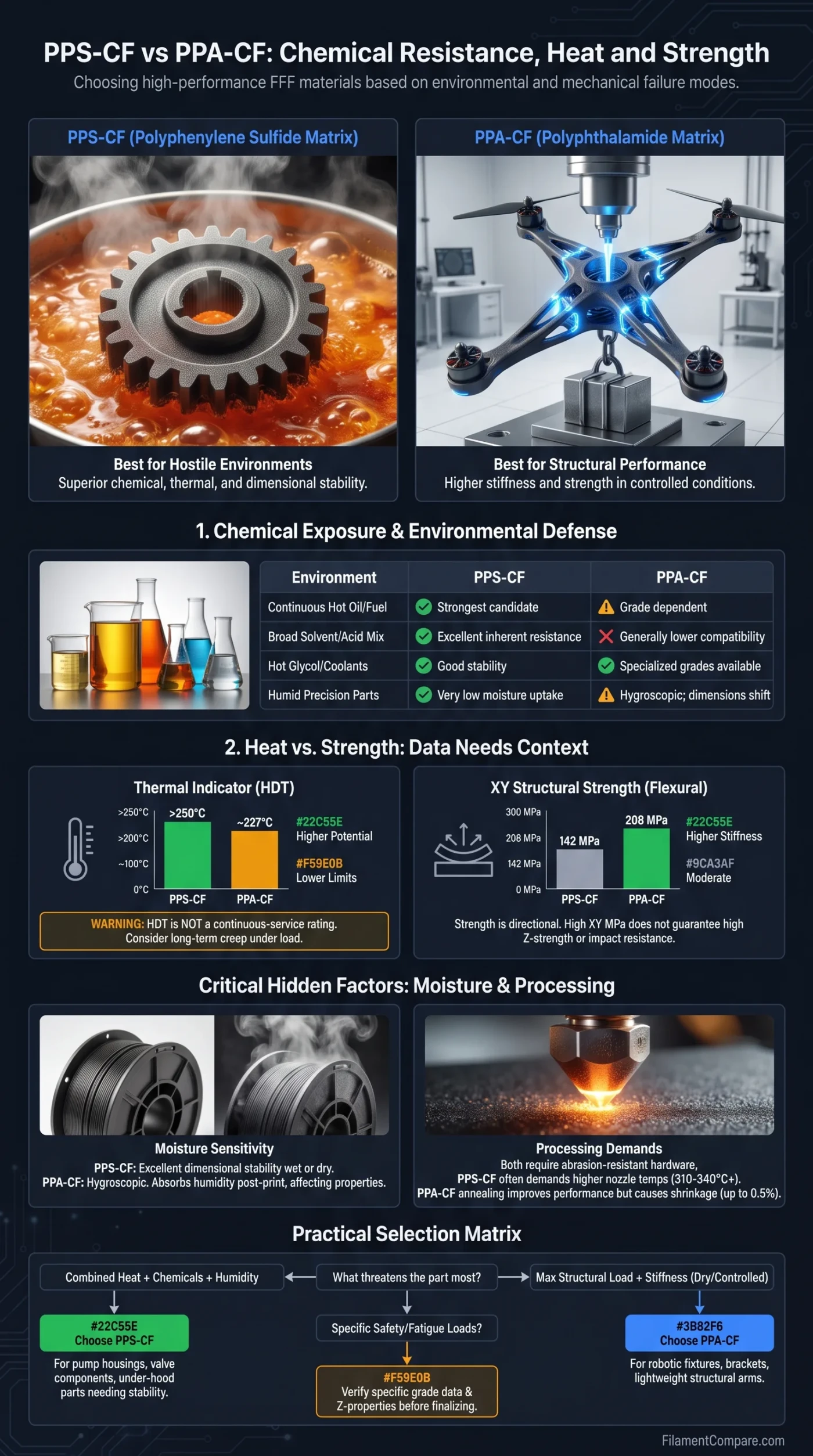
PPS-CF and PPA-CF solve different failure problems even though both sit near the high end of carbon-fiber-reinforced FFF materials. PPA-CF can deliver higher mechanical strength in some printed-material comparisons, while PPS-CF becomes more compelling when high temperature, chemicals and moisture act on the same part. The better choice therefore depends less on which material has the larger headline number and more on what is most likely to make the finished component fail.
Choose PPS-CF first for parts that must retain dimensions and function around elevated heat, oils, fuels, solvents, process fluids or persistent humidity. Choose PPA-CF first when structural strength, stiffness and strength-to-weight performance dominate and the chemical and thermal environment stays within the selected PPA grade’s validated limits. Neither polymer family has one universal set of properties: carbon-fiber loading, fiber distribution, conditioning, print orientation and post-processing can change the result enough to reverse a brand-to-brand comparison.
The carbon fiber is only part of the comparison. PPS-CF uses a polyphenylene sulfide matrix, whereas PPA-CF uses a high-performance polyphthalamide matrix. Carbon reinforcement can increase stiffness and control shrinkage, but it does not erase the chemical, moisture and thermal behavior of the polymer surrounding those fibers.
| Decision Point | PPS-CF | PPA-CF |
|---|---|---|
| Polymer matrix | Polyphenylene sulfide | Polyphthalamide, a high-performance polyamide family |
| Main material advantage | Thermal, chemical and dimensional stability under hostile environmental exposure | High structural performance with lower moisture sensitivity than many conventional polyamides |
| Broad chemical exposure | Usually the stronger starting point for mixed chemical environments | Can be very capable, but compatibility is more grade- and medium-dependent |
| High heat under load | Very high potential, with several printed PPS-CF grades reporting HDT above 250°C | High-temperature material, but product-specific limits can sit below PPS-CF |
| Moisture after printing | Very low moisture sensitivity is a major material advantage | Lower moisture uptake than many conventional nylons, but PPA remains hygroscopic |
| Bambu Lab reference snapshot | 142 MPa XY flexural strength; 264°C HDT at 0.45 MPa | 208 MPa XY flexural strength; 227°C HDT at 0.45 MPa[a] |
| Z-direction behavior | Depends heavily on print conditions and formulation | Also formulation-dependent; specialized fiber architectures can target better interlayer performance |
| Creep and sustained loading | Strong candidate where heat and long-term load occur together | Strong candidate, but the service temperature and conditioned state matter |
| Drying sensitivity before printing | Should still follow the filament maker’s drying instructions despite low in-service moisture uptake | Drying control is especially important because PPA is hygroscopic |
| Nozzle requirement | Abrasion-resistant hardware is normally required for the carbon-fiber reinforcement | Abrasion-resistant hardware is normally required for the carbon-fiber reinforcement |
| Best first screening | Hot chemical environments, precision parts around humidity, high-temperature housings and process equipment | High-load brackets, tooling, fixtures and structural components in a controlled or validated environment |
| Main comparison trap | Assuming high heat capability means the grade also has the highest room-temperature strength | Assuming a strong dry test result will remain unchanged after moisture, heat or chemical conditioning |
Chemical Exposure Is Where PPS-CF Creates the Largest Margin
PPS is attractive for chemically exposed parts because the polymer matrix combines thermal stability with resistance to a broad group of aggressive media. Syensqo lists PPS applications involving pumps, oil-field components, valves and chemical-resistant industrial equipment, and describes resistance to common solvents, caustic solutions and dilute acids alongside hot-water and temperature exposure.[b]
That combination matters more than a simple room-temperature solvent test. An enclosure that receives occasional oil mist, a pump component continuously surrounded by hot fluid and a bracket exposed to fuel vapor are all described as “chemical exposure,” yet their material demands are very different. Temperature, concentration, immersion time, mechanical stress and the porosity of the printed part all influence whether a polymer remains suitable.
Chemical resistance is not the same as application compatibility. A broad “resistant to acids, fuels and solvents” description does not approve a printed part for every acid, every fuel blend or every concentration. Continuous immersion at elevated temperature deserves material-specific compatibility data or testing that matches the actual medium.
PPA-CF should not be treated as chemically weak simply because PPS has the broader reputation. Modern PPA grades can be engineered specifically for hydrolysis and coolant resistance. BASF, for example, describes PPA grades developed for long-term contact with glycol, thermal oil, water and specialized cooling media at elevated temperatures.[c] That makes the correct comparison PPS-CF versus the actual PPA-CF grade, not PPS versus a generic idea of nylon.
The advantage shifts toward PPS-CF as multiple stresses accumulate. A PPA-CF structural bracket in dry air may never use the extra chemical margin of PPS. A pump housing exposed to heat, coolant and long service intervals is asking much more from the polymer matrix. In that second case, PPS-CF deserves earlier screening even if a PPA-CF datasheet shows the higher room-temperature strength number.
| Operating Condition | First Material to Evaluate | Reason | What Still Needs Checking |
|---|---|---|---|
| Occasional oil splash at moderate temperature | Either | Both families can have suitable grades | Actual oil formulation and printed-part strength requirements |
| Continuous hot oil exposure | PPS-CF | Heat and chemical exposure act together | Long-term immersion data for the chosen filament |
| Hot glycol or coolant | PPS-CF or hydrolysis-resistant PPA-CF | Specialized PPA grades can narrow the chemical gap | Coolant composition, concentration and operating temperature |
| Fuel or solvent environment | PPS-CF | Broad chemical resistance is one of the PPS matrix’s main strengths | Specific fuel blend or solvent compatibility |
| Dry structural fixture | PPA-CF | Chemical margin may provide little practical benefit | Load direction, temperature and creep |
| Humid precision assembly with chemical cleaning | PPS-CF | Low moisture response and chemical resistance support dimensional stability | Cleaner chemistry and tolerance requirement |
Heat Numbers Need Context: HDT Is Not a Continuous-Service Rating
The thermal comparison favors PPS-CF, but the common way of quoting that advantage can be misleading. Bambu Lab’s comparison data place its PPS-CF at 264°C HDT under a 0.45 MPa condition and its PPA-CF at 227°C under the same stated load. Those numbers are useful because the materials are presented in the same comparison system, but they do not mean a printed component can carry its design load indefinitely at either temperature.
Heat-deflection testing measures deformation under a defined flexural load and test procedure. ASTM explicitly warns that deflection-temperature data are not intended to predict long-term elevated-temperature endurance unless the real application closely matches the test’s time, temperature, loading and stress conditions.[d] HDT should therefore be treated as a comparative thermal indicator, not a direct continuous-service temperature.
Keep four thermal questions separate: when the polymer begins to change thermomechanically, when a standardized specimen deflects under load, how the part behaves during a short temperature excursion, and how it retains dimensions and strength after months or years at temperature. One HDT value cannot answer all four.
The PPS-CF thermal advantage is not limited to one product table. Fiberon PPS-CF10 lists a 252.5°C HDT at 0.45 MPa for printed specimens and also describes the material as insensitive to moisture and resistant to a wide range of acids, alkalis, fuels and solvents.[e] This supports PPS-CF as the more natural first candidate when thermal deformation and environmental exposure are both high priorities.
For loaded components, creep deserves as much attention as the highest thermal number. A tensile or flexural test asks how the specimen behaves during a relatively short test. A motor mount, clamp or bolted fixture may instead spend thousands of hours under a lower force. As temperature rises, long-term deformation can become the limiting condition well before a dramatic one-time fracture occurs.
Heat Favors PPS-CF When
- The component stays loaded at elevated temperature.
- Heat appears together with oil, fuel, solvent or process fluid.
- Dimensional drift matters more than maximum dry strength.
- The design needs extra thermal margin rather than only a short heat excursion.
PPA-CF Still Makes Sense When
- The service temperature remains inside validated grade limits.
- Higher structural performance is more valuable than the extra PPS thermal margin.
- The chemical environment is controlled or has grade-specific compatibility data.
- A particular PPA formulation has already been qualified for the application.
PPA-CF Can Win the Strength Test While PPS-CF Wins the Environment
The Bambu Lab comparison illustrates why “PPS-CF is the higher-performance polymer” should not be converted into “PPS-CF is mechanically stronger.” In the cited XY flexural test, PPA-CF reaches 208 MPa while PPS-CF is listed at 142 MPa. At the same time, PPS-CF holds the higher HDT figure. One material leads the stated structural test; the other leads the stated thermal test.
Those numbers are product results, not universal constants for PPS-CF and PPA-CF. The amount of carbon fiber, fiber length, orientation, polymer formulation, specimen conditioning, raster direction, annealing procedure and test method can all change the mechanical result. Comparing a high-fiber PPA-CF from one manufacturer with a differently reinforced PPS-CF from another and then ranking the polymer families from the MPa values alone can produce the wrong design decision.
Carbon-fiber percentage is another incomplete shortcut. Raise3D’s standard Industrial PPA CF uses 15 wt.% chopped carbon fiber, while its Hyper Core PPA CF25 uses 25 wt.% and a deliberately fiber-rich inner structure. Raise3D states that the CF25 architecture is intended to improve high-speed flow behavior and Z-direction bonding compared with its regular PPA CF.[f] The example shows why fiber architecture matters alongside fiber percentage.
“Strength” needs a direction and a failure mode. XY flexural strength, tensile strength, stiffness, impact resistance, fatigue life and Z-direction layer adhesion are different properties. A filament that leads one of them does not automatically lead the others.
This matters especially in FFF parts because chopped fibers tend to align with extrusion paths. A highly reinforced material can produce very stiff roads in the XY plane without creating an equally large improvement across layer interfaces. If the part is loaded through Z, a smaller headline XY value paired with better interlayer behavior can be the more useful result.
For a structural arm, fixture or bracket used in a moderate and controlled environment, PPA-CF can therefore be the more efficient material choice. For a housing that must remain stable while heat, fluid exposure and humidity vary, PPS-CF can be preferable even when its room-temperature strength number is lower.
Moisture, Z-Direction and Annealing Can Reverse a Datasheet Expectation
PPA reduces many of the moisture problems associated with conventional polyamides, but it does not stop being a polyamide. Syensqo identifies Amodel PPA resins as hygroscopic and notes that they absorb moisture when exposed to humid air.[g] The degree to which this changes a finished component varies by grade, reinforcement and conditioning, so a dry-spool test should not automatically be treated as the service-state result.
There are two separate moisture problems. Before printing, excess water can interfere with extrusion and part quality. After printing, environmental moisture can change dimensions or mechanical behavior in moisture-sensitive polymer systems. PPS-CF’s low moisture uptake is particularly useful for the second problem, especially where fits, bearing positions or alignment features have narrow tolerances.
Before comparing two datasheets, check the specimen state. “Dry,” “conditioned” and post-annealed values are not interchangeable. Also check whether the specimen was printed or molded, whether the value is XY or Z, which standard was used, and whether HDT values were measured under the same load.
Post-processing creates another source of misleading comparisons. Raise3D recommends annealing its Industrial PPA CF at 80–100°C for 8–12 hours after printing to improve mechanical properties and dimensional accuracy.[h] Fiberon PPS-CF10, by contrast, is specified for use without mandatory annealing, while the manufacturer says a 125°C, 16-hour anneal can be used when greater performance is desired. An as-printed PPS-CF specimen and an annealed PPA-CF specimen are therefore not equivalent test states.
Annealing also carries a tolerance cost. Raise3D states that its Hyper Core PPA CF25 can show up to 0.5% Z-axis shrinkage after the recommended annealing process depending on infill and layer height. That is enough to matter in assemblies where holes, bearing seats or stack heights are tolerance-sensitive. The thermal treatment may improve the material state while forcing a dimensional compensation into the CAD and process plan.
Dry Datasheet Result
Useful for comparing controlled specimens, print settings and formulations when the test conditions match.
- Check orientation.
- Check conditioning.
- Check annealing state.
- Check test standard and load.
Service-State Result
More relevant when the finished part spends time in humidity, heat, chemicals or constant mechanical load.
- Consider moisture exposure.
- Consider long-term temperature.
- Consider creep.
- Consider dimensional change after post-processing.
Printer Capability Can Eliminate a Material Before the Part Does
Both materials belong on printers equipped for abrasive fiber-filled filament, but PPS-CF often places the higher demand on hotend temperature. Bambu Lab specifies a 310–340°C nozzle range for its PPS-CF and requires a hardened steel nozzle.[i] Its PPA-CF is specified at 280–310°C and likewise requires hardened abrasion-resistant nozzle hardware.[j]
These are product settings rather than universal PPS-CF and PPA-CF temperatures. They do, however, expose an important purchasing filter: a printer capped around the upper end of ordinary engineering-filament temperatures may be able to process one PPA-CF formulation while being outside the recommended range of a PPS-CF formulation.
Chamber requirements are also formulation-specific. It is too broad to state that every PPS-CF requires the same high chamber temperature. Fiberon PPS-CF10, for example, lists printing at 310–350°C with an 80–90°C bed while stating that a heated chamber or enclosure is not required. Other PPS-CF systems use or recommend elevated chamber temperatures. The filament’s own profile is more useful than a polymer-family rule.
Low moisture absorption does not mean “no drying required.” Moisture behavior during service and moisture control before extrusion are separate issues. Follow the specific spool or technical documentation even when the finished PPS-CF part is selected partly for low moisture sensitivity.
Printer choice also affects whether the theoretical strength difference is reachable. Poor drying, insufficient melt temperature, an unsuitable nozzle, unstable chamber conditions or weak layer bonding can erase an advantage shown on a controlled test specimen. For functional parts, process repeatability belongs in the material decision rather than being treated as a separate concern after the polymer has been chosen.
Choose by the Failure Mode You Need to Prevent
A useful PPS-CF versus PPA-CF decision starts by identifying what threatens the component first. The question is not whether heat, strength or chemical resistance matters in isolation, but which combination appears in the real duty cycle.
| Part Requirement | Better First Candidate | Why |
|---|---|---|
| High-load robotic fixture in a controlled indoor environment | PPA-CF | Structural strength and stiffness can matter more than extra chemical or thermal margin. |
| Under-hood bracket exposed to heat and oil mist | PPS-CF | Combined thermal and chemical exposure makes the PPS matrix attractive. |
| Pump or valve component around hot process fluid | PPS-CF | Heat, chemical exposure and dimensional retention act at the same time. |
| Hot-coolant component with an application-qualified PPA grade | Either | Hydrolysis-resistant PPA can narrow the gap; grade-specific data should decide. |
| Lightweight structural arm with moderate service temperature | PPA-CF | High mechanical performance can be more valuable than unused environmental margin. |
| Precision fixture exposed to changing humidity | PPS-CF | Very low moisture response supports dimensional consistency. |
| Part dominated by Z-direction loading | Compare actual printed Z data | Polymer family and XY strength do not predict interlayer failure reliably. |
| Impact-loaded clamp | Compare grade-specific toughness data | High stiffness or flexural strength alone does not establish impact behavior. |
| Printer cannot reach the filament’s specified hotend temperature | Neither until compatibility is resolved | The intended polymer properties are irrelevant if the material cannot be processed correctly. |
Choose PPS-CF when high heat, chemical exposure, low moisture response and long-term dimensional stability are the main risks. Its value becomes clearer when two or more of those conditions occur together.
Choose PPA-CF when structural load, stiffness and strength-to-weight performance dominate and the selected grade has enough thermal, moisture and chemical resistance for the actual environment.
Either can work when the service environment is moderate and both specific grades satisfy the load and temperature requirements. In that case, Z strength, printer compatibility, post-processing, availability and dimensional tolerances may decide the choice.
Neither should be selected from the polymer name alone when the part sees continuous hot chemical immersion, pressure, fatigue, safety-related loads or a narrowly controlled service life. Those applications need data for the exact grade, exposure medium, printed orientation and conditioning state.
The useful dividing line is therefore not simply strength versus heat. PPA-CF can be the better structural material while PPS-CF is the better environmental material. When the load itself is the main problem, PPA-CF deserves early consideration; when the environment is what threatens the part—especially through a combination of heat, chemicals and moisture—PPS-CF usually provides the more relevant material advantages.
Technical Sources and Documentation
- [a] PET-CF / PPA-CF / PPS-CF / PA6 CF Carbon Fibers Filament Usage Guide (Used for the same-comparison XY flexural-strength and HDT values.)
- [b] Ryton® PPS – Applications (Used for PPS chemical, hot-water and industrial exposure behavior.)
- [c] Against hydrolytic degradation: durable PPAs for components in harsh environments (Used for grade-specific PPA resistance to hot coolant and other thermal-management media.)
- [d] Standard Test Method for Deflection Temperature of Plastics Under Flexural Load in the Edgewise Position Using a Dry Bath (Used to distinguish HDT testing from long-term elevated-temperature endurance.)
- [e] PPS-CF10 – Fiberon 3D Printing Filament by Polymaker (Used for printed-specimen HDT, chemical-resistance, annealing and processing information.)
- [f] Hyper Core PPA CF25 (Used for the 25 wt.% carbon-fiber architecture, Z-direction bonding and post-annealing dimensional information.)
- [g] Amodel® PPA – Properties (Used for PPA hygroscopic behavior and moisture-processing context.)
- [h] Industrial PPA CF – Raise3D (Used for PPA-CF drying and post-print annealing recommendations.)
- [i] Comprehensive Guide to PPS-CF 3D Printing Filament (Used for Bambu PPS-CF nozzle-temperature and nozzle-hardware requirements.)
- [j] Comprehensive Guide to PPA-CF 3D Printing Filament (Used for Bambu PPA-CF nozzle-temperature and nozzle-hardware requirements.)
